Facial Serum Market Size & Growth Forecast 2027–2036, By Segments (Price Point, Form, Distribution Channel, Type), Regional Demand Trends (North America, Asia Pacific, Europe), Key Country Insights (U.S., Japan, South Korea, Germany, France, Italy), and Competitive Landscape
Jump to content
Market Size and Growth Outlook
Facial Serum Market size was over USD 6.6 billion in 2026 and is likely to grow at a 6.75% CAGR between 2027 and 2036, exceeding USD 12.68 billion by 2036. The industry revenue for 2027 is calculated at USD 6.97 billion.
Get more details on this report
Request Free Sample ReportFacial Serum Market Intelligence Snapshot
Regional Market Dynamics
- Europe held a 33.55% market share in 2026, supported by mature skincare habits, broad retail availability, and steady demand for hydration, anti-aging, and skin repair formulations.
- Asia Pacific is projected to grow at a 7.57% CAGR as rising skincare adoption, stronger digital retail channels, and increasing demand for targeted treatment products accelerate market expansion.
Segment Momentum
- Mass-Market captured 52.95% of the market in 2026, supported by broad consumer accessibility, frequent repeat purchases, strong retail availability, and affordability that encourages everyday skincare use.
- Oil Based serums are growing fastest as consumers increasingly seek richer, more intensive skincare options that support targeted routines and deliver a more treatment-focused product experience.
Market Expansion Drivers
- Rising consumer awareness of skincare and demand for targeted anti-aging and dermatological solutions.
- Growth of clean beauty and natural ingredient formulations driving premium skincare product adoption.
- Expansion of AI-driven personalized skincare diagnostics enabling customized serum recommendations.
Leading Market Participants
- Key companies in the facial serum market include L'Oréal S.A. (France), The Estée Lauder Companies Inc. (United States), Shiseido Company, Limited (Japan), Beiersdorf AG (Germany), Unilever PLC (United Kingdom), Galderma S.A. (Switzerland), Amorepacific Corporation (South Korea), KOSÉ Corporation (Japan), Clarins Group (France), Revlon, Inc. (United States).
Global Market Forecast Snapshot
Market Outlook
- 2026 Market Size: USD 6.6 billion
- 2027 Estimated Market Size: USD 6.97 billion.
- Projected Market Size: USD 12.68 billion by 2036
- Growth Forecast: 6.75% CAGR (2027-2036)
Regional and Segment Outlook
- Leading Regional Market: Europe
- High-Growth Regional Hub: Asia Pacific
- Core Revenue Segment: Mass-Market (Price Point) | Water Based (Form) | Supermarkets & Hypermarkets (Distribution Channel) | Anti-Aging Serums (Type)
- Emerging Opportunity Segment: Luxury (Price Point) | Oil Based (Form) | Online Retailers (Distribution Channel) | Skin Brightening Serums (Type)
Market Growth Drivers and Industry Trends
Rising consumer awareness of skincare and demand for targeted anti-aging and dermatological solutions
Heightened consumer awareness of skincare routines and concerns related to visible aging, pigmentation, dryness, acne, and uneven skin tone will drive the facial serum market growth by increasing demand for concentrated products designed to address specific skin conditions. Consumers are becoming more attentive to ingredient functionality and product suitability, encouraging the adoption of serums that offer targeted benefits compared with conventional moisturizers. The growing emphasis on preventive skincare is also encouraging younger consumers to incorporate specialized formulations into daily routines, while mature consumers are seeking products that support firmness, hydration, and the appearance of fine lines. Greater access to skincare education through digital content, dermatological guidance, and consumer reviews is helping individuals understand the role of active ingredients and select products according to their specific concerns.
Growth of clean beauty and natural ingredient formulations driving premium skincare product adoption
The facial serum market growth is being supported by rising interest in clean beauty, plant-derived ingredients, and formulations perceived as safer and more environmentally conscious. Consumers increasingly examine ingredient lists and show greater preference for products formulated around naturally derived extracts, botanical actives, and simplified compositions, particularly when purchasing premium skincare products. This shift is encouraging manufacturers to develop differentiated serums that combine functional skin benefits with clean-label positioning, sustainable sourcing, and transparent formulation practices. Premiumization is further strengthened by consumers' willingness to pay more for specialized products that align with personal wellness and beauty preferences, creating opportunities for higher-value serum formulations across different skin types and concerns.
Expansion of AI-driven personalized skincare diagnostics enabling customized serum recommendations
Advances in artificial intelligence and digital skin analysis are creating new pathways for personalization, and AI-driven diagnostics will propel the facial serum market growth by helping consumers identify individual skincare needs more efficiently. Digital tools can assess visible characteristics such as skin texture, tone, hydration levels, and signs associated with aging, allowing recommendations to be aligned with specific concerns rather than relying solely on generalized product categories. Personalized recommendations can also improve product discovery by connecting consumers with serum formulations and ingredient combinations suited to their perceived skin requirements. As digital beauty platforms become more capable of integrating assessment tools with product selection, personalization is becoming an increasingly important element of the consumer skincare experience.
| Growth Driver | Impact on CAGR | Regulatory Influence | Geographic Relevance | Adoption Rate | Impact Timeline |
|---|---|---|---|---|---|
| Rising consumer awareness of skincare and demand for targeted anti-aging and dermatological solutions | 2.00% | Low | Europe, Asia Pacific | High | Near Term |
| Growth of clean beauty and natural ingredient formulations driving premium skincare product adoption | 1.80% | Moderate | Europe, North America | High | Mid Term |
| Expansion of AI-driven personalized skincare diagnostics enabling customized serum recommendations | 1.60% | Moderate | Asia Pacific, North America | Emerging | Mid Term |
Unlock insights tailored to your business with our bespoke market research solutions.
Click to get your customized report now.
Regional Demand Dynamics
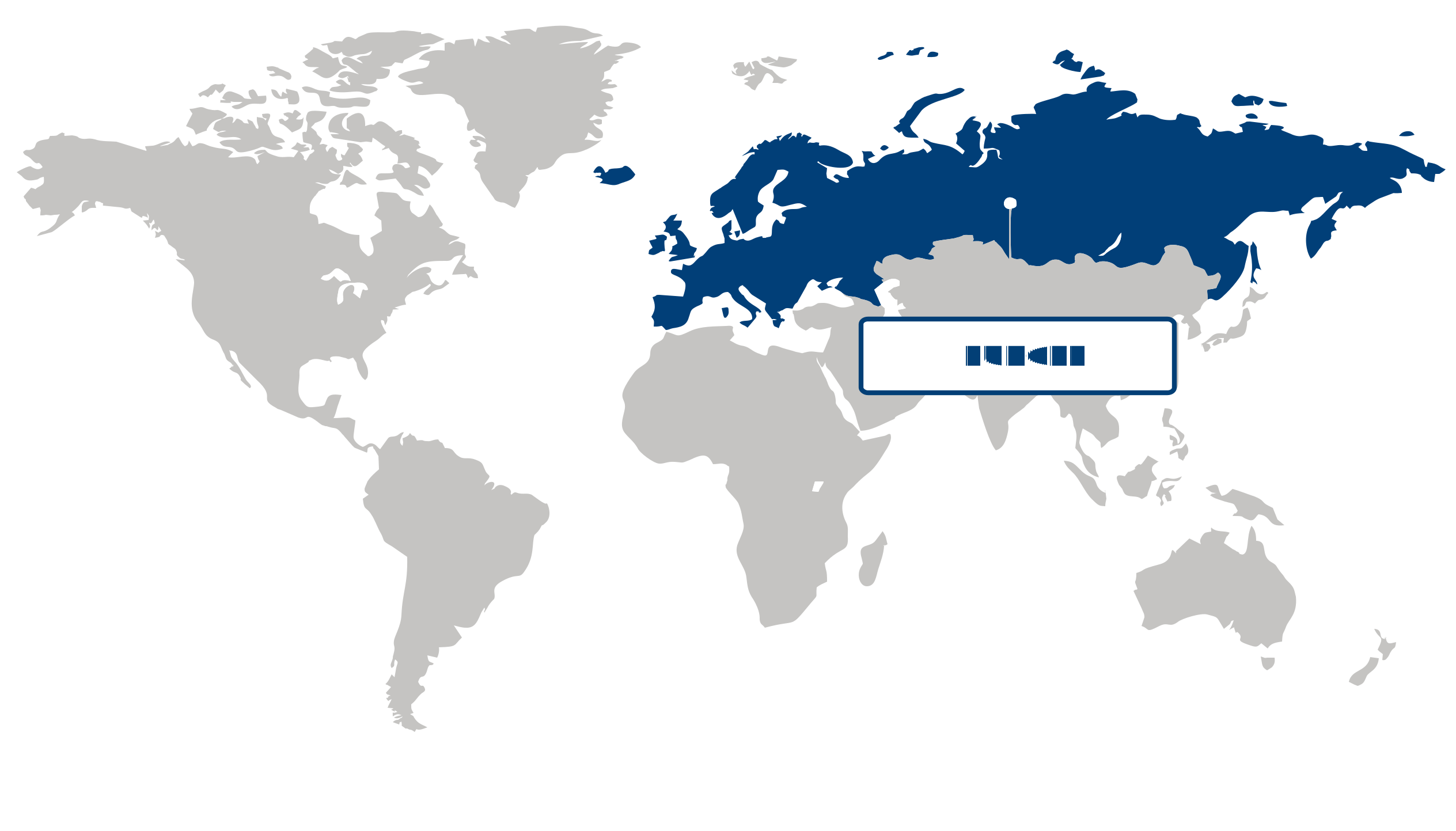
Europe (Largest Region)
Europe held the largest share of the facial serum market in 2026, accounting for 33.55% of the market, supported by strong consumer interest in advanced skincare, premium beauty products, and specialized formulations targeting hydration, aging, pigmentation, and skin protection. The region benefits from established beauty and personal care industries, high consumer awareness of ingredient efficacy, and a well-developed retail and e-commerce environment that facilitates access to a broad range of facial serum products. Growing preference for scientifically formulated skincare and demand for products aligned with clean beauty, natural ingredients, and sustainable packaging are also influencing purchasing decisions. In addition, strong regulatory oversight and consumer familiarity with cosmetic ingredients encourage manufacturers to emphasize product safety, formulation quality, and transparent labeling, reinforcing Europe's established market position.
Asia Pacific (Fastest-Growing Region)
Asia Pacific is expected to demonstrate the fastest growth, driven by expanding middle-class consumer groups, rising disposable incomes, and increasing awareness of structured skincare routines. Facial serums are gaining wider acceptance as consumers become more familiar with targeted skincare products and seek solutions for concerns such as uneven skin tone, dryness, acne, and premature aging. Growing urbanization, exposure to environmental stressors, and increasing influence of beauty trends through digital platforms are further encouraging consumers to incorporate specialized skincare products into daily routines. The expansion of modern retail, online beauty commerce, and localized product development is improving accessibility across emerging markets, while growing interest in both traditional botanical ingredients and advanced cosmetic formulations is creating additional opportunities for market expansion.
| Parameter | North America | Asia Pacific | Europe | Latin America | MEA |
|---|---|---|---|---|---|
| Innovation HubiScaleNascentDeveloping Advanced | |||||
| Cost-Sensitive RegioniScaleLowMedium High | |||||
| Regulatory EnvironmentiScaleRestrictiveNeutral Supportive | |||||
| Demand DriversiScaleWeakModerate Strong | |||||
| Development StageiScaleEmergingDeveloping Developed | |||||
| Adoption RateiScaleLowMedium High | |||||
| New Entrants / StartupsiScaleSparseModerate Dense | |||||
| Macro IndicatorsiScaleWeakStable Strong |
Key Country Insights
Germany 🇩🇪
Science-Based FormulationsGermany is prioritizing facial serums with transparent ingredient profiles and evidence-based performance claims. Consumers are favoring dermatologically tested products that combine efficacy with skin compatibility, encouraging manufacturers to emphasize formulation quality.
France 🇫🇷
Luxury Beauty PortfolioFrance is expanding facial serum offerings that combine premium positioning with high-quality cosmetic ingredients. Beauty companies are emphasizing sophisticated formulations and sensory appeal to strengthen consumer engagement across prestige skincare categories.
Italy 🇮🇹
Botanical Skincare AppealItaly is increasing interest in facial serums featuring natural extracts and premium cosmetic ingredients. Manufacturers are blending botanical positioning with modern skincare science to meet consumer demand for effective yet aesthetically appealing daily skincare products.
Japan 🇯🇵
Minimalist Beauty SolutionsJapan is strengthening demand for lightweight facial serums that support hydration, brightening, and daily skincare routines. Companies are focusing on refined textures and gentle formulations that complement established beauty regimens and long-term skin maintenance.
South Korea 🇰🇷
Trend-Driven SkincareSouth Korea continues to shape facial serum innovation through advanced formulations and ingredient-focused product development. Domestic brands are introducing targeted serums that align with evolving beauty routines and demand for high-performance skincare solutions.
United States 🇺🇸
Premium Skincare InnovationThe U.S. facial serum market is driven by demand for multifunctional formulations featuring clinically supported active ingredients. Brands are expanding personalized skincare portfolios that address hydration, anti-aging, and skin barrier health across diverse consumer segments.
Facial Serum Market Share (%), by Price Point, 2026
Go beyond the chart, access full insights & data tables
Request Free Sample ReportPrice Point Segment Analysis: Mass-Market (Largest Segment) vs Luxury (Fastest-Growing Segment)
In the facial serum market, the mass-market segment held the largest share at 52.95% in 2026, driven by broad consumer accessibility and growing demand for affordable skincare products that address hydration, aging, pigmentation, and other common skin concerns. Mass-market facial serums benefit from wide retail availability and their ability to serve consumers seeking targeted skincare without premium price positioning. Increasing consumer awareness of active ingredients and daily skincare routines is encouraging greater adoption across mainstream audiences. Product variety and expanding availability through both physical and digital retail channels further strengthen the segment's reach.
Luxury facial serums are gaining momentum as consumers increasingly seek premium formulations that combine sophisticated ingredients, elevated product experiences, and targeted skin benefits. Growing interest in personalized skincare and high-performance beauty routines is encouraging consumers to trade up toward products positioned around advanced formulations and specialized concerns. Premium packaging, differentiated textures, and ingredient-focused product development further support the appeal of luxury offerings. The broader shift toward skincare as a premium self-care category is creating favorable conditions for continued expansion of the luxury segment.
Form Segment Analysis: Water Based (Largest Segment) vs Oil Based (Fastest-Growing Segment)
Water-based facial serums accounted for the largest share of 47.59% in 2026, reflecting their lightweight texture, rapid absorption, and suitability for a wide range of skin types. These formulations are particularly compatible with layered skincare routines because they can be applied easily alongside moisturizers, sunscreens, and other topical products. Consumer preference for non-greasy formulations and products designed for everyday use has strengthened demand for water-based serums. Their compatibility with hydrating and active-ingredient formulations further supports widespread adoption.
Oil-based facial serums represent the fastest-growing form as consumers increasingly explore richer formulations designed to nourish, soften, and support the skin barrier. These products appeal particularly to consumers seeking enhanced moisturization and formulations that complement dry or mature skin routines. Growing interest in botanical oils, lipid-rich ingredients, and simplified skincare regimens is encouraging broader experimentation with oil-based formats. The increasing focus on skin barrier health and multifunctional beauty products is also expanding the role of oil-based serums in premium and specialized skincare.
| Segment | Sub-Segment | Largest Segment | Fastest Growing |
|---|---|---|---|
| Price Point | Mass-Market, Premium, Luxury | Mass-Market | Luxury |
| Form | Oil Based, Gel Based, Water Based, Others | Water Based | Oil Based |
| Distribution Channel | Supermarkets & Hypermarkets, Drugstores & Pharmacies, Specialty Beauty Stores, Online Retailers, Others | Supermarkets & Hypermarkets | Online Retailers |
| Type | Anti-Aging Serums, Skin Brightening Serums, Acne Fighting Serums, Hydrating Face Serums, Exfoliating Face Serums, Others | Anti-Aging Serums | Skin Brightening Serums |
Competitive Landscape and Market Positioning
Key companies in the facial serum market:
1. L'Oréal S.A. (France)
2. The Estée Lauder Companies Inc. (United States)
3. Shiseido Company Limited (Japan)
4. Beiersdorf AG (Germany)
5. Unilever PLC (United Kingdom)
6. Galderma S.A. (Switzerland)
7. Amorepacific Corporation (South Korea)
8. KOSÉ Corporation (Japan)
9. Clarins Group (France)
10. Revlon Inc. (United States)
The facial serum market is evolving rapidly with increasing demand for personalized skincare solutions targeting hydration, anti-aging, and skin repair benefits. Continuous formulation innovation is improving ingredient absorption and skin compatibility. Expanding cosmetic research is also supporting more targeted dermatological solutions.
| Company | Market Share | Company Revenue | Revenue CAGR (%) | Product Portfolio | Geographic Presence | Innovation / R&D Focus | Strategic Developments |
|---|---|---|---|---|---|---|---|
| L'Oréal S.A. (France) | |||||||
| The Estée Lauder Companies Inc. (United States) | |||||||
| Shiseido Company Limited (Japan) | |||||||
| Beiersdorf AG (Germany) | |||||||
| Unilever PLC (United Kingdom) | |||||||
| Galderma S.A. (Switzerland) | |||||||
| Amorepacific Corporation (South Korea) | |||||||
| KOSÉ Corporation (Japan) | |||||||
| Clarins Group (France) | |||||||
| Revlon Inc. (United States). |
Industry Development / News
| Company Name | Date | Key Development |
|---|---|---|
| Givaudan Active Beauty | Mar-26 | Givaudan introduced VectorHyal, an advanced hyaluronic acid-based delivery system designed to enhance the efficacy, stability, and controlled release of active ingredients in facial serums. This platform technology supports premium brands in developing next-generation formulations, reflecting a strategic shift toward high-performance delivery systems in the skincare value chain. |
| Dr. Barbara Sturm | Mar-26 | Dr. Barbara Sturm expanded its portfolio with the Exoso-Metic Face Serum, integrating lab-engineered exosome technology and biomimetic peptides to target cellular-level repair. This launch signifies a strategic push into high-tech, molecular-focused anti-aging solutions, aligning with the brand’s ongoing research initiatives following recent changes in its corporate ownership structure. |
| Galderma | Mar-26 | Galderma expanded its Cetaphil brand with a new line of AM/PM Antioxidant Serums specifically engineered for sensitive skin. The dual-system approach focuses on providing environmental protection and nighttime repair to strengthen the skin barrier, reinforcing the company’s commitment to growing its science-backed, dermatologist-recommended offerings within the mass-market premium segment. |
| ENTOD Pharmaceuticals | Feb-26 | ENTOD Pharmaceuticals launched COLLADERM, an AI-enabled, bio-engineered collagen serum designed for clinical dermatology applications. By utilizing AI to optimize collagen synthesis for deeper skin repair, the company demonstrates the increasing convergence of pharmaceutical-grade research and biotechnology in the development of high-efficacy regenerative skincare solutions. |
| Alkem Laboratories | Feb-25 | Alkem Laboratories entered the clinical dermatology segment with the launch of its Kojiglo serum for hyperpigmentation. Utilizing advanced Duo-Lipo liposomal technology to improve the penetration and efficacy of active ingredients, the company positions the product as a prescription-based solution, signaling a broader movement toward targeted, bio-available treatments in the Indian skincare market. |
| ÄIO | May-24 | Biotech company ÄIO partnered with skincare brand tilk! to introduce a commercial facial serum formulated with bio-fermented oils. This development marks a significant transition for ÄIO from biotech R&D to active market participation, demonstrating the integration of sustainable, fermentation-based ingredients into premium cosmetic formulations as manufacturers seek circular supply chain alternatives. |
| L’Oréal | May-24 | L’Oréal-owned Skinbetter Science introduced the Ampra Volumizing Macro HA Serum, expanding its physician-dispensed dermocosmetics portfolio. The launch reinforces the company’s strategic focus on science-led innovation in high-end channels, specifically targeting market demand for clinical-grade formulations that address facial volume loss and skin firmness through advanced HA-based technological interventions. |
| Medik8 | May-24 | Medik8 launched a vegan PDRN-based facial serum aimed at improving skin volume and reducing wrinkle appearance. By utilizing biomimetic ingredients to meet consumer demand for high-performance active skincare, the company strengthens its competitive positioning in the anti-aging category, focusing on rapid-result formulations that align with the industry trend toward clinical efficacy. |
| Cetaphil (Galderma) | May-24 | Galderma introduced the “Healthy Renew” skincare range, featuring a facial serum formulated with botanical glycopeptides and vitamins. The product targets sensitive-skin consumers by providing an alternative to traditional retinol, highlighting a strategic effort to expand the brand’s reach by addressing barrier support and collagen production through dermatologically guided, lower-irritation formulations. |
Customize Your Report
Explore examples of how this report can be tailored to different research needs, including custom segments, additional topics or chapters, and related reports. Click a section of the wheel or its numbered marker to explore the available options.
Facial Serum Market — Custom Segments
| Segment | Sub-Segment |
|---|---|
| Consumer Age Group | Gen Z & Young Adults, Millennials, Generation X, Baby Boomers & Older Adults |
| Skin Concern Category | Hydration & Barrier Support, Brightening & Hyperpigmentation, Acne & Blemish Control, Anti-Aging & Firming, Sensitive Skin & Redness |
| Ingredient Type | Vitamins & Antioxidants, Hyaluronic Acid & Humectants, Retinoids & Retinol, Botanical & Natural Actives, Acids & Exfoliating Actives |
Facial Serum Market — Custom TOC
| Custom Chapter | Chapter Details |
|---|---|
| Consumer Skincare Trend Intelligence |
|
| Ingredient Innovation Landscape |
|
| E-commerce & Direct-to-Consumer Growth Strategy |
|
Need a different cut of the data?
Request Custom ResearchFrequently Asked Questions
What is the market size of facial serum?
How is the facial serum industry expected to grow over the next 10 years?
How is personalized skincare influencing purchasing behavior in the facial serum market?
Why are clean beauty formulations becoming a competitive priority in the facial serum market?
Why does the Mass-Market segment lead the facial serum market?
Why are Oil Based facial serums the fastest-growing form segment?
What factors make Europe the leading facial serum market?
Why is Asia Pacific the fastest-growing region for facial serums?
Which organizations are considered leaders in the facial serum landscape?
Our Clients
"The report provided us with a clear direction, and the level of detail was beyond what we expected. I would definitely recommend their services to others."
Haier Appliances
"The collaboration with Fundamental Business Insights has added significant value to our decision-making process, and we look forward to continuing this partnership for our future market research requirements."
Luxottica Group S.p.A.
"The team at FBI delivered an exceptional research report. The insights on industry innovations were particularly impressive and added a lot of value to the overall report."
Nike
Our Research Team & Methodology
Every Fundamental Business Insights report is built by a dedicated vertical research team, validated through a structured primary-and-secondary methodology, and reviewed for accuracy before it reaches you.
Delivery
Published
Available
Support
- Market Size & Forecast
- Market Segmentation
- Regional Analysis
- Growth Drivers & Challenges
- Market Dynamics
- Competitive Landscape
- Company Profiles
- Competitive Benchmarking
- Mergers & Acquisitions
- Market Share Analysis or Key Company Strategies
- Value Chain Analysis
- Porter's Five Forces
- PESTLE Analysis
- Pricing Trends
- Supply-Demand Analysis
- Technology Landscape
- Regulatory Landscape
- Investment & Funding Landscape
- Emerging Opportunities
- Future Market Outlook