



Language Service Market Size & Growth Forecast 2027–2036, By Segments (Services, Vertical), Regional Demand Trends (North America, Asia Pacific, Europe), Key Country Insights (U.S., Japan, South Korea, Germany, France, Italy), and Competitive Landscape
Market Size and Growth Outlook
Language Service Market size was estimated at USD 92.49 billion in 2026 and is projected to grow at a 6.57% CAGR from 2027 to 2036, attaining USD 174.76 billion by 2036. The industry revenue for 2027 is assessed at USD 98.23 billion.
Base Year Value (2026)
USD 92.49 billion
CAGR (2027-2036)
6.57%
Forecast Year Value (2036)
USD 174.76 billion

Historical Data Period
2022-2026

Largest Region
Europe

Forecast Period
2027-2036
Language Service Market Intelligence Snapshot:
-
Regional Market Dynamics:
- Europe leads due to strong multilingual business activity, cross-border commerce, and sustained demand for translation, localization, and interpretation across regulated and content-intensive sectors.
- Asia Pacific is expected to grow at an 8.25% CAGR, supported by increasing content localization, expanding cross-border e-commerce, and rising demand for multilingual customer and business communications.
-
Segment Momentum:
- Translation leads the market because it is a core requirement for multilingual communication across documents, websites, product materials, and customer-facing content, creating consistent demand across industries.
- Healthcare is the fastest-growing vertical as organizations increasingly require accurate multilingual communication for patient information, clinical materials, administrative processes, and accessible service delivery.
-
Market Expansion Drivers:
- Expanding multilingual digital content increasing demand for real-time translation and localization services.
- Rising international migration and student mobility accelerating educational and immigration language support demand.
- Growing enterprise investment in AI-assisted localization platforms improving multilingual customer engagement efficiency.
-
Leading Market Participants:
Major players in the language service market include TransPerfect Global, Inc. (U.S.), RWS Holdings plc (U.K.), Lionbridge Technologies, LLC (U.S.), LanguageLine Solutions (U.S.), Welocalize, Inc. (U.S.), Keywords Studios plc (Ireland), Iyuno Media Group (South Korea), Semantix AB (Sweden), Hogarth Worldwide Limited (U.K.), Mission Essential Group, LLC (U.S.).
Global Market Forecast Snapshot:
-
Market Outlook:
- 2026 Market Size: USD 92.49 billion
- 2027 Estimated Market Size: USD 98.23 billion.
- Projected Market Size: USD 174.76 billion by 2036
- Growth Forecasts: 6.57% CAGR (2027-2036)
-
Regional and Segment Outlook:
- Leading Regional Market: Europe
- High-Growth Regional Hub: Asia Pacific
- Core Revenue Segment: Translation (Services) | IT and Telecom (Vertical)
- Emerging Opportunity Segment: Localization (Services) | Healthcare (Vertical)
Market Growth Drivers and Industry Trends
Expanding multilingual digital content increasing demand for real-time translation and localization services
The rapid expansion of multilingual digital content is creating greater demand for services that can translate and localize information quickly across languages and markets. The language service market is supported by the need to adapt websites, applications, digital communications, and other content for audiences with different linguistic and cultural requirements. Real-time translation capabilities are particularly valuable for digital environments where content must be delivered across multiple markets without creating delays in communication or compromising contextual relevance.
Rising international migration and student mobility accelerating educational and immigration language support demand
Increasing international migration and student mobility are expanding the need for language assistance across educational, immigration, and administrative settings. Within the language service market, individuals moving between countries often require translation, interpretation, document support, and language-related assistance to navigate education systems and immigration procedures. Educational institutions and service providers likewise require multilingual capabilities to communicate effectively with international students and diverse populations, increasing the need for accessible language support services.
Growing enterprise investment in AI-assisted localization platforms improving multilingual customer engagement efficiency
Enterprises are increasingly investing in AI-assisted localization platforms to manage multilingual content more efficiently while maintaining consistent customer communication across markets. This trend is strengthening the language service market as businesses use automated tools to accelerate translation workflows, adapt content at scale, and support localized customer interactions. AI-assisted systems can also help organizations manage large volumes of multilingual material while reducing manual processing requirements for repetitive localization tasks.
| Growth Driver Assessment Framework | |||||
| Growth Driver | Impact On CAGR | Regulatory Influence | Geographic Relevance | Adoption Rate | Impact Timeline |
|---|---|---|---|---|---|
| Expanding multilingual digital content increasing demand for real-time translation and localization services | 1.90% | Moderate | North America, Europe, Asia Pacific | High | Near Term |
| Rising international migration and student mobility accelerating educational and immigration language support demand | 1.50% | High | Europe, North America | Medium | Mid Term |
| Growing enterprise investment in AI-assisted localization platforms improving multilingual customer engagement efficiency | 1.30% | Moderate | Asia Pacific, North America | Emerging | Mid Term |
Unlock insights tailored to your business with our bespoke market research solutions - Click to get your customized report now!
Regional Demand Dynamics
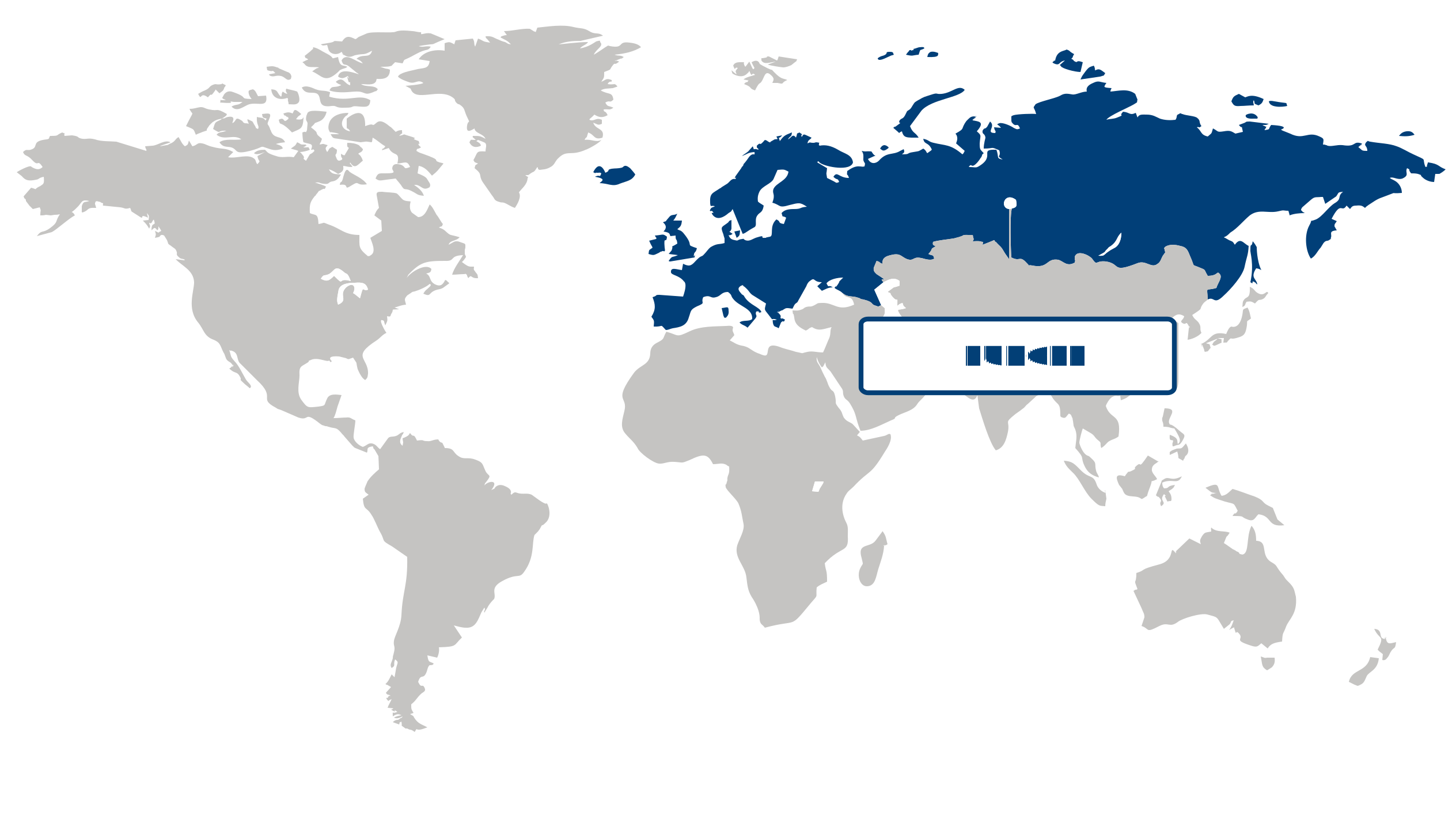
Largest Region
Europe
Largest Market Share in 2026
Europe (Largest Region) vs Asia Pacific (Fastest-Growing Region)
Europe accounted for the largest share of the language service market in 2026, reflecting its linguistic diversity, extensive cross-border commercial activity, and strong demand for multilingual communication. Businesses operating across multiple countries require translation, localization, interpretation, and other language solutions to support international operations and customer engagement. The region’s regulatory environment, particularly the need for clear multilingual information across regulated industries, further sustains demand for professional language services while digital transformation is expanding the use of technology-assisted translation workflows.
Asia Pacific is recording the fastest growth in the language service market as international trade, digital commerce, and cross-border business activity continue to expand. The region’s diverse linguistic landscape creates substantial requirements for localization across software, media, e-commerce, tourism, and professional services. Increasing adoption of digital platforms and artificial intelligence-enabled language technologies is also improving accessibility and turnaround times, allowing businesses to address multilingual markets more efficiently.
Key Country Insights
The U.S. language service market is driven by multinational organizations seeking scalable localization, multimedia translation, and AI-assisted language solutions. Businesses in the U.S. increasingly combine automation with professional linguistic expertise to support global customer engagement.
Japan places strong emphasis on high-quality localization for software, digital content, and technical documentation. Organizations in Japan continue balancing machine translation technologies with expert linguistic review to maintain accuracy and cultural relevance.
South Korea is expanding language service adoption alongside global distribution of digital media, gaming, and technology products. Companies in South Korea increasingly seek integrated localization workflows that accelerate multilingual content delivery while maintaining brand consistency.
Germany emphasizes specialized language services for manufacturing, engineering, legal, and technical documentation. Organizations in Germany continue prioritizing terminology consistency and regulatory accuracy to support international operations and multilingual product communication.
France relies on language services for regulatory documentation, legal translation, and multilingual business communication across international markets. Organizations in France continue investing in specialized linguistic expertise to meet quality expectations across diverse industries.
Italy utilizes language services to support export-oriented industries through multilingual marketing, technical documentation, and customer communications. Businesses in Italy continue expanding localization capabilities to strengthen engagement with international partners and end users.
Segment Leadership and Growth Trends
Services Segment Analysis: Translation (Largest Segment) vs Localization (Fastest-Growing Segment)
Translation held the largest share of the language service market in 2026, supported by the persistent need to convert business, technical, legal, and digital content across languages. Organizations operating across international markets require accurate multilingual communication for customer engagement, documentation, and cross-border operations, sustaining demand for translation services. The expansion of global digital content and international business activities further reinforces the segment’s established position.
Localization is emerging as the fastest-growing segment as organizations increasingly seek language services that adapt content to local cultural, linguistic, and market-specific preferences. Beyond direct language conversion, localization helps businesses tailor digital products, websites, software, and customer-facing materials to individual markets. Growing emphasis on personalized user experiences and successful international market entry is therefore supporting greater adoption of localization services.
Vertical Segment Analysis: IT and Telecom (Largest Segment) vs Healthcare (Fastest-Growing Segment)
The IT and telecom segment accounted for the largest share of the language service market in 2026, reflecting the sector’s extensive dependence on multilingual digital content and cross-border communication. Technology providers and telecommunications organizations require translation of software interfaces, technical documentation, product information, and customer communications across diverse markets. Continued digital transformation and international technology deployment are supporting sustained demand for specialized language services within this vertical.
Healthcare is experiencing the fastest growth as the sector increasingly requires accurate multilingual communication across clinical, regulatory, pharmaceutical, and patient-facing content. The expansion of healthcare services across international markets, combined with the need for clear and reliable medical information, is increasing demand for specialized language support. Greater emphasis on accessibility, regulatory compliance, and effective communication with diverse patient populations is further strengthening the healthcare segment.
| Report Segmentation | |||
| Segment | Sub-Segment | Largest Segment | Fastest Growing Segment |
|---|---|---|---|
| Services | Translation, Interpretation, Localization, Transcription, Others | Translation | Localization |
| Vertical | IT and Telecom, Healthcare, Legal, Government, BFSI, Education, Travel and Hospitality, Others | IT and Telecom | Healthcare |
 Read our Research Approach
Competitive Landscape and Market Positioning
Prominent players in the language service market:
1. TransPerfect Global Inc. (U.S.)
2. RWS Holdings plc (U.K.)
3. Lionbridge Technologies LLC (U.S.)
4. LanguageLine Solutions (U.S.)
5. Welocalize Inc. (U.S.)
6. Keywords Studios plc (Ireland)
7. Iyuno Media Group (South Korea)
8. Semantix AB (Sweden)
9. Hogarth Worldwide Limited (U.K.)
10. Mission Essential Group LLC (U.S.)
Geographical borders are dissolving rapidly as the language service market pivots toward highly localized, region-specific scaling strategies. Rather than relying on rigid, centralized translation models, the strategic focus has shifted toward building hybrid neural-human networks tailored to emerging regional economies. This hyper-localized approach enables rapid scaling into previously inaccessible territories, ensuring that complex cultural nuances and strict linguistic localization are preserved across global corporate operations.
Industry Development/News
| Company Name | Date | Key Development |
|---|---|---|
| Sopoltrad | Feb-26 | Sopoltrad acquired translation and localization firm TextPartner to consolidate its market position across Central and Eastern Europe. This strategic acquisition expands the company’s regional language coverage and enhances its comprehensive multilingual service portfolio, allowing for increased penetration into enterprise client segments within the region. |
| DigitalTolk | Jul-25 | DigitalTolk acquired 24translate, a move designed to accelerate its footprint within the European language services sector. By integrating 24translate’s operations, the company strengthens its capacity as a language solutions integrator, facilitating broader client coverage and enabling entry into previously inaccessible regional market segments. |
| The Translation People | Mar-25 | The Translation People acquired Transladiem to bolster its specialized multilingual eLearning service capabilities. This acquisition enables the company to broaden its service offerings for global clients, effectively strengthening its competitive positioning in the specialized language and localization solutions market. |
| Propio Language Services | Oct-24 | Propio Language Services acquired United Language Group, significantly expanding its scale in the global interpreting and language solutions market. This consolidation enhances the firm's operational footprint and competitive standing, facilitating improved service delivery and capacity for its expanding base of enterprise clients. |
| Smartling | May-24 | Smartling launched an AI Translation Toolkit, reflecting the industry's shift toward automation. The platform enhances translation productivity by integrating advanced AI technologies into enterprise workflows. This launch represents a material technological innovation, aimed at improving translation speed and quality while addressing the increasing demand for efficient, large-scale language operations. |
| Jonckers and Acclaro | Feb-24 | Jonckers and Acclaro merged to form a technology-enabled language service provider with significant cross-Atlantic reach. This integration combines the operational scale and resources of both entities, creating a robust platform for service delivery across Europe and the United States, and strengthening their position against key competitors in the global landscape. |
| Microsoft | Mar-23 | Microsoft integrated 13 additional African languages into the Azure Cognitive Services Translator. By expanding the linguistic reach of its platform, Microsoft strengthens its ecosystem of automated translation tools, enabling greater language accessibility and setting a competitive benchmark for AI-driven language inclusivity within global enterprise software infrastructure. |
| American Journal Experts | Sep-21 | American Journal Experts introduced the Standard Translation service, a strategic hybrid model combining AI-driven software with human editorial expertise. Designed for the technical domain, this development addresses the demand for high-quality, efficient translation services by optimizing workflows to meet specific turnaround requirements, marking a key evolution in technical document translation. |
Why Choose Us
Specialized Expertise: Our team comprises industry experts with a deep understanding of your market segment. We bring specialized knowledge and experience that ensures our research and consulting services are tailored to your unique needs.
Customized Solutions: We understand that every client is different. That's why we offer customized research and consulting solutions designed specifically to address your challenges and capitalize on opportunities within your industry.
Proven Results: With a track record of successful projects and satisfied clients, we have demonstrated our ability to deliver tangible results. Our case studies and testimonials speak to our effectiveness in helping clients achieve their goals.
Cutting-Edge Methodologies: We leverage the latest methodologies and technologies to gather insights and drive informed decision-making. Our innovative approach ensures that you stay ahead of the curve and gain a competitive edge in your market.
Client-Centric Approach: Your satisfaction is our top priority. We prioritize open communication, responsiveness, and transparency to ensure that we not only meet but exceed your expectations at every stage of the engagement.
Continuous Innovation: We are committed to continuous improvement and staying at the forefront of our industry. Through ongoing learning, professional development, and investment in new technologies, we ensure that our services are always evolving to meet your evolving needs.
Value for Money: Our competitive pricing and flexible engagement models ensure that you get maximum value for your investment. We are committed to delivering high-quality results that help you achieve a strong return on your investment.
Select Licence Type

