



Liquefied Petroleum Gas Market Size & Growth Forecast 2026–2035, By Segments (Source, Application), Regional Demand Trends (North America, Asia Pacific, Europe), Key Country Insights (U.S., Japan, South Korea, Germany, France, Italy), and Competitive Landscape
Market Size and Growth Outlook
Liquefied Petroleum Gas Market size stood at USD 129.69 Billion in 2025 and is predicted to grow at a 3.9% CAGR from 2026 to 2035, attaining USD 190.13 Billion by 2035. The industry revenue for 2026 is calculated at USD 134.01 billion.
Base Year Value (2025)
USD 129.69 Billion
CAGR (2026-2035)
3.9%
Forecast Year Value (2035)
USD 190.13 Billion

Historical Data Period
2022-2025

Largest Region
Europe

Forecast Period
2026-2035
Liquefied Petroleum Gas Market Intelligence Snapshot:
-
Regional Market Dynamics:
- Europe leads with 31.21% share, supported by strong distribution infrastructure, mature supply networks, and steady residential, commercial, and industrial LPG consumption across heating and cooking needs.
- Asia Pacific is expanding at 4.45% CAGR due to rising household fuel demand, cylinder-based access expansion, growing small industry usage, and reliance on LPG where pipeline gas is limited.
-
Segment Momentum:
- Non-Associated Gas held a 57.86% market share in 2025 because dedicated gas fields provide more dependable production planning and feedstock availability, supporting stable LPG supply chains and reliable downstream distribution.
- Chemical is the fastest-growing application segment as LPG is increasingly used as a feedstock in chemical processing, where its role can improve process efficiency and production economics.
-
Market Expansion Drivers:
- Expanding clean cooking adoption programs increasing LPG penetration across emerging residential markets.
- Rising autogas usage and distribution network modernization strengthening low-emission fuel demand.
- Growing renewable bio-LPG investments supporting decarbonized industrial and distributed energy applications.
-
Leading Market Participants:
Major players in the liquefied petroleum gas market include Saudi Arabian Oil Company (Saudi Aramco) (Saudi Arabia), Shell plc (United Kingdom), BP p.l.c. (United Kingdom), Exxon Mobil Corporation (United States), TotalEnergies SE (France), China Petroleum & Chemical Corporation (Sinopec) (China), PetroChina Company Limited (China), QatarEnergy (Qatar), Reliance Industries Limited (India), Vitol Group (Netherlands).
Global Market Forecast Snapshot:
-
Market Outlook:
- 2025 Market Size: USD 129.69 Billion
- Projected Market Size: USD 190.13 Billion by 2035
- Growth Forecasts: 3.9% CAGR (2026-2035)
-
Regional and Segment Outlook:
- Leading Regional Market: Europe
- High-Growth Regional Hub: Asia Pacific
- Core Revenue Segment: Non-Associated Gas (Source) | Industrial (Application)
- Emerging Opportunity Segment: Associated Gas (Source) | Chemical (Application)
Market Growth Drivers and Industry Trends
Expanding clean cooking adoption programs increasing LPG penetration across emerging residential marketsGovernment-led clean cooking programs, fuel subsidy reforms, and cylinder distribution initiatives are bringing first-time users into the liquefied petroleum gas market by lowering the upfront barriers that have historically kept households dependent on biomass and kerosene. In practice, demand rises not only through initial stove and cylinder connections but through recurring refill consumption once LPG becomes embedded in daily cooking behavior, prompting distributors to widen last-mile delivery, expand dealer networks, and build smaller-pack offerings suited to price-sensitive consumers. This makes the liquefied petroleum gas market increasingly tied to residential energy access policy, where adoption programs translate directly into sustained household fuel demand and stronger downstream infrastructure utilization.
Rising autogas usage and distribution network modernization strengthening low-emission fuel demand
As fleets and cost-conscious motorists look for lower-emission alternatives to conventional transport fuels, autogas is creating a durable outlet for volume growth in the liquefied petroleum gas market, especially where urban air quality pressures and fuel affordability influence vehicle fuel choice. The effect becomes more pronounced when retail infrastructure is upgraded through station conversions, dedicated dispensing equipment, and more reliable supply logistics, because wider refueling access reduces a key adoption constraint for vehicle owners and commercial operators. This combination of vehicle-side economics and network modernization supports more consistent throughput, encourages fleet conversion decisions, and increases the strategic role of transport demand in the liquefied petroleum gas market.
Growing renewable bio-LPG investments supporting decarbonized industrial and distributed energy applications
Investment in renewable bio-LPG is widening the addressable use case for the liquefied petroleum gas market by allowing industrial users, commercial sites, and off-grid energy operators to pursue lower-carbon fuel substitution without replacing existing LPG-compatible equipment. That compatibility matters in practice: buyers can decarbonize heat and distributed energy operations through procurement shifts rather than capital-intensive system overhauls, which shortens adoption cycles and improves the attractiveness of LPG supply contracts that incorporate renewable content. As supply chains for bio-LPG develop, the liquefied petroleum gas market gains relevance in segments where emissions performance increasingly shapes fuel selection, procurement policy, and long-term energy sourcing decisions.
| Growth Driver Assessment Framework | |||||
| Growth Driver | Impact On CAGR | Regulatory Influence | Geographic Relevance | Adoption Rate | Impact Timeline |
|---|---|---|---|---|---|
| Expanding clean cooking adoption programs increasing LPG penetration across emerging residential markets | 2.00% | High | Asia Pacific, Africa | High | Near Term |
| Rising autogas usage and distribution network modernization strengthening low-emission fuel demand | 1.70% | Moderate | Europe, Asia Pacific, Middle East | High | Mid Term |
| Growing renewable bio-LPG investments supporting decarbonized industrial and distributed energy applications | 1.30% | High | North America, Europe | Emerging | Long Term |
Unlock insights tailored to your business with our bespoke market research solutions - Click to get your customized report now!
Regional Demand Dynamics
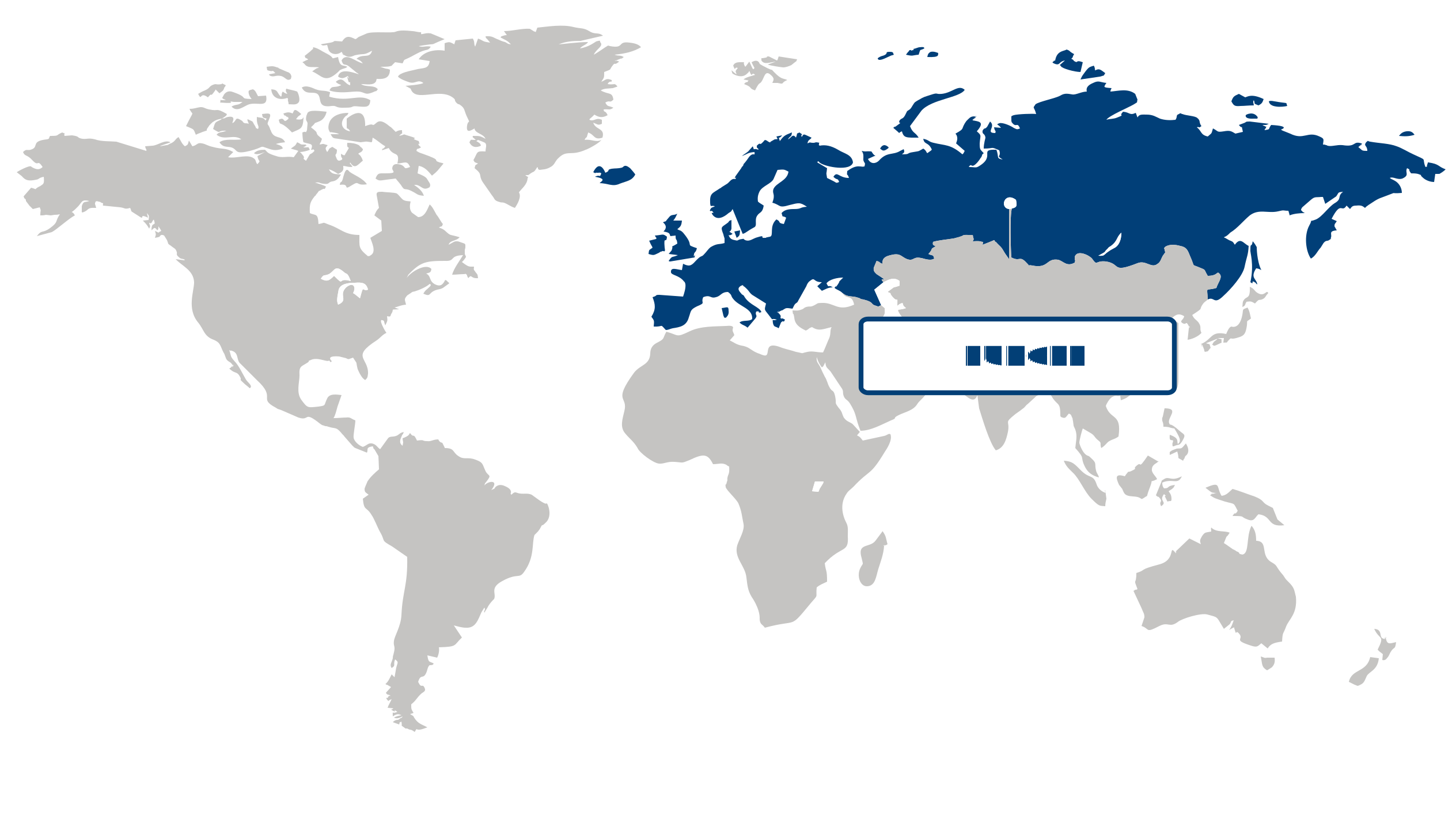
Largest Region
Europe
31.21% Market Share in 2025
Europe held the leading regional position in 2025, accounting for a 31.21% share of the liquefied petroleum gas market. This leadership is backed by the region’s established distribution and storage infrastructure, broad residential and commercial consumption base, and continued use of LPG across heating, cooking, and industrial applications. The market remains active in practice because mature supply networks enable reliable delivery across both urban and off-grid areas, while diversified end-use demand helps maintain steady purchasing volumes across seasonal and industrial cycles.
Asia Pacific is projected to expand at a 4.45% CAGR over the forecast period in the liquefied petroleum gas market, driven by rising household fuel demand and expanding commercial and industrial consumption. Growth is being impelled by increasing adoption in densely populated economies where LPG serves as a practical alternative to more polluting traditional fuels, alongside ongoing demand from small industries and food service operations. In practical terms, market acceleration is closely tied to widening access to cylinder-based supply systems and rising fuel usage in areas where pipeline gas penetration remains limited.
Key Country Insights
The U.S. liquefied petroleum gas market supports residential, commercial, industrial, and transportation applications through an extensive distribution network. Market participants continue improving supply flexibility and storage infrastructure to serve varied end-use requirements efficiently.
Japan prioritizes liquefied petroleum gas as a dependable energy source supporting residential and industrial demand. Market activity emphasizes resilient supply chains, storage capabilities, and distribution efficiency to maintain consistent energy availability.
South Korea continues optimizing liquefied petroleum gas distribution through improved logistics and storage infrastructure. Suppliers focus on dependable fuel availability while supporting industrial users and residential consumers with efficient delivery networks.
Germany utilizes liquefied petroleum gas to support industrial processes requiring dependable and flexible fuel solutions. Businesses increasingly value efficient storage, distribution reliability, and cleaner combustion characteristics for specialized energy applications.
France encourages liquefied petroleum gas adoption in applications seeking cleaner conventional fuel alternatives. The market prioritizes efficient distribution systems and dependable supply to support commercial, residential, and transportation energy requirements.
Italy maintains steady demand for liquefied petroleum gas across household, industrial, and agricultural applications. Market participants continue strengthening regional supply networks and storage capabilities to improve distribution efficiency and customer service.
Segment Leadership and Growth Trends
Non-Associated Gas held the leading position in the liquefied petroleum gas market in 2025, accounting for a 57.86% share. Its leadership is maintained through the dependable nature of production from dedicated gas fields, which gives suppliers greater control over output planning and feedstock availability for LPG extraction. In the liquefied petroleum gas market, this operational consistency supports stable supply chains and makes Non-Associated Gas a preferred source where reliability and volume assurance remain central to downstream distribution and consumption.
Associated Gas is emerging as the fastest-growing source in the liquefied petroleum gas market as producers increasingly capture and process gas streams generated alongside crude oil production. Its momentum is aided by the practical advantage of converting what was previously less-utilized output into commercially valuable LPG, improving overall resource use and supply potential. Compared with alternatives, Associated Gas is seeing wider adoption because it benefits directly from expanding recovery and processing focus tied to existing oilfield operations.
Application Segment Analysis: Industrial (Largest Segment) vs Chemical (Fastest-Growing Segment)
By 2025, Industrial represented the largest application in the liquefied petroleum gas market with an 18.81% share. This position is aided by the segment’s steady consumption profile across manufacturing and process-based operations that require reliable fuel for heat and energy needs. In the liquefied petroleum gas market, Industrial demand remains firmly established because LPG offers operational flexibility for facilities that depend on consistent thermal performance across diverse industrial uses.
Chemical is the fastest-growing application in the liquefied petroleum gas market, encouraged by rising use of LPG as a feedstock in chemical processing rather than only as a fuel source. Its stronger growth relative to other applications comes from the practical value of LPG components in production chains where feedstock selection directly affects process efficiency and output economics. As chemical producers expand applications tied to hydrocarbon inputs, the Chemical segment is gaining momentum within the liquefied petroleum gas market.
| Report Segmentation | |||
| Segment | Sub-Segment | Largest Segment | Fastest Growing Segment |
|---|---|---|---|
| Source | Refinery, Associated Gas, Non-Associated Gas | Non-Associated Gas | Associated Gas |
| Application | Residential/Commercial, Chemical, Industrial, Autogas, Refinery, Others | Industrial | Chemical |
 Read our Research Approach
Competitive Landscape and Market Positioning
Prominent players in the liquefied petroleum gas market:1. Saudi Arabian Oil Company (Saudi Aramco) (Saudi Arabia)
2. Shell plc (United Kingdom)
3. BP p.l.c. (United Kingdom)
4. Exxon Mobil Corporation (United States)
5. TotalEnergies SE (France)
6. China Petroleum & Chemical Corporation (Sinopec) (China)
7. PetroChina Company Limited (China)
8. QatarEnergy (Qatar)
9. Reliance Industries Limited (India)
10. Vitol Group (Netherlands)
The liquefied petroleum gas market is evolving with expanding distribution infrastructure and improved storage systems enhancing fuel accessibility. Collaborative supply agreements are strengthening energy delivery networks. Continuous investment in cleaner fuel solutions is supporting sustainability goals, while market expansion efforts are improving global energy availability.
Industry Development/News
| Company Name | Date | Key Development |
|---|---|---|
| Trigon Pacific Terminals | Jun-25 | Trigon approved the development of a CAD 750 million LPG export terminal in Prince Rupert, Canada, with operations targeted for 2029. The infrastructure investment significantly expands North American export capacity and enhances supply chain connectivity to global markets. |
| ONEOK | Feb-25 | ONEOK announced plans to construct a USD 1.4 billion LPG export terminal in Texas. The strategic facility investment strengthens midstream infrastructure capabilities and expands the company's export footprint to meet growing global demand. |
| Vitol Group | Nov-25 | Vitol agreed to construct a 750,000-cubic-meter LPG terminal at the ATT Tanjung Bin facility in Malaysia. This infrastructure development scales up regional storage capacity and strengthens the company's trading and distribution networks within international energy markets. |
| ORLEN Paliwa | Jun-25 | ORLEN completed an expansion of its LPG terminal in Szczecin, Poland, doubling total storage capacity. The modernized import infrastructure can handle up to 400,000 tonnes of LPG annually, enhancing supply chain resilience in Europe. |
| GOIL PLC | Nov-25 | GOIL announced a USD 50 million investment to add 12,000 tonnes of LPG storage capacity in Ghana. The capital project expands domestic midstream infrastructure, directly supporting local supply reliability and distribution operations. |
| Saudi Aramco | Feb-25 | Saudi Aramco announced an expansion of its Yanbu Gas Plant to increase total LPG production capacity by 10%. The project supports the company's downstream diversification strategy and scales export capacity directed toward Asia-Pacific and European markets. |
| Kuwait National Petroleum Corporation (KNPC) | May-26 | KNPC is evaluating the revival of a feasibility study for a sixth LPG production unit in Kuwait. The proposed facility aims to expand domestic processing capacity to handle increasing upstream gas output and optimize industrial fuel production. |
| Government of India & United Arab Emirates | May-26 | India and the United Arab Emirates ratified energy partnership agreements focusing on long-term LPG supply cooperation and strategic petroleum reserves, establishing a structured bilateral framework to improve national energy security and trade flows. |
| Government of Venezuela | Jan-26 | Venezuela executed its first commercial LPG export contract. This development marks a transition toward establishing a formal domestic LPG export industry and expanding the nation's operational footprint within competitive global energy markets. |
| TotalEnergies | May-24 | TotalEnergies announced a commitment to invest over USD 400 million by 2030 to expand clean cooking solutions, including downstream LPG distribution infrastructure, targeting 100 million consumers across Africa and India to build out new regional retail segments. |
Why Choose Us
Specialized Expertise: Our team comprises industry experts with a deep understanding of your market segment. We bring specialized knowledge and experience that ensures our research and consulting services are tailored to your unique needs.
Customized Solutions: We understand that every client is different. That's why we offer customized research and consulting solutions designed specifically to address your challenges and capitalize on opportunities within your industry.
Proven Results: With a track record of successful projects and satisfied clients, we have demonstrated our ability to deliver tangible results. Our case studies and testimonials speak to our effectiveness in helping clients achieve their goals.
Cutting-Edge Methodologies: We leverage the latest methodologies and technologies to gather insights and drive informed decision-making. Our innovative approach ensures that you stay ahead of the curve and gain a competitive edge in your market.
Client-Centric Approach: Your satisfaction is our top priority. We prioritize open communication, responsiveness, and transparency to ensure that we not only meet but exceed your expectations at every stage of the engagement.
Continuous Innovation: We are committed to continuous improvement and staying at the forefront of our industry. Through ongoing learning, professional development, and investment in new technologies, we ensure that our services are always evolving to meet your evolving needs.
Value for Money: Our competitive pricing and flexible engagement models ensure that you get maximum value for your investment. We are committed to delivering high-quality results that help you achieve a strong return on your investment.
Select Licence Type

