Panel Mounted Industrial Disconnect Switch Market Size & Growth Forecast 2027–2036, By Segments (Product, Voltage), Regional Demand Trends (North America, Asia Pacific, Europe), Key Country Insights (U.S., Japan, South Korea, Germany, France, Italy), and Competitive Landscape
Jump to content
Market Size and Growth Outlook
Panel Mounted Industrial Disconnect Switch Market size was estimated at USD 8.66 Billion in 2026 and is projected to grow at 6.68% CAGR from 2027 to 2036, exceeding USD 16.53 Billion by 2036. The industry revenue for 2027 is calculated at USD 9.15 Billion.
Get more details on this report
Request Free Sample ReportPanel Mounted Industrial Disconnect Switch Market Intelligence Snapshot
Regional Market Dynamics
- Europe led in 2026, supported by its mature industrial base, manufacturing activity, developed infrastructure, and strong emphasis on electrical safety and equipment reliability.
- Asia Pacific is projected to grow fastest as industrialization, factory investment, infrastructure development, automation, and electrical system modernization increase demand for reliable protection equipment.
Segment Momentum
- Non-fused disconnect switches held 61.34% of the market in 2026 and are growing the fastest due to their simple design, ease of operation, and suitability for reliable circuit isolation in industrial environments.
- Medium-voltage disconnect switches are projected to grow the fastest as investments in industrial electrification, facility upgrades, and modern power distribution systems increase demand for reliable switching solutions.
Market Expansion Drivers
- Rising industrial electrification increasing demand for safe power isolation systems
- Expansion of industrial automation boosting requirement for safety compliance devices
- Infrastructure modernization driving replacement of legacy electrical switch systems
Leading Market Participants
- Top companies in the panel mounted industrial disconnect switch market include Schneider Electric SE (France), Siemens AG (Germany), ABB Ltd (Switzerland), Eaton Corporation plc (Ireland), Rockwell Automation, Inc. (United States), Socomec Group (France), Rittal GmbH & Co. KG (Germany), Hubbell Incorporated (United States), Littelfuse, Inc. (United States), WEG S.A. (Brazil)
Global Market Forecast Snapshot
Market Outlook
- 2026 Market Size: USD 8.66 Billion
- 2027 Estimated Market Size: USD 9.15 Billion
- Projected Market Size: USD 16.53 Billion by 2036
- Growth Forecast: 6.68% CAGR (2027-2036)
Regional and Segment Outlook
- Leading Regional Market: Europe
- High-Growth Regional Hub: Asia Pacific
- Core Revenue Segment: Non-fused (Product) | High (Voltage)
- Emerging Opportunity Segment: Non-fused (Product) | Medium (Voltage)
Market Growth Drivers and Industry Trends
Rising industrial electrification increasing demand for safe power isolation systems
The expansion of industrial electrification across manufacturing facilities, processing plants, and commercial infrastructure is strengthening the need for reliable electrical safety components. The panel mounted industrial disconnect switch market will drive growth as industries prioritize secure power isolation mechanisms that allow maintenance teams to safely disconnect equipment from energy sources. Increasing deployment of electrically powered machinery and distributed power systems requires switching solutions that support operational safety, reduce electrical risks, and maintain continuity in complex industrial environments.
Expansion of industrial automation boosting requirement for safety compliance devices
Automation initiatives are increasing the integration of advanced machinery, robotic systems, and digitally controlled production lines that require dependable protection measures. The panel mounted industrial disconnect switch market growth is driven by the rising adoption of safety compliance devices that enable controlled shutdowns and emergency isolation during equipment servicing or faults. As automated operations become more interconnected, manufacturers are focusing on electrical components that support workplace safety standards while fitting seamlessly into modern control panels.
Infrastructure modernization driving replacement of legacy electrical switch systems
Aging industrial infrastructure is encouraging facilities to upgrade outdated electrical distribution and control systems with more efficient and safer alternatives. Replacement activities will propel the panel mounted industrial disconnect switch market growth as operators seek improved equipment protection, simplified maintenance procedures, and enhanced compatibility with upgraded power architectures. Modernization programs across industrial sites are creating demand for disconnect solutions designed to support evolving electrical requirements.
| Growth Driver | Impact on CAGR | Regulatory Influence | Geographic Relevance | Adoption Rate | Impact Timeline |
|---|---|---|---|---|---|
| Rising industrial electrification increasing demand for safe power isolation systems | 2% | High | Asia Pacific, Europe | High | Near Term |
| Expansion of industrial automation boosting requirement for safety compliance devices | 1.6% | High | North America, Europe | High | Mid Term |
| Infrastructure modernization driving replacement of legacy electrical switch systems | 1.4% | Moderate | Asia Pacific, Middle East & Africa | Medium | Mid Term |
Unlock insights tailored to your business with our bespoke market research solutions.
Click to get your customized report now.
Regional Demand Dynamics
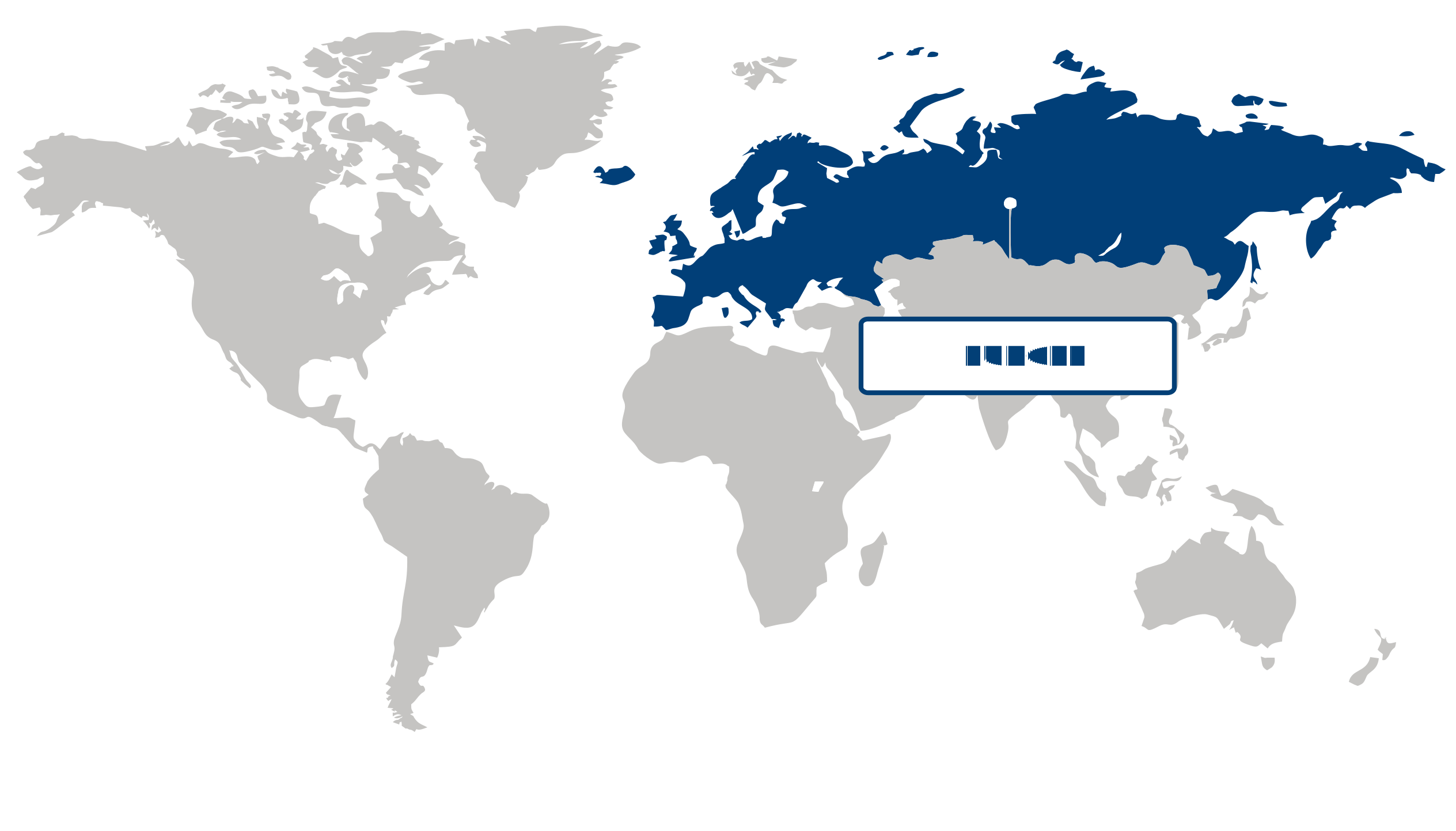
Europe (Largest Region)
Europe held the largest position in the panel mounted industrial disconnect switch market in 2026, supported by its mature industrial base, extensive manufacturing activity, and strong emphasis on electrical safety and equipment reliability. The region's well-developed infrastructure and continued modernization of industrial facilities create consistent demand for dependable electrical isolation solutions. Increasing adoption of automated production systems and investment in efficient industrial equipment further support the integration of disconnect switches across manufacturing and commercial applications.
Asia Pacific (Fastest-Growing Region)
Asia Pacific is expected to be the fastest-growing region, driven by rapid industrialization, infrastructure development, and expanding manufacturing capacity. Increasing investment in factories, commercial facilities, and power infrastructure is creating greater demand for electrical distribution and protection equipment. The expansion of industrial automation and modernization of electrical systems across emerging economies is also supporting adoption, while growing emphasis on operational safety and reliable power management is strengthening opportunities for panel mounted disconnect switches.
| Parameter | North America | Asia Pacific | Europe | Latin America | MEA |
|---|---|---|---|---|---|
| Innovation HubiScaleNascentDeveloping Advanced | |||||
| Cost-Sensitive RegioniScaleLowMedium High | |||||
| Regulatory EnvironmentiScaleRestrictiveNeutral Supportive | |||||
| Demand DriversiScaleWeakModerate Strong | |||||
| Development StageiScaleEmergingDeveloping Developed | |||||
| Adoption RateiScaleLowMedium High | |||||
| New Entrants / StartupsiScaleSparseModerate Dense | |||||
| Macro IndicatorsiScaleWeakStable Strong |
Key Country Insights
United States 🇺🇸
Industrial Safety ComplianceThe U.S. prioritizes panel mounted industrial disconnect switches across manufacturing, utilities, and commercial facilities to strengthen electrical safety and maintenance practices. Buyers increasingly seek compact, code-compliant products that integrate seamlessly with automated control panels and modern electrical infrastructure.
Germany 🇩🇪
Automation Control IntegrationGermany incorporates panel mounted industrial disconnect switches into advanced factory automation and machinery systems. German equipment manufacturers emphasize reliable switching performance, modular installation, and compliance with stringent industrial safety requirements across production environments.
Japan 🇯🇵
Compact Equipment DesignJapan favors panel mounted industrial disconnect switches designed for space-efficient control cabinets used in electronics, robotics, and industrial automation. Manufacturers focus on durable components that support reliable operation while simplifying maintenance within compact production systems.
South Korea 🇰🇷
Smart Factory DeploymentSouth Korea expands the use of panel mounted industrial disconnect switches through investments in smart manufacturing and industrial automation. End users prioritize dependable electrical isolation solutions compatible with digitally controlled production equipment and advanced factory infrastructure.
France 🇫🇷
Infrastructure Protection FocusFrance adopts panel mounted industrial disconnect switches across industrial plants, utilities, and infrastructure modernization projects. French buyers increasingly value products offering robust safety performance, easy installation, and compatibility with evolving electrical distribution systems.
Italy 🇮🇹
Machinery Equipment SupportItaly utilizes panel mounted industrial disconnect switches extensively in industrial machinery and equipment manufacturing. Italian producers favor flexible product configurations that improve operator safety while supporting efficient maintenance across diverse manufacturing applications.
Panel Mounted Industrial Disconnect Switch Market Share (%), by Product, 2026
Go beyond the chart, access full insights & data tables
Request Free Sample ReportProduct Segment Analysis: Non-fused (Largest & Fastest-Growing Segment)
Non-fused disconnect switches dominated the panel mounted industrial disconnect switch market and accounted for 61.34% in 2026, while also representing the fastest-growing product segment. Their strong position is supported by their straightforward construction, ease of operation, and suitability for applications where circuit isolation is required separately from overcurrent protection. Industrial facilities increasingly require dependable disconnect solutions to support equipment maintenance, operational safety, and effective electrical system management. The expansion of industrial automation and electrical infrastructure is expected to continue supporting demand for non-fused configurations.
Voltage Segment Analysis: High (Largest Segment) vs Medium (Fastest-Growing Segment)
High-voltage disconnect switches held the largest share of the panel mounted industrial disconnect switch market, representing 49.61% in 2026. Their leading position reflects the need for reliable isolation and safe switching in industrial electrical systems operating under demanding power conditions. As industrial facilities expand their electrical infrastructure and deploy larger, more power-intensive equipment, dependable disconnect solutions become increasingly important for maintenance, protection, and operational control. The continued modernization of industrial power systems is supporting demand for high-voltage panel-mounted disconnect switches.
Medium-voltage disconnect switches are expected to be the fastest-growing voltage segment as industrial and commercial facilities increasingly expand electrical distribution systems that require reliable switching and isolation at intermediate power levels. These systems are widely suited to applications involving industrial machinery, distribution equipment, and facility infrastructure where operational flexibility and safety are essential. Growing investment in industrial electrification, facility upgrades, and modern power distribution networks is expected to support increasing adoption of medium-voltage disconnect switches.
| Segment | Sub-Segment | Largest Segment | Fastest Growing |
|---|---|---|---|
| Product | Fused, Non-fused | Non-fused | Non-fused |
| Voltage | Low, Medium, High | High | Medium |
Competitive Landscape and Market Positioning
Major players in the panel mounted industrial disconnect switch market:
- Schneider Electric SE (France)
- Siemens AG (Germany)
- ABB Ltd (Switzerland)
- Eaton Corporation plc (Ireland)
- Rockwell Automation, Inc. (United States)
- Socomec Group (France)
- Rittal GmbH & Co. KG (Germany)
- Hubbell Incorporated (United States)
- Littelfuse, Inc. (United States)
- WEG S.A. (Brazil)
Greater emphasis on electrical safety, operational continuity, and industrial system modernization is influencing competitive dynamics within the Panel Mounted Industrial Disconnect Switch market. Manufacturers are differentiating their offerings through enhanced reliability, compact designs, and simplified installation that support increasingly sophisticated control panels and industrial equipment. The market is also evolving toward products that integrate more effectively with automated electrical systems while meeting stringent operational and compliance requirements, placing greater value on design durability, application-specific flexibility, and long-term performance in demanding industrial environments.
| Company | Market Share | Company Revenue | Revenue CAGR (%) | Product Portfolio | Geographic Presence | Innovation / R&D Focus | Strategic Developments |
|---|---|---|---|---|---|---|---|
| Schneider Electric SE (France) | |||||||
| Siemens AG (Germany) | |||||||
| ABB Ltd (Switzerland) | |||||||
| Eaton Corporation plc (Ireland) | |||||||
| Rockwell Automation Inc. (United States) | |||||||
| Socomec Group (France) | |||||||
| Rittal GmbH & Co. KG (Germany) | |||||||
| Hubbell Incorporated (United States) | |||||||
| Littelfuse Inc. (United States) | |||||||
| WEG S.A. (Brazil) |
Industry Development / News
| Company Name | Date | Key Development |
|---|---|---|
| ABB | Mar-25 | ABB committed 120 million USD to expand its U.S. electrification product manufacturing capacity. The investment includes a 40 million USD expansion to double its Mississippi plant, creating 200 jobs, alongside an 80 million USD investment in Selmer, Tennessee operations, adding 50 jobs. |
| Siemens | Mar-25 | Siemens invested 95 million USD to expand and upgrade its Pomona, California facility to enhance manufacturing capacity for U.S. energy infrastructure. The initiative aims to strengthen the national energy grid and meet the growing demand for energy-efficient technologies. |
| Socomec | Nov-24 | Socomec supplied disconnect switches exceeding 50 gigawatts for solar projects, supporting India's 90-gigawatt solar capacity and national renewable targets. The SIRCO PV and INOSYS PV switches utilize patented technology for high breaking capacity per pole up to 1500 VDC, ensuring efficient power management. |
Customize Your Report
Explore examples of how this report can be tailored to different research needs, including custom segments, additional topics or chapters, and related reports. Click a section of the wheel or its numbered marker to explore the available options.
Panel Mounted Industrial Disconnect Switch Market — Custom Segments
| Segment | Sub-Segment |
|---|---|
| Current Rating | Up to 100 A, 101–400 A, 401–800 A, Above 800 A |
| Number of Poles | 2-Pole, 3-Pole, 4-Pole, More Than 4 Poles |
| Operating Mechanism | Rotary, Lever-Operated, Push-Pull, Motorized |
Panel Mounted Industrial Disconnect Switch Market — Custom TOC
| Custom Chapter | Chapter Details |
|---|---|
| Industrial Safety Compliance and Upgrade Priorities |
|
| Electrical Panel Retrofit Opportunities |
|
| Switchgear Specification and Selection Strategy |
|
Need a different cut of the data?
Request Custom ResearchFrequently Asked Questions
What is the current size of the panel mounted industrial disconnect switch market?
How is the panel mounted industrial disconnect switch industry size expected to evolve during the forecast period?
How is industrial automation influencing demand for panel mounted industrial disconnect switches?
Why is infrastructure modernization creating opportunities in the panel mounted industrial disconnect switch market?
Why are non-fused disconnect switches the preferred product segment?
Which voltage segment is expected to grow the fastest in the panel mounted industrial disconnect switch market?
What makes Europe the leading market for panel mounted industrial disconnect switches?
Why is Asia Pacific expected to grow fastest in this market?
Who are the leading players in the panel mounted industrial disconnect switch landscape?
Our Clients
"The team at Fundamental Business Insights & Consulting demonstrated a commitment to excellence, not only in the quality of the report but also in their client-centric approach."
FANUC
"The level of detail in the market segmentation provided were particularly noteworthy. The detailed country-level insights were also very helpful."
B&R Industrial Automation GmbH
"The consultant took the time to understand our specific business objectives, ensuring that the reports were tailored to address our unique challenges and opportunities."
KUKA SE & Co. KGaA
Our Research Team & Methodology
Every Fundamental Business Insights report is built by a dedicated vertical research team, validated through a structured primary-and-secondary methodology, and reviewed for accuracy before it reaches you.
Delivery
Published
Available
Support
- Market Size & Forecast
- Market Segmentation
- Regional Analysis
- Growth Drivers & Challenges
- Market Dynamics
- Competitive Landscape
- Company Profiles
- Competitive Benchmarking
- Mergers & Acquisitions
- Market Share Analysis or Key Company Strategies
- Value Chain Analysis
- Porter's Five Forces
- PESTLE Analysis
- Pricing Trends
- Supply-Demand Analysis
- Technology Landscape
- Regulatory Landscape
- Investment & Funding Landscape
- Emerging Opportunities
- Future Market Outlook