Residential Underfloor Heating Market Size & Growth Forecast 2027–2036, By Segments (Facility, Technology, Application), Regional Demand Trends (North America, Asia Pacific, Europe), Key Country Insights (U.S., Japan, South Korea, Germany, France, Italy), and Competitive Landscape
Market Size and Growth Outlook
Residential Underfloor Heating Market size was assessed at USD 5.03 Billion in 2026 and is poised to grow at 5.72% CAGR between 2027 and 2036, exceeding USD 8.77 Billion by 2036. The industry revenue for 2027 is estimated at USD 5.27 Billion.
Get more details on this report
Request Free Sample ReportResidential Underfloor Heating Market Intelligence Snapshot
Regional Market Dynamics
- Europe led in 2026, supported by demand for energy-efficient heating, residential modernization, sustainable solutions, and growing integration with smart home controls.
- Asia Pacific is the fastest-growing region, fueled by urbanization, residential construction, rising living standards, and increasing investment in energy-efficient and smart housing.
Segment Momentum
- New buildings held 71.52% of the market in 2026 because underfloor heating is easier to integrate during construction, supporting energy-efficient designs, sustainable building practices, and improved occupant comfort.
- Electric systems are growing rapidly due to their straightforward installation, minimal structural requirements, and suitability for renovation projects, making them an attractive option for homeowners upgrading existing properties.
Market Expansion Drivers
- Shift toward low-carbon residential heating accelerating underfloor heating adoption
- Growing construction of energy-efficient buildings boosting modern heating infrastructure demand
- Urban housing modernization increasing preference for space-saving heating systems
Leading Market Participants
- Key players in the residential underfloor heating market include Uponor Corporation (Finland), Danfoss A/S (Denmark), Rehau Group (Germany), Watts Water Technologies, Inc. (USA), Schluter-Systems L.P. (Germany), Warmup plc (UK), OJ Electronics A/S (Denmark), Hemstedt GmbH (Germany), Warmboard Inc. (USA), Viega GmbH & Co. KG (Germany)
Global Market Forecast Snapshot
Market Outlook
- 2026 Market Size: USD 5.03 Billion
- 2027 Estimated Market Size: USD 5.27 Billion
- Projected Market Size: USD 8.77 Billion by 2036
- Growth Forecast: 5.72% CAGR (2027-2036)
Regional and Segment Outlook
- Leading Regional Market: Europe
- High-Growth Regional Hub: Asia Pacific
- Core Revenue Segment: New Buildings (Facility) | Hydronic (Technology) | Single Family (Application)
- Emerging Opportunity Segment: Retrofit (Facility) | Electric (Technology) | Single Family (Application)
Market Growth Drivers and Industry Trends
Shift toward low-carbon residential heating accelerating underfloor heating adoption
The transition toward lower-emission residential heating solutions is encouraging homeowners and developers to replace conventional heating systems with more energy-efficient alternatives. This shift will drive the residential underfloor heating market growth as underfloor heating systems distribute heat evenly while operating efficiently with a range of low-carbon heating technologies. Their compatibility with modern residential energy strategies makes them increasingly attractive for households seeking improved thermal comfort alongside reduced environmental impact and enhanced energy utilization.
Growing construction of energy-efficient buildings boosting modern heating infrastructure demand
The expansion of energy-efficient residential construction is increasing demand for heating systems that complement high-performance building designs and optimized insulation standards. The residential underfloor heating market benefits from this trend because underfloor heating integrates effectively with contemporary building layouts while providing consistent indoor temperatures and efficient heat distribution. Architects, builders, and property developers are increasingly incorporating these systems into new housing projects to meet evolving energy performance requirements and improve long-term residential comfort.
Urban housing modernization increasing preference for space-saving heating systems
Residential renovation projects and urban housing modernization are encouraging homeowners to adopt heating technologies that maximize usable interior space while supporting contemporary design preferences. This development will propel the residential underfloor heating market growth as concealed heating installations eliminate the need for visible radiators, providing greater flexibility for interior layouts and furniture placement. The seamless integration of underfloor heating within modern living spaces appeals to homeowners seeking both aesthetic improvements and efficient thermal management across apartments, townhouses, and single-family residences.
| Growth Driver | Impact on CAGR | Regulatory Influence | Geographic Relevance | Adoption Rate | Impact Timeline |
|---|---|---|---|---|---|
| Shift toward low-carbon residential heating accelerating underfloor heating adoption | 2.1% | High | Europe, North America | High | Near Term |
| Growing construction of energy-efficient buildings boosting modern heating infrastructure demand | 1.9% | High | Europe, Asia Pacific | High | Mid Term |
| Urban housing modernization increasing preference for space-saving heating systems | 1.6% | Moderate | North America, Europe | High | Mid Term |
Unlock insights tailored to your business with our bespoke market research solutions.
Click to get your customized report now.
Regional Demand Dynamics
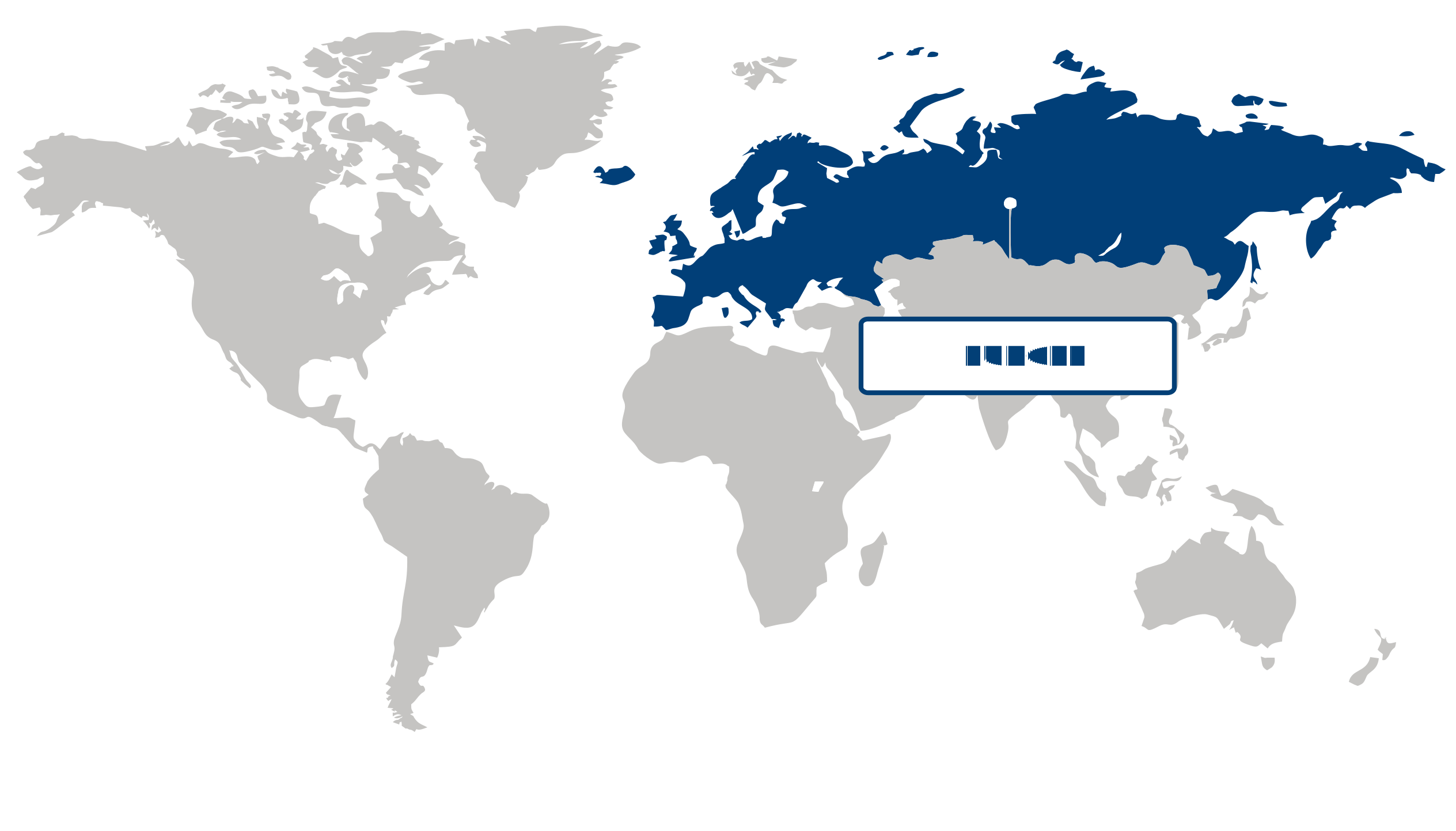
Europe (Largest Region)
Europe held the largest position in the residential underfloor heating market in 2026, supported by strong demand for energy-efficient residential heating systems and increasing emphasis on reducing household energy consumption. Underfloor heating provides uniform heat distribution and can operate efficiently with modern low-temperature heating technologies, making it suitable for both new residential construction and renovation projects. The region's focus on building energy performance, growing adoption of sustainable heating solutions, and continued modernization of residential properties are supporting market development. Rising interest in integrating heating systems with smart home controls is also encouraging demand for advanced underfloor heating technologies.
Asia Pacific (Fastest-Growing Region)
Asia Pacific is the fastest-growing regional market, driven by rapid urbanization, expanding residential construction, and increasing awareness of energy-efficient heating solutions. Rising living standards and the development of modern housing infrastructure are creating greater demand for comfortable and technologically advanced indoor climate systems. The expansion of residential development in colder parts of the region is further supporting the adoption of underfloor heating, particularly where conventional heating systems are being upgraded or replaced. Growing investment in energy-efficient buildings and increasing interest in smart residential technologies are expected to create additional opportunities across Asia Pacific.
| Parameter | North America | Asia Pacific | Europe | Latin America | MEA |
|---|---|---|---|---|---|
| Innovation Hub i Scale Nascent Developing Advanced | |||||
| Cost-Sensitive Region i Scale Low Medium High | |||||
| Regulatory Environment i Scale Restrictive Neutral Supportive | |||||
| Demand Drivers i Scale Weak Moderate Strong | |||||
| Development Stage i Scale Emerging Developing Developed | |||||
| Adoption Rate i Scale Low Medium High | |||||
| New Entrants / Startups i Scale Sparse Moderate Dense | |||||
| Macro Indicators i Scale Weak Stable Strong |
Key Country Insights
United States 🇺🇸
Premium Home ComfortThe U.S. residential underfloor heating market is supported by demand for energy-efficient home upgrades and premium residential construction. Adoption is increasingly centered on retrofit-friendly electric systems and smart thermostat integration, allowing homeowners to improve comfort while aligning with modern energy management preferences.
Germany 🇩🇪
Energy-Efficient RenovationGermany emphasizes residential underfloor heating in renovation projects where energy efficiency standards and low-temperature heating systems are priorities. The country continues to encourage solutions that integrate effectively with heat pumps and modern building insulation practices.
Japan 🇯🇵
Compact Living SolutionsJapan adopts residential underfloor heating to enhance comfort in compact living spaces while maintaining efficient energy use. Demand favors quiet, space-saving systems that integrate seamlessly with modern residential construction and advanced home automation features.
South Korea 🇰🇷
Smart Residential IntegrationSouth Korea combines residential underfloor heating with connected home technologies, supporting consumer interest in automated temperature control and efficient energy use. Local housing developments increasingly prioritize digitally managed heating systems that improve convenience and indoor comfort.
France 🇫🇷
Low-Carbon Home HeatingFrance continues to incorporate residential underfloor heating into projects focused on lowering building emissions and improving thermal efficiency. Preference for hydronic systems compatible with renewable heating technologies supports broader residential modernization initiatives.
Italy 🇮🇹
Renovation-Focused HeatingItaly's residential underfloor heating market benefits from renovation activity aimed at improving comfort and reducing heating costs in existing homes. Demand is reinforced by solutions designed for compatibility with traditional building layouts and efficient hydronic heating systems.
Segment Leadership and Growth Trends
Residential Underfloor Heating Market Share (%), by Facility, 2026
Go beyond the chart, access full insights & data tables
Request Free Sample ReportFacility Segment Analysis: New Buildings (Largest Segment) vs Retrofit (Fastest-Growing Segment)
Holding the largest share of the residential underfloor heating market, the new buildings segment accounted for 71.52% of the market in 2026. Its dominance is largely attributed to the ease of integrating underfloor heating systems during the construction phase, allowing developers to optimize building layouts and energy performance from the outset. New residential projects increasingly emphasize energy-efficient designs and enhanced occupant comfort, making underfloor heating an attractive solution. The growing adoption of modern building standards and sustainable construction practices has further supported the segment’s leading position.
The retrofit segment is expected to experience the fastest growth as homeowners increasingly seek to upgrade existing properties with more efficient and comfortable heating solutions. Advancements in installation techniques and system designs have made retrofitting underfloor heating more practical across a wider range of residential structures. Rising renovation activity, coupled with growing awareness of long-term energy savings and indoor comfort benefits, is encouraging greater adoption of retrofit underfloor heating systems in established housing stock.
Technology Segment Analysis: Hydronic (Largest Segment) vs Electric (Fastest-Growing Segment)
The hydronic segment held the largest share of the market in 2026 due to its ability to deliver consistent and energy-efficient heating across larger residential spaces. These systems are widely favored for their compatibility with various heat sources and their effectiveness in maintaining uniform temperature distribution. Their long-term operational efficiency and suitability for whole-home heating applications have contributed significantly to their market leadership.
In the residential underfloor heating market, the electric segment is emerging as the fastest-growing technology category. Growth is supported by its relatively straightforward installation process, reduced structural requirements, and suitability for renovation projects where extensive modifications may not be feasible. Increasing demand for flexible heating solutions and the rising adoption of electrically powered home systems are creating favorable conditions for the expansion of electric underfloor heating technologies.
Application Segment Analysis: Single Family (Largest & Fastest-Growing Segment)
The single-family application segment held the largest share and was also the fastest-growing segment in 2026. Strong demand stems from homeowners’ increasing focus on energy-efficient heating systems that enhance comfort while supporting modern home design preferences. Underfloor heating is particularly attractive in single-family residences because it provides even heat distribution, frees up wall space by eliminating visible radiators, and complements contemporary construction trends. Continued investment in home improvement projects and growing interest in sustainable residential living are expected to sustain the segment’s strong market position.
| Segment | Sub-Segment | Largest Segment | Fastest Growing |
|---|---|---|---|
| Facility | New Buildings, Retrofit | New Buildings | Retrofit |
| Technology | Hydronic, Electric | Hydronic | Electric |
| Application | Single Family, Multi Family | Single Family | Single Family |
Competitive Landscape and Market Positioning
Key companies in the residential underfloor heating market:
- Uponor Corporation (Finland)
- Danfoss A/S (Denmark)
- Rehau Group (Germany)
- Watts Water Technologies, Inc. (USA)
- Schluter-Systems L.P. (Germany)
- Warmup plc (UK)
- OJ Electronics A/S (Denmark)
- Hemstedt GmbH (Germany)
- Warmboard, Inc. (USA)
- Viega GmbH & Co. KG (Germany)
The residential underfloor heating market is becoming increasingly influenced by the convergence of energy efficiency, user comfort, and smart home integration. Manufacturers are competing through system designs that offer more responsive temperature control, simplified installation, and compatibility with modern residential construction practices, enabling broader adoption across both renovation and new housing projects. Digital control technologies are further reshaping the market by allowing homeowners to manage heating performance more precisely while improving overall energy utilization. As consumers increasingly evaluate long-term operating convenience alongside installation quality, suppliers with flexible system configurations and reliable technical support are gaining a stronger competitive foothold.
| Company | Market Share | Company Revenue | Revenue CAGR (%) | Product Portfolio | Geographic Presence | Innovation / R&D Focus | Strategic Developments |
|---|---|---|---|---|---|---|---|
| Uponor Corporation (Finland) | |||||||
| Danfoss A/S (Denmark) | |||||||
| Rehau Group (Germany) | |||||||
| Watts Water Technologies Inc. (USA) | |||||||
| Schluter-Systems L.P. (Germany) | |||||||
| Warmup plc (UK) | |||||||
| OJ Electronics A/S (Denmark) | |||||||
| Hemstedt GmbH (Germany) | |||||||
| Warmboard Inc. (USA) | |||||||
| Viega GmbH & Co. KG (Germany) |
Industry Development/News
| Company Name | Date | Key Development |
|---|---|---|
| PURMO Group | Apr-25 | PURMO Group announced the acquisition of UFHN, a provider of electric and hydronic underfloor heating systems. This strategic integration enhances capabilities, expands market reach in the UK, and incorporates the portfolio into sustainable climate solutions while granting access to extensive resources and research and development capabilities. |
| Elydan Group | Feb-25 | Elydan Group integrated HeatUp, a Swedish provider of comprehensive underfloor heating systems, sanitary hot and cold-water distribution, and pre-insulated flexible tubing systems. This move allows HeatUp to leverage Elydan Group's extensive distribution network across Europe to drive its regional expansion initiatives. |
| Ambiente | Nov-24 | Ambiente expanded its underfloor heating product range with the introduction of LoFloor 18 for premium floor build-up projects, utilizing a dry build-up methodology designed to eliminate wet trades and screeds while allowing direct installation of floor finishes over the panels. |
| Jersey Energy Technologies | Sep-24 | Jersey Energy Technologies finalized a contract with Haydale to implement a graphene-enhanced underfloor heating system incorporating HDPlas functionalization technology across social housing on the channel island, leveraging thermal conductivity to achieve up to thirty percent reductions in operating costs compared to standard wired systems. |
| UFHN Ltd | May-24 | UFHN Ltd secured a contract with London Land Group to participate in the Waterfront Development on Poole Quay, executing the implementation of the Mercury Aurora castellated panel system across 291 residential apartments covering 17,000 square meters to deliver advanced heat distribution and energy efficiency. |
Customize Your Report
Explore examples of how this report can be tailored to different research needs, including custom segments, additional topics or chapters, and related reports. Click a section of the wheel or its numbered marker to explore the available options.
Residential Underfloor Heating Market — Custom Segments
| Segment | Sub-Segment |
|---|---|
| Floor Covering | Tile & Stone, Wood & Engineered Wood, Laminate & Vinyl, Carpet & Other Floor Coverings |
| Installation Channel | Specialist Heating Contractors, Plumbing & HVAC Contractors, Electrical Contractors, General Building Contractors |
| Climate Zone | Cold Climate, Temperate Climate, Warm Climate |
Residential Underfloor Heating Market — Custom TOC
| Custom Chapter | Custom Details |
|---|---|
| Retrofit Adoption Opportunity Assessment |
|
| Installer Ecosystem & Channel Strategy |
|
| Smart Home Integration Roadmap |
|
Need a different cut of the data?
Request Custom ResearchHow much is the residential underfloor heating market worth?
How is the residential underfloor heating industry projected to perform over the next decade?
What factors are accelerating adoption of residential underfloor heating systems?
How is residential modernization shaping the residential underfloor heating market?
Why do new buildings account for the largest share of the residential underfloor heating market?
Why is electric underfloor heating the fastest-growing technology segment?
Why does Europe lead the residential underfloor heating market?
How is Asia Pacific driving growth in residential underfloor heating?
What are the key competitors in the residential underfloor heating landscape?
Our Clients
"Your insights on workforce structures were spot-on. The analysis on mid-to-senior level roles validated some of our hiring decisions and highlighted gaps."
Ateliers De France
"The report gave us insights on competitors in the market. It helped our team refine our bidding strategy for upcoming contracts."
Clark Construction
"The reports provided a deep dive into market trends, and competitive landscape. The strategic insights and recommendations have been very helpful."
Rudolph and Sletten
Our Research Team & Methodology
Every Fundamental Business Insights report is built by a dedicated vertical research team, validated through a structured primary-and-secondary methodology, and reviewed for accuracy before it reaches you.
Research Team Overview
Prepared by the Construction & Manufacturing Research Team
Delivery
Published
Demand
Available
Support
Trust & Compliance
Research Intelligence
Research Workflow & Quality Assurance
Data Collection
Verified information gathered through primary and secondary research.
Data Triangulation
Cross-validation using multiple independent data sources.
Forecast Modelling
Market estimates developed using historical trends and analytical models.
Analyst Validation
Findings reviewed by domain experts for accuracy and consistency.
Editorial & Quality Review
Final editorial, quality, and compliance checks before publication.
Final Publication
Released after successful completion of the internal review process.
Report Coverage
📊 Market Assessment
- Market Size & Forecast
- Market Segmentation
- Regional Analysis
- Growth Drivers & Challenges
- Market Dynamics
🏢 Competitive Intelligence
- Competitive Landscape
- Company Profiles
- Competitive Benchmarking
- Mergers & Acquisitions
- Market Share Analysis or Key Company Strategies
🔍 Strategic Analysis
- Value Chain Analysis
- Porter's Five Forces
- PESTLE Analysis
- Pricing Trends
- Supply-Demand Analysis
🚀 Future Outlook
- Technology Landscape
- Regulatory Landscape
- Investment & Funding Landscape
- Emerging Opportunities
- Future Market Outlook
Have a question about this report or need a custom scope?
Request Customization