



1-Decene Market Size & Growth Forecast 2026–2035, By Segments (Application), Regional Demand Trends (North America, Asia Pacific, Europe), Key Country Insights (U.S., Japan, South Korea, Germany, France, Italy), and Competitive Landscape
Market Size and Growth Outlook
1-Decene Market size stood at USD 1.16 Billion in 2025 and is predicted to grow at a 5.8% CAGR from 2026 to 2035, attaining USD 2.04 Billion by 2035. The industry revenue for 2026 is assessed at USD 1.22 billion.
Base Year Value (2025)
USD 1.16 Billion
CAGR (2026-2035)
5.8%
Forecast Year Value (2035)
USD 2.04 Billion

Historical Data Period
2022-2025

Largest Region
Europe

Forecast Period
2026-2035
1-Decene Market Intelligence Snapshot:
-
Regional Market Dynamics:
- Europe held a 48.97% share in 2025, supported by integrated petrochemical infrastructure, reliable processing capacity, and steady downstream demand from chemical manufacturing industries.
- Asia Pacific is forecast to expand at a 6.55% CAGR as chemical processing capacity grows, industrial consumption rises, and regional supply chains strengthen sourcing and production efficiency.
-
Segment Momentum:
- Poly Alpha Olefin accounted for a 65.33% share in 2025 because it depends directly on 1-decene as a key feedstock, making it the largest and fastest-growing commercial application for the material.
- Asia Pacific is the fastest-growing region with a projected 6.55% CAGR, driven by expanding chemical processing capacity, increasing industrial consumption, and stronger regional downstream production demand.
-
Market Expansion Drivers:
- Increasing demand for synthetic lubricants driving poly alpha olefin production growth.
- Shale gas expansion and ethylene availability supporting alpha olefin feedstock supply.
- Limited C10 alpha olefin supply encouraging alternative lubricant raw material adoption.
-
Leading Market Participants:
Major players in the 1-decene market include Shell Chemicals (United Kingdom), Chevron Phillips Chemical Company (United States), INEOS Group Holdings S.A. (United Kingdom), Qatar Chemical Company Ltd. (Qatar), Sasol Limited (South Africa), Exxon Mobil Corporation (United States), SABIC (Saudi Arabia), LyondellBasell Industries Holdings B.V. (Netherlands), Idemitsu Kosan Co., Ltd. (Japan), Dow Inc. (United States).
Global Market Forecast Snapshot:
-
Market Outlook:
- 2025 Market Size: USD 1.16 Billion
- Projected Market Size: USD 2.04 Billion by 2035
- Growth Forecasts: 5.8% CAGR (2026-2035)
-
Regional and Segment Outlook:
- Leading Regional Market: Europe
- High-Growth Regional Hub: Asia Pacific
- Core Revenue Segment: Poly Alpha Olefin (Application)
- Emerging Opportunity Segment: Poly Alpha Olefin (Application)
Market Growth Drivers and Industry Trends
Increasing demand for synthetic lubricants driving poly alpha olefin production growthRising use of synthetic lubricants in automotive, industrial, and high-performance equipment is increasing procurement of poly alpha olefins, which directly strengthens demand for 1-decene as a core feedstock. In the 1-decene market, this driver operates through production planning and formulation choices: lubricant manufacturers favor PAO-based base oils for their thermal stability, low-temperature performance, and longer service life, prompting upstream producers to secure greater volumes of 1-decene for oligomerization. As PAO capacity utilization improves and producers prioritize feedstock reliability for premium lubricant applications, 1-decene sees stronger pull-through demand tied to lubricant value chains rather than purely commodity olefin cycles.
Shale gas expansion and ethylene availability supporting alpha olefin feedstock supply
Greater shale gas development improves access to ethane-derived ethylene, which supports alpha olefin production economics and reinforces supply conditions for the 1-decene market. In practice, abundant ethylene availability encourages investment in cracking and downstream alpha olefin units, allowing producers to run more consistently and optimize product slates that include C10 olefins. This supply-side support reduces some of the feedstock pressure that can constrain specialty olefin output, helping 1-decene producers align production with demand from lubricant and chemical applications while supporting market development through a more favorable raw material base.
Limited C10 alpha olefin supply encouraging alternative lubricant raw material adoption
Tight availability of C10 alpha olefins is reshaping sourcing behavior in the 1-decene market by making supply security a more important purchasing criterion for lubricant and specialty chemical producers. When buyers face difficulty securing consistent 1-decene volumes, they increasingly evaluate substitute raw materials or reformulate around alternative base stock pathways, which changes competitive dynamics and puts pressure on suppliers to improve availability, integration, or contract structures. This constraint-driven shift influences market adoption patterns by linking 1-decene demand not only to end-use performance needs but also to how reliably producers can serve customers with narrow formulation and qualification requirements.
| Growth Driver Assessment Framework | |||||
| Growth Driver | Impact On CAGR | Regulatory Influence | Geographic Relevance | Adoption Rate | Impact Timeline |
|---|---|---|---|---|---|
| Increasing demand for synthetic lubricants driving poly alpha olefin production growth | 1.80% | Low | Europe, North America | Medium | Mid Term |
| Shale gas expansion and ethylene availability supporting alpha olefin feedstock supply | 1.60% | Low | North America, Asia Pacific | Medium | Mid Term |
| Limited C10 alpha olefin supply encouraging alternative lubricant raw material adoption | 1.30% | Low | Europe, Asia Pacific | Emerging | Long Term |
Unlock insights tailored to your business with our bespoke market research solutions - Click to get your customized report now!
Regional Demand Dynamics
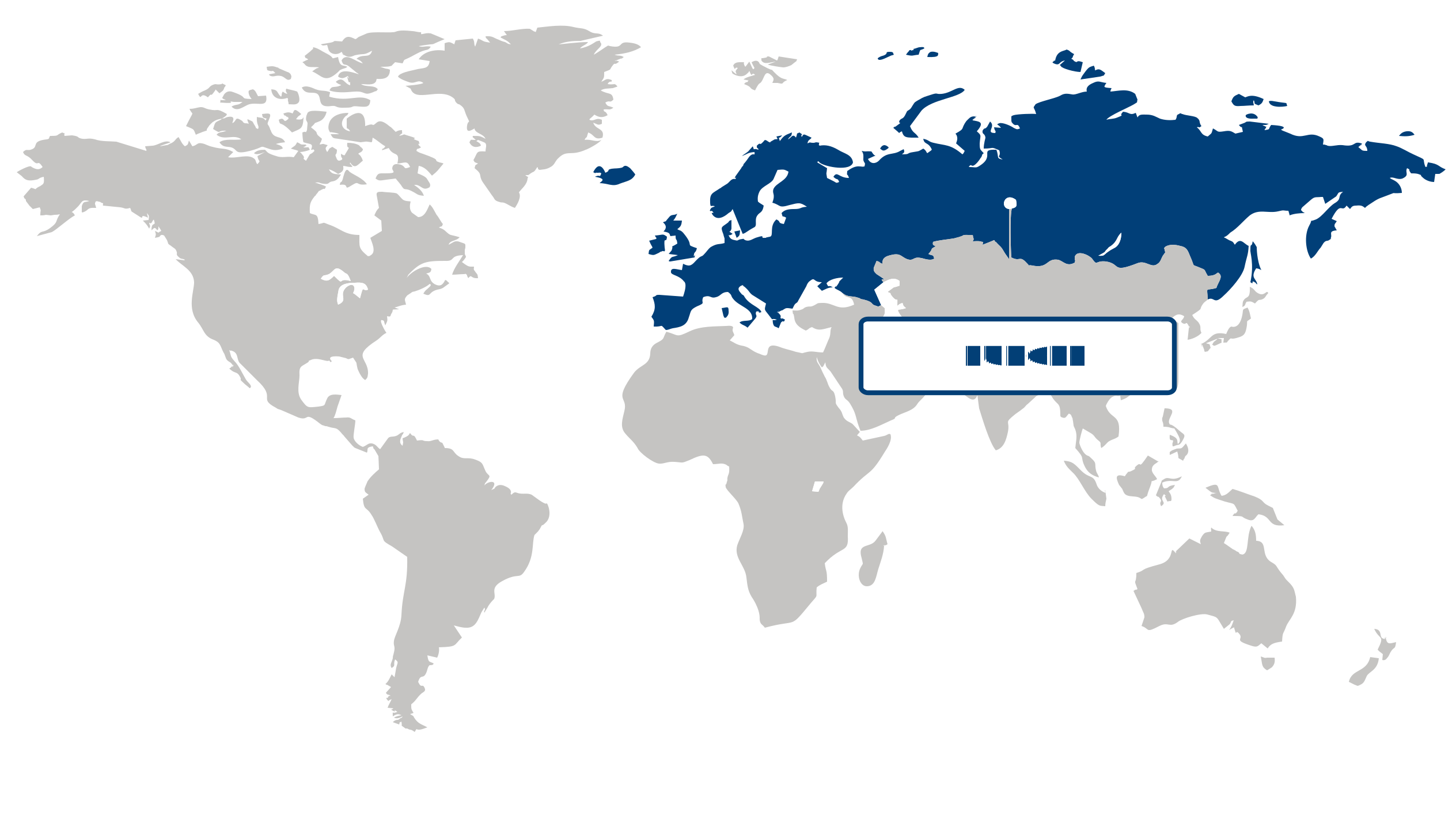
Largest Region
Europe
48.97% Market Share in 2025
Europe held a 48.97% share of the 1-decene market in 2025, bolstered by its established petrochemical value chain, reliable access to processing infrastructure, and steady downstream demand from chemical manufacturing. The region’s leadership is reinforced by the presence of integrated production and refining networks that enable efficient conversion, handling, and distribution of olefin-based intermediates, helping suppliers maintain consistent availability for industrial buyers. This operating base supports high market activity by reducing supply friction and allowing producers to serve application demand with greater predictability.
Asia Pacific is projected to expand at a 6.55% CAGR over the forecast period, with growth in the 1-decene market being propelled by rising industrial consumption and expanding chemical processing capacity across key manufacturing economies. The region’s acceleration is closely tied to increasing downstream production, where demand for intermediate chemicals grows alongside broader industrial output and capacity additions. As more local facilities scale operations and procurement shifts closer to regional supply chains, adoption strengthens through practical advantages in sourcing, production responsiveness, and volume absorption.
Key Country Insights
The U.S. 1-decene market benefits from a well-established petrochemical industry supplying feedstocks for lubricants, surfactants, and specialty chemicals. U.S. producers continue investing in efficient production technologies to support diverse downstream industrial applications.
Japan prioritizes high-purity 1-decene for advanced chemical formulations used in electronics, lubricants, and specialty manufacturing. Japanese producers continue optimizing production processes that deliver consistent performance for precision industrial applications.
South Korea utilizes 1-decene as a key intermediate for specialty chemicals and high-value industrial materials supporting manufacturing sectors. Companies in South Korea are expanding process capabilities that improve supply reliability for downstream chemical producers.
Germany emphasizes high-quality 1-decene production for specialty chemicals, synthetic lubricants, and performance materials. German manufacturers focus on consistent product quality and efficient processing to meet demanding industrial and automotive application requirements.
France supports 1-decene demand through specialty chemical manufacturing and industrial processing applications requiring dependable feedstock quality. French producers increasingly emphasize operational efficiency and sustainable manufacturing practices across chemical production facilities.
Italy applies 1-decene across lubricant, polymer, and specialty chemical manufacturing to support a diverse industrial base. Italian manufacturers seek dependable raw material supply and flexible processing capabilities for customized chemical production.
Segment Leadership and Growth Trends
Poly Alpha Olefin accounted for a 65.33% share of the 1-decene market in 2025, reflecting its established role as the principal application for 1-decene consumption. Its leadership is underpinned by the direct dependence of Poly Alpha Olefin production on 1-decene as a key feedstock, which keeps demand closely tied to core manufacturing volumes rather than more limited or niche end uses. The same structural reliance is also supporting continued growth momentum in the 1-decene market, as Poly Alpha Olefin remains the most scalable and commercially anchored outlet for the material, allowing incremental demand to concentrate in the application already backed by the strongest consumption base.
| Report Segmentation | |||
| Segment | Sub-Segment | Largest Segment | Fastest Growing Segment |
|---|---|---|---|
| Application | Poly Alpha Olefin, Polyethylene, Detergent Alcohols, Others | Poly Alpha Olefin | Poly Alpha Olefin |
 Read our Research Approach
Competitive Landscape and Market Positioning
Prominent players in the 1-decene market:1. Shell Chemicals (United Kingdom)
2. Chevron Phillips Chemical Company (United States)
3. INEOS Group Holdings S.A. (United Kingdom)
4. Qatar Chemical Company Ltd. (Qatar)
5. Sasol Limited (South Africa)
6. Exxon Mobil Corporation (United States)
7. SABIC (Saudi Arabia)
8. LyondellBasell Industries Holdings B.V. (Netherlands)
9. Idemitsu Kosan Co. Ltd. (Japan)
10. Dow Inc. (United States)
The 1-decene market is witnessing structural improvements driven by efficiency enhancements and expanded production capabilities. Market expansion efforts are supported by optimized supply chain and processing technologies. R&D investments are focused on improving yield efficiency and feedstock utilization. Strategic consolidation activities are also contributing to stronger capacity utilization and broader market access.
Why Choose Us
Specialized Expertise: Our team comprises industry experts with a deep understanding of your market segment. We bring specialized knowledge and experience that ensures our research and consulting services are tailored to your unique needs.
Customized Solutions: We understand that every client is different. That's why we offer customized research and consulting solutions designed specifically to address your challenges and capitalize on opportunities within your industry.
Proven Results: With a track record of successful projects and satisfied clients, we have demonstrated our ability to deliver tangible results. Our case studies and testimonials speak to our effectiveness in helping clients achieve their goals.
Cutting-Edge Methodologies: We leverage the latest methodologies and technologies to gather insights and drive informed decision-making. Our innovative approach ensures that you stay ahead of the curve and gain a competitive edge in your market.
Client-Centric Approach: Your satisfaction is our top priority. We prioritize open communication, responsiveness, and transparency to ensure that we not only meet but exceed your expectations at every stage of the engagement.
Continuous Innovation: We are committed to continuous improvement and staying at the forefront of our industry. Through ongoing learning, professional development, and investment in new technologies, we ensure that our services are always evolving to meet your evolving needs.
Value for Money: Our competitive pricing and flexible engagement models ensure that you get maximum value for your investment. We are committed to delivering high-quality results that help you achieve a strong return on your investment.
Select Licence Type

