3D Printing Metal Market Size & Growth Forecast 2027–2036, By Segments (Form, Application, Product), Regional Demand Trends (North America, Asia Pacific, Europe), Key Country Insights (U.S., Japan, South Korea, Germany, France, Italy), and Competitive Landscape
Market Size and Growth Outlook
3D Printing Metal Market size was worth USD 1.7 billion in 2026 and is poised to grow at a 17.67% CAGR between 2027 and 2036, attaining USD 8.65 billion by 2036. The industry revenue for 2027 is assessed at USD 1.95 billion.
Get more details on this report
Request Free Sample Report3D Printing Metal Market Intelligence Snapshot
Regional Market Dynamics
- Europe leads with 40.81% share due to advanced manufacturing base, strong aerospace and automotive adoption, mature supplier networks, and established production-scale additive manufacturing and material qualification capabilities.
- Asia Pacific grows at 19.26% CAGR driven by rapid industrial adoption, rising manufacturing investment, localized flexible production strategies, and shift from pilot projects to full-scale complex component manufacturing.
Segment Momentum
- Aerospace & Defense leads with a 45.9% share due to strong demand for precision, durability, and performance-critical metal parts where additive manufacturing delivers clear operational and production efficiency advantages.
- Filament is the fastest-growing form as users adopt lower-barrier metal printing solutions, enabling easier deployment and broader usability without the complex handling requirements associated with powder-based workflows.
Market Expansion Drivers
- Advancements in metal 3D printing technologies improving production speed and component performance.
- Growing integration of digital manufacturing workflows accelerating industrial additive manufacturing adoption.
- Rising demand for sustainable low-waste production driving adoption of recyclable metal powder technologies.
Leading Market Participants
- Prominent companies in the 3D printing metal market include Sandvik AB (Sweden), Höganäs AB (Sweden), Oerlikon Metco AG (Switzerland), GKN Powder Metallurgy (United Kingdom), ATI Inc. (United States), Colibrium Additive (United States), Kennametal Inc. (United States), Rio Tinto Metal Powders (Canada), Indo-MIM Pvt. Ltd. (India), Carpenter Technology Corporation (United States).
Global Market Forecast Snapshot
Market Outlook
- 2026 Market Size: USD 1.7 billion
- 2027 Estimated Market Size: USD 1.95 billion.
- Projected Market Size: USD 8.65 billion by 2036
- Growth Forecast: 17.67% CAGR (2027-2036)
Regional and Segment Outlook
- Leading Regional Market: Europe
- High-Growth Regional Hub: Asia Pacific
- Core Revenue Segment: Powder (Form) | Aerospace & Defense (Application) | Titanium (Product)
- Emerging Opportunity Segment: Filament (Form) | Medical & Dental (Application) | Stainless Steel (Product)
Market Growth Drivers and Industry Trends
Advancements in metal 3D printing technologies improving production speed and component performance
Technological advancements in metal additive manufacturing are supporting 3D printing metal market growth by improving the efficiency, precision, and functional performance of printed components. Developments in printing processes, material handling, process control, and equipment capabilities are enabling manufacturers to produce increasingly complex metal parts with improved consistency and application-specific characteristics. These improvements are expanding the suitability of metal additive manufacturing beyond prototyping toward functional components and production applications where geometric flexibility, customization, and performance requirements make conventional manufacturing approaches less advantageous.
Growing integration of digital manufacturing workflows accelerating industrial additive manufacturing adoption
Greater integration of computer-aided design, simulation, production planning, and automated manufacturing systems is contributing to 3D printing metal market growth by creating more connected additive production workflows. Digital manufacturing enables manufacturers to move more efficiently from component design to process preparation and production while supporting rapid design modifications and complex geometries that are difficult to manufacture using traditional methods. The ability to integrate digital files, process monitoring, and production data also improves coordination across engineering and manufacturing activities, encouraging wider use of metal additive manufacturing in industrial production environments.
Rising demand for sustainable low-waste production driving adoption of recyclable metal powder technologies
Growing pressure to improve material efficiency is boosting 3D printing metal market demand as manufacturers seek production methods that generate less waste and make more effective use of high-value metal materials. Metal additive manufacturing can support near-net-shape production, reducing the need for extensive material removal associated with certain conventional machining processes. At the same time, recyclable metal powder technologies provide opportunities to recover and reuse suitable material within controlled production systems, aligning additive manufacturing practices with broader industrial efforts to improve resource utilization and reduce material losses.
| Growth Driver | Impact on CAGR | Regulatory Influence | Geographic Relevance | Adoption Rate | Impact Timeline |
|---|---|---|---|---|---|
| Advancements in metal 3D printing technologies improving production speed and component performance | 2.00% | Moderate | Europe, North America | High | Near Term |
| Growing integration of digital manufacturing workflows accelerating industrial additive manufacturing adoption | 1.80% | Moderate | Europe, Asia Pacific | High | Mid Term |
| Rising demand for sustainable low-waste production driving adoption of recyclable metal powder technologies | 1.50% | Moderate | North America, Europe | Medium | Mid Term |
Unlock insights tailored to your business with our bespoke market research solutions.
Click to get your customized report now.
Regional Demand Dynamics
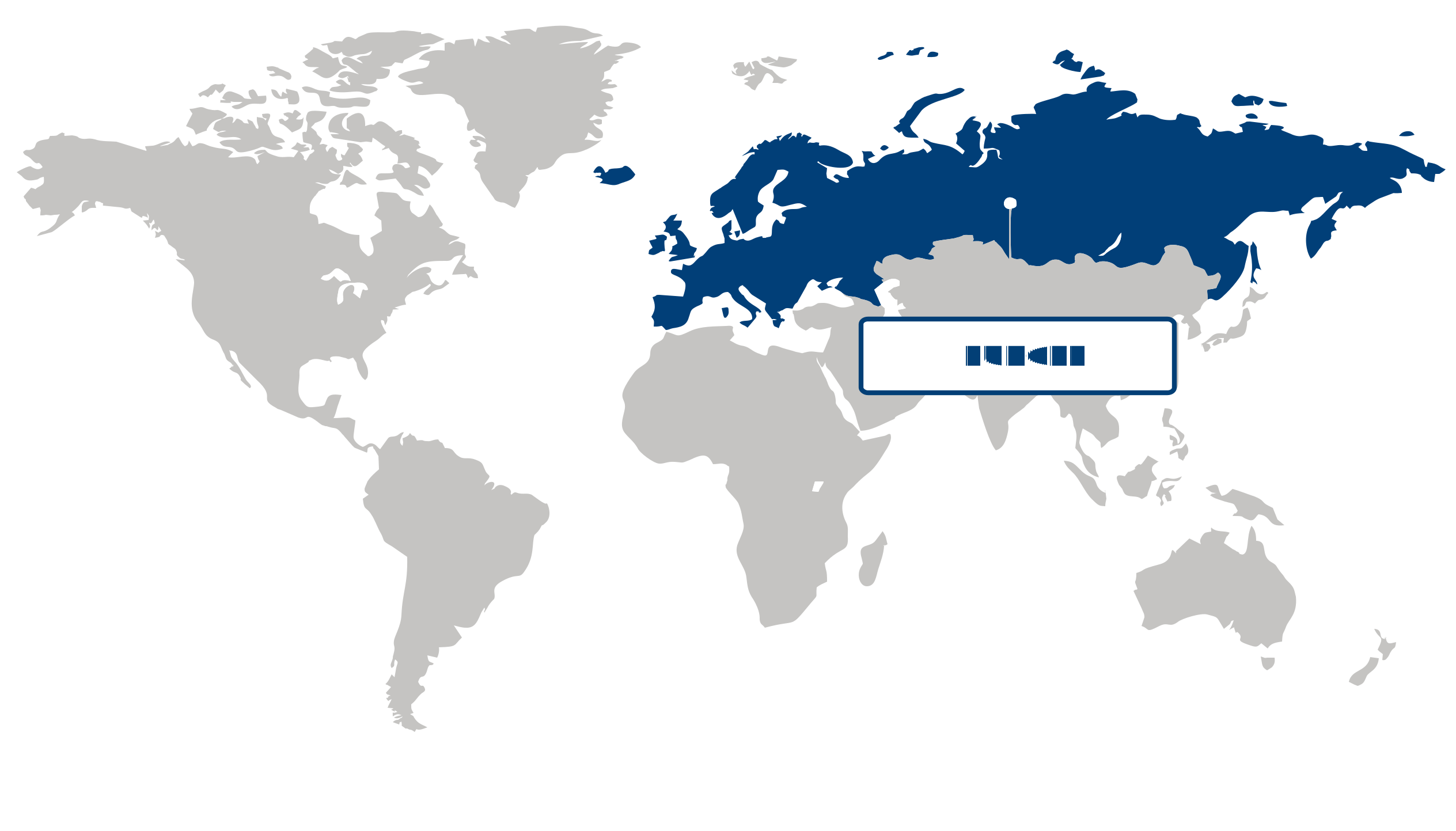
Europe (Largest Region)
In the 3D printing metal market, Europe held the largest regional share of 40.81% in 2026, reflecting the region’s established advanced manufacturing ecosystem and strong integration of additive technologies into industrial production. Adoption is being supported by demand for lightweight and complex metal components across aerospace, automotive, healthcare, and engineering applications, where additive manufacturing can improve design flexibility and material utilization. Continued emphasis on manufacturing modernization, engineering innovation, and high-performance production processes is reinforcing the region’s position in metal additive manufacturing.
Asia Pacific (Fastest-Growing Region)
Asia Pacific is the fastest-growing region, supported by expanding industrial manufacturing capacity, increasing adoption of advanced production technologies, and rising demand for customized metal components. The development of aerospace, automotive, electronics, and medical manufacturing ecosystems is creating broader opportunities for metal 3D printing across prototyping and production applications. Greater investment in additive manufacturing capabilities and the push toward digitally enabled, flexible production are also accelerating regional adoption and expanding the commercial potential of metal-based additive processes.
| Parameter | North America | Asia Pacific | Europe | Latin America | MEA |
|---|---|---|---|---|---|
| Innovation Hub i Scale Nascent Developing Advanced | |||||
| Cost-Sensitive Region i Scale Low Medium High | |||||
| Regulatory Environment i Scale Restrictive Neutral Supportive | |||||
| Demand Drivers i Scale Weak Moderate Strong | |||||
| Development Stage i Scale Emerging Developing Developed | |||||
| Adoption Rate i Scale Low Medium High | |||||
| New Entrants / Startups i Scale Sparse Moderate Dense | |||||
| Macro Indicators i Scale Weak Stable Strong |
Key Country Insights
Germany 🇩🇪
Industrial Manufacturing ApplicationsGermany integrates metal 3D printing into precision engineering and automotive manufacturing to improve production flexibility. German manufacturers emphasize certified materials, process optimization, and digital production strategies that enhance component performance and manufacturing efficiency.
France 🇫🇷
Aerospace Materials FocusFrance leverages metal 3D printing to produce lightweight and high-performance components for aerospace and industrial engineering. French manufacturers prioritize validated production methods and material innovation that support demanding technical specifications and certification requirements.
Italy 🇮🇹
Engineering Design FlexibilityItaly applies metal 3D printing to industrial equipment, automotive components, and customized engineering applications. Businesses increasingly invest in additive manufacturing to simplify complex part production while improving responsiveness to specialized customer requirements.
Japan 🇯🇵
Precision Component FabricationJapan expands metal additive manufacturing for high-value industrial, medical, and electronics applications requiring complex geometries. The country's priorities include consistent product quality, advanced powder technologies, and manufacturing processes that reduce design constraints.
South Korea 🇰🇷
High-Tech Manufacturing SupportSouth Korea incorporates metal 3D printing into semiconductor equipment, aerospace, and advanced manufacturing supply chains. The market emphasizes production flexibility and rapid design iteration while strengthening localized manufacturing capabilities for specialized metal components.
United States 🇺🇸
Advanced Production AdoptionThe U.S. 3D printing metal market benefits from increasing use of additive manufacturing for aerospace, healthcare, and industrial production. Companies prioritize qualified materials, process repeatability, and scalable manufacturing workflows that support both prototyping and end-use component production.
Segment Leadership and Growth Trends
3D Printing Metal Market Share (%), by Form, 2026
Go beyond the chart, access full insights & data tables
Request Free Sample ReportForm Segment Analysis: Powder (Largest Segment) vs Filament (Fastest-Growing Segment)
The powder segment dominated the 3D printing metal market with an 89.3% share in 2026. Metal powders are extensively used in major additive manufacturing processes because they enable the production of complex geometries and high-performance components with precise material deposition. Strong adoption across aerospace, defense, medical, automotive, and industrial manufacturing is supporting demand, particularly for applications requiring lightweight designs and complex component structures. Continued technological development in metal additive manufacturing is expected to reinforce the powder segment's leading position.
The filament segment is expected to be the fastest-growing segment as manufacturers seek more accessible and flexible approaches to metal additive manufacturing. Metal-filled filaments can support production workflows that use extrusion-based technologies, potentially expanding the range of organizations able to adopt metal 3D printing. Growing interest in cost-effective additive manufacturing solutions and broader use for prototyping and specialized production are expected to support segment growth.
Application Segment Analysis: Aerospace & Defense (Largest Segment) vs Medical & Dental (Fastest-Growing Segment)
Holding the largest share of the 3D printing metal market, the aerospace & defense segment accounted for 45.9% in 2026. The segment is supported by the need for lightweight, high-strength, and geometrically complex components that can enhance system performance while reducing material waste. Metal additive manufacturing enables the production of specialized parts with optimized designs that can be difficult to manufacture through conventional processes. Increasing investment in advanced manufacturing technologies continues to strengthen adoption across aerospace and defense applications.
The medical & dental segment is anticipated to be the fastest-growing segment due to the growing use of metal additive manufacturing for customized implants, prosthetics, dental components, and other patient-specific applications. The technology's ability to produce complex and individualized designs supports the increasing shift toward personalized healthcare solutions. Advancements in digital treatment planning and medical manufacturing workflows are expected to further accelerate demand.
| Segment | Sub-Segment | Largest Segment | Fastest Growing |
|---|---|---|---|
| Form | Powder, Filament | Powder | Filament |
| Application | Aerospace & Defense, Automotive, Medical & Dental, Others | Aerospace & Defense | Medical & Dental |
| Product | Titanium, Nickel, Stainless Steel, Aluminum, Others | Titanium | Stainless Steel |
Competitive Landscape and Market Positioning
Prominent players in the 3D printing metal market:
1. Sandvik AB (Sweden)
2. Höganäs AB (Sweden)
3. Oerlikon Metco AG (Switzerland)
4. GKN Powder Metallurgy (United Kingdom)
5. ATI Inc. (United States)
6. Colibrium Additive (United States)
7. Kennametal Inc. (United States)
8. Rio Tinto Metal Powders (Canada)
9. Indo-MIM Pvt. Ltd. (India)
10. Carpenter Technology Corporation (United States)
Rising demand for lightweight and customized components is driving continuous advancements in the 3D printing metal market. Market participants are expanding production capabilities and investing heavily in material innovation to improve printing precision, durability, and application flexibility. The increasing use of additive manufacturing in aerospace, healthcare, and automotive industries is also encouraging geographic expansion strategies and the commercialization of next-generation metal printing technologies.
| Company | Market Share | Company Revenue | Revenue CAGR (%) | Product Portfolio | Geographic Presence | Innovation / R&D Focus | Strategic Developments |
|---|---|---|---|---|---|---|---|
| Sandvik AB (Sweden) | |||||||
| Höganäs AB (Sweden) | |||||||
| Oerlikon Metco AG (Switzerland) | |||||||
| GKN Powder Metallurgy (United Kingdom) | |||||||
| ATI Inc. (United States) | |||||||
| Colibrium Additive (United States) | |||||||
| Kennametal Inc. (United States) | |||||||
| Rio Tinto Metal Powders (Canada) | |||||||
| Indo-MIM Pvt. Ltd. (India) | |||||||
| Carpenter Technology Corporation (United States). |
Industry Development/News
| Company Name | Date | Key Development |
|---|---|---|
| Portsmouth Naval Shipyard | Apr-26 | Portsmouth Naval Shipyard successfully integrated the first 3D-printed metal submarine component into the USS Washington during maintenance. This development signals a critical advancement in the adoption of additive manufacturing for complex defense logistics, demonstrating the feasibility of using 3D printing to improve lifecycle management and repair efficiency for naval systems. |
| Intech Additive | Jan-26 | Intech Additive launched India’s first 8-laser metal additive manufacturing system designed for high-throughput serial production. This system marks a significant technical shift toward multi-laser architectures, enhancing scalability and cost-efficiency for industrial users transitioning from prototyping to full-scale metal component manufacturing. |
| CVMR Corporation | Apr-25 | CVMR Corporation initiated the development of a nickel refinery in Albania, designed to be environmentally neutral and support significant ferro-nickel production. By integrating mineral processing with industrial infrastructure, the project strengthens the regional supply chain for raw materials essential to the metal additive manufacturing sector. |
| Bosch | Mar-25 | Bosch invested $6 million in metal 3D printing initiatives, targeting improved precision, energy efficiency, and production speed. This strategic commitment focuses on scaling additive manufacturing capabilities for industrial applications, supporting the advancement of complex component production and broader manufacturing process optimization within their industrial footprint. |
| Intech Additive | Jan-25 | Intech Additive deployed an advanced multi-laser metal 3D printing system aimed at optimizing production efficiency and reducing the cost-per-part ratio. The technology is positioned to accelerate the adoption of serial additive manufacturing, providing industrial operators with increased throughput capabilities for engineering and manufacturing applications. |
| 3D Monotech | Nov-24 | 3D Monotech launched the Markforged FX10 system in India, representing a notable integration of metal and advanced composite 3D printing capabilities. The deployment of this technology broadens the reach of high-performance manufacturing solutions in the region, facilitating the production of industrial-grade components through hybrid additive materials. |
| Eplus3D | Jan-24 | Eplus3D introduced the EP-M2050, a large-format Laser Beam Powder Bed Fusion 3D printer featuring a scalable architecture of up to 64 lasers. This technology addresses demand for high-volume metal additive manufacturing, providing the industrial capacity and precision required for large-scale, complex part production in high-performance sectors. |
Customize Your Report
Explore examples of how this report can be tailored to different research needs, including custom segments, additional topics or chapters, and related reports. Click a section of the wheel or its numbered marker to explore the available options.
3D Printing Metal Market — Custom Segments
| Segment | Sub-Segment |
|---|---|
| Manufacturing Process | Powder Bed Fusion, Directed Energy Deposition, Binder Jetting, Material Extrusion, Cold Spray |
| Part Function | Structural Components, Functional Prototypes, Tooling & Fixtures, Heat Exchangers, Lightweight Components |
| End-User Type | Original Equipment Manufacturers, Contract Manufacturers, Research Institutions, Service Bureaus |
3D Printing Metal Market — Custom TOC
| Custom Chapter | Custom Details |
|---|---|
| Additive Manufacturing Adoption Roadmap by Industry |
|
| Qualification and Certification Landscape |
|
| Recycling and Powder Circularity Outlook |
|
Need a different cut of the data?
Request Custom ResearchWhat is the market valuation of 3D printing metal?
What is the forecasted size of the 3D printing metal industry?
How are advancements in metal 3D printing technologies reshaping production economics and end-use adoption across industries?
How are digital workflows and sustainability priorities influencing industrial adoption in the metal 3D printing market?
Why does Aerospace & Defense dominate the 3D printing metal market?
How is Filament gaining traction in the market?
Why does Europe dominate the 3D printing metal market?
What is driving rapid growth of metal 3D printing in Asia Pacific?
Which companies dominate the 3D printing metal landscape?
Our Clients
"The team at Fundamental Business Insights & Consulting demonstrated a commitment to excellence, not only in the quality of the report but also in their client-centric approach."
FANUC
"The level of detail in the market segmentation provided were particularly noteworthy. The detailed country-level insights were also very helpful."
B&R Industrial Automation GmbH
"The consultant took the time to understand our specific business objectives, ensuring that the reports were tailored to address our unique challenges and opportunities."
KUKA SE & Co. KGaA
Our Research Team & Methodology
Every Fundamental Business Insights report is built by a dedicated vertical research team, validated through a structured primary-and-secondary methodology, and reviewed for accuracy before it reaches you.
Research Team Overview
Prepared by the Industrial Automation & Equipment Research Team
Delivery
Published
Demand
Available
Support
Trust & Compliance
Research Domains
10 coverage areasResearch Intelligence
| Source | Reference |
|---|---|
| International Society of Automation (ISA) | www.isa.org |
| International Organization for Standardization (ISO) | www.iso.org |
| National Institute of Standards and Technology (NIST) | www.nist.gov |
| IEEE | www.ieee.org |
| VDMA (German Mechanical Engineering Industry Association) | www.vdma.org |
| Association for Advancing Automation (A3) | www.automate.org |
| International Federation of Robotics (IFR) | ifr.org |
| ASME (American Society of Mechanical Engineers) | www.asme.org |
| ASHRAE | www.ashrae.org |
| American Society of Heating, Refrigerating and Air-Conditioning Engineers (ASHRAE) | www.ashrae.org |
| Material Handling Industry (MHI) | www.mhi.org |
| OSHA (Occupational Safety and Health Administration) | www.osha.gov |
| National Fire Protection Association (NFPA) | www.nfpa.org |
| ASTM International | www.astm.org |
| International Electrotechnical Commission (IEC) | www.iec.ch |
| Open Process Automation Forum (The Open Group) | www.opengroup.org/open-process-automation-forum |
| AGMA (American Gear Manufacturers Association) | www.agma.org |
| Association of Equipment Manufacturers (AEM) | www.aem.org |
| Food and Agriculture Organization (FAO) | www.fao.org |
| International Labour Organization (ILO) | www.ilo.org |
Research Workflow & Quality Assurance
Data Collection
Verified information gathered through primary and secondary research.
Data Triangulation
Cross-validation using multiple independent data sources.
Forecast Modelling
Market estimates developed using historical trends and analytical models.
Analyst Validation
Findings reviewed by domain experts for accuracy and consistency.
Editorial & Quality Review
Final editorial, quality, and compliance checks before publication.
Final Publication
Released after successful completion of the internal review process.
Report Coverage
📊 Market Assessment
- Market Size & Forecast
- Market Segmentation
- Regional Analysis
- Growth Drivers & Challenges
- Market Dynamics
🏢 Competitive Intelligence
- Competitive Landscape
- Company Profiles
- Competitive Benchmarking
- Mergers & Acquisitions
- Market Share Analysis or Key Company Strategies
🔍 Strategic Analysis
- Value Chain Analysis
- Porter's Five Forces
- PESTLE Analysis
- Pricing Trends
- Supply-Demand Analysis
🚀 Future Outlook
- Technology Landscape
- Regulatory Landscape
- Investment & Funding Landscape
- Emerging Opportunities
- Future Market Outlook
Have a question about this report or need a custom scope?
Request Customization