3D Snapshot Sensor Market Size & Forecasts 2026-2035, By Segments (Type, Application), Growth Opportunities, Innovation Landscape, Regulatory Shifts, Strategic Regional Insights (U.S., Japan, China, South Korea, UK, Germany, France), and Competitive Dynamics (Texas Instruments, Sony, STMicroelectronics, Himax Technologies, Lumentum)
Market Size and Growth Outlook
3D Snapshot Sensor Market size is estimated to increase from USD 1.12 billion in 2025 to USD 6.99 billion by 2035, supported by a CAGR exceeding 20.1% during 2026-2035. In 2026, revenues are forecast to reach USD 1.33 billion.
Get more details on this report
Request Free Sample Report3D Snapshot Sensor Market Intelligence Snapshot
Regional Market Dynamics
Segment Momentum
Market Expansion Drivers
Leading Market Participants
Global Market Forecast Snapshot
Market Outlook
Regional and Segment Outlook
Market Growth Drivers and Industry Trends
The growing reliance on robotics across manufacturing and service sectors is driving demand for 3D snapshot sensors, vital for enhancing machine perception and precision. Leading robotics firms like Boston Dynamics and FANUC have integrated advanced 3D sensors to improve spatial awareness and manipulation capabilities. This trend reflects evolving consumer and industrial expectations for automation that combines speed with accuracy. As companies seek to optimize production workflows and reduce labor costs, the 3D snapshot sensor market benefits from intensified R&D investments and innovation diversity. New entrants can capitalize on niche applications in service robotics, while incumbents must focus on sensor miniaturization and energy efficiency. The increasing complexity of automated tasks ensures sustained relevance for 3D snapshot technology as part of next-generation robotics systems.
Expansion of Advanced Machine Vision in Logistics and Warehousing
The logistics industry is rapidly digitizing, with companies like DHL and FedEx deploying sophisticated machine vision systems incorporating 3D snapshot sensors to automate sorting, handling, and inventory management. This shift responds directly to e-commerce growth and consumer demand for faster, error-free deliveries, prompting investments in sensor-driven automation solutions. Improved accuracy in real-time object recognition and spatial mapping enhances operational efficiency, positioning the 3D snapshot sensor market as critical infrastructure. Market players have opportunities to develop tailored sensor modules addressing harsh warehouse environments and integration with AI analytics. These ongoing deployments highlight the need for scalable, interoperable 3D sensing technologies that will continue to reshape warehouse operations and spur innovation across the supply chain.
Long-Term Integration in Autonomous Systems and Smart Factories
Autonomous vehicles and smart factories represent a pivotal arena for 3D snapshot sensors, with companies like Bosch and Siemens embedding these sensors to facilitate seamless environmental interaction and predictive maintenance capabilities. This adoption aligns with broader economic shifts toward Industry 4.0, where connectivity and digital twins depend on precise, real-time 3D data. Regulatory frameworks promoting workplace safety and emissions reductions further catalyze smart factory deployments incorporating 3D sensing. For market participants, opportunities exist in developing robust, low-latency sensors tailored for complex autonomous navigation and industrial process controls. Observed global initiatives in sustainable manufacturing and urban mobility underscore the 3D snapshot sensor market’s strategic role in enabling integrated, intelligent systems across multiple sectors.
Industry Restraints:
High Component Manufacturing Costs
The expense of producing high-precision optical components integral to 3D snapshot sensors significantly limits market expansion. Fabrication challenges related to sophisticated photodiodes and micro-lens arrays increase production costs, as noted in the 2023 technical whitepaper by STMicroelectronics. These elevated costs deter widespread adoption, particularly in consumer electronics, where price sensitivity is paramount. Both market incumbents and startups face margin pressures, complicating efforts to scale volume while maintaining affordable pricing. Furthermore, the need for cutting-edge cleanroom facilities and specialized manufacturing expertise restricts new entrants. Moving forward, cost reductions via process innovations and economies of scale, while possible, are expected to be gradual, sustaining this barrier for the near term and maintaining competitive differentiation around manufacturing capabilities.
Limited Standardization in Data Integration
Fragmentation in data output formats and integration protocols undermines the seamless deployment of 3D snapshot sensors across end-use applications, impeding interoperability. The International Electrotechnical Commission (IEC) has yet to finalize comprehensive standards governing these sensors’ data interfaces, according to the IEC’s 2023 policy update. This absence generates operational inefficiencies, discouraging system integrators from adopting 3D snapshot technology amid concerns over integration complexity and increased downstream development costs. For established players, this raises the cost of customization; new entrants face elevated barriers to compatibility assurance. Industry alliances and consortia are actively pursuing standardization efforts, but until effective harmonization materializes, this fragmentation will restrain broader ecosystem development and slow market maturation.
| Growth Driver | Impact on CAGR | Regulatory Influence | Geographic Relevance | Adoption Rate | Impact Timeline |
|---|---|---|---|---|---|
| Rapid adoption of 3D vision sensors in robotics and automation | 3.90% | Short term (≤ 2 yrs) | Asia Pacific, Europe (spillover: North America) | Low | Fast |
| Growth of advanced machine vision in logistics and warehousing | 3.40% | Medium term (2–5 yrs) | North America, Europe (spillover: Asia Pacific) | Low | Moderate |
| Long-term integration in autonomous systems and smart factories | 2.50% | Long term (5+ yrs) | Asia Pacific (spillover: MEA) | Medium | Slow |
Unlock insights tailored to your business with our bespoke market research solutions.
Click to get your customized report now.
Regional Demand Dynamics
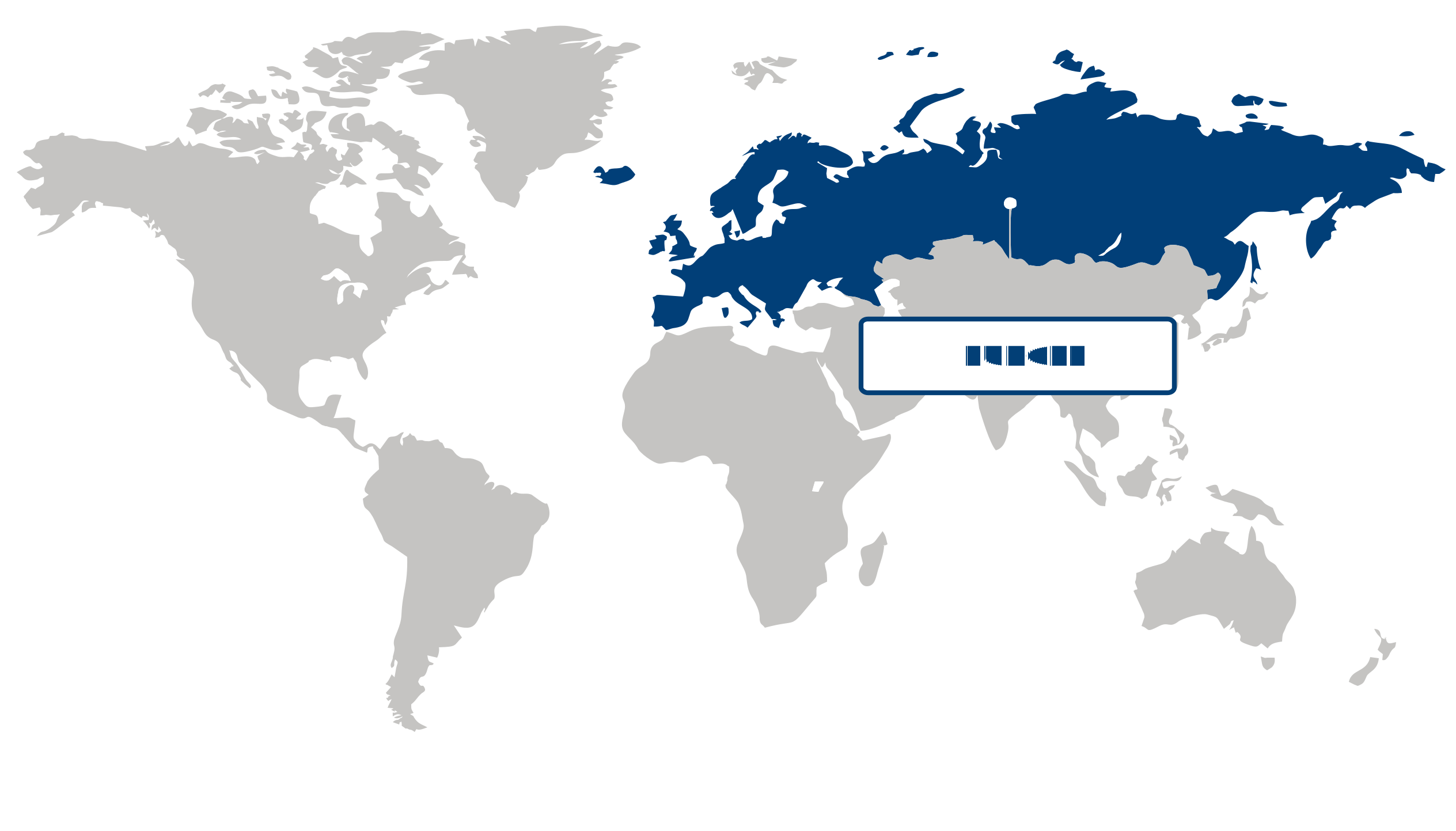
Europe captured over 34% of the global 3D snapshot sensor market share in 2025, establishing itself as the largest regional player driven primarily by its strong automotive and consumer electronics sectors. The region benefits from a robust industrial ecosystem where German and French manufacturers lead innovation in advanced driver-assistance systems (ADAS) and immersive consumer devices. Regulatory emphasis on vehicle safety and emissions, evidenced by initiatives from the European Commission, further accelerates adoption of 3D sensing technologies. Additionally, Europe's commitment to sustainability and digital transformation fosters investments in smart manufacturing and IoT integration, creating a competitive edge. For instance, Bosch's recent announcement of integrated 3D snapshot sensors for automotive applications underscores the region's innovation momentum. These dynamics ensure Europe remains a fertile ground for growth and technological advancement in the 3D snapshot sensor market.
Germany anchors the European 3D snapshot sensor market, leveraging its automotive industry's global leadership, particularly with companies like Volkswagen and BMW intensifying deployment of sensors in autonomous and semi-autonomous vehicles. Strong collaboration between industry and research institutes, such as Fraunhofer, drives continuous improvements in sensor accuracy and cost efficiency. Germany's progressive regulatory environment, reflected in the Federal Ministry for Digital and Transport's support of intelligent mobility projects, paves a favorable path for accelerated sensor adoption. This strategic focus secures Germany’s pivotal role in reinforcing Europe’s dominance in the 3D snapshot sensor market.
France plays a critical role in Europe's 3D snapshot sensor market, primarily powered by its consumer electronics sector and burgeoning smart home applications. Major French players like STMicroelectronics contribute advanced sensor solutions, while national programs encouraging digital innovation, such as La French Tech, promote startups focused on 3D imaging technologies. The country's proactive data protection rules also stimulate development of privacy-conscious sensor designs, appealing to privacy-sensitive European consumers. As a result, France complements the broader regional growth by expanding use cases beyond automotive, thereby enriching Europe's leadership in the 3D snapshot sensor market.
Asia Pacific Market Analysis:
Asia Pacific emerged as the fastest-growing region in the 3D snapshot sensor market, registering a robust CAGR of 24.12%. This rapid growth is driven primarily by accelerated industrialization and surging consumer demand across diverse sectors such as automotive, electronics, and healthcare. The region’s expansive manufacturing base, particularly in electronics and smart devices, is fostering increased integration of advanced sensing technologies. Efforts by governments, such as Japan’s Ministry of Economy, Trade and Industry (METI) promoting Industry 4.0 initiatives, and China’s Made in China 2025 strategy, have further catalyzed technology adoption, enhancing production capabilities and operational efficiencies. Moreover, rising disposable incomes and shifting consumer preferences towards smart and connected devices underline sustained demand growth. These factors, combined with strategic investments in research and innovation hubs in countries like South Korea, position Asia Pacific as a dynamic market for 3D snapshot sensors, offering promising opportunities for suppliers and investors focused on cutting-edge imaging solutions.
Japan holds a pivotal role in the Asia Pacific 3D snapshot sensor market, leveraging its advanced technological infrastructure and innovation-driven industrial sectors. The country’s emphasis on robotics and automation in manufacturing, supported by government policies such as the New Robot Strategy by the Ministry of Economy, Trade and Industry (METI), has stimulated aggressive adoption of 3D sensing technologies. Japanese consumers’ preference for precision and quality in electronics and healthcare devices fuels demand for sophisticated sensors capable of enhanced real-time imaging and depth perception. Corporate players like Sony Corporation have been at the forefront, unveiling next-generation 3D sensors tailored for smartphones and automotive applications, as detailed in Sony’s 2023 press releases. This sustained innovation pipeline solidifies Japan’s leadership within the region and ensures robust technology diffusion, reinforcing Asia Pacific’s overall market momentum.
China significantly amplifies Asia Pacific’s position in the 3D snapshot sensor market by capitalizing on its expansive consumer base and large-scale industrial manufacturing. The country’s rapid urbanization and growing middle class are driving heightened consumption of smart devices embedded with advanced sensors, aligning with rising consumer expectations for immersive and interactive user experiences. Government-backed initiatives such as the National New Generation Artificial Intelligence Open Innovation Platform have expedited technological advancements and ecosystem development for sensing technologies. Leading Chinese firms like Huawei and Xiaomi continue to integrate 3D snapshot sensors into flagship products, as highlighted in their 2024 investor briefings. This dynamic ecosystem, coupled with efficient manufacturing supply chains, not only propels domestic market growth but also enables China to serve as a key export hub, amplifying the Asia Pacific market’s significance on a global scale.
North America Market Trends:
North America held a substantial share in the 3D snapshot sensor market, driven by its advanced technological infrastructure and strong emphasis on innovation in imaging solutions. The region benefits from a confluence of high consumer demand for augmented reality, automotive safety systems, and industrial automation applications that rely heavily on 3D sensing. Additionally, regulatory frameworks advocating for enhanced vehicle safety standards, spearheaded by the U.S. National Highway Traffic Safety Administration (NHTSA), have spurred adoption of advanced sensing technologies. The presence of leading semiconductor manufacturers and startups in Silicon Valley accelerates product development, while sustainability initiatives encourage energy-efficient sensor designs. These factors collectively position North America as a pivotal market with robust ecosystem support, ensuring attractive opportunities for market participants aiming to capitalize on next-generation sensing capabilities and evolving application landscapes.
The U.S. serves as the cornerstone of North America’s 3D snapshot sensor market, leveraging its leadership in consumer electronics and automotive industries. The country's comprehensive innovation ecosystem, supported by institutions such as the Advanced Research Projects Agency-Energy (ARPA-E), drives advancements in sensor miniaturization and real-time processing capabilities. Strong consumer preference for smart home devices and immersive gaming experiences fuels demand for high-resolution 3D sensors, as evidenced by product launches from companies like Apple and Google. Furthermore, federal incentives for autonomous vehicle research reinforce competitive dynamics among manufacturers. Strategically, the U.S. market’s integration of cutting-edge R&D and favorable regulatory conditions underlines its critical role in anchoring North American growth and shaping global technological standards in the 3D snapshot sensor market.
| Parameter | North America | Asia Pacific | Europe | Latin America | MEA |
|---|---|---|---|---|---|
| Innovation Hub i Scale Nascent Developing Advanced | |||||
| Cost-Sensitive Region i Scale Low Medium High | |||||
| Regulatory Environment i Scale Restrictive Neutral Supportive | |||||
| Demand Drivers i Scale Weak Moderate Strong | |||||
| Development Stage i Scale Emerging Developing Developed | |||||
| Adoption Rate i Scale Low Medium High | |||||
| New Entrants / Startups i Scale Sparse Moderate Dense | |||||
| Macro Indicators i Scale Weak Stable Strong |
Segment Leadership and Growth Trends
3D Snapshot Sensor Market Share (%), by Type, 2026
Go beyond the chart, access full insights & data tables
Request Free Sample ReportThe Time-of-flight (ToF) Camera segment held the largest share in the 3D snapshot sensor market in 2025, driven strongly by its high accuracy depth sensing capabilities in industrial and robotic applications. This precision meets the growing demand for advanced automation and real-time spatial analysis in sectors such as manufacturing and logistics. Leading companies like Sony and Infineon have showcased significant product innovations, reinforcing supply chain resilience and technological advancement. The segment benefits from increasing customer emphasis on operational efficiency and error minimization, supported by regulatory standards promoting automation safety and reliability. This positioning offers established players and new entrants opportunities to develop specialized sensors tailored to evolving industrial needs. Continued advancements in sensor miniaturization and integration with AI systems indicate that ToF cameras will remain central to 3D snapshot sensor market growth in the near to medium term.
Analysis by Application
The Robotic Application segment represented the largest share in the 3D snapshot sensor market, fueled by the rapid adoption of automation and smart robotics solutions across industries. This segment leads due to the rising integration of 3D snapshot sensors in robotic systems enhancing navigation, object recognition, and precision tasks. Policymakers such as the European Commission have recently emphasized robotics innovation in industrial modernization plans, further propelling demand. Consumer inclination toward automated services and workplace digital transformation also supports this trend. Industry frontrunners like ABB and FANUC continue to invest heavily in sensor-enabled robotic platforms, enabling competitive differentiation. Strategic advantages include the ability to serve diverse verticals from healthcare to automotive manufacturing, positioning this segment for sustained relevance as robotics evolve with increasing AI-driven functionalities.
| Segment | Sub-Segment | Largest Segment | Fastest Growing |
|---|---|---|---|
| Type | Stereoscopic Camera, Time-of-flight (ToF) Camera | ||
| Application | Quality Inspection, Robotic Application |
Competitive Landscape and Market Positioning
The competitive landscape is characterized by a dynamic interplay of strategic expansions and innovation accelerations among the top players. Partnerships aligning sensor technology with AI and machine vision continue to redefine product capabilities, as seen in collaborations between semiconductor specialists and imaging experts. New sensor architectures and enhanced integration techniques introduced by companies like Himax Technologies and Lumentum emphasize precision and energy efficiency, elevating market competitiveness. Acquisitions and cross-sector alliances enable firms such as ON Semiconductor and ams OSRAM to diversify product offerings and deepen supply chain resilience. This concerted emphasis on research investment and collaborative growth fosters accelerated market responsiveness and continuous evolution of 3D snapshot sensor applications.
Strategic / Actionable Recommendations for Regional Players
North American players should focus on expanding alliances that merge 3D snapshot sensors with AI-driven analytics, tapping into the region’s leadership in both semiconductor manufacturing and artificial intelligence development. Emphasizing high-precision industrial and autonomous vehicle segments can drive differentiated innovation.
In the Asia Pacific, leveraging cutting-edge manufacturing capabilities alongside collaborations with consumer electronics giants is critical. Embracing emerging sensor modalities and supporting local ecosystem development will help capture expansive user bases and enhance market share.
European firms could capitalize on their strengths in automotive and industrial automation by fostering partnerships that integrate 3D sensing with robust safety and environmental standards. Prioritizing sustainable sensor solutions and advancing embedded system integration positions regional stakeholders for sustained growth.
| Company | Market Share | Company Revenue | Revenue CAGR (%) | Product Portfolio | Geographic Presence | Innovation / R&D Focus | Strategic Developments |
|---|---|---|---|---|---|---|---|
| No companies available. | |||||||
Industry Development/News
| Company Name | Date | Key Development |
|---|
Customize Your Report
Explore examples of how this report can be tailored to different research needs, including custom segments, additional topics or chapters, and related reports. Click a section of the wheel or its numbered marker to explore the available options.
3D Snapshot Sensor Market — Custom Segments
| Segment | Sub-Segment |
|---|---|
| No segment data available. | |
3D Snapshot Sensor Market — Custom TOC
| Custom Chapter | Custom Details | ||
|---|---|---|---|
| No custom TOC data available. | |||
Need a different cut of the data?
Request Custom ResearchWhat is the expected industry size of 3D snapshot sensor by 2035?
Which territory demonstrates the strongest presence in the 3D snapshot sensor market?
In which region is the 3D snapshot sensor sector expanding most rapidly?
What factors give time-of-flight (ToF) camera segment a competitive edge in the 3D snapshot sensor sector?
Which is the largest sub-segment within the application segment for 3D snapshot sensor industry?
What are the key competitors in the 3D snapshot sensor landscape?
Our Clients
"Working with FBI has been a good experience. The market report provided a holistic view, covering everything from emerging trends to potential risks."
Semtech Corporation
"The experience was highly positive. The team showcased remarkable flexibility in adapting to our specific needs and delivered report that perfectly aligned with all our requirements."
TSMC
"What really stood out to me was how clearly and promptly the Fundamental Business Insights team communicated throughout. It made the collaboration feel effortless."
NXP Semiconductors
Our Research Team & Methodology
Every Fundamental Business Insights report is built by a dedicated vertical research team, validated through a structured primary-and-secondary methodology, and reviewed for accuracy before it reaches you.
Research Team Overview
Prepared by the Electronics & Semiconductors Research Team
Delivery
Published
Demand
Available
Support
Trust & Compliance
Research Domains
10 coverage areasResearch Intelligence
| Source | Reference |
|---|---|
| Semiconductor Industry Association (SIA) | www.semiconductors.org |
| SEMI | www.semi.org |
| JEDEC Solid State Technology Association | www.jedec.org |
| IEEE | www.ieee.org |
| IPC – Association Connecting Electronics Industries | www.ipc.org |
| International Electrotechnical Commission (IEC) | www.iec.ch |
| International Organization for Standardization (ISO) | www.iso.org |
| U.S. Bureau of Industry and Security (BIS) | www.bis.gov |
| U.S. Patent and Trademark Office (USPTO) | www.uspto.gov |
| European Patent Office (EPO) | www.epo.org |
| Taiwan Semiconductor Industry Association (TSIA) | www.tsia.org.tw |
| World Semiconductor Trade Statistics (WSTS) | www.wsts.org |
| International Energy Agency (IEA) | www.iea.org |
| GSMA | www.gsma.com |
| 3GPP | www.3gpp.org |
| ITU (International Telecommunication Union) | www.itu.int |
| Omdia (public insights) | omdia.tech.informa.com |
| Display Supply Chain Consultants (DSCC) | www.displaysupplychain.com |
| U.S. Department of Energy (DOE) | www.energy.gov |
| NIST (National Institute of Standards and Technology) | www.nist.gov |
Research Workflow & Quality Assurance
Data Collection
Verified information gathered through primary and secondary research.
Data Triangulation
Cross-validation using multiple independent data sources.
Forecast Modelling
Market estimates developed using historical trends and analytical models.
Analyst Validation
Findings reviewed by domain experts for accuracy and consistency.
Editorial & Quality Review
Final editorial, quality, and compliance checks before publication.
Final Publication
Released after successful completion of the internal review process.
Report Coverage
📊 Market Assessment
- Market Size & Forecast
- Market Segmentation
- Regional Analysis
- Growth Drivers & Challenges
- Market Dynamics
🏢 Competitive Intelligence
- Competitive Landscape
- Company Profiles
- Competitive Benchmarking
- Mergers & Acquisitions
- Market Share Analysis or Key Company Strategies
🔍 Strategic Analysis
- Value Chain Analysis
- Porter's Five Forces
- PESTLE Analysis
- Pricing Trends
- Supply-Demand Analysis
🚀 Future Outlook
- Technology Landscape
- Regulatory Landscape
- Investment & Funding Landscape
- Emerging Opportunities
- Future Market Outlook
Have a question about this report or need a custom scope?
Request Customization