



Advanced Phase Change Materials Market Size & Growth Forecast 2027–2036, By Segments (Product, Application), Regional Demand Trends (North America, Asia Pacific, Europe), Key Country Insights (U.S., Japan, South Korea, Germany, France, Italy), and Competitive Landscape
Market Size and Growth Outlook
Advanced Phase Change Materials Market size was worth USD 4.17 billion in 2026 and is expected to grow at a 7.79% CAGR between 2027 and 2036, attaining USD 8.83 billion by 2036. The industry revenue for 2027 is calculated at USD 4.44 billion.
Base Year Value (2026)
USD 4.17 billion
CAGR (2027-2036)
7.79%
Forecast Year Value (2036)
USD 8.83 billion

Historical Data Period
2022-2026

Largest Region
Europe

Forecast Period
2027-2036
Advanced Phase Change Materials Market Intelligence Snapshot:
-
Regional Market Dynamics:
- Europe leads due to strong adoption in energy-efficient buildings and thermal management, supported by sustainability frameworks and established industrial deployment across construction and energy systems.
- Asia Pacific is expanding at 9.27% CAGR, driven by industrialization, rising construction activity, and increasing deployment of energy-saving thermal materials across buildings and manufacturing environments.
-
Segment Momentum:
- Paraffin leads with 49.08% share due to stable thermal performance, broad industry acceptance, and easy integration across construction, textiles, packaging, and thermal management applications.
- Energy Storage is fastest-growing as systems increasingly require efficient thermal capture and release to manage variable energy loads and improve overall energy utilization.
-
Market Expansion Drivers:
- Rising focus on energy-efficient construction increasing adoption of thermal storage materials.
- Growing electric vehicle production driving demand for advanced battery thermal management solutions.
- Advancements in encapsulation technologies improving commercial viability of phase change material applications.
-
Leading Market Participants:
Prominent companies in the advanced phase change materials market include BASF SE (Germany), Honeywell International Inc. (United States), DuPont de Nemours, Inc. (United States), Outlast Technologies GmbH (Germany), Rubitherm Technologies GmbH (Germany), Climator Sweden AB (Sweden), Cryopak Industries Inc. (Canada), PCM Energy Ltd. (United Kingdom), Croda International Plc (United Kingdom), Phase Change Energy Solutions, Inc. (United States).
Global Market Forecast Snapshot:
-
Market Outlook:
- 2026 Market Size: USD 4.17 billion
- 2027 Estimated Market Size: USD 4.44 billion.
- Projected Market Size: USD 8.83 billion by 2036
- Growth Forecasts: 7.79% CAGR (2027-2036)
-
Regional and Segment Outlook:
- Leading Regional Market: Europe
- High-Growth Regional Hub: Asia Pacific
- Core Revenue Segment: Paraffin (Product) | Building & Construction (Application)
- Emerging Opportunity Segment: Salt Hydrates (Product) | Energy Storage (Application)
Market Growth Drivers and Industry Trends
Rising focus on energy-efficient construction increasing adoption of thermal storage materials
Increasing emphasis on reducing building energy consumption is supporting the use of materials that can regulate indoor temperatures and improve overall thermal performance. The advanced phase change materials market is gaining from their ability to absorb and release thermal energy as temperatures change, helping buildings manage heat loads and reduce dependence on conventional heating and cooling systems. Integration of these materials into walls, ceilings, floors, insulation systems, and other building components can improve thermal stability while supporting energy-efficiency objectives. Growing interest in sustainable construction practices and improved building performance is encouraging architects, developers, and material manufacturers to consider thermal energy storage as part of modern building design.
Growing electric vehicle production driving demand for advanced battery thermal management solutions
As electric vehicle manufacturing expands, maintaining battery temperature within an appropriate operating range has become increasingly important for vehicle performance, safety, and battery durability. Advanced phase change materials market growth is supported by the application of these materials in battery thermal management systems, where they can absorb excess heat generated during charging and vehicle operation. Their passive heat-management characteristics can complement other cooling approaches and help limit temperature fluctuations within battery packs. The continued development of higher-performance batteries and increased focus on thermal safety are creating opportunities for phase change materials in battery modules, packs, and related electric mobility components.
Advancements in encapsulation technologies improving commercial viability of phase change material applications
Improved encapsulation techniques are addressing important challenges associated with incorporating phase change materials into practical products and systems. Within the advanced phase change materials market, encapsulation can contain the phase change medium, reduce leakage risks, improve handling, and support integration into construction materials, thermal storage units, textiles, and other applications. Developments in microencapsulation and macroencapsulation are also enabling better control of material performance and compatibility with surrounding components. Enhanced durability and easier incorporation into commercial products can make phase change solutions more suitable for applications requiring repeated thermal cycling and consistent heat-storage performance.
| Growth Driver Assessment Framework | |||||
| Growth Driver | Impact On CAGR | Regulatory Influence | Geographic Relevance | Adoption Rate | Impact Timeline |
|---|---|---|---|---|---|
| Rising focus on energy-efficient construction increasing adoption of thermal storage materials | 1.90% | High | Europe, North America, Asia Pacific | High | Near Term |
| Growing electric vehicle production driving demand for advanced battery thermal management solutions | 1.70% | Moderate | Asia Pacific, Europe | High | Mid Term |
| Advancements in encapsulation technologies improving commercial viability of phase change material applications | 1.40% | Moderate | North America, Europe | Emerging | Mid Term |
Unlock insights tailored to your business with our bespoke market research solutions - Click to get your customized report now!
Regional Demand Dynamics
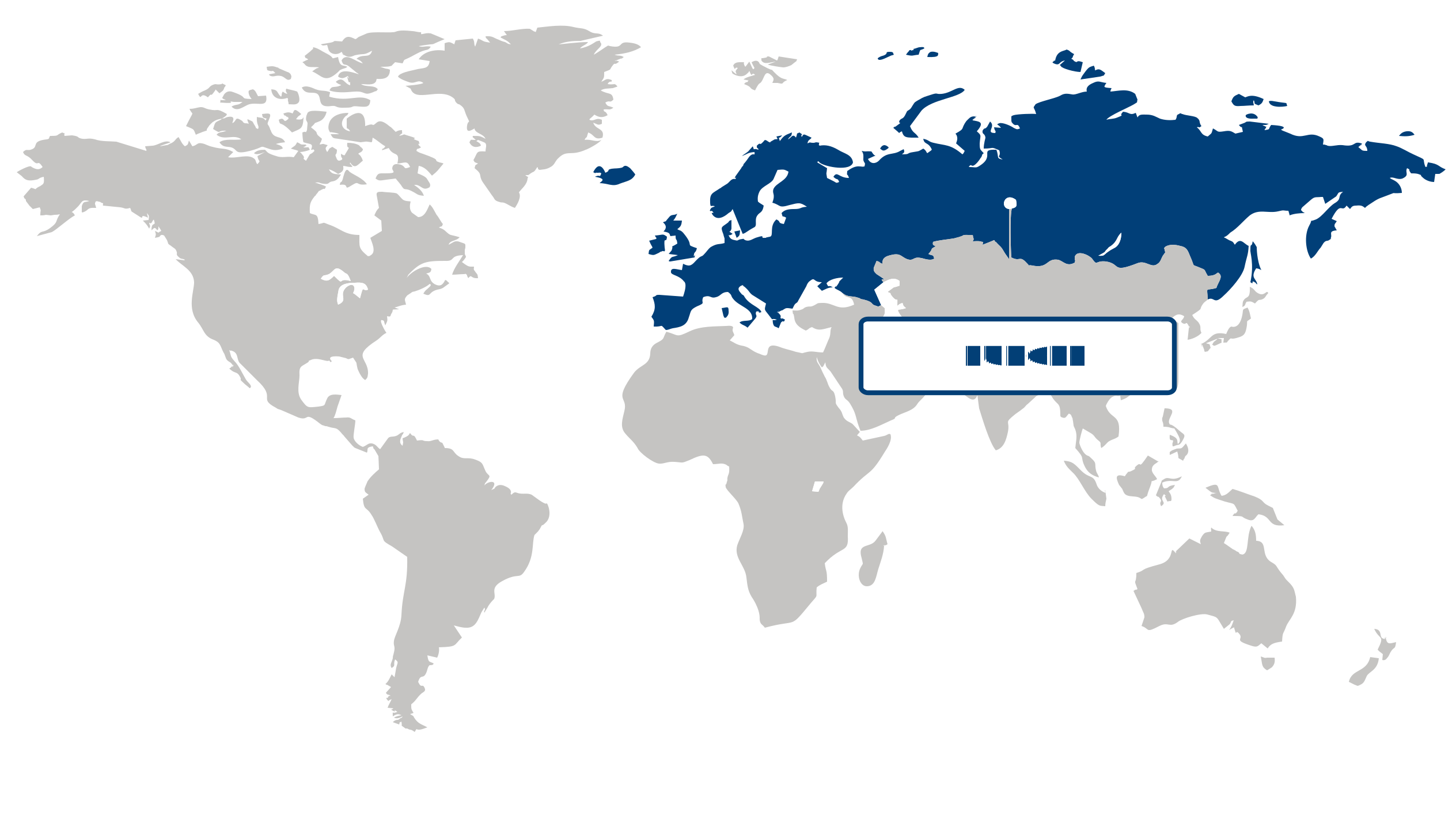
Largest Region
Europe
Largest Market Share in 2026
Europe (Largest Region) vs Asia Pacific (Fastest-Growing Region)
Europe held the largest share of the advanced phase change materials market in 2026, supported by strong emphasis on energy efficiency, sustainable building practices, and thermal management across industrial applications. Demand is being reinforced by efforts to reduce energy consumption in buildings and industrial facilities, where phase change materials can improve temperature regulation and thermal storage performance. The region's established research ecosystem and focus on low-carbon technologies also encourage development and adoption of advanced thermal materials. In addition, stringent environmental objectives and growing investment in energy-efficient infrastructure are creating favorable conditions for wider integration of phase change materials across construction, cold-chain, electronics, and energy applications.
Asia Pacific is the fastest-growing region, driven by rapid industrialization, expanding construction activity, and rising requirements for efficient thermal management. Growing investments in electronics manufacturing, renewable energy infrastructure, transportation, and modern buildings are creating new application opportunities for advanced phase change materials. The region's increasing focus on energy conservation and the adoption of sustainable technologies are further supporting demand. Expanding manufacturing capabilities and greater awareness of thermal storage solutions are also encouraging local adoption, positioning Asia Pacific for strong market expansion as industries seek improved energy performance and temperature-control efficiency.
Key Country Insights
The U.S. advanced phase change materials market focuses on thermal energy storage solutions supporting sustainable buildings, electronics, and industrial efficiency. Organizations in the U.S. continue investing in material innovations that improve temperature management across diverse applications.
Japan continues advancing advanced phase change materials for electronics, automotive components, and precision thermal control applications. Japanese manufacturers favor compact, durable material solutions that improve operational efficiency under demanding performance conditions.
South Korea increasingly utilizes advanced phase change materials to address thermal management requirements in electronics and battery technologies. Manufacturers in South Korea focus on improving product reliability while supporting compact and high-performance device designs.
Germany emphasizes advanced phase change materials that enhance thermal management in manufacturing, construction, and mobility applications. German companies prioritize material performance, sustainability, and integration into energy-efficient industrial systems.
France promotes advanced phase change materials within energy-efficient construction and environmentally conscious infrastructure projects. French market participants increasingly evaluate solutions that improve indoor thermal regulation while supporting sustainability objectives.
Italy applies advanced phase change materials to improve energy efficiency across residential and commercial building renovation projects. Italian stakeholders increasingly explore thermal storage materials that enhance comfort while reducing operational energy consumption.
Segment Leadership and Growth Trends
Product Segment Analysis: Paraffin (Largest Segment) vs Salt Hydrates (Fastest-Growing Segment)
The paraffin segment led the advanced phase change materials market with a 49.08% share in 2026, owing to its established thermal storage performance, chemical stability, and suitability across a broad range of temperature-management applications. Its relatively predictable phase-change behavior and compatibility with established encapsulation approaches have supported widespread use in thermal management systems where reliable heat absorption and release are essential.
Salt hydrates are gaining momentum as the fastest-growing product segment, driven by their attractive thermal storage characteristics and potential for efficient heat management in applications requiring higher energy storage density. Growing interest in thermal energy storage, building efficiency, and improved utilization of intermittent energy sources is encouraging greater attention to salt hydrate-based materials and their application-specific formulations.
Application Segment Analysis: Building & Construction (Largest Segment) vs Energy Storage (Fastest-Growing Segment)
Building & construction represented the largest application segment in the advanced phase change materials market, accounting for 32.29% in 2026, as phase change materials can help moderate indoor temperatures and reduce the burden on conventional heating and cooling systems. Their incorporation into building materials and thermal management solutions supports improved energy efficiency while helping structures respond more effectively to changing thermal conditions.
Energy storage is expanding at the fastest pace as advanced phase change materials become increasingly relevant for capturing and releasing thermal energy when needed. The broader shift toward efficient energy utilization and integration of renewable power is creating demand for technologies that can store excess thermal energy and make it available during periods of higher demand.
| Report Segmentation | |||
| Segment | Sub-Segment | Largest Segment | Fastest Growing Segment |
|---|---|---|---|
| Product | Paraffin, Salt Hydrates, Others | Paraffin | Salt Hydrates |
| Application | Building & Construction, Commercial Refrigeration, HVAC, Energy Storage, Shipping & Transportation, Others | Building & Construction | Energy Storage |
 Read our Research Approach
Competitive Landscape and Market Positioning
Prominent players in the advanced phase change materials market:
1. BASF SE (Germany)
2. Honeywell International Inc. (United States)
3. DuPont de Nemours Inc. (United States)
4. Outlast Technologies GmbH (Germany)
5. Rubitherm Technologies GmbH (Germany)
6. Climator Sweden AB (Sweden)
7. Cryopak Industries Inc. (Canada)
8. PCM Energy Ltd. (United Kingdom)
9. Croda International Plc (United Kingdom)
10. Phase Change Energy Solutions Inc. (United States)
In the advanced phase change materials market, innovation is being strongly driven by the pursuit of energy efficiency and thermal management performance across multiple industries. Continuous material science advancements are enabling more stable, high-capacity storage solutions, particularly for applications requiring temperature regulation. Sustainability considerations are increasingly influencing formulation approaches, pushing the development of environmentally responsible material systems. At the same time, emerging product variations are targeting specialized industrial and building applications, reflecting a gradual but steady expansion of use cases beyond traditional domains.
Industry Development/News
| Company Name | Date | Key Development |
|---|---|---|
| Pluss Advanced Technology | Aug-24 | Pluss Advanced Technology launched a form-stable phase change material at LogiPharma 2024 in Lyon, designed as an organic 2°C–8°C thermal storage blend. The solution is engineered to eliminate leakage risk and comply with WHO stability requirements, expanding controlled-temperature logistics applications in pharmaceutical cold chain infrastructure. |
| BASF | Jun-23 | BASF established a co-located battery materials and recycling center in Schwarzheide, Germany, integrating cathode active material production with a battery recycling facility. The initiative strengthens circular material flows by enabling black mass recycling and supporting industrial-scale thermal and energy materials integration within advanced materials value chains. |
| Phase Change Solutions | Mar-23 | Phase Change Solutions expanded its portfolio with shape-stable BioPCM Bricks designed for thermal energy storage applications. The extruded material is reusable, structurally stable, and retains form up to +60°C, supporting broader adoption of bio-based phase change materials in building efficiency and thermal regulation systems. |
| Henkel | May-23 | Henkel launched Bergquist Hi Flow THF 5000UT, a phase change thermal interface film designed for advanced thermal management applications. The material enables ultra-thin bond line formation under minimal mechanical pressure, improving heat dissipation performance in electronic assemblies and supporting higher-efficiency thermal control in compact device architectures. |
Why Choose Us
Specialized Expertise: Our team comprises industry experts with a deep understanding of your market segment. We bring specialized knowledge and experience that ensures our research and consulting services are tailored to your unique needs.
Customized Solutions: We understand that every client is different. That's why we offer customized research and consulting solutions designed specifically to address your challenges and capitalize on opportunities within your industry.
Proven Results: With a track record of successful projects and satisfied clients, we have demonstrated our ability to deliver tangible results. Our case studies and testimonials speak to our effectiveness in helping clients achieve their goals.
Cutting-Edge Methodologies: We leverage the latest methodologies and technologies to gather insights and drive informed decision-making. Our innovative approach ensures that you stay ahead of the curve and gain a competitive edge in your market.
Client-Centric Approach: Your satisfaction is our top priority. We prioritize open communication, responsiveness, and transparency to ensure that we not only meet but exceed your expectations at every stage of the engagement.
Continuous Innovation: We are committed to continuous improvement and staying at the forefront of our industry. Through ongoing learning, professional development, and investment in new technologies, we ensure that our services are always evolving to meet your evolving needs.
Value for Money: Our competitive pricing and flexible engagement models ensure that you get maximum value for your investment. We are committed to delivering high-quality results that help you achieve a strong return on your investment.
Select Licence Type

