



Alginate Market Size & Growth Forecast 2027–2036, By Segments (Type, Product, Application), Regional Demand Trends (North America, Asia Pacific, Europe), Key Country Insights (U.S., Japan, South Korea, Germany, France, Italy), and Competitive Landscape
Market Size and Growth Outlook
Alginate Market size was worth USD 173.98 Million in 2026 and is poised to grow at 4.21% CAGR between 2027 and 2036, attaining USD 262.78 Million by 2036. The industry revenue for 2027 is assessed at USD 180.09 Million.
Base Year Value (2026)
USD 173.98 Million
CAGR (2027-2036)
4.21%
Forecast Year Value (2036)
USD 262.78 Million

Historical Data Period
2022-2026

Largest Region
Europe

Forecast Period
2027-2036
Alginate Market Intelligence Snapshot:
-
Regional Market Dynamics:
- Europe led in 2025, supported by established processing industries, demand across food and healthcare, and strong preference for functional, naturally derived materials.
- Expanding food processing, pharmaceutical manufacturing, healthcare infrastructure, and demand for functional food ingredients are broadening alginate applications across the region.
-
Segment Momentum:
- The industrial segment led the market in 2025, supported by extensive use in textiles, paper manufacturing, welding, coatings, and other applications requiring reliable thickening and stabilization properties.
- The pharmaceutical segment is growing fastest due to increasing use of alginate in drug delivery, wound care, and controlled-release formulations, supported by its biocompatibility, biodegradability, and gel-forming characteristics.
-
Market Expansion Drivers:
- Expanding pharmaceutical and food industry applications driving alginate demand
- Rising demand for health and nutrition ingredients supporting functional product use
- Growth of plant-based and clean-label formulations increasing alginate adoption
-
Leading Market Participants:
Major players in the alginate market include DuPont de Nemours, Inc. (United States), KIMICA Corporation (Japan), Ceamsa (Spain), Algaia S.A. (France), Shandong Jiejing Group Corporation (China), Ingredients Solutions, Inc. (United States), Marine Biopolymers Ltd (United Kingdom), Algea AS (Norway), CP Kelco (United States), FMC Corporation (United States)
Global Market Forecast Snapshot:
-
Market Outlook:
- 2026 Market Size: USD 173.98 Million
- 2027 Estimated Market Size: USD 180.09 Million
- Projected Market Size: USD 262.78 Million by 2036
- Growth Forecasts: 4.21% CAGR (2027-2036)
-
Regional and Segment Outlook:
- Leading Regional Market: Europe
- High-Growth Regional Hub: Asia Pacific
- Core Revenue Segment: High G (Type) | Propylene Glycol (Product) | Industrial (Application)
- Emerging Opportunity Segment: High G (Type) | Sodium (Product) | Pharmaceutical (Application)
Market Growth Drivers and Industry Trends
Expanding pharmaceutical and food industry applications driving alginate demand
The alginate market growth is driven by expanding utilization of alginate across pharmaceutical formulations, food processing, and industrial applications where its functional properties support product innovation. In pharmaceuticals, alginate is increasingly valued for applications such as controlled-release formulations, wound care materials, and encapsulation technologies, while food manufacturers use it as a stabilizer, thickener, and texture-enhancing ingredient. The broader adoption across multiple industries is encouraging producers to develop application-specific alginate solutions that meet evolving formulation requirements.
Rising demand for health and nutrition ingredients supporting functional product use
Increasing consumer focus on wellness-oriented products is supporting the adoption of natural ingredients with functional benefits across food and nutrition categories. The alginate market growth will be propelled by rising demand for ingredients that improve product texture, support dietary formulations, and enhance the nutritional profile of health-focused products. Manufacturers are incorporating alginate into functional foods and supplements as consumers increasingly seek products associated with improved digestive health, balanced nutrition, and clean ingredient profiles.
Growth of plant-based and clean-label formulations increasing alginate adoption
The shift toward plant-based and clean-label products is accelerating the use of naturally derived ingredients in food, personal care, and pharmaceutical formulations. Alginate market growth is supported by its compatibility with clean-label positioning and its ability to replace synthetic additives while maintaining desirable product characteristics. As brands reformulate products to meet consumer expectations for transparency and sustainable sourcing, alginate is gaining importance as a versatile ingredient in emerging formulation strategies.
| Growth Driver Assessment Framework | |||||
| Growth Driver | Impact On CAGR | Regulatory Influence | Geographic Relevance | Adoption Rate | Impact Timeline |
|---|---|---|---|---|---|
| Expanding pharmaceutical and food industry applications driving alginate demand | 2% | Moderate | North America, Europe, Asia Pacific | High | Near Term |
| Rising demand for health and nutrition ingredients supporting functional product use | 1.7% | Low | North America, Europe | High | Near Term |
| Growth of plant-based and clean-label formulations increasing alginate adoption | 1.5% | Low | Europe, Asia Pacific | Medium | Mid Term |
Unlock insights tailored to your business with our bespoke market research solutions - Click to get your customized report now!
Regional Demand Dynamics
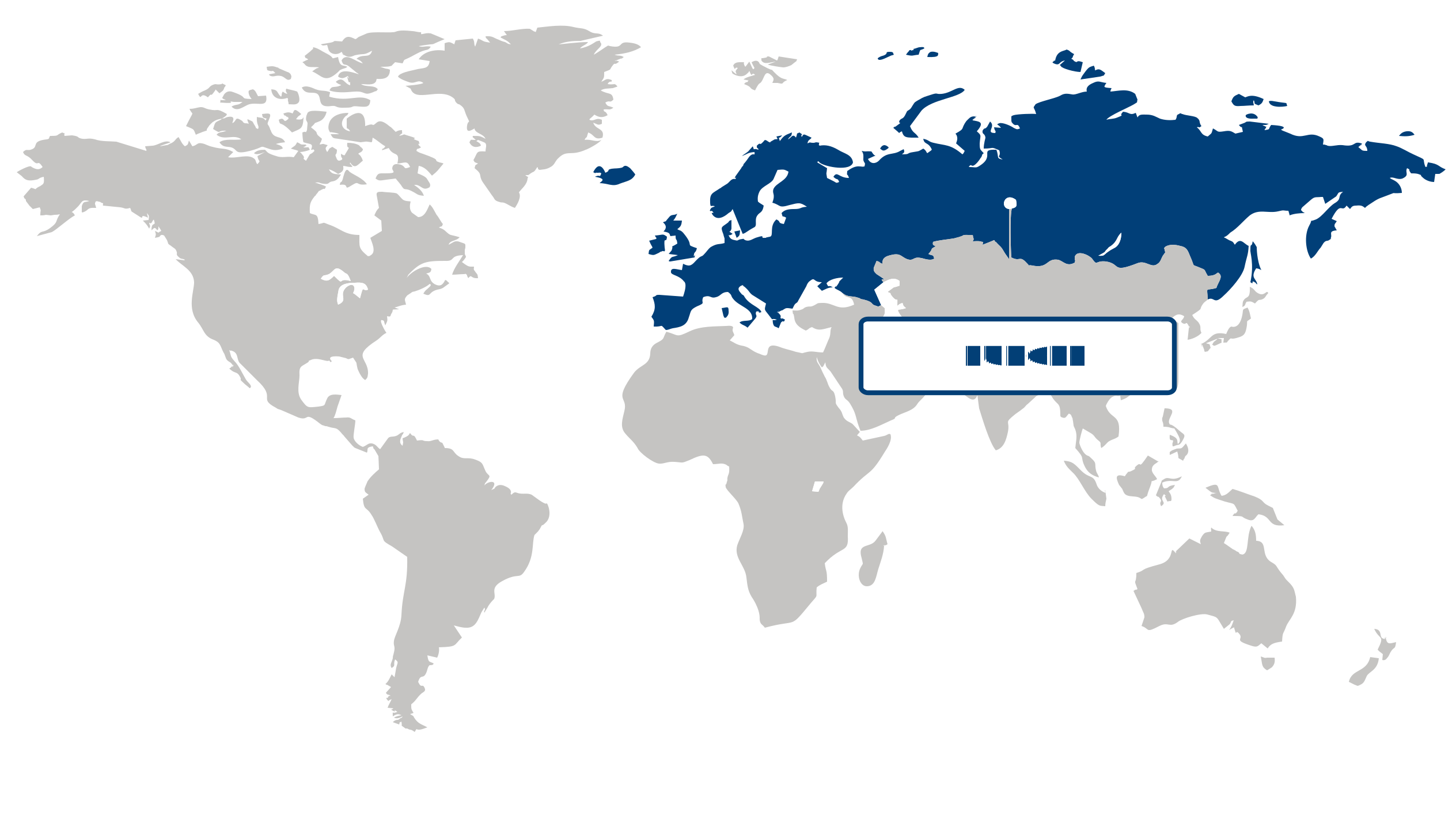
Largest Region
Europe
Largest Market Share in 2026
Europe (Largest Region) vs Asia Pacific (Fastest-Growing Region)
Europe dominated the alginate market in 2026, benefiting from strong demand for alginate-based products across food, pharmaceuticals, healthcare, and industrial applications. The region's established processing industries, emphasis on functional and naturally derived materials, and well-developed regulatory environment support consistent utilization of alginate. Growing consumer interest in clean-label and sustainable ingredients is also encouraging demand in food and related applications, while healthcare uses provide an additional source of regional market strength.
Asia Pacific is projected to experience the fastest growth, supported by expanding food processing, pharmaceutical manufacturing, and healthcare industries. Rising urbanization and changing consumer preferences are increasing demand for processed and functional food products, creating opportunities for alginate applications as thickeners, stabilizers, and texture-enhancing ingredients. At the same time, improvements in healthcare infrastructure and increasing pharmaceutical production are broadening regional demand across medical and drug-delivery applications.
No card data available for this language/report.
Segment Leadership and Growth Trends
Type Segment Analysis: High G (Largest & Fastest-Growing Segment)
The alginate market was led by the high G segment, which held the largest share in 2026 while also emerging as the fastest-growing category. High G alginate is widely preferred because of its ability to form strong, stable gels with excellent structural integrity, making it suitable for demanding industrial and biomedical applications. Its superior mechanical strength, consistent performance, and compatibility with diverse formulations continue to support expanding adoption across multiple end-use industries. Ongoing demand for high-performance hydrocolloids is expected to reinforce the segment's leadership over the coming years.
Product Segment Analysis: Propylene Glycol (Largest Segment) vs Sodium (Fastest-Growing Segment)
The propylene glycol alginate segment held the largest share in 2026 owing to its excellent emulsifying, stabilizing, and thickening characteristics across food, beverage, and industrial formulations. Its ability to maintain product consistency under varying processing conditions has made it a preferred ingredient for manufacturers seeking reliable formulation performance. Strong demand for multifunctional additives with broad application versatility further supports the segment's dominant position.
The sodium alginate segment is anticipated to witness the fastest growth as its biocompatibility, film-forming capability, and gel-forming properties continue to expand its use across pharmaceutical, biomedical, and specialty industrial applications. Rising interest in sustainable and naturally derived ingredients is encouraging broader adoption of sodium alginate in advanced formulations. Continuous innovation in healthcare and functional material applications is also contributing to its accelerating demand.
Application Segment Analysis: Industrial (Largest Segment) vs Pharmaceutical (Fastest-Growing Segment)
The industrial segment accounted for the largest share in 2026 due to extensive utilization of alginate in textile processing, paper manufacturing, welding, coatings, and other industrial applications requiring effective thickening and stabilization properties. Its versatility, process compatibility, and ability to improve product performance have established industrial applications as the primary source of demand. Continued emphasis on efficient manufacturing processes further sustains the segment's leading position.
The pharmaceutical segment is projected to grow the fastest in the alginate market as increasing use of alginate in drug delivery systems, wound care products, and controlled-release formulations drives demand. The material's biocompatibility, biodegradability, and gentle gel-forming characteristics make it well suited for advanced healthcare applications. Expanding research into innovative therapeutic formulations and regenerative medicine is expected to further strengthen growth prospects for the pharmaceutical segment.
| Report Segmentation | |||
| Segment | Sub-Segment | Largest Segment | Fastest Growing Segment |
|---|---|---|---|
| Type | High M, High G | High G | High G |
| Product | Sodium, Propylene Glycol | Propylene Glycol | Sodium |
| Application | Pharmaceutical, Industrial | Industrial | Pharmaceutical |
 Read our Research Approach
Competitive Landscape and Market Positioning
Prominent players in the alginate market:
- DuPont de Nemours, Inc. (United States)
- KIMICA Corporation (Japan)
- Ceamsa (Spain)
- Algaia S.A. (France)
- Shandong Jiejing Group Corporation (China)
- Ingredients Solutions, Inc. (United States)
- Marine Biopolymers Ltd (United Kingdom)
- Algea AS (Norway)
- CP Kelco (United States)
- FMC Corporation (United States)
Competition in the alginate market is evolving as suppliers move beyond traditional raw material supply toward application-focused solutions across food, pharmaceutical, biotechnology, and industrial uses. Companies are increasingly differentiating through processing expertise, quality consistency, and the ability to tailor alginate properties for specialized end applications. Growing demand for sustainable and functional biomaterials is encouraging market participants to strengthen innovation capabilities and develop higher-value offerings. The competitive landscape is gradually shifting toward technical expertise and customization, with suppliers seeking stronger positions through expanded application support and product versatility.
Industry Development/News
| Company Name | Date | Key Development |
|---|---|---|
| Bayou Best Foods | Jul-26 | Bayou Best Foods acquired seaweed-focused developer BettaF!sh to establish a cross-Atlantic plant-based seafood business, integrating seaweed-derived ingredient innovations and expanding structural distribution networks across U.S. and European markets. |
| Roquette | Apr-26 | Roquette launched four cosmetic ingredients, including sensory-driven alginates and a starch-based softgel technology, expanding its specialty portfolio to enhance film-forming functionality, product wear, and texture performance in personal care applications. |
| Origin by Ocean | Jun-25 | Origin by Ocean partnered with CABB Group to build an algae biorefinery in Finland, advancing industrial-scale biochemical manufacturing to accelerate the commercialization of sustainable, seaweed-derived materials and alginate products. |
| GFRP | Feb-24 | GFRP acquired edible packaging startup DisSolves to commercialize sustainable, edible packaging solutions and launch operational pilot programs with major food manufacturers utilizing alginate-based application technologies. |
| JRS Group | Mar-23 | JRS Group acquired Alagia to address growing global demand for alginate and seaweed-based solutions, expanding its specialized portfolio across the food, feed, pharmaceutical, agriculture, and home and personal care sectors. |
Why Choose Us
Specialized Expertise: Our team comprises industry experts with a deep understanding of your market segment. We bring specialized knowledge and experience that ensures our research and consulting services are tailored to your unique needs.
Customized Solutions: We understand that every client is different. That's why we offer customized research and consulting solutions designed specifically to address your challenges and capitalize on opportunities within your industry.
Proven Results: With a track record of successful projects and satisfied clients, we have demonstrated our ability to deliver tangible results. Our case studies and testimonials speak to our effectiveness in helping clients achieve their goals.
Cutting-Edge Methodologies: We leverage the latest methodologies and technologies to gather insights and drive informed decision-making. Our innovative approach ensures that you stay ahead of the curve and gain a competitive edge in your market.
Client-Centric Approach: Your satisfaction is our top priority. We prioritize open communication, responsiveness, and transparency to ensure that we not only meet but exceed your expectations at every stage of the engagement.
Continuous Innovation: We are committed to continuous improvement and staying at the forefront of our industry. Through ongoing learning, professional development, and investment in new technologies, we ensure that our services are always evolving to meet your evolving needs.
Value for Money: Our competitive pricing and flexible engagement models ensure that you get maximum value for your investment. We are committed to delivering high-quality results that help you achieve a strong return on your investment.
Select Licence Type

