Anthocyanin Market Size & Growth Forecast 2027–2036, By Segments (Source, Application, Sales Channel), Regional Demand Trends (North America, Asia Pacific, Europe), Key Country Insights (U.S., Japan, South Korea, Germany, France, Italy), and Competitive Landscape
Jump to content
Market Size and Growth Outlook
Anthocyanin Market size stood at USD 700.73 Million in 2026 and is predicted to grow at 4.86% CAGR from 2027 to 2036, surpassing USD 1.13 Billion by 2036. The industry revenue for 2027 is calculated at USD 729.11 Million.
Get more details on this report
Request Free Sample ReportAnthocyanin Market Intelligence Snapshot
Regional Market Dynamics
- Europe leads through strong demand for natural, clean-label ingredients, a developed food processing industry, and growing interest in sustainable and plant-derived formulations.
- Asia Pacific is gaining momentum from expanding processed foods, rising natural-ingredient awareness, nutraceutical demand, improving manufacturing capabilities, and greater raw-material availability.
Segment Momentum
- Fruits accounted for 42.55% of the market in 2026 due to their high anthocyanin content, established supply chains, and broad use across food, beverage, nutraceutical, and personal care applications.
- Vegetable-derived anthocyanins are growing fastest as manufacturers diversify natural pigment sources, supported by advances in extraction technologies and rising demand for plant-based colorants with functional benefits.
Market Expansion Drivers
- Rising demand for natural colorants in food and beverage formulations
- Growing consumer shift toward plant-based dietary ingredient adoption
- Expanding functional food and beverage fortification using botanical pigments
Leading Market Participants
- Key companies in the anthocyanin market include Chr. Hansen Holding A/S (Denmark), Givaudan SA (Switzerland), Symrise AG (Germany), Kerry Group plc (Ireland), Sensient Technologies Corporation (United States), Roha Dyechem Pvt. Ltd. (India), Döhler GmbH (Germany), BASF SE (Germany)
Global Market Forecast Snapshot
Market Outlook
- 2026 Market Size: USD 700.73 Million
- 2027 Estimated Market Size: USD 729.11 Million
- Projected Market Size: USD 1.13 Billion by 2036
- Growth Forecast: 4.86% CAGR (2027-2036)
Regional and Segment Outlook
- Leading Regional Market: Europe
- High-Growth Regional Hub: Asia Pacific
- Core Revenue Segment: Fruits (Source) | Food & Beverages (Application) | Distributors/Suppliers (Sales Channel)
- Emerging Opportunity Segment: Vegetables (Source) | Food & Beverages (Application) | Online Sales (Sales Channel)
Market Growth Drivers and Industry Trends
Rising demand for natural colorants in food and beverage formulations
Food and beverage manufacturers are increasingly replacing synthetic additives with naturally derived ingredients to address evolving consumer preferences and clean-label trends. Rising demand for natural colorants will drive the anthocyanin market growth by increasing adoption of plant-based pigments that provide attractive coloration while aligning with product transparency expectations. These pigments are being incorporated into beverages, confectionery, dairy alternatives, and other formulations where natural ingredient profiles influence purchasing decisions.
Growing consumer shift toward plant-based dietary ingredient adoption
The rising preference for botanical and plant-derived ingredients is reshaping product development strategies across the nutrition and wellness sector. Growing consumer shift toward plant-based dietary ingredient adoption will propel the anthocyanin market growth as manufacturers incorporate naturally sourced compounds into functional foods and supplements. Anthocyanins offer appeal through their botanical origin and compatibility with formulations targeting health-conscious consumers seeking cleaner ingredient choices.
Expanding functional food and beverage fortification using botanical pigments
The growing focus on foods that provide additional nutritional value is encouraging manufacturers to combine visual appeal with functional benefits. Expanding functional food and beverage fortification using botanical pigments will boost the anthocyanin market demand by increasing use of anthocyanin-based ingredients in enhanced beverages, nutritional products, and wellness-focused formulations. Product developers are leveraging these pigments to create differentiated offerings that connect natural appearance with functional positioning.
| Growth Driver | Impact on CAGR | Regulatory Influence | Geographic Relevance | Adoption Rate | Impact Timeline |
|---|---|---|---|---|---|
| Rising demand for natural colorants in food and beverage formulations | 2% | High | North America, Europe | High | Mid Term |
| Growing consumer shift toward plant-based dietary ingredient adoption | 1.7% | Moderate | Europe, Asia Pacific | Medium | Mid Term |
| Expanding functional food and beverage fortification using botanical pigments | 1.5% | Moderate | North America, Asia Pacific | Emerging | Long Term |
Unlock insights tailored to your business with our bespoke market research solutions.
Click to get your customized report now.
Regional Demand Dynamics
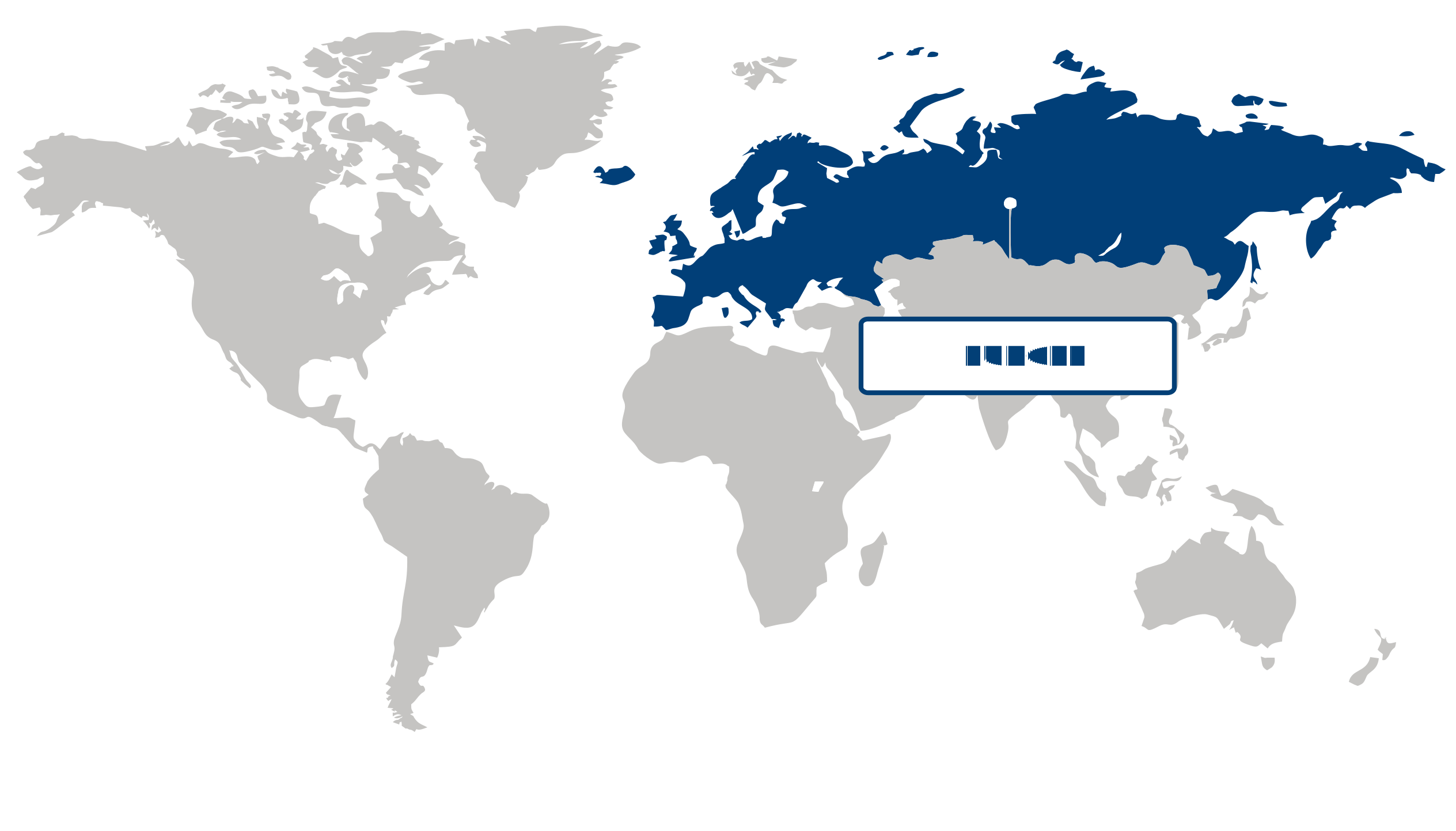
Europe (Largest Region)
Europe held the largest share of the anthocyanin market in 2026, supported by strong consumer interest in natural food ingredients and growing preference for clean-label products. Food and beverage manufacturers across the region are increasingly incorporating naturally sourced colors into formulations in response to consumer expectations around ingredient transparency and healthier product positioning. Demand is also being supported by the region's developed food processing industry and increasing attention to sustainable sourcing and plant-derived ingredients. Broader interest in functional foods and naturally occurring compounds is creating additional opportunities for anthocyanin applications across food, beverage, and nutraceutical products.
Asia Pacific (Fastest-Growing Region)
Asia Pacific represents the fastest-growing region, driven by expanding processed food and beverage industries, rising consumer awareness of natural ingredients, and increasing demand for products positioned around health and wellness. Growing urbanization and changing dietary preferences are encouraging manufacturers to introduce more sophisticated packaged food and beverage offerings that incorporate natural colorants. The region's expanding nutraceutical sector is also creating opportunities for anthocyanins due to their association with antioxidant properties. Improvements in food manufacturing capabilities and greater availability of plant-based raw materials are further supporting regional market development.
| Parameter | North America | Asia Pacific | Europe | Latin America | MEA |
|---|---|---|---|---|---|
| Innovation HubiScaleNascentDeveloping Advanced | |||||
| Cost-Sensitive RegioniScaleLowMedium High | |||||
| Regulatory EnvironmentiScaleRestrictiveNeutral Supportive | |||||
| Demand DriversiScaleWeakModerate Strong | |||||
| Development StageiScaleEmergingDeveloping Developed | |||||
| Adoption RateiScaleLowMedium High | |||||
| New Entrants / StartupsiScaleSparseModerate Dense | |||||
| Macro IndicatorsiScaleWeakStable Strong |
Key Country Insights
United States 🇺🇸
Clean Label IngredientsThe U.S. anthocyanin market is driven by demand for naturally sourced colors and functional ingredients across foods, beverages, and dietary supplements. Manufacturers are expanding applications that combine visual appeal with consumer interest in plant-derived formulations.
Germany 🇩🇪
Natural Color InnovationGermany emphasizes anthocyanin ingredients for food and beverage products seeking natural alternatives to synthetic colors. German producers continue improving extraction efficiency and formulation stability for premium product applications.
Japan 🇯🇵
Functional Beverage DemandJapan incorporates anthocyanin into beverages and health-oriented products where natural ingredients support product differentiation. Japanese manufacturers focus on ingredient quality and stable formulations suitable for premium consumer products.
South Korea 🇰🇷
Wellness Product DevelopmentSouth Korea is increasing anthocyanin utilization across functional foods, beverages, and nutritional products. Local companies are developing innovative formulations that align with consumer demand for naturally derived ingredients with appealing visual characteristics.
France 🇫🇷
Premium Botanical SourcingFrance values anthocyanin ingredients for premium food and beverage applications emphasizing natural formulation strategies. French manufacturers prioritize botanical sourcing quality and processing techniques that preserve ingredient performance and product appeal.
Italy 🇮🇹
Fruit-Based Ingredient ApplicationsItaly leverages anthocyanin in food, beverage, and specialty product development supported by strong expertise in fruit-derived ingredients. Italian manufacturers continue refining extraction and formulation practices to enhance natural color performance across premium applications.
Anthocyanin Market Share (%), by Source, 2026
Go beyond the chart, access full insights & data tables
Request Free Sample ReportSource Segment Analysis: Fruits (Largest Segment) vs Vegetables (Fastest-Growing Segment)
Holding the largest share of the anthocyanin market, the fruits source segment accounted for 42.55% in 2026. Fruits such as berries, grapes, cherries, and other naturally pigmented varieties are widely recognized as rich sources of anthocyanins, making them the preferred raw materials for commercial extraction. Their abundant pigment concentration, established agricultural supply chains, and broad acceptance across food, beverage, nutraceutical, and personal care applications have reinforced their market leadership. Increasing consumer preference for naturally derived ingredients and clean-label products continues to support sustained demand for fruit-based anthocyanins.
The vegetables source segment is expected to witness the fastest growth over the forecast period. Rising interest in diversifying natural pigment sources and expanding the use of plant-based ingredients is encouraging greater utilization of anthocyanin-rich vegetables. Advances in extraction technologies and increasing demand for naturally sourced colorants with functional health benefits are expected to strengthen the adoption of vegetable-derived anthocyanins across multiple end-use industries.
Application Segment Analysis: Food & Beverages (Largest & Fastest-Growing Segment)
The food & beverages application segment dominated the anthocyanin market, capturing 39.96% in 2026, while also emerging as the fastest-growing segment. Anthocyanins are increasingly used as natural colorants and functional ingredients in beverages, confectionery, dairy products, bakery items, and processed foods as manufacturers respond to growing consumer demand for clean-label formulations. Their ability to provide vibrant natural coloring while offering antioxidant properties has enhanced their appeal in product innovation. Continued replacement of synthetic additives with plant-derived alternatives and rising demand for healthier food products are expected to further reinforce the segment's leadership and growth.
Sales Channel Segment Analysis: Distributors/Suppliers (Largest Segment) vs Online Sales (Fastest-Growing Segment)
The distributors/suppliers sales channel segment held the leading position in the anthocyanin market in 2026. Distributors and suppliers play a vital role in connecting ingredient manufacturers with food, beverage, pharmaceutical, and personal care companies by ensuring reliable product availability, technical support, and efficient supply chain management. Their established distribution networks and long-standing industry relationships continue to make them the preferred procurement channel for bulk anthocyanin ingredients.
The online sales channel segment is anticipated to record the fastest growth over the forecast period. Increasing digitalization of business procurement processes and the growing availability of specialty ingredients through online platforms are making sourcing more efficient for manufacturers and smaller buyers. Improved product accessibility, broader supplier visibility, and streamlined purchasing processes are expected to accelerate the adoption of online sales channels.
| Segment | Sub-Segment | Largest Segment | Fastest Growing |
|---|---|---|---|
| Source | Fruits, Vegetables, Legumes & Cereals, Other | Fruits | Vegetables |
| Application | Food & Beverages, Pharmaceutical Products, Personal Care, Other | Food & Beverages | Food & Beverages |
| Sales Channel | Direct Sales, Distributors/Suppliers, Online Sales | Distributors/Suppliers | Online Sales |
Competitive Landscape and Market Positioning
Major players in the anthocyanin market:
- Chr. Hansen Holding A/S (Denmark)
- Givaudan SA (Switzerland)
- Symrise AG (Germany)
- Kerry Group plc (Ireland)
- Sensient Technologies Corporation (United States)
- Roha Dyechem Pvt. Ltd. (India)
- Döhler GmbH (Germany)
- BASF SE (Germany)
Shifting consumer preference toward naturally derived ingredients is redefining competition in the anthocyanin market, encouraging producers to strengthen capabilities in raw material sourcing, extraction efficiency, and color stability across diverse applications. Suppliers are investing in advanced processing methods that improve consistency and shelf-life performance while addressing the formulation requirements of food, beverages, nutraceuticals, and personal care products. Competitive differentiation is increasingly influenced by the ability to provide traceable supply chains, application-specific ingredient customization, and technical support for manufacturers seeking reliable natural alternatives to synthetic colorants.
| Company | Market Share | Company Revenue | Revenue CAGR (%) | Product Portfolio | Geographic Presence | Innovation / R&D Focus | Strategic Developments |
|---|---|---|---|---|---|---|---|
| Chr. Hansen Holding A/S (Denmark) | |||||||
| Givaudan SA (Switzerland) | |||||||
| Symrise AG (Germany) | |||||||
| Kerry Group plc (Ireland) | |||||||
| Sensient Technologies Corporation (United States) | |||||||
| Roha Dyechem Pvt. Ltd. (India) | |||||||
| Döhler GmbH (Germany) | |||||||
| BASF SE (Germany) |
Industry Development / News
| Company Name | Date | Key Development |
|---|---|---|
| Norfolk Healthy Produce | Jul-24 | Norfolk Healthy Produce secured an exclusive commercial partnership with All Aussie Farmers for the regional distribution of its bioengineered Purple Tomato. The agreement marks a significant geographic expansion, accelerating the commercialization and availability of functional, anthocyanin-rich produce in the Australian market. |
| Givaudan Sense Colour | Jul-24 | Givaudan Sense Colour expanded its product capabilities by launching Amaize orange-red, a corn-based anthocyanin ingredient engineered as a natural alternative to synthetic Red 40. The highly stable formulation provides distinct functional differentiation for acidic food and beverage manufacturing applications. |
| Naturex | Jul-23 | Naturex entered an operational partnership with Indigo Agriculture to develop and commercialize black soybean varieties rich in anthocyanins. This supply chain initiative aims to establish a sustainable raw material source for food and beverage manufacturers seeking natural colorants and functional ingredients. |
Customize Your Report
Explore examples of how this report can be tailored to different research needs, including custom segments, additional topics or chapters, and related reports. Click a section of the wheel or its numbered marker to explore the available options.
Anthocyanin Market — Custom Segments
| Segment | Sub-Segment |
|---|---|
| Purity Grade | Food Grade, Pharmaceutical Grade, Cosmetic Grade, Research Grade |
| Extraction Technology | Solvent Extraction, Supercritical Fluid Extraction, Pressurized Liquid Extraction, Ultrasound-Assisted Extraction |
| Buyer Type | Food & Beverage Manufacturers, Pharmaceutical Companies, Cosmetics & Personal Care Manufacturers, Ingredient Distributors |
Anthocyanin Market — Custom TOC
| Custom Chapter | Chapter Details |
|---|---|
| Stability & Application Commercialization |
|
| Botanical Sourcing Resilience |
|
| Clean-Label Reformulation Opportunities |
|
Need a different cut of the data?
Request Custom ResearchFrequently Asked Questions
How much revenue does the anthocyanin market generate?
What is the forecasted size of the anthocyanin industry?
How are clean-label preferences driving growth in the anthocyanin market?
Why are functional food manufacturers increasing the use of anthocyanin-based ingredients?
Why are fruits the leading source segment in the anthocyanin market?
What is driving the rapid growth of the vegetables source segment?
What makes Europe the leading anthocyanin market?
Why is Asia Pacific the fastest-growing region for anthocyanins?
What are the prominent companies operating in the anthocyanin landscape?
Our Clients
"The report provided a thorough look at market trends, technological advancements, and the competitive landscape. The depth of insights was really valuable."
ITC Limited
"We would highly recommend Fundamental Business Insights & Consulting to anyone looking for reliable, detailed, and comprehensive market research in the Food industry."
Tyson Foods
"The clarity and presentation of the information were commendable. The report was delivered timely, which made the overall experience smooth and convenient."
Mondelēz International
Our Research Team & Methodology
Every Fundamental Business Insights report is built by a dedicated vertical research team, validated through a structured primary-and-secondary methodology, and reviewed for accuracy before it reaches you.
Delivery
Published
Available
Support
- Market Size & Forecast
- Market Segmentation
- Regional Analysis
- Growth Drivers & Challenges
- Market Dynamics
- Competitive Landscape
- Company Profiles
- Competitive Benchmarking
- Mergers & Acquisitions
- Market Share Analysis or Key Company Strategies
- Value Chain Analysis
- Porter's Five Forces
- PESTLE Analysis
- Pricing Trends
- Supply-Demand Analysis
- Technology Landscape
- Regulatory Landscape
- Investment & Funding Landscape
- Emerging Opportunities
- Future Market Outlook