Automated Feeding Systems Market Size & Growth Forecast 2027–2036, By Segments (Component, System, Livestock), Regional Demand Trends (North America, Asia Pacific, Europe), Key Country Insights (U.S., Japan, South Korea, Germany, France, Italy), and Competitive Landscape
Jump to content
Market Size and Growth Outlook
Automated Feeding Systems Market size was around USD 7.2 billion in 2026 and is slated to grow at a 16.44% CAGR from 2027 to 2036, exceeding USD 32.99 billion by 2036. The industry revenue for 2027 is estimated at USD 8.2 billion.
Get more details on this report
Request Free Sample ReportAutomated Feeding Systems Market Intelligence Snapshot
Regional Market Dynamics
- Europe accounted for a 37.63% share in 2026, supported by established livestock operations and automation adoption for feed efficiency and labor optimization.
- North America is projected to expand at a 12.66% CAGR as commercial farms adopt automation to improve operational control and manage larger herds efficiently.
Segment Momentum
- Hardware accounted for 59.75% of the market in 2026 because feeders, sensors, control units, and delivery equipment form the essential infrastructure required to operate automated feeding systems.
- Self-propelled feeding systems are growing fastest due to their mobility and flexibility, allowing farms to support changing layouts and adaptive feeding routines more efficiently than fixed systems.
Market Expansion Drivers
- Rising demand for dairy and meat products accelerating precision livestock feeding automation adoption.
- Integration of AI, IoT, and machine learning improving real-time feed optimization and livestock monitoring.
- Agricultural labor shortages increasing investment in automated and labor-efficient farm feeding infrastructure.
Leading Market Participants
- Leading players in the automated feeding systems market include DeLaval Holding AB (Sweden), GEA Group AG (Germany), Lely Holding S.à r.l. (Netherlands), BouMatic LLC (United States), Dairymaster (Ireland), Trioliet B.V. (Netherlands), Fullwood Packo Ltd. (United Kingdom), Schauer Agrotronic GmbH (Austria), Rovibec Agrisolutions Inc. (Canada), JOZ B.V. (Netherlands).
Global Market Forecast Snapshot
Market Outlook
- 2026 Market Size: USD 7.2 billion
- 2027 Estimated Market Size: USD 8.2 billion.
- Projected Market Size: USD 32.99 billion by 2036
- Growth Forecast: 16.44% CAGR (2027-2036)
Regional and Segment Outlook
- Leading Regional Market: Europe
- High-Growth Regional Hub: North America
- Core Revenue Segment: Hardware (Component) | Conveyor Feeding Systems (System) | Ruminants (Livestock)
- Emerging Opportunity Segment: Software (Component) | Self-Propelled Feeding Systems (System) | Poultry (Livestock)
Market Growth Drivers and Industry Trends
Rising demand for dairy and meat products accelerating precision livestock feeding automation adoption
Rising consumption of dairy and meat products is creating stronger pressure on livestock producers to improve feeding efficiency, and the automated feeding systems market is benefiting from this shift toward more precise herd management. Automated solutions enable farms to deliver feed at consistent intervals and in controlled quantities, helping producers manage nutritional requirements across different animal groups while reducing feed wastage and operational inconsistencies. As livestock operations expand and production targets become more demanding, precision feeding also supports better utilization of feed resources and more systematic farm routines, particularly where producers are seeking greater consistency in animal nutrition and productivity.
Integration of AI, IoT, and machine learning improving real-time feed optimization and livestock monitoring
Integration of advanced digital technologies is transforming feeding operations, with the automated feeding systems market gaining momentum as AI, IoT, and machine learning enable more responsive livestock management. Connected sensors and monitoring devices can capture information related to feeding behavior, animal activity, and feed consumption, allowing automated systems to adjust feeding schedules and quantities according to changing conditions. AI-driven analysis can further identify consumption patterns and support more precise nutritional management, while connected farm equipment improves visibility across feeding operations and allows producers to manage processes with less manual intervention.
Agricultural labor shortages increasing investment in automated and labor-efficient farm feeding infrastructure
Persistent shortages of agricultural labor are encouraging livestock producers to invest in technologies that reduce dependence on manual feeding activities, supporting demand for the automated feeding systems market. Feeding is a recurring operational task that requires considerable time and consistency, making automation particularly valuable for farms facing difficulties in recruiting and retaining workers. Automated equipment can handle routine feed distribution, scheduled delivery, and related feeding processes with limited human intervention, enabling available workers to focus on animal health, farm supervision, and other higher-value activities while maintaining regular feeding routines.
| Growth Driver | Impact on CAGR | Regulatory Influence | Geographic Relevance | Adoption Rate | Impact Timeline |
|---|---|---|---|---|---|
| Rising demand for dairy and meat products accelerating precision livestock feeding automation adoption | 2.00% | Moderate | Europe, North America | High | Near Term |
| Integration of AI, IoT, and machine learning improving real-time feed optimization and livestock monitoring | 1.80% | Moderate | North America, Asia Pacific | High | Mid Term |
| Agricultural labor shortages increasing investment in automated and labor-efficient farm feeding infrastructure | 1.40% | Low | Europe, Asia Pacific | Medium | Mid Term |
Unlock insights tailored to your business with our bespoke market research solutions.
Click to get your customized report now.
Regional Demand Dynamics
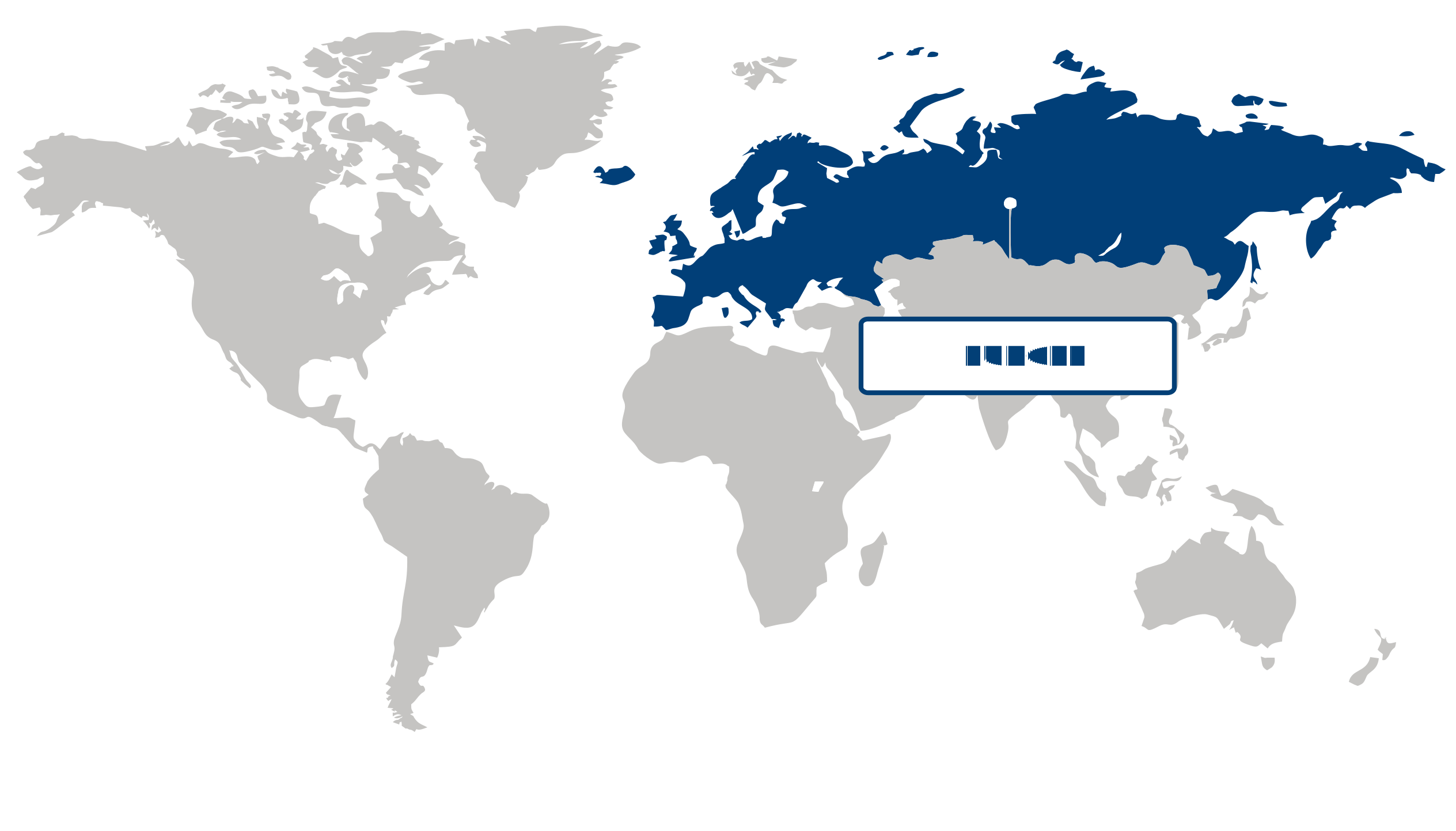
Europe (Largest Region)
In the automated feeding systems market, Europe held the largest share of 37.63% in 2026. The region’s strong position is supported by the modernization of livestock farming, increasing emphasis on labor efficiency, and growing adoption of precision-based farm management practices. Automated feeding solutions help producers improve feeding consistency, reduce manual workloads, and optimize resource utilization. The region’s established agricultural infrastructure, focus on animal welfare, and increasing integration of digital technologies into farming operations further strengthen demand for advanced feeding systems.
North America (Fastest-Growing Region)
North America is emerging as the fastest-growing regional market, driven by the increasing modernization of livestock operations and demand for technologies that improve farm productivity and operational efficiency. Producers are increasingly adopting automated solutions to address labor availability challenges while maintaining consistent feeding practices across larger and more technologically advanced farming operations. Greater acceptance of smart farming technologies, rising investment in agricultural automation, and the integration of data-driven management systems are supporting the region’s accelerating adoption of automated feeding equipment.
| Parameter | North America | Asia Pacific | Europe | Latin America | MEA |
|---|---|---|---|---|---|
| Innovation HubiScaleNascentDeveloping Advanced | |||||
| Cost-Sensitive RegioniScaleLowMedium High | |||||
| Regulatory EnvironmentiScaleRestrictiveNeutral Supportive | |||||
| Demand DriversiScaleWeakModerate Strong | |||||
| Development StageiScaleEmergingDeveloping Developed | |||||
| Adoption RateiScaleLowMedium High | |||||
| New Entrants / StartupsiScaleSparseModerate Dense | |||||
| Macro IndicatorsiScaleWeakStable Strong |
Key Country Insights
Germany 🇩🇪
Smart Dairy AutomationGermany focuses on automated feeding systems that enhance dairy farm productivity through digital monitoring and efficient feed delivery. Farmers increasingly value equipment compatible with precision agriculture technologies and sustainability-focused herd management practices.
France 🇫🇷
Efficient Dairy FeedingFrance emphasizes automated feeding systems that improve feed utilization and herd productivity across dairy operations. Farmers increasingly invest in flexible solutions that optimize feeding schedules while supporting animal welfare and sustainable production objectives.
Italy 🇮🇹
Modern Farm MechanizationItaly is expanding the use of automated feeding systems to improve efficiency across dairy and livestock farms. Italian producers favor adaptable equipment that supports mixed farming operations while helping reduce labor requirements and feed waste.
Japan 🇯🇵
Labor-Saving Farm SolutionsJapan prioritizes automated feeding systems that address labor shortages while maintaining consistent livestock care across commercial farms. Compact, reliable, and highly automated equipment aligns well with the country's emphasis on operational efficiency and advanced agricultural technologies.
South Korea 🇰🇷
Connected Livestock OperationsSouth Korea is strengthening adoption of automated feeding systems that support data-driven livestock management and modern farm operations. Producers seek integrated technologies that improve feeding accuracy while reducing manual intervention across intensive farming environments.
United States 🇺🇸
Precision Livestock IntegrationThe U.S. market emphasizes automated feeding systems that integrate with precision livestock management platforms to improve feed efficiency and labor utilization. Dairy and large-scale poultry operations increasingly prioritize connected solutions that support real-time monitoring and operational consistency.
Automated Feeding Systems Market Share (%), by Component, 2026
Go beyond the chart, access full insights & data tables
Request Free Sample ReportComponent Segment Analysis: Hardware (Largest Segment) vs Software (Fastest-Growing Segment)
The hardware segment led the automated feeding systems market with a 59.75% share in 2026, reflecting the essential role of physical equipment in automating feed handling, storage, transport, and delivery operations. Automated feeding hardware can improve consistency in feed distribution while reducing manual intervention and supporting more efficient livestock management. Growing emphasis on farm productivity, labor optimization, and controlled feeding practices is encouraging producers to invest in automated equipment capable of operating reliably within demanding agricultural environments.
Software is advancing rapidly as livestock producers increasingly seek greater visibility and control over automated feeding operations. Software platforms can connect feeding equipment with monitoring and management functions, enabling users to adjust feeding schedules, track consumption patterns, and support data-driven operational decisions. The broader adoption of connected agriculture technologies and increasing interest in precision livestock management are strengthening demand for software that enhances the intelligence and flexibility of automated feeding systems.
System Segment Analysis: Conveyor Feeding Systems (Largest Segment) vs Self-Propelled Feeding Systems (Fastest-Growing Segment)
Conveyor feeding systems held the largest share in 2026, supported by their ability to deliver feed consistently across designated livestock housing and feeding areas. These systems can streamline material movement, reduce manual handling, and provide controlled feed distribution, making them suitable for operations seeking greater efficiency and repeatability. Their integration into established automated farm infrastructure also supports continued adoption as livestock producers prioritize dependable feeding processes and improved labor utilization.
In the automated feeding systems market, self-propelled feeding systems are gaining momentum as farms seek flexible automation that can operate across multiple feeding locations with reduced dependence on fixed infrastructure. Their mobile design can provide greater operational flexibility and facilitate feed distribution across larger or changing farm layouts. Increasing interest in labor-saving technologies and precision livestock management is further encouraging adoption of mobile automated feeding solutions.
| Segment | Sub-Segment | Largest Segment | Fastest Growing |
|---|---|---|---|
| Component | Hardware, Software, Services | Hardware | Software |
| System | Rail-Guided Feeding Systems, Conveyor Feeding Systems, Self-Propelled Feeding Systems | Conveyor Feeding Systems | Self-Propelled Feeding Systems |
| Livestock | Ruminants, Poultry, Swine, Others | Ruminants | Poultry |
Competitive Landscape and Market Positioning
Key companies in the automated feeding systems market:
1. DeLaval Holding AB (Sweden)
2. GEA Group AG (Germany)
3. Lely Holding S.Ã r.l. (Netherlands)
4. BouMatic LLC (United States)
5. Dairymaster (Ireland)
6. Trioliet B.V. (Netherlands)
7. Fullwood Packo Ltd. (United Kingdom)
8. Schauer Agrotronic GmbH (Austria)
9. Rovibec Agrisolutions Inc. (Canada)
10. JOZ B.V. (Netherlands)
The automated feeding systems market is witnessing rising adoption of precision feeding technologies designed to improve livestock productivity and reduce labor dependency. Manufacturers are developing sensor-integrated systems and data-driven feeding platforms that optimize feed utilization and animal health monitoring. Growing emphasis on farm automation and sustainable agricultural operations is further accelerating innovation in the automated feeding systems market.
| Company | Market Share | Company Revenue | Revenue CAGR (%) | Product Portfolio | Geographic Presence | Innovation / R&D Focus | Strategic Developments |
|---|---|---|---|---|---|---|---|
| DeLaval Holding AB (Sweden) | |||||||
| GEA Group AG (Germany) | |||||||
| Lely Holding S.à r.l. (Netherlands) | |||||||
| BouMatic LLC (United States) | |||||||
| Dairymaster (Ireland) | |||||||
| Trioliet B.V. (Netherlands) | |||||||
| Fullwood Packo Ltd. (United Kingdom) | |||||||
| Schauer Agrotronic GmbH (Austria) | |||||||
| Rovibec Agrisolutions Inc. (Canada) | |||||||
| JOZ B.V. (Netherlands). |
Industry Development / News
| Company Name | Date | Key Development |
|---|---|---|
| Gloagburn Farm | May-26 | Gloagburn Farm initiated a £2 million expansion of its free-range egg production facility. The project incorporates advanced infrastructure, including automated feeding systems and climate control, as part of a broader strategy to increase capacity to 32,000 birds and improve operational efficiency amid shifting market demands. |
| BouMatic | Jul-25 | BouMatic announced a strategic merger with the SAC brand to consolidate their dairy equipment portfolios under a unified brand. This integration aims to streamline operations and enhance the company's competitive position by delivering comprehensive, data-driven feeding and milking solutions to the global dairy sector. |
| Rawdah Farm | May-25 | Rawdah Farm integrated advanced poultry production technologies, including automated feeding and precision climate control systems. This investment reflects a strategic commitment to enhancing operational productivity and scaling capacity through the adoption of automated infrastructure in commercial poultry operations. |
| UAE Poultry Industry | Mar-25 | Poultry producers in the UAE increased capital investment in automation, data analytics, and smart farm technologies. This sector-wide transition focuses on improving operational sustainability and productivity, marking a significant shift toward technology-driven resource management and automated feeding in the Middle Eastern agricultural market. |
| Lely | Nov-24 | Lely introduced an enhanced feed grabber for its Vector automatic feeding system. By improving loading precision to 98% accuracy within the feed kitchen, this innovation optimizes mixing and distribution efficiency, demonstrating a continued focus on reducing maintenance costs and improving performance for automated livestock management. |
| Cyprus Aquaculture Sector | Oct-24 | The Cyprus aquaculture sector implemented innovative floating fish feeding systems to advance automation within its operations. This deployment focuses on improving feeding efficiency and reducing resource waste, highlighting the ongoing trend of technological adoption in precision aquaculture feeding environments. |
| Innovasea | May-24 | Innovasea expanded its operational footprint in Chile by extending its aquaculture technology portfolio. This development strengthens the company’s ability to provide integrated automated and land-based aquaculture solutions, supporting the transition toward high-efficiency, technology-enabled farming practices in the region. |
| Iowa Department of Agriculture and Land Stewardship | Jan-24 | The Iowa Department of Agriculture launched the Choose Iowa Dairy Innovation Grant Program to incentivize dairy farm modernization. By funding the adoption of advanced on-farm technologies, including automated feeding and milking systems, the program serves as a catalyst for infrastructure upgrades and increased automation within the dairy supply chain. |
Customize Your Report
Explore examples of how this report can be tailored to different research needs, including custom segments, additional topics or chapters, and related reports. Click a section of the wheel or its numbered marker to explore the available options.
Automated Feeding Systems Market — Custom Segments
| Segment | Sub-Segment |
|---|---|
| Farm Size | Small-Scale Farms, Medium-Scale Farms, Large-Scale Farms, Industrial-Scale Farms |
| Feed Type | Total Mixed Ration, Silage, Concentrates, Hay & Forage, Liquid Feed |
| Purchase Model | Direct Purchase, Equipment Leasing, Automation-as-a-Service, Dealer-Financed Purchase |
Automated Feeding Systems Market — Custom TOC
| Custom Chapter | Chapter Details |
|---|---|
| Farm Economics and ROI Analysis |
|
| Dairy Farm Automation Adoption Benchmarking |
|
| Government Incentives and Farm Modernization Programs Assessment |
|
Need a different cut of the data?
Request Custom ResearchFrequently Asked Questions
How big is the automated feeding systems market?
How is the automated feeding systems industry projected to perform over the next decade?
Why are livestock producers increasing investment in automated feeding systems?
How is intelligent technology changing value creation in the automated feeding systems market?
Why is hardware the largest component segment in the automated feeding systems market?
What is driving growth in self-propelled feeding systems?
What factors support Europe’s leadership in automated feeding systems?
Why is North America gaining momentum in automated feeding systems?
Who are the major participants shaping the automated feeding systems landscape?
Our Clients
"The team at Fundamental Business Insights & Consulting demonstrated a commitment to excellence, not only in the quality of the report but also in their client-centric approach."
FANUC
"The level of detail in the market segmentation provided were particularly noteworthy. The detailed country-level insights were also very helpful."
B&R Industrial Automation GmbH
"The consultant took the time to understand our specific business objectives, ensuring that the reports were tailored to address our unique challenges and opportunities."
KUKA SE & Co. KGaA
Our Research Team & Methodology
Every Fundamental Business Insights report is built by a dedicated vertical research team, validated through a structured primary-and-secondary methodology, and reviewed for accuracy before it reaches you.
Delivery
Published
Available
Support
- Market Size & Forecast
- Market Segmentation
- Regional Analysis
- Growth Drivers & Challenges
- Market Dynamics
- Competitive Landscape
- Company Profiles
- Competitive Benchmarking
- Mergers & Acquisitions
- Market Share Analysis or Key Company Strategies
- Value Chain Analysis
- Porter's Five Forces
- PESTLE Analysis
- Pricing Trends
- Supply-Demand Analysis
- Technology Landscape
- Regulatory Landscape
- Investment & Funding Landscape
- Emerging Opportunities
- Future Market Outlook