



Automotive Adhesive Tapes Market Size & Growth Forecast 2027–2036, By Segments (Adhesive Chemistry, Application, Backing Material), Regional Demand Trends (North America, Asia Pacific, Europe), Key Country Insights (U.S., Japan, South Korea, Germany, France, Italy), and Competitive Landscape
Market Size and Growth Outlook
Automotive Adhesive Tapes Market size was assessed at USD 4.3 Billion in 2026 and is poised to grow at a 5.51% CAGR between 2027 and 2036, surpassing USD 7.35 Billion by 2036. The industry revenue for 2027 is calculated at USD 4.5 Billion.
Base Year Value (2026)
USD 4.3 Billion
CAGR (2027-2036)
5.51%
Forecast Year Value (2036)
USD 7.35 Billion

Historical Data Period
2022-2026

Largest Region
Europe

Forecast Period
2027-2036
Automotive Adhesive Tapes Market Intelligence Snapshot:
-
Regional Market Dynamics:
- Europe accounted for 30.24% of the market in 2026, supported by its mature automotive manufacturing base, strong supplier networks, and widespread use of adhesive bonding in vehicle assembly.
- Asia Pacific is expected to grow at a 6.89% CAGR as vehicle production expands, manufacturing capacity increases, and automakers adopt lightweight, efficient adhesive bonding solutions.
-
Segment Momentum:
- Solvent-based adhesives accounted for 46.64% of the market in 2026 because they provide dependable bonding performance, durability, and compatibility with established automotive manufacturing and assembly processes.
- Electronics is the fastest-growing application as increasing use of displays, sensors, and control units drives higher demand for adhesive tapes used in bonding, insulation, and component fixation within compact assemblies.
-
Market Expansion Drivers:
- Shift toward lightweight vehicle assembly replacing mechanical fasteners with adhesive bonding solutions.
- Growing electric vehicle production accelerating demand for weight-reduction adhesive applications.
- Rising automotive interior electronics integration increasing demand for precision bonding materials.
-
Leading Market Participants:
Leading companies in the automotive adhesive tapes market include 3M Company (United States), Nitto Denko Corporation (Japan), tesa SE (Germany), Avery Dennison Corporation (United States), Sika Automotive AG (Switzerland), L&L Products Inc. (United States), Lintec Corporation (Japan), Berry Global Inc. (United States), Saint-Gobain S.A. (France), PPG Industries Inc. (United States).
Global Market Forecast Snapshot:
-
Market Outlook:
- 2026 Market Size: USD 4.3 Billion
- 2027 Estimated Market Size: USD 4.5 Billion.
- Projected Market Size: USD 7.35 Billion by 2036
- Growth Forecasts: 5.51% CAGR (2027-2036)
-
Regional and Segment Outlook:
- Leading Regional Market: Europe
- High-Growth Regional Hub: Asia Pacific
- Core Revenue Segment: Solvent-based Adhesives (Adhesive Chemistry) | Interior Attachment (Application) | Polyvinylchloride (Backing Material)
- Emerging Opportunity Segment: Emulsion-based Adhesives (Adhesive Chemistry) | Electronics (Application) | Polyvinylchloride (Backing Material)
Market Growth Drivers and Industry Trends
Shift toward lightweight vehicle assembly replacing mechanical fasteners with adhesive bonding solutions
The automotive adhesive tapes market is benefiting from the industry's increasing focus on vehicle lightweighting, as manufacturers seek assembly methods that reduce component weight while maintaining structural integrity and production efficiency. Adhesive bonding can replace or complement mechanical fasteners such as screws, bolts, and rivets across selected vehicle applications, enabling smoother surfaces, improved design flexibility, and more efficient joining of dissimilar materials. The ability to distribute bonding forces across a larger surface area also supports the assembly of lightweight metals, plastics, composites, and other materials increasingly used in modern vehicles. In addition, adhesive tapes can simplify assembly processes by reducing drilling, fastening operations, and associated material handling requirements.
Growing electric vehicle production accelerating demand for weight-reduction adhesive applications
Rising electric vehicle production is strengthening the automotive adhesive tapes market as manufacturers place greater emphasis on controlling vehicle weight to improve driving range and overall energy efficiency. Adhesive tapes can support lightweight assembly by bonding components without adding the mass associated with conventional fastening hardware, while also enabling flexible attachment of battery-related components, trims, insulation, and other vehicle systems. Their ability to accommodate different substrates and provide vibration damping is particularly relevant in electric vehicles, where manufacturers are redesigning vehicle architectures around battery systems and electronic components. Growing electrification is therefore creating additional opportunities for specialized bonding solutions across vehicle assembly and component integration.
Rising automotive interior electronics integration increasing demand for precision bonding materials
Increasing incorporation of displays, sensors, lighting elements, control interfaces, wiring systems, and other electronic features within vehicle interiors is creating a greater need for accurate and reliable bonding materials. In the automotive adhesive tapes market, precision bonding solutions enable manufacturers to secure compact electronic components and decorative elements while maintaining clean surfaces and minimizing visible fastening hardware. Double-sided and specialized adhesive tapes can also support attachment where space is limited, helping accommodate increasingly integrated interior designs. Requirements for resistance to vibration, temperature variation, and repeated vehicle use further encourage the adoption of engineered bonding materials suited to demanding interior environments.
| Growth Driver Assessment Framework | |||||
| Growth Driver | Impact On CAGR | Regulatory Influence | Geographic Relevance | Adoption Rate | Impact Timeline |
|---|---|---|---|---|---|
| Shift toward lightweight vehicle assembly replacing mechanical fasteners with adhesive bonding solutions | 2.30% | Moderate | Europe, North America | High | Near Term |
| Growing electric vehicle production accelerating demand for weight-reduction adhesive applications | 2.10% | Moderate | Asia Pacific, Europe | High | Mid Term |
| Rising automotive interior electronics integration increasing demand for precision bonding materials | 1.90% | Low | North America, Asia Pacific | Emerging | Mid Term |
Unlock insights tailored to your business with our bespoke market research solutions - Click to get your customized report now!
Regional Demand Dynamics
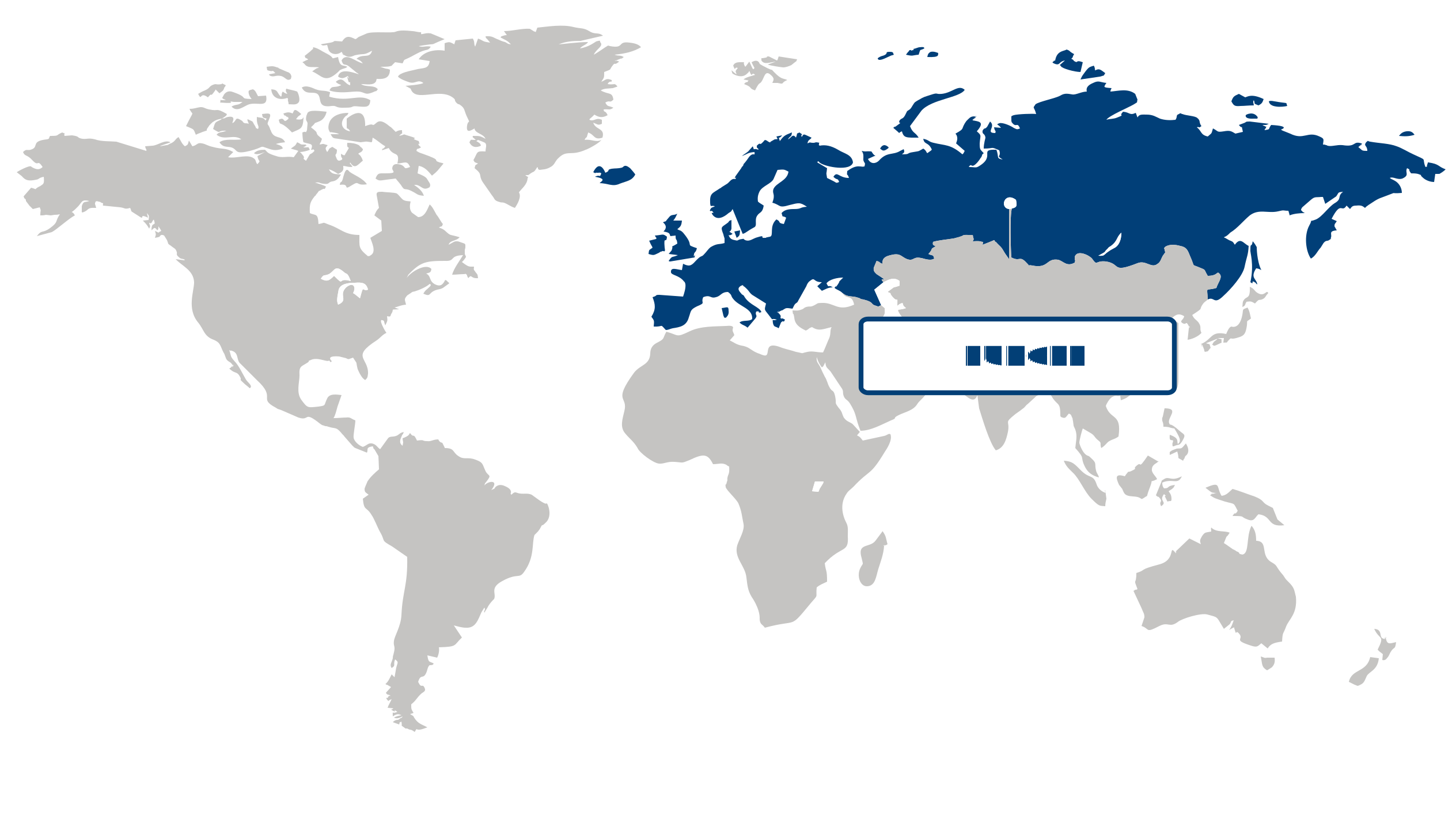
Largest Region
Europe
30.24% Market Share in 2026
Europe (Largest Region) vs Asia Pacific (Fastest-Growing Region)
Europe held the largest share of the automotive adhesive tapes market at 30.24% in 2026, supported by its established automotive manufacturing base, emphasis on lightweight vehicle construction, and growing adoption of advanced bonding solutions. Automotive manufacturers are increasingly using adhesive tapes as alternatives or complements to mechanical fastening methods because they can support weight reduction, improved surface finishing, vibration control, and efficient assembly. The region's focus on vehicle electrification is also creating opportunities for specialized adhesive applications in battery systems, electronic components, interior assemblies, and lightweight body structures. Strict environmental and vehicle-efficiency requirements are encouraging manufacturers to improve material utilization and production processes, while advances in high-performance adhesive formulations are expanding applications across demanding automotive environments.
Asia Pacific is the fastest-growing region, driven by expanding vehicle production, increasing investments in electric mobility, and rapid development of automotive component manufacturing. The growth of domestic automotive supply chains is creating wider opportunities for adhesive tapes across interior, exterior, electrical, battery, and structural applications. Manufacturers are increasingly seeking bonding technologies that can improve assembly efficiency while supporting lightweight vehicle designs and modern styling requirements. The expansion of electric vehicle production is particularly relevant because battery packs, sensors, displays, wiring systems, and other electronic components require reliable bonding and insulation solutions. Rising consumer demand for technologically advanced vehicles and continued investment in manufacturing capacity are further strengthening the regional adoption of automotive adhesive tapes.
Key Country Insights
The U.S. automotive adhesive tapes market is shaped by demand for lightweight vehicle assembly and efficient manufacturing processes. Automotive manufacturers in the U.S. increasingly adopt advanced tapes that improve component bonding while reducing assembly complexity and vehicle weight.
Japan emphasizes automotive adhesive tapes that enable lightweight component integration and efficient vehicle production. Japanese automakers increasingly utilize specialized bonding materials that improve durability while supporting compact and technologically advanced vehicle designs.
South Korea is expanding the use of automotive adhesive tapes as electric vehicle production increases and electronic component integration becomes more sophisticated. Manufacturers in South Korea prioritize high-performance tapes that provide reliable bonding under demanding operating conditions.
Germany prioritizes automotive adhesive tapes that support precision assembly and high-quality vehicle manufacturing across conventional and electric platforms. German manufacturers seek durable bonding solutions that enhance structural performance and design flexibility.
France focuses on automotive adhesive tapes for lightweight interiors, exterior trim, and acoustic performance improvements. Vehicle manufacturers in France increasingly adopt multifunctional bonding solutions that simplify assembly while supporting evolving vehicle design requirements.
Italy applies automotive adhesive tapes across premium vehicle production and specialized component manufacturing where aesthetics and precision are important. Italian manufacturers favor bonding technologies that improve assembly efficiency while maintaining high-quality vehicle finishes.
Segment Leadership and Growth Trends
Adhesive Chemistry Segment Analysis: Solvent-based Adhesives (Largest Segment) vs Emulsion-based Adhesives (Fastest-Growing Segment)
Solvent-based adhesives led the automotive adhesive tapes market with a 46.64% share in 2026, owing to their strong bonding performance and suitability for demanding automotive assembly environments. These adhesives provide reliable adhesion across diverse substrates and can withstand conditions involving vibration, temperature variation, and mechanical stress. Their established use in automotive attachment applications and consistent performance requirements continue to sustain their prominent position.
Emulsion-based adhesives are gaining traction as automotive manufacturers increasingly prioritize adhesive solutions that support more environmentally conscious production practices. Their water-based formulation characteristics can reduce reliance on solvent-intensive processes while still enabling effective bonding for selected automotive applications. Growing attention to manufacturing efficiency, material sustainability, and improved workplace conditions is encouraging greater consideration of emulsion-based adhesive technologies.
Application Segment Analysis: Interior Attachment (Largest Segment) vs Electronics (Fastest-Growing Segment)
Holding the largest share of the automotive adhesive tapes market, interior attachment represented 30.35% in 2026, supported by the extensive use of adhesive tapes for securing and assembling interior components. These solutions enable clean attachment of trim, panels, carpets, insulation materials, and other interior elements while reducing the need for mechanical fasteners. Demand for lightweight construction, improved cabin aesthetics, and efficient assembly processes further supports the widespread use of adhesive tapes in automotive interiors.
Electronics is emerging as a faster-growing application as vehicles incorporate increasingly sophisticated electronic systems and connected functions. Adhesive tapes can provide secure attachment, insulation, cushioning, and component protection while helping manufacturers manage space constraints within vehicle systems. The increasing integration of electronic components is therefore creating additional opportunities for specialized automotive adhesive tape solutions.
| Report Segmentation | |||
| Segment | Sub-Segment | Largest Segment | Fastest Growing Segment |
|---|---|---|---|
| Adhesive Chemistry | Solvent-based Adhesives, Emulsion-based Adhesives, Hot Melt Adhesives, Radiation Adhesives | Solvent-based Adhesives | Emulsion-based Adhesives |
| Application | Wire Harnessing, Powertrain, Acoustic Insulation, Interior Attachment, Exterior Attachment, Electronics, Chassis & Wheels | Interior Attachment | Electronics |
| Backing Material | Polypropylene, Polyvinylchloride, Paper, Others | Polyvinylchloride | Polyvinylchloride |
 Read our Research Approach
Competitive Landscape and Market Positioning
Major players in the automotive adhesive tapes market:
1. 3M Company (United States)
2. Nitto Denko Corporation (Japan)
3. tesa SE (Germany)
4. Avery Dennison Corporation (United States)
5. Sika Automotive AG (Switzerland)
6. L&L Products Inc. (United States)
7. Lintec Corporation (Japan)
8. Berry Global Inc. (United States)
9. Saint-Gobain S.A. (France)
10. PPG Industries Inc. (United States)
The automotive adhesive tapes market is evolving with increasing demand for lightweight bonding solutions in vehicle manufacturing. Advanced adhesive formulations are improving thermal and mechanical resistance. The automotive adhesive tapes market is also driven by applications that support vehicle electrification and design optimization.
Industry Development/News
| Company Name | Date | Key Development |
|---|---|---|
| Avery Dennison | Nov-25 | Avery Dennison introduced pressure-sensitive tapes, labels, and reflective solutions designed for electric vehicle charging infrastructure. The development expands its footprint into EV ecosystem applications, influencing demand dynamics for automotive adhesive tapes used in charging stations and adjacent electrical safety and identification use cases. |
| Avery Dennison | Jun-24 | Avery Dennison launched a cell-wrapping tape portfolio engineered to mitigate arcing within electric vehicle battery packs. The product strengthens its position in high-performance automotive materials by addressing EV battery safety requirements and supporting advanced insulation and protection functions in electrified vehicle architectures. |
| Berry Global Group | Apr-23 | Berry Global expanded a manufacturing facility in Lewisburg, Tennessee to scale production of stretch films and related adhesive-enabled materials. The expansion supports rising demand for sustainable packaging and automotive-adjacent applications, reinforcing its production capacity and strengthening its supply position in performance material markets. |
| L&L Products, Inc. | Feb-23 | L&L Products expanded its manufacturing footprint in Romeo, Michigan to increase production capacity for automotive finished goods. The investment enhances its ability to supply engineered materials to the automotive sector, strengthening its manufacturing base and supporting continued demand from vehicle OEMs and tier-one suppliers. |
| MarketsandMarkets | Mar-24 | MarketsandMarkets published a forecast projecting the automotive adhesive tapes market to reach USD 12.1 billion by 2026. The report provides structured demand outlooks and market segmentation analysis, supporting strategic planning and investment decisions across automotive adhesive and materials value chains. |
| 3M | Dec-20 | 3M launched 2480 Hi-Tack silicone adhesive tapes designed to deliver higher adhesion strength and improved durability performance. The product enhances 3M’s automotive and industrial adhesive portfolio by addressing demand for high-performance bonding solutions with extended wear characteristics in demanding applications. |
| tesa SE | May-20 | tesa SE expanded its manufacturing footprint through a new adhesive tape production plant in Vietnam, scheduled to begin operations in 2023. The expansion strengthens its Asia-Pacific supply capabilities and increases production capacity for automotive and industrial adhesive tape applications across high-growth regional markets. |
Why Choose Us
Specialized Expertise: Our team comprises industry experts with a deep understanding of your market segment. We bring specialized knowledge and experience that ensures our research and consulting services are tailored to your unique needs.
Customized Solutions: We understand that every client is different. That's why we offer customized research and consulting solutions designed specifically to address your challenges and capitalize on opportunities within your industry.
Proven Results: With a track record of successful projects and satisfied clients, we have demonstrated our ability to deliver tangible results. Our case studies and testimonials speak to our effectiveness in helping clients achieve their goals.
Cutting-Edge Methodologies: We leverage the latest methodologies and technologies to gather insights and drive informed decision-making. Our innovative approach ensures that you stay ahead of the curve and gain a competitive edge in your market.
Client-Centric Approach: Your satisfaction is our top priority. We prioritize open communication, responsiveness, and transparency to ensure that we not only meet but exceed your expectations at every stage of the engagement.
Continuous Innovation: We are committed to continuous improvement and staying at the forefront of our industry. Through ongoing learning, professional development, and investment in new technologies, we ensure that our services are always evolving to meet your evolving needs.
Value for Money: Our competitive pricing and flexible engagement models ensure that you get maximum value for your investment. We are committed to delivering high-quality results that help you achieve a strong return on your investment.
Select Licence Type

