Automotive Lightweight Material Market Size & Growth Forecast 2027–2036, By Segments (End Use, Material, Application), Regional Demand Trends (North America, Asia Pacific, Europe), Key Country Insights (U.S., Japan, South Korea, Germany, France, Italy), and Competitive Landscape
Market Size and Growth Outlook
Automotive Lightweight Material Market size was more than USD 102.27 billion in 2026 and is set to grow at a 2.19% CAGR between 2027 and 2036, reaching USD 127.01 billion by 2036. The industry revenue for 2027 is calculated at USD 104.15 billion.
Get more details on this report
Request Free Sample ReportAutomotive Lightweight Material Market Intelligence Snapshot
Regional Market Dynamics
- Europe held a 37.84% share in 2026, supported by established automakers, mature supplier networks, and widespread integration of lightweight materials in vehicle production.
- Asia Pacific is projected to grow at a 2.74% CAGR, driven by rising vehicle production and increasing adoption of lightweight components across mass-market manufacturing.
Segment Momentum
- Passenger cars accounted for 79.04% of the market in 2026, supported by high production volumes and broad use of lightweight materials across body structures, interiors, and closures to improve vehicle efficiency and performance.
- Plastics are the fastest-growing material segment due to their suitability for high-volume vehicle production, processing efficiency, cost control, and expanding use in both functional and aesthetic automotive components.
Market Expansion Drivers
- Stringent emission regulations accelerating adoption of lightweight automotive materials across vehicle platforms.
- Expanding electric vehicle production increasing demand for aluminum and composite lightweight components.
- Automakers optimizing lifecycle fuel efficiency through advanced high-strength lightweight material integration.
Leading Market Participants
- Major companies in the automotive lightweight material market include BASF SE (Germany), Toray Industries Inc. (Japan), LyondellBasell Industries N.V. (Netherlands), Novelis Inc. (USA), ArcelorMittal (Luxembourg), Alcoa Corporation (USA), Owens Corning (USA), Stratasys Ltd. (USA), Tata Steel Limited (India), POSCO Holdings Inc. (South Korea).
Global Market Forecast Snapshot
Market Outlook
- 2026 Market Size: USD 102.27 billion
- 2027 Estimated Market Size: USD 104.15 billion.
- Projected Market Size: USD 127.01 billion by 2036
- Growth Forecast: 2.19% CAGR (2027-2036)
Regional and Segment Outlook
- Leading Regional Market: Europe
- High-Growth Regional Hub: Asia Pacific
- Core Revenue Segment: Passenger Cars (End Use) | Composites (Material) | Body In White (Application)
- Emerging Opportunity Segment: Light Commercial Vehicles (LCV) (End Use) | Plastics (Material) | Closures (Application)
Market Growth Drivers and Industry Trends
Stringent emission regulations accelerating adoption of lightweight automotive materials across vehicle platforms
Stringent emission regulations will drive the automotive lightweight material market growth as vehicle manufacturers seek to reduce vehicle mass and improve efficiency while meeting increasingly demanding environmental requirements. Lightweight metals, advanced composites, and high-strength materials allow automakers to reduce weight without relying solely on conventional material structures, supporting improvements in vehicle energy efficiency. Material substitution is therefore becoming an important engineering strategy across body structures, chassis components, closures, and other vehicle systems affected by weight and emissions considerations.
Expanding electric vehicle production increasing demand for aluminum and composite lightweight components
Expanding electric vehicle production is strengthening the automotive lightweight material market as manufacturers seek to offset battery-related vehicle mass through lighter structural and body components. Aluminum and composite materials can provide useful combinations of low weight, strength, corrosion resistance, and design flexibility, making them suitable for applications across electric vehicle platforms. Reducing unnecessary vehicle mass can also support efficient use of stored battery energy while enabling manufacturers to balance vehicle performance, range, and structural requirements.
Automakers optimizing lifecycle fuel efficiency through advanced high-strength lightweight material integration
Automakers optimizing lifecycle fuel efficiency are increasing adoption of advanced high-strength lightweight materials and supporting the automotive lightweight material market through broader material engineering strategies. High-strength materials can enable thinner or more efficiently designed components while maintaining structural integrity, allowing manufacturers to manage weight without compromising safety requirements. Their integration across vehicle structures and load-bearing applications also supports more efficient material utilization and enables engineers to redesign components around weight reduction and durability objectives.
| Growth Driver | Impact on CAGR | Regulatory Influence | Geographic Relevance | Adoption Rate | Impact Timeline |
|---|---|---|---|---|---|
| Stringent emission regulations accelerating adoption of lightweight automotive materials across vehicle platforms | 1.80% | High | Europe, North America | High | Near Term |
| Expanding electric vehicle production increasing demand for aluminum and composite lightweight components | 1.70% | Moderate | Asia Pacific, Europe | High | Mid Term |
| Automakers optimizing lifecycle fuel efficiency through advanced high-strength lightweight material integration | 1.30% | Moderate | North America, Europe | Emerging | Long Term |
Explore Growth Opportunities
Request Free Sample ReportRegional Demand Dynamics
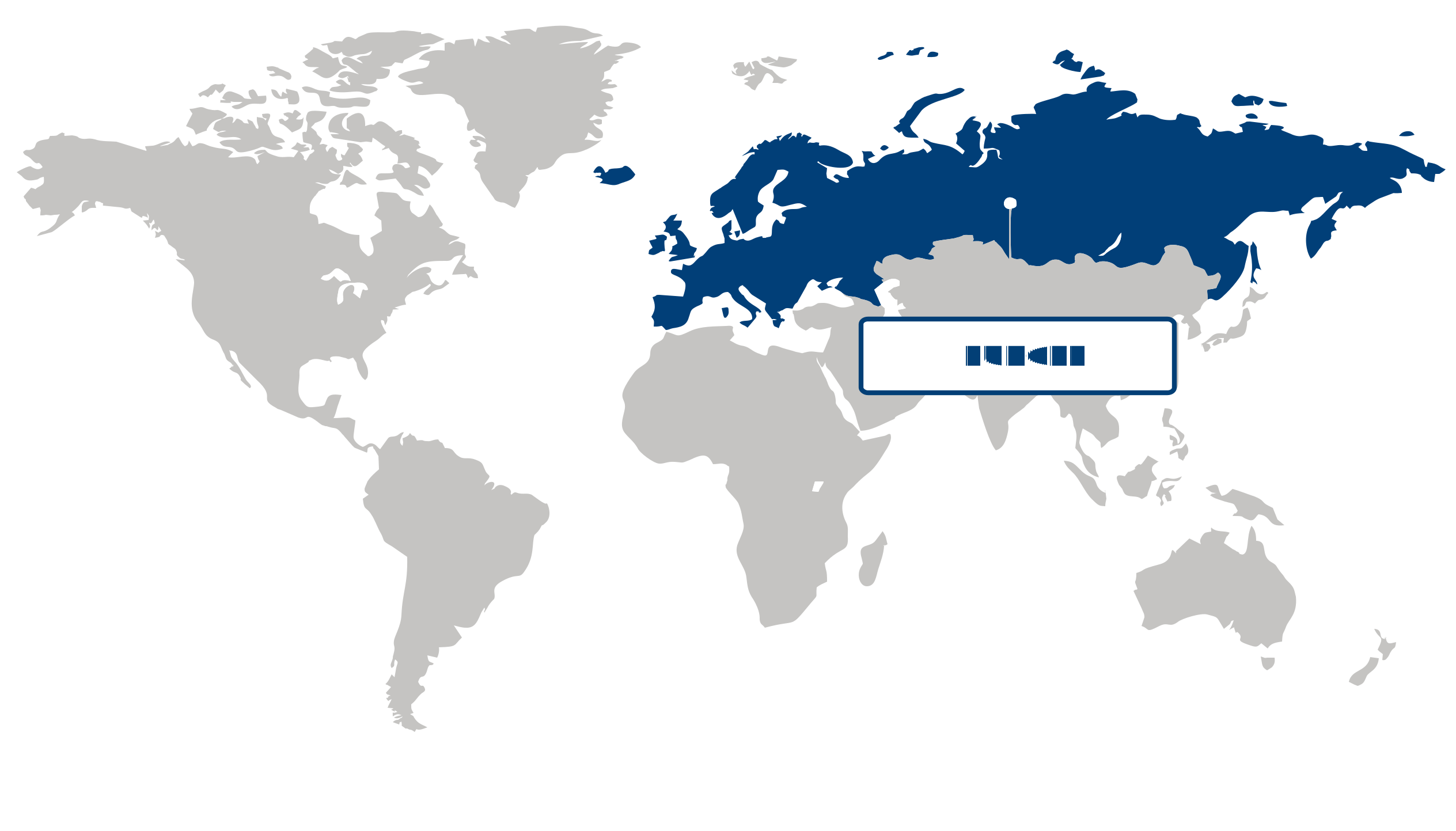
Europe (Largest Region)
Europe accounted for the largest share of the automotive lightweight material market, with 37.84% share in 2026. The region’s established automotive manufacturing base and strong emphasis on vehicle efficiency are supporting the adoption of materials that can reduce vehicle weight while maintaining structural performance. Environmental requirements and the industry's transition toward more efficient vehicle technologies are encouraging manufacturers to reconsider material selection across vehicle components. Ongoing innovation in advanced metals, composites, and other lightweight solutions is further strengthening their role in vehicle design and supporting demand across the automotive supply chain.
Asia Pacific (Fastest-Growing Region)
Asia Pacific represents the fastest-growing region for the automotive lightweight material market, supported by expanding vehicle production, rising automotive demand, and increasing adoption of advanced manufacturing technologies. Automakers and component manufacturers are placing greater emphasis on improving vehicle efficiency and performance, creating opportunities for lightweight materials across multiple applications. The region’s expanding electric mobility ecosystem is also encouraging greater attention to weight optimization, as manufacturers seek to improve vehicle efficiency and overall performance. Growing manufacturing capabilities and investments in automotive production are expected to reinforce the region’s adoption of advanced lightweight materials.
| Parameter | North America | Asia Pacific | Europe | Latin America | MEA |
|---|---|---|---|---|---|
| Innovation Hub i Scale Nascent Developing Advanced | |||||
| Cost-Sensitive Region i Scale Low Medium High | |||||
| Regulatory Environment i Scale Restrictive Neutral Supportive | |||||
| Demand Drivers i Scale Weak Moderate Strong | |||||
| Development Stage i Scale Emerging Developing Developed | |||||
| Adoption Rate i Scale Low Medium High | |||||
| New Entrants / Startups i Scale Sparse Moderate Dense | |||||
| Macro Indicators i Scale Weak Stable Strong |
Key Country Insights
Germany 🇩🇪
Engineering Material InnovationGermany prioritizes lightweight materials that support premium vehicle engineering and advanced manufacturing processes. Automotive manufacturers continue integrating innovative metal alloys and composites to enhance structural performance without compromising durability.
France 🇫🇷
Sustainable Material AdoptionFrance emphasizes lightweight automotive materials that contribute to lower vehicle emissions and improved manufacturing sustainability. Automakers increasingly evaluate recyclable materials and optimized component designs to meet evolving mobility requirements.
Italy 🇮🇹
Performance Component MaterialsItaly prioritizes lightweight materials for performance-oriented vehicles and specialized automotive manufacturing. Manufacturers increasingly integrate advanced composites and lightweight alloys that improve driving dynamics while supporting efficient production processes.
Japan 🇯🇵
Efficient Mobility MaterialsJapan focuses on lightweight automotive materials that improve energy efficiency across passenger and hybrid vehicles. Manufacturers increasingly adopt high-performance materials that enable compact vehicle designs while maintaining reliability and production efficiency.
South Korea 🇰🇷
Electric Vehicle MaterialsSouth Korea is strengthening the use of lightweight materials to support electric vehicle development and battery efficiency. Automotive suppliers increasingly invest in advanced composites and lightweight metals that enhance vehicle range and manufacturing flexibility.
United States 🇺🇸
Multi-Material Vehicle DesignThe U.S. automotive lightweight material market emphasizes advanced composites, aluminum, and high-strength steel to improve vehicle efficiency and performance. Automakers increasingly optimize material selection to balance weight reduction with manufacturing scalability and safety requirements.
Segment Leadership and Growth Trends
Automotive Lightweight Material Market Share (%), by End Use, 2026
Go beyond the chart, access full insights & data tables
Request Free Sample ReportEnd Use Segment Analysis: Passenger Cars (Largest Segment) vs Light Commercial Vehicles (LCV) (Fastest-Growing Segment)
Passenger cars represented the largest end-use segment in the automotive lightweight material market, holding a 79.04% share in 2026. Automakers increasingly use lightweight materials to reduce vehicle mass while supporting fuel efficiency, vehicle performance, and emissions objectives. The large production base and broad range of passenger vehicle applications create substantial opportunities for lightweight metals, composites, and plastics across structural, body, interior, and component applications. Growing consumer expectations for efficient and technologically advanced vehicles further encourage manufacturers to incorporate materials that deliver weight savings without compromising functional performance.
Light commercial vehicles (LCVs) are the fastest-growing end-use segment as fleet operators and manufacturers place greater emphasis on operating efficiency, payload optimization, and vehicle performance. Lightweight materials can help reduce vehicle mass and create greater flexibility for balancing payload requirements with efficiency objectives. Expanding commercial transportation activity and increasing attention to operating costs are encouraging manufacturers to explore lightweight solutions across LCV platforms, creating additional opportunities for advanced material adoption.
Material Segment Analysis: Composites (Largest Segment) vs Plastics (Fastest-Growing Segment)
Composites held the largest share of the automotive lightweight material market, accounting for 64.02% in 2026. Their strong position is supported by the ability to combine low weight with desirable mechanical and structural properties, making them suitable for applications where manufacturers seek meaningful mass reduction without sacrificing performance. Automotive manufacturers are increasingly evaluating material solutions that support vehicle efficiency and design flexibility, while composites can serve diverse applications across vehicle structures and components. Continued emphasis on weight reduction and material performance reinforces their leading position.
Plastics are the fastest-growing material segment as automotive manufacturers increasingly incorporate lightweight polymer-based materials into vehicle components. Plastics can offer weight reduction, design flexibility, corrosion resistance, and manufacturing advantages across interior, exterior, and functional applications. The growing use of electronics and increasingly complex vehicle designs is also creating opportunities for specialized plastic components. As automakers seek practical ways to reduce mass while maintaining functionality and design freedom, plastics are gaining greater importance in lightweight vehicle manufacturing.
| Segment | Sub-Segment | Largest Segment | Fastest Growing |
|---|---|---|---|
| End Use | Passenger Cars, Light Commercial Vehicles (LCV), Heavy Commercial Vehicles (HCV) | Passenger Cars | Light Commercial Vehicles (LCV) |
| Material | Metals, Composites, Plastics, Elastomers | Composites | Plastics |
| Application | Body In White, Chassis & Suspension, Powertrain, Closures, Interiors, Others | Body In White | Closures |
Unlock insights tailored to your business with our bespoke market research solutions.
Click to get your customized report now.
Competitive Landscape and Market Positioning
Top players in the automotive lightweight material market:
1. BASF SE (Germany)
2. Toray Industries Inc. (Japan)
3. LyondellBasell Industries N.V. (Netherlands)
4. Novelis Inc. (USA)
5. ArcelorMittal (Luxembourg)
6. Alcoa Corporation (USA)
7. Owens Corning (USA)
8. Stratasys Ltd. (USA)
9. Tata Steel Limited (India)
10. POSCO Holdings Inc. (South Korea)
The automotive lightweight material market is advancing through extensive research into high-strength composites, aluminum alloys, and sustainable material alternatives that support vehicle weight reduction goals. Industry consolidation and supply chain expansion initiatives are improving access to advanced lightweight solutions for next-generation mobility applications. Increasing regulatory pressure related to fuel efficiency and emissions reduction continues to drive innovation across material development processes.
| Company | Market Share | Company Revenue | Revenue CAGR (%) | Product Portfolio | Geographic Presence | Innovation / R&D Focus | Strategic Developments |
|---|---|---|---|---|---|---|---|
| BASF SE (Germany) | |||||||
| Toray Industries Inc. (Japan) | |||||||
| LyondellBasell Industries N.V. (Netherlands) | |||||||
| Novelis Inc. (USA) | |||||||
| ArcelorMittal (Luxembourg) | |||||||
| Alcoa Corporation (USA) | |||||||
| Owens Corning (USA) | |||||||
| Stratasys Ltd. (USA) | |||||||
| Tata Steel Limited (India) | |||||||
| POSCO Holdings Inc. (South Korea). |
Industry Development/News
| Company Name | Date | Key Development |
|---|---|---|
| BMW Group | Jan-26 | The BMW Group received the JEC Composites Innovation Award for its development of series-production exterior automobile components. The manufacturer integrated flax fiber-based natural composites into production vehicle body panels, achieving structural weight-saving objectives while significantly reducing its lifecycle CO₂e footprint. |
| ArcelorMittal S.A. | Nov-25 | ArcelorMittal S.A. launched an interactive digital 3D Car Configurator tool designed for original equipment manufacturer (OEM) engineers. The platform enables real-time selection of advanced high-strength steel grades and advanced coatings to model weight-saving, multi-material vehicle architectures for electrified platforms. |
| Continental Structural Plastics (CSP) | Nov-25 | Continental Structural Plastics (CSP) introduced 'TCA Ultra Lite Float', an ultra-lightweight composite formulation that is 23% lighter than previous generations. The material is designed to significantly reduce overall vehicle body-panel weight while fully maintaining structural performance, rigid impact resistance, and Class A paintability. |
| Hyundai Motor Group | Oct-25 | Hyundai Motor Group signed a Strategic Joint Development Agreement with Toray Industries to co-develop next-generation advanced composite materials. The partnership integrates research, development, and mass-production capabilities to commercialize lightweight, high-performance mobility solutions for next-generation electric vehicles. |
| BASF | Oct-25 | BASF, in collaboration with ETH Zurich and BEST GmbH, unveiled two pilot chemical recycling processes that successfully convert automotive shredder plastic waste and biomass into high-quality feedstock. The process advances circular economy closed-loop models for lightweight vehicle plastics. |
| Constellium SE | Jun-25 | Constellium SE unveiled new aluminum alloy engineering and specialized recycling technologies that reduce structural vehicle component weight by 20%. The manufacturing process lowers energy consumption by up to 95% compared to virgin metal production, positioning recycled aluminum as a sustainable alternative to structural composites. |
| LyondellBasell Industries Holdings B.V. | Oct-22 | LyondellBasell developed a lightweight polypropylene (PP) compound designed to reduce total vehicle weight by up to 10kg. The high-performance polymer formulation supports part foaming, density reduction, and thin-walling of components, acting as a direct metal substitute that eliminates the need for automotive paint. |
Customize Your Report
Explore examples of how this report can be tailored to different research needs, including custom segments, additional topics or chapters, and related reports. Click a section of the wheel or its numbered marker to explore the available options.
Automotive Lightweight Material Market — Custom Segments
| Segment | Sub-Segment |
|---|---|
| Manufacturing Process | Stamping & Forming, Casting, Injection & Compression Molding, Pultrusion & Resin Transfer Molding, Additive Manufacturing |
| Propulsion Type Compatibility | Internal Combustion Engine Vehicles, Hybrid Electric Vehicles, Battery Electric Vehicles, Fuel Cell Electric Vehicles |
| OEM Supply Chain Tier | Tier 1 Suppliers, Tier 2 Suppliers, Tier 3 Suppliers, Direct OEM Procurement |
Automotive Lightweight Material Market — Custom TOC
| Custom Chapter | Custom Details |
|---|---|
| Vehicle Platform Lightweighting Roadmap Assessment |
|
| Multi-Material Adoption Strategy Benchmarking |
|
| Circular Material Recovery and Recycling Economics |
|
Need a different cut of the data?
Request Custom ResearchWhat is the current size of the automotive lightweight material market?
What are the growth projections for the automotive lightweight material industry?
How are emission regulations reshaping material selection strategies in the automotive lightweight material market?
Why is electric vehicle production accelerating demand for advanced lightweight materials?
Why do passenger cars lead the automotive lightweight material market?
Which material segment is growing fastest in the automotive lightweight material market?
Why does Europe lead the automotive lightweight material market?
How is Asia Pacific supporting future growth in automotive lightweight materials?
Who are the leading players in the automotive lightweight material landscape?
Our Clients
"The team surpassed our expectations with the report depth. The actionable insights provided proved crucial in navigating market challenges."
Tata Motors
"We found the report to be very informative. The expertise and attention to market nuances significantly influenced our business direction."
DENSO Corporation
"The consumer survey findings were quite good. We now have a clearer picture of the customer churning and retention strategy."
HL Mando
Our Research Team & Methodology
Every Fundamental Business Insights report is built by a dedicated vertical research team, validated through a structured primary-and-secondary methodology, and reviewed for accuracy before it reaches you.
Research Team Overview
Prepared by the Automotive & Transportation Research Team
Delivery
Published
Demand
Available
Support
Trust & Compliance
Research Intelligence
Research Workflow & Quality Assurance
Data Collection
Verified information gathered through primary and secondary research.
Data Triangulation
Cross-validation using multiple independent data sources.
Forecast Modelling
Market estimates developed using historical trends and analytical models.
Analyst Validation
Findings reviewed by domain experts for accuracy and consistency.
Editorial & Quality Review
Final editorial, quality, and compliance checks before publication.
Final Publication
Released after successful completion of the internal review process.
Report Coverage
📊 Market Assessment
- Market Size & Forecast
- Market Segmentation
- Regional Analysis
- Growth Drivers & Challenges
- Market Dynamics
🏢 Competitive Intelligence
- Competitive Landscape
- Company Profiles
- Competitive Benchmarking
- Mergers & Acquisitions
- Market Share Analysis or Key Company Strategies
🔍 Strategic Analysis
- Value Chain Analysis
- Porter's Five Forces
- PESTLE Analysis
- Pricing Trends
- Supply-Demand Analysis
🚀 Future Outlook
- Technology Landscape
- Regulatory Landscape
- Investment & Funding Landscape
- Emerging Opportunities
- Future Market Outlook
Have a question about this report or need a custom scope?
Request Customization