Automotive Polymer Composites Market Size & Growth Forecast 2027–2036, By Segments (Product, End Use, Application, Manufacturing Process, Material), Regional Demand Trends (North America, Asia Pacific, Europe), Key Country Insights (U.S., Japan, South Korea, Germany, France, Italy), and Competitive Landscape
Market Size and Growth Outlook
Automotive Polymer Composites Market size was around USD 12.1 billion in 2026 and is slated to grow at a 4.75% CAGR from 2027 to 2036, reaching USD 19.25 billion by 2036. The industry revenue for 2027 is assessed at USD 12.58 billion.
Get more details on this report
Request Free Sample ReportAutomotive Polymer Composites Market Intelligence Snapshot
Regional Market Dynamics
- Europe accounted for a 39.33% share in 2026, supported by mature automotive manufacturing, OEM supply chains, and composite integration for lightweight vehicle designs.
- Asia Pacific is projected to expand at a 5.76% CAGR, driven by rising vehicle production and wider use of lightweight materials.
Segment Momentum
- Glass Fiber Reinforced Polymer Composite accounted for 63.63% of the market in 2026 by offering an effective balance of lightweight performance, mechanical strength, and cost efficiency for high-volume vehicle production.
- Electric Vehicles are expanding fastest because lightweight polymer composites help offset battery weight, improve vehicle efficiency, and support evolving electric vehicle platform designs.
Market Expansion Drivers
- Rising demand for lightweight vehicles and fuel-efficient designs accelerating polymer composite adoption.
- Growing electric vehicle production increasing need for weight reduction and battery efficiency optimization.
- Stringent emission regulations driving substitution of metals with high-performance composite materials.
Leading Market Participants
- Key players in the automotive polymer composites market include BASF SE (Germany), Covestro AG (Germany), DuPont de Nemours, Inc. (United States), Hexcel Corporation (United States), Mitsubishi Chemical Group Corporation (Japan), Owens Corning (United States), Gurit Holding AG (Switzerland), Johns Manville Corporation (United States), Kolon Industries, Inc. (South Korea), SGL Carbon SE (Germany).
Global Market Forecast Snapshot
Market Outlook
- 2026 Market Size: USD 12.1 billion
- 2027 Estimated Market Size: USD 12.58 billion.
- Projected Market Size: USD 19.25 billion by 2036
- Growth Forecast: 4.75% CAGR (2027-2036)
Regional and Segment Outlook
- Leading Regional Market: Europe
- High-Growth Regional Hub: Asia Pacific
- Core Revenue Segment: Glass Fiber Reinforced Polymer Composite (Product) | Conventional Vehicles (End Use) | Exterior Components (Application) | Compression Molding (Manufacturing Process) | Polyester (Material)
- Emerging Opportunity Segment: Carbon Fiber Reinforced Polymer Composite (Product) | Electric Vehicles (End Use) | Interior Components (Application) | Injection Molding (Manufacturing Process) | Vinyl Ester (Material)
Market Growth Drivers and Industry Trends
Rising demand for lightweight vehicles and fuel-efficient designs accelerating polymer composite adoption
The automotive polymer composites market is expanding as vehicle manufacturers seek to reduce overall vehicle weight without compromising structural performance, durability, or design flexibility. Polymer composites can provide favorable strength-to-weight characteristics and can be molded into complex shapes, enabling their use across body components, interior parts, under-the-hood applications, and structural elements. Increasing emphasis on fuel-efficient vehicle designs is encouraging greater consideration of these materials as automakers seek alternatives to heavier conventional materials while maintaining performance and manufacturing efficiency.
Growing electric vehicle production increasing need for weight reduction and battery efficiency optimization
Growing electric vehicle production is creating stronger demand for the automotive polymer composites market because vehicle weight has a direct influence on energy consumption, driving range, and overall system efficiency. Lightweight composite components can help offset the additional mass associated with batteries and supporting electrical systems, allowing manufacturers to optimize vehicle architecture without relying solely on larger battery capacity. Their potential use in battery housings, structural components, interiors, and exterior parts also supports greater material flexibility as electric vehicle platforms evolve.
Stringent emission regulations driving substitution of metals with high-performance composite materials
Stringent emissions requirements are encouraging adoption of the automotive polymer composites market as manufacturers pursue material strategies that can reduce vehicle mass and support compliance with environmental performance targets. Replacing selected metal components with high-performance polymer composites can lower component weight while providing resistance to corrosion, design flexibility, and integration of multiple functions into molded parts. As automotive engineering increasingly focuses on improving efficiency across vehicle platforms, composite materials are being evaluated for applications where their performance characteristics can provide advantages over conventional metal construction.
| Growth Driver | Impact on CAGR | Regulatory Influence | Geographic Relevance | Adoption Rate | Impact Timeline |
|---|---|---|---|---|---|
| Rising demand for lightweight vehicles and fuel-efficient designs accelerating polymer composite adoption | 2.00% | High | Europe, Asia Pacific | High | Near Term |
| Growing electric vehicle production increasing need for weight reduction and battery efficiency optimization | 1.80% | High | Asia Pacific, Europe | High | Mid Term |
| Stringent emission regulations driving substitution of metals with high-performance composite materials | 1.60% | High | Europe, North America | High | Mid Term |
Unlock insights tailored to your business with our bespoke market research solutions.
Click to get your customized report now.
Regional Demand Dynamics
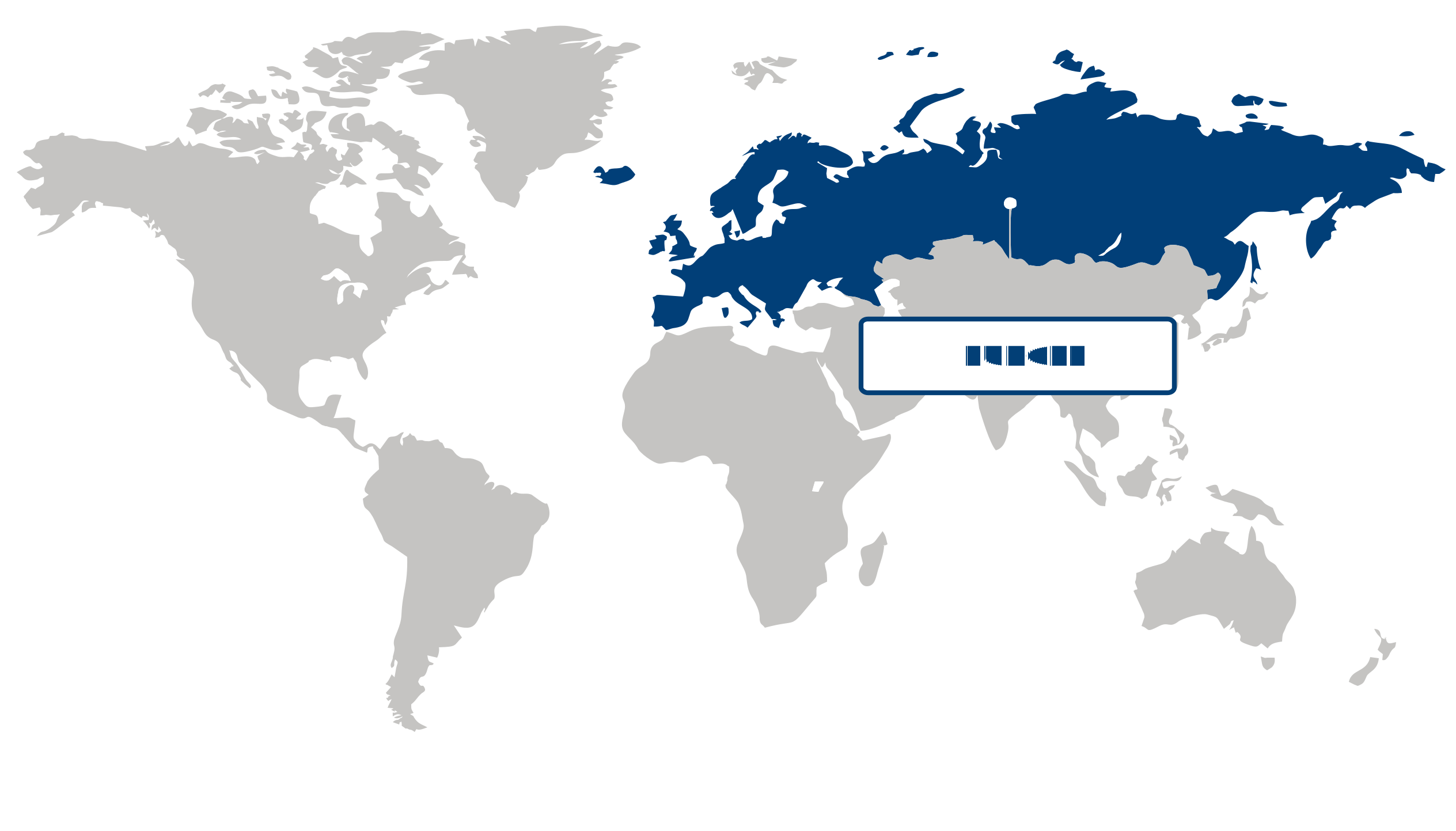
Europe (Largest Region)
Europe accounted for a 39.33% share of the automotive polymer composites market in 2026, supported by its strong automotive manufacturing base and emphasis on lightweight vehicle design. Automotive manufacturers are increasingly focused on reducing vehicle weight while maintaining structural performance, durability, and design flexibility, strengthening the role of polymer composites in vehicle components. The region's focus on vehicle efficiency, emissions reduction, and advanced material development also encourages greater use of lightweight composite solutions across interior, exterior, and structural applications.
Asia Pacific (Fastest-Growing Region)
Asia Pacific is the fastest-growing region, driven by expanding automotive production, rising vehicle demand, and increasing adoption of lightweight materials across passenger and commercial vehicles. Growing manufacturing capacity and continued development of automotive supply chains are creating favorable conditions for composite material adoption. The region is also benefiting from efforts to improve vehicle efficiency and incorporate advanced materials into next-generation vehicle platforms, supporting broader applications for polymer composites as automotive manufacturers pursue performance and weight optimization.
| Parameter | North America | Asia Pacific | Europe | Latin America | MEA |
|---|---|---|---|---|---|
| Innovation Hub i Scale Nascent Developing Advanced | |||||
| Cost-Sensitive Region i Scale Low Medium High | |||||
| Regulatory Environment i Scale Restrictive Neutral Supportive | |||||
| Demand Drivers i Scale Weak Moderate Strong | |||||
| Development Stage i Scale Emerging Developing Developed | |||||
| Adoption Rate i Scale Low Medium High | |||||
| New Entrants / Startups i Scale Sparse Moderate Dense | |||||
| Macro Indicators i Scale Weak Stable Strong |
Key Country Insights
Germany 🇩🇪
Premium automotive materialsIn Germany, the automotive polymer composites market is anchored in premium vehicle manufacturing and advanced engineering requirements. Automakers emphasize high-performance composite materials for structural and interior applications, with strong alignment to precision design standards and long development cycles in luxury and performance segments.
France 🇫🇷
Sustainable mobility materialsIn France, the automotive polymer composites market is influenced by sustainability-driven mobility programs and regulatory pressure on emissions reduction. Manufacturers emphasize recyclable and bio-based composites for vehicle interiors and structural parts, aligning material innovation with long-term environmental and design priorities.
Italy 🇮🇹
Design-led composite adoptionIn Italy, the automotive polymer composites market reflects strong design orientation and niche vehicle manufacturing. Demand is concentrated in styling-intensive segments where composites enable complex shapes, lightweight construction, and customization, particularly across specialty cars and coachbuilding applications.
Japan 🇯🇵
Efficiency-driven composites useIn Japan, the automotive polymer composites market is guided by efficiency optimization and compact vehicle design strategies. Manufacturers adopt composites to reduce weight while maintaining durability, particularly in hybrid and small vehicle segments, with strong integration into tightly engineered production systems.
South Korea 🇰🇷
EV body component shiftIn South Korea, the automotive polymer composites market is increasingly linked to electric vehicle development and evolving body component requirements. Automakers and suppliers focus on lightweight structural parts and cost-efficient composite solutions that support rapid EV platform scaling and modular production strategies.
United States 🇺🇸
Lightweight vehicle integrationIn the U.S., the automotive polymer composites market is driven by lightweighting initiatives across passenger and commercial vehicles, with strong adoption in EV platforms. OEMs prioritize scalable composite integration to improve fuel efficiency and range, while suppliers focus on high-volume manufacturing compatibility and structural performance.
Segment Leadership and Growth Trends
Automotive Polymer Composites Market Share (%), by Product, 2026
Go beyond the chart, access full insights & data tables
Request Free Sample ReportProduct Segment Analysis: Glass Fiber Reinforced Polymer Composite (Largest Segment) vs Carbon Fiber Reinforced Polymer Composite (Fastest-Growing Segment)
The glass fiber reinforced polymer composite segment dominated the automotive polymer composites market with a 63.63% share in 2026, supported by its favorable balance of strength, weight reduction, durability, and cost efficiency. These composites are widely used across automotive components where manufacturers seek to reduce vehicle mass without compromising structural performance. Continued emphasis on fuel efficiency and lightweight vehicle design reinforces the segment's leading position.
The carbon fiber reinforced polymer composite segment is expected to be the fastest-growing segment, driven by increasing demand for high-strength and lightweight materials in advanced automotive applications. Carbon fiber composites offer significant weight-reduction potential and are gaining relevance as manufacturers develop performance-oriented and next-generation vehicles. Growing investment in lightweight engineering is expected to support segment growth.
End Use Segment Analysis: Conventional Vehicles (Largest Segment) vs Electric Vehicles (Fastest-Growing Segment)
The automotive polymer composites market was led by the conventional vehicles segment, which held a 52.26% share in 2026, supported by the large global fleet and continued production of vehicles powered by conventional propulsion systems. Automotive manufacturers are increasingly using composite materials to improve fuel efficiency, reduce weight, and enhance component performance. The broad production base of conventional vehicles continues to reinforce the segment's dominant position.
The electric vehicles segment is expected to be the fastest-growing segment, driven by the need to offset battery weight and improve overall vehicle efficiency through lightweight construction. Polymer composites can provide manufacturers with design flexibility while supporting weight reduction and structural performance. The continued expansion of electric vehicle production is expected to create substantial growth opportunities for composite materials.
| Segment | Sub-Segment | Largest Segment | Fastest Growing |
|---|---|---|---|
| Product | Glass Fiber Reinforced Polymer Composite, Natural Fiber Reinforced Polymer Composite, Carbon Fiber Reinforced Polymer Composite | Glass Fiber Reinforced Polymer Composite | Carbon Fiber Reinforced Polymer Composite |
| End Use | Conventional Vehicles, Electric Vehicles, Trucks & Buses | Conventional Vehicles | Electric Vehicles |
| Application | Interior Components, Exterior Components, Structural Components, Powertrain Components | Exterior Components | Interior Components |
| Manufacturing Process | Compression Molding, Injection Molding, Sheet Molding, Resin Transfer Molding | Compression Molding | Injection Molding |
| Material | Epoxy, Polyurethane, Polyamide, Polypropylene, Polyethylene, Polyester, Vinyl Ester, Others | Polyester | Vinyl Ester |
Competitive Landscape and Market Positioning
Top players in the automotive polymer composites market:
1. BASF SE (Germany)
2. Covestro AG (Germany)
3. DuPont de Nemours Inc. (United States)
4. Hexcel Corporation (United States)
5. Mitsubishi Chemical Group Corporation (Japan)
6. Owens Corning (United States)
7. Gurit Holding AG (Switzerland)
8. Johns Manville Corporation (United States)
9. Kolon Industries Inc. (South Korea)
10. SGL Carbon SE (Germany)
The automotive polymer composites market is witnessing growing adoption of lightweight material systems designed for improved efficiency. Innovation is increasingly focused on durability and environmental performance characteristics. Expansion across mobility applications is also encouraging broader material experimentation. The automotive polymer composites market continues to evolve toward sustainable and high-performance structural solutions.
| Company | Market Share | Company Revenue | Revenue CAGR (%) | Product Portfolio | Geographic Presence | Innovation / R&D Focus | Strategic Developments |
|---|---|---|---|---|---|---|---|
| BASF SE (Germany) | |||||||
| Covestro AG (Germany) | |||||||
| DuPont de Nemours Inc. (United States) | |||||||
| Hexcel Corporation (United States) | |||||||
| Mitsubishi Chemical Group Corporation (Japan) | |||||||
| Owens Corning (United States) | |||||||
| Gurit Holding AG (Switzerland) | |||||||
| Johns Manville Corporation (United States) | |||||||
| Kolon Industries Inc. (South Korea) | |||||||
| SGL Carbon SE (Germany). |
Industry Development/News
| Company Name | Date | Key Development |
|---|---|---|
| BASF | May-24 | BASF introduced a sustainable photovoltaic frame solution developed with Worldlight, replacing aluminum components with polyurethane-based composites and water-borne coating systems. The innovation achieves an 85% reduction in product carbon footprint, strengthening BASF’s positioning in low-emission automotive and energy-related composite material solutions. |
| Mitsubishi Chemical Group Corporation | Feb-24 | Mitsubishi Chemical Group Corporation developed a heat-resistant ceramic matrix composite using carbon fibers derived from pitch, capable of withstanding temperatures up to 1,500°C. The material is targeted for aerospace applications and strengthens the company’s advanced composites portfolio for high-temperature structural environments. |
| Pyrophobic Systems Ltd | Feb-23 | Pyrophobic Systems Ltd’s LithiumPrevent 200 material was selected by General Motors for battery-related applications. The adoption strengthens the company’s position in automotive safety composites by supporting advanced thermal and fire-resistant material requirements in electric vehicle battery systems. |
Customize Your Report
Explore examples of how this report can be tailored to different research needs, including custom segments, additional topics or chapters, and related reports. Click a section of the wheel or its numbered marker to explore the available options.
Automotive Polymer Composites Market — Custom Segments
| Segment | Sub-Segment |
|---|---|
| OEM vs. Aftermarket | Original Equipment Manufacturing, Aftermarket Replacement, Aftermarket Customization & Modification |
| Manufacturing Stage | Component Manufacturing, Vehicle Assembly Integration, Vehicle Finishing & Integration, Replacement & Repair |
| Vehicle Class | Passenger Cars, Light Commercial Vehicles, Heavy Commercial Vehicles, Buses, Specialty Vehicles |
Automotive Polymer Composites Market — Custom TOC
| Custom Chapter | Custom Details |
|---|---|
| Lightweight Vehicle Material Strategy |
|
| EV Composite Integration Roadmap |
|
| Recyclable Composite Adoption Strategy |
|
Need a different cut of the data?
Request Custom ResearchWhat is the current revenue of the automotive polymer composites market?
What is the forecasted size of the automotive polymer composites industry?
How is vehicle lightweighting reshaping material adoption in the automotive polymer composites market?
Why is electric vehicle growth accelerating demand for automotive polymer composites?
Why do Glass Fiber Reinforced Polymer Composites dominate the automotive polymer composites market?
Why are electric vehicles the fastest-growing end-use segment in the automotive polymer composites market?
What supports Europe’s leadership in automotive polymer composites adoption?
How is Asia Pacific accelerating growth in the automotive polymer composites market?
Which companies are driving growth in the automotive polymer composites landscape?
Our Clients
"The team surpassed our expectations with the report depth. The actionable insights provided proved crucial in navigating market challenges."
Tata Motors
"We found the report to be very informative. The expertise and attention to market nuances significantly influenced our business direction."
DENSO Corporation
"The consumer survey findings were quite good. We now have a clearer picture of the customer churning and retention strategy."
HL Mando
Our Research Team & Methodology
Every Fundamental Business Insights report is built by a dedicated vertical research team, validated through a structured primary-and-secondary methodology, and reviewed for accuracy before it reaches you.
Research Team Overview
Prepared by the Automotive & Transportation Research Team
Delivery
Published
Demand
Available
Support
Trust & Compliance
Research Domains
10 coverage areasResearch Intelligence
| Source | Reference |
|---|---|
| International Organization of Motor Vehicle Manufacturers (OICA) | www.oica.net |
| SAE International | www.sae.org |
| International Energy Agency (IEA) | www.iea.org |
| International Transport Forum (ITF) | www.itf-oecd.org |
| International Road Federation (IRF) | www.irf.global |
| International Organization for Standardization (ISO) | www.iso.org |
| United Nations Economic Commission for Europe (UNECE) | unece.org |
| National Highway Traffic Safety Administration (NHTSA) | www.nhtsa.gov |
| U.S. Department of Transportation (USDOT) | www.transportation.gov |
| European Automobile Manufacturers' Association (ACEA) | www.acea.auto |
| Society of Indian Automobile Manufacturers (SIAM) | www.siam.in |
| International Air Transport Association (IATA) | www.iata.org |
| International Civil Aviation Organization (ICAO) | www.icao.int |
| International Maritime Organization (IMO) | www.imo.org |
| International Union of Railways (UIC) | uic.org |
| American Public Transportation Association (APTA) | www.apta.com |
| International Federation of Robotics (IFR) | ifr.org |
| CharIN | www.charin.global |
| World Shipping Council | www.worldshipping.org |
| International Federation of Freight Forwarders Associations (FIATA) | fiata.org |
Research Workflow & Quality Assurance
Data Collection
Verified information gathered through primary and secondary research.
Data Triangulation
Cross-validation using multiple independent data sources.
Forecast Modelling
Market estimates developed using historical trends and analytical models.
Analyst Validation
Findings reviewed by domain experts for accuracy and consistency.
Editorial & Quality Review
Final editorial, quality, and compliance checks before publication.
Final Publication
Released after successful completion of the internal review process.
Report Coverage
📊 Market Assessment
- Market Size & Forecast
- Market Segmentation
- Regional Analysis
- Growth Drivers & Challenges
- Market Dynamics
🏢 Competitive Intelligence
- Competitive Landscape
- Company Profiles
- Competitive Benchmarking
- Mergers & Acquisitions
- Market Share Analysis or Key Company Strategies
🔍 Strategic Analysis
- Value Chain Analysis
- Porter's Five Forces
- PESTLE Analysis
- Pricing Trends
- Supply-Demand Analysis
🚀 Future Outlook
- Technology Landscape
- Regulatory Landscape
- Investment & Funding Landscape
- Emerging Opportunities
- Future Market Outlook
Have a question about this report or need a custom scope?
Request Customization