



Automotive RADAR Market Size & Growth Forecast 2027–2036, By Segments (Range, Engine, Vehicle, Frequency, Application), Regional Demand Trends (North America, Asia Pacific, Europe), Key Country Insights (U.S., Japan, South Korea, Germany, France, Italy), and Competitive Landscape
Market Size and Growth Outlook
Automotive RADAR Market size was over USD 10.5 billion in 2026 and is likely to grow at a 27.84% CAGR between 2027 and 2036, exceeding USD 122.42 billion by 2036. The industry revenue for 2027 is assessed at USD 12.96 billion.
Base Year Value (2026)
USD 10.5 billion
CAGR (2027-2036)
27.84%
Forecast Year Value (2036)
USD 122.42 billion

Historical Data Period
2022-2026

Largest Region
Europe

Forecast Period
2027-2036
Automotive RADAR Market Intelligence Snapshot:
-
Regional Market Dynamics:
- Europe leads with 38.18% share due to strong OEM presence, advanced ADAS integration, and strict safety regulations driving widespread adoption of radar-based driver assistance systems.
- Asia Pacific’s 31.57% CAGR is driven by rapid vehicle production growth, expanding ADAS adoption in mass-market models, and rising automotive electronics manufacturing investments.
-
Segment Momentum:
- Medium & Short Range Radar held a 57.65% share in 2026, supported by widespread deployment in blind spot detection, parking assistance, lane change support, and other high-volume driver-assistance applications.
- Electric vehicles are adopting radar more rapidly because newer platforms are designed with advanced sensor integration, connected features, and driver-assistance capabilities from the beginning of vehicle development.
-
Market Expansion Drivers:
- Rising ADAS deployment increasing integration of automotive radar for collision avoidance systems.
- Stricter vehicle safety regulations accelerating multi-radar sensor adoption across passenger vehicles.
- Advancements in compact high-frequency radar improving autonomous driving and perimeter sensing capabilities.
-
Leading Market Participants:
Key companies in the automotive RADAR market include Robert Bosch GmbH (Germany), Continental AG (Germany), DENSO Corporation (Japan), Valeo SE (France), ZF Friedrichshafen AG (Germany), HELLA GmbH & Co. KGaA (Germany), Infineon Technologies AG (Germany), NXP Semiconductors N.V. (Netherlands), Texas Instruments Incorporated (United States), Aptiv PLC (Ireland).
Global Market Forecast Snapshot:
-
Market Outlook:
- 2026 Market Size: USD 10.5 billion
- 2027 Estimated Market Size: USD 12.96 billion.
- Projected Market Size: USD 122.42 billion by 2036
- Growth Forecasts: 27.84% CAGR (2027-2036)
-
Regional and Segment Outlook:
- Leading Regional Market: Europe
- High-Growth Regional Hub: Asia Pacific
- Core Revenue Segment: Medium & Short Range Radar (Range) | ICE (Engine) | Passenger Cars (Vehicle) | 7X-GHz (Frequency) | Adaptive Cruise Control (ACC) (Application)
- Emerging Opportunity Segment: Medium & Short Range Radar (Range) | Electric (Engine) | Passenger Cars (Vehicle) | 7X-GHz (Frequency) | Forward Collision Warning System (Application)
Market Growth Drivers and Industry Trends
Rising ADAS deployment increasing integration of automotive radar for collision avoidance systems
The expanding adoption of advanced driver assistance systems is increasing the use of radar sensors for detecting vehicles, pedestrians, and surrounding objects, which will drive the automotive RADAR market growth as manufacturers add more sensing capabilities to vehicles. Radar provides reliable distance and relative-speed information across varying visibility conditions, making it well suited for functions such as adaptive cruise control, forward collision warning, and automatic emergency braking. As vehicle safety systems become more sophisticated, radar integration is extending across multiple sensing zones to improve object detection and support coordinated driver-assistance functions.
Stricter vehicle safety regulations accelerating multi-radar sensor adoption across passenger vehicles
Stronger vehicle safety requirements are encouraging automakers to incorporate more comprehensive sensing architectures, supporting automotive RADAR market growth through increased deployment of radar across passenger vehicles. Regulatory emphasis on collision prevention and enhanced driver assistance is pushing manufacturers to improve coverage around the vehicle rather than relying on limited forward-facing detection. Multiple radar sensors can provide complementary front, rear, and side coverage, helping vehicle systems identify surrounding traffic and potential hazards during lane changes, parking, and other driving situations.
Advancements in compact high-frequency radar improving autonomous driving and perimeter sensing capabilities
Progress in compact, high-frequency radar technology is expanding sensing performance while making it easier to integrate multiple sensors into vehicle body structures, thereby boosting automotive RADAR market growth. Higher-resolution radar can provide more detailed information about the position, movement, and characteristics of nearby objects, which is valuable for automated driving and complex environmental perception. Smaller sensor designs also support discreet installation across bumpers, mirrors, and other vehicle areas, enabling broader perimeter monitoring without creating significant packaging constraints.
| Growth Driver Assessment Framework | |||||
| Growth Driver | Impact On CAGR | Regulatory Influence | Geographic Relevance | Adoption Rate | Impact Timeline |
|---|---|---|---|---|---|
| Rising ADAS deployment increasing integration of automotive radar for collision avoidance systems | 2.00% | High | Europe, North America | High | Near Term |
| Stricter vehicle safety regulations accelerating multi-radar sensor adoption across passenger vehicles | 1.90% | High | Europe, Asia Pacific | High | Mid Term |
| Advancements in compact high-frequency radar improving autonomous driving and perimeter sensing capabilities | 1.60% | Moderate | North America, Asia Pacific | Emerging | Mid Term |
Unlock insights tailored to your business with our bespoke market research solutions - Click to get your customized report now!
Regional Demand Dynamics
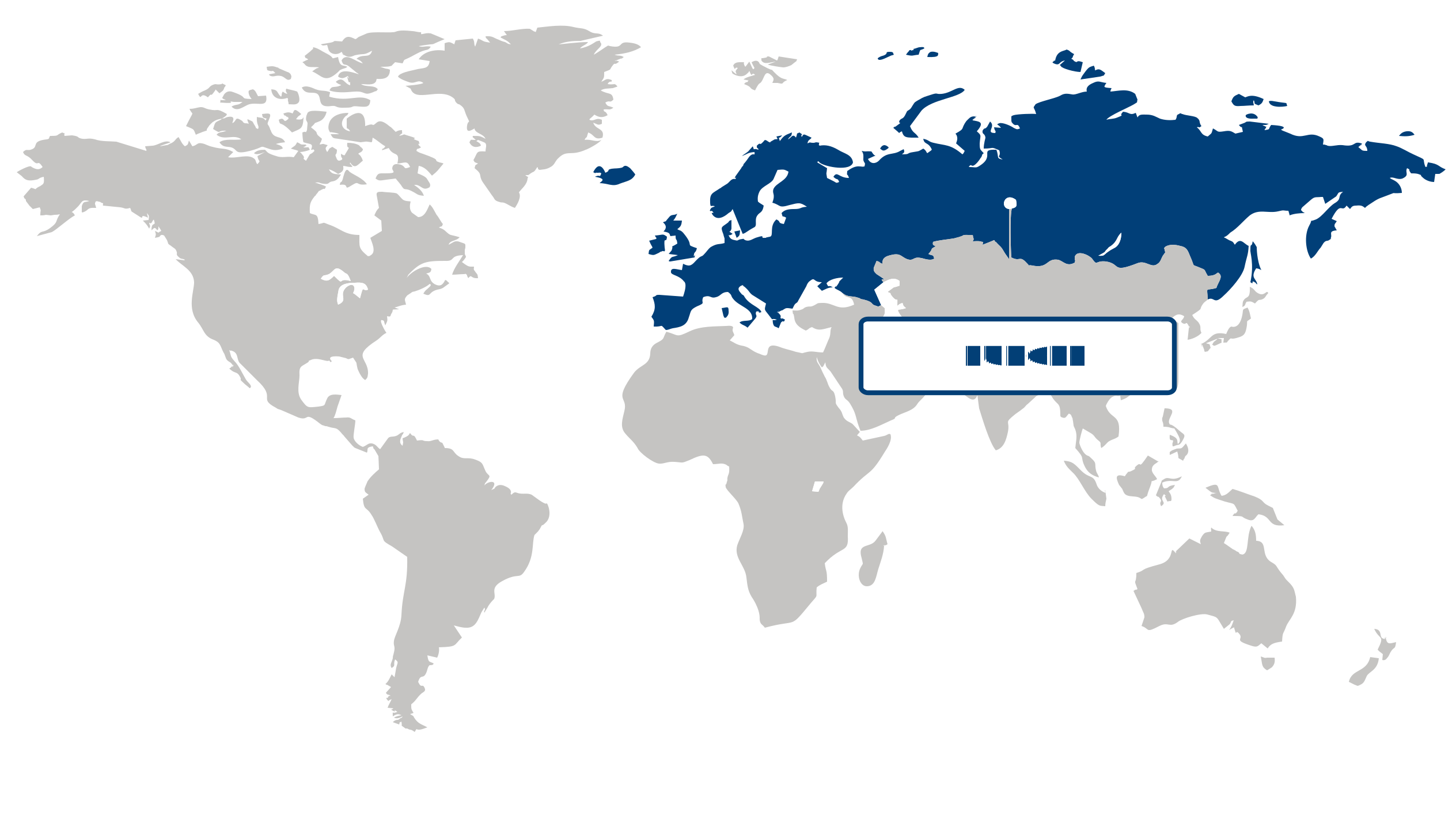
Largest Region
Europe
38.18% Market Share in 2026
Europe (Largest Region) vs Asia Pacific (Fastest-Growing Region)
Europe dominated the automotive RADAR market, accounting for a 38.18% share in 2026, supported by strong automotive engineering capabilities, stringent vehicle safety requirements, and increasing integration of advanced driver assistance systems. Automakers and automotive technology developers across the region are placing greater emphasis on collision avoidance, adaptive cruise control, blind-spot detection, and other safety functions that rely on accurate environmental sensing. Regulatory focus on vehicle safety is encouraging the integration of sophisticated sensing technologies into passenger and commercial vehicles, while premium and technologically advanced vehicle segments are accelerating demand for higher-performance RADAR systems. Europe's established automotive manufacturing ecosystem and strong research capabilities also support continued innovation in sensor accuracy, reliability, and integration. The shift toward higher levels of vehicle automation is further strengthening the strategic importance of RADAR technology within regional automotive development.
Asia Pacific is the fastest-growing region, driven by expanding vehicle production, rising demand for advanced safety features, and increasing adoption of intelligent and connected vehicles. Growing automotive manufacturing activity across major economies is creating a broad addressable base for RADAR technologies, while consumers are becoming more receptive to vehicles equipped with sophisticated driver assistance functions. Government efforts to improve road safety and the automotive industry's transition toward software-enabled vehicle architectures are also supporting technology adoption. Increasing investment in electric and autonomous vehicle platforms is creating additional opportunities because these vehicles increasingly depend on integrated sensing systems for navigation and safety functions. Improvements in semiconductor manufacturing, sensor technologies, and automotive electronics capabilities are further strengthening the regional supply ecosystem, positioning Asia Pacific for rapid expansion in automotive RADAR adoption.
Key Country Insights
The U.S. automotive RADAR market is driven by increasing integration of advanced driver assistance systems across passenger and commercial vehicles. Manufacturers prioritize high-performance radar sensors, software integration, and scalable production to support evolving vehicle safety requirements.
Japan advances the automotive RADAR market by focusing on compact, energy-efficient radar solutions for next-generation vehicles. The country's priorities include improving sensor accuracy, reducing component size, and integrating radar with complementary vehicle perception technologies.
South Korea expands the automotive RADAR market through investments in connected mobility and intelligent vehicle technologies. South Korea emphasizes advanced radar modules, semiconductor integration, and cost-efficient sensor production for broader vehicle deployment.
Germany supports the automotive RADAR market through close collaboration between automotive manufacturers and sensor technology suppliers. Germany emphasizes high-precision radar systems, autonomous driving development, and reliable sensor performance across premium vehicle platforms.
France strengthens the automotive RADAR market by supporting innovation in vehicle safety systems and automated driving technologies. France prioritizes radar integration with software platforms, enhanced object detection capabilities, and collaborative automotive technology development.
Italy supports the automotive RADAR market through engineering expertise in automotive electronics and component manufacturing. The country's commercial focus includes integrating radar technologies into vehicle platforms while improving production flexibility and system reliability.
Segment Leadership and Growth Trends
Range Segment Analysis: Medium & Short Range Radar (Largest & Fastest-Growing Segment)
The medium & short range radar segment led the automotive RADAR market, representing a 57.65% share in 2026 and also standing as the fastest-growing segment. Its strong position is closely linked to the widespread need for object detection and situational awareness in urban driving, parking, lane-change assistance, collision avoidance, and other advanced driver-assistance applications. These radar systems provide reliable sensing in varying visibility conditions and support the increasing integration of safety and driver-assistance functions into modern vehicles.
Engine Segment Analysis: ICE (Largest Segment) vs Electric (Fastest-Growing Segment)
In the automotive RADAR market, the ICE segment retained the largest position in 2026 as radar technologies continue to be deployed across conventional vehicles to support active safety and driver-assistance functions. Broad adoption of radar-enabled features such as adaptive cruise control, blind-spot detection, and collision warning strengthens demand within vehicles powered by internal combustion engines, while established vehicle production and extensive installed fleets continue to sustain the segment.
The electric segment is the fastest-growing portion of the engine category, supported by the increasing integration of advanced sensing technologies into electric vehicle platforms. Electric vehicles are frequently developed with sophisticated electronic architectures and intelligent safety features, encouraging greater use of radar for automated perception, driver assistance, and enhanced road awareness. The broader transition toward electrified and increasingly software-defined vehicles is therefore creating favorable conditions for radar deployment in this segment.
| Report Segmentation | |||
| Segment | Sub-Segment | Largest Segment | Fastest Growing Segment |
|---|---|---|---|
| Range | Long Range Radar, Medium & Short Range Radar | Medium & Short Range Radar | Medium & Short Range Radar |
| Engine | ICE, Electric | ICE | Electric |
| Vehicle | Passenger Cars, Commercial Vehicles | Passenger Cars | Passenger Cars |
| Frequency | 2X-GHz, 7X-GHz | 7X-GHz | 7X-GHz |
| Application | Adaptive Cruise Control (ACC), Autonomous Emergency Braking (AEB), Blind Spot Detection (BSD), Forward Collision Warning System, Intelligent Park Assist, Others | Adaptive Cruise Control (ACC) | Forward Collision Warning System |
 Read our Research Approach
Competitive Landscape and Market Positioning
Key companies in the automotive RADAR market:
1. Robert Bosch GmbH (Germany)
2. Continental AG (Germany)
3. DENSO Corporation (Japan)
4. Valeo SE (France)
5. ZF Friedrichshafen AG (Germany)
6. HELLA GmbH & Co. KGaA (Germany)
7. Infineon Technologies AG (Germany)
8. NXP Semiconductors N.V. (Netherlands)
9. Texas Instruments Incorporated (United States)
10. Aptiv PLC (Ireland)
The automotive RADAR market is evolving through advanced sensing technologies for autonomous and assisted driving systems. Innovation is improving detection accuracy and vehicle safety performance. Collaborative automotive engineering is strengthening system integration. Continuous development is supporting next-generation mobility solutions.
Industry Development/News
| Company Name | Date | Key Development |
|---|---|---|
| Teradar | Nov-25 | Teradar secured US$150 million in funding to advance its terahertz-vision sensing platform. This technology aims to provide high-resolution, all-weather performance for autonomous vehicle applications, representing a potential competitive alternative to conventional automotive radar and lidar systems in the autonomous driving sensor stack. |
| NXP Semiconductors | Jan-25 | NXP Semiconductors obtained a €1 billion loan from the European Investment Bank to accelerate R&D in next-generation semiconductor technologies. This investment specifically targets the advancement of automotive sensing capabilities and radar-related chip development, strengthening the company's manufacturing and innovation footprint within the European automotive electronics sector. |
| NXP Semiconductors | Dec-24 | NXP Semiconductors acquired Aviva Links and established a strategic collaboration with bitsensing to enhance its automotive sensing portfolio. These actions strengthen NXP’s capabilities in automotive connectivity and radar sensing, directly supporting the development of integrated, sensor-rich architectures for modern vehicle platforms. |
| Texas Instruments | Mar-26 | Texas Instruments formed a strategic partnership with NVIDIA to integrate its sensing, control, power, and safety technologies with NVIDIA’s physical AI computing platform. This integration supports the development of advanced autonomous and robotic systems, leveraging high-performance sensing capabilities to improve vehicle perception and decision-making architecture. |
| bitsensing | May-26 | bitsensing launched the AIR4D automotive imaging radar platform, which provides developers with access to raw radar data. By enabling improved software training and supporting deployments beyond restricted pilot environments, this platform facilitates the commercialization and operational scaling of advanced autonomous driving perception systems. |
| Telemeter Electronic | Dec-24 | Telemeter Electronic partnered with dSPACE to develop customizable radar test benches featuring integrated temperature control. This development enhances the precision of automotive radar validation processes, addressing critical technical requirements for high-performance sensing systems operating under diverse environmental conditions. |
| Rohde & Schwarz | Apr-24 | Rohde & Schwarz partnered with IPG Automotive to deliver a comprehensive hardware-in-the-loop (HiL) testing solution for automotive radar. By combining radar test equipment with vehicle simulation software, the initiative streamlines the validation workflow for advanced driver assistance systems (ADAS) and autonomous driving technologies. |
| Rohde & Schwarz | Jan-26 | Rohde & Schwarz expanded its regional footprint by opening a larger facility in Osaki, Japan. This investment strengthens the company’s local capabilities in engineering, calibration, and repair, ensuring dedicated support for customers utilizing its advanced automotive radar testing and validation technologies in the Japanese market. |
| Microchip Technology | Apr-24 | Microchip Technology acquired VSI, a specialist in high-speed in-vehicle networking connectivity based on Automotive SerDes Alliance standards. This acquisition bolsters Microchip’s automotive electronics portfolio, providing the necessary bandwidth and infrastructure to support increasingly complex, sensor-rich vehicle architectures that utilize radar and other advanced sensing technologies. |
Why Choose Us
Specialized Expertise: Our team comprises industry experts with a deep understanding of your market segment. We bring specialized knowledge and experience that ensures our research and consulting services are tailored to your unique needs.
Customized Solutions: We understand that every client is different. That's why we offer customized research and consulting solutions designed specifically to address your challenges and capitalize on opportunities within your industry.
Proven Results: With a track record of successful projects and satisfied clients, we have demonstrated our ability to deliver tangible results. Our case studies and testimonials speak to our effectiveness in helping clients achieve their goals.
Cutting-Edge Methodologies: We leverage the latest methodologies and technologies to gather insights and drive informed decision-making. Our innovative approach ensures that you stay ahead of the curve and gain a competitive edge in your market.
Client-Centric Approach: Your satisfaction is our top priority. We prioritize open communication, responsiveness, and transparency to ensure that we not only meet but exceed your expectations at every stage of the engagement.
Continuous Innovation: We are committed to continuous improvement and staying at the forefront of our industry. Through ongoing learning, professional development, and investment in new technologies, we ensure that our services are always evolving to meet your evolving needs.
Value for Money: Our competitive pricing and flexible engagement models ensure that you get maximum value for your investment. We are committed to delivering high-quality results that help you achieve a strong return on your investment.
Select Licence Type

