



Automotive Supercharger Market Size & Growth Forecast 2027–2036, By Segments (Technology, Vehicle, Sales Channel), Regional Demand Trends (North America, Asia Pacific, Europe), Key Country Insights (U.S., Japan, South Korea, Germany, France, Italy), and Competitive Landscape
Market Size and Growth Outlook
Automotive Supercharger Market size was valued at USD 8.94 billion in 2026 and is anticipated to grow at a 4.28% CAGR from 2027 to 2036, crossing USD 13.59 billion by 2036. The industry revenue for 2027 is assessed at USD 9.26 billion.
Base Year Value (2026)
USD 8.94 billion
CAGR (2027-2036)
4.28%
Forecast Year Value (2036)
USD 13.59 billion

Historical Data Period
2022-2026

Largest Region
Asia Pacific

Forecast Period
2027-2036
Automotive Supercharger Market Intelligence Snapshot:
-
Regional Market Dynamics:
- Asia Pacific held a 41.02% market share in 2026, supported by high-volume vehicle manufacturing, strong consumer demand, and large-scale integration of superchargers into locally produced vehicle platforms.
- Asia Pacific is projected to grow at a 5.24% CAGR as manufacturers adopt superchargers to improve performance and efficiency while benefiting from a deep supplier base and sustained vehicle production.
-
Segment Momentum:
- Centrifugal Superchargers held a 54.29% share in 2026 because they offer a practical balance of performance, packaging flexibility, installation efficiency, and compatibility across a wide range of vehicle applications.
- Passenger vehicles are growing fastest because demand combines everyday drivability with stronger acceleration and responsive engine performance, supporting both mainstream consumer and enthusiast adoption.
-
Market Expansion Drivers:
- Rising demand for high-performance vehicles driving supercharger adoption in passenger segments.
- Advancements in compact and efficient supercharger designs improving engine power output.
- Integration of supercharger technology into hybrid performance vehicle platforms expanding applications.
-
Leading Market Participants:
Prominent players in the automotive supercharger market include Eaton Corporation plc (Ireland), IHI Corporation (Japan), Honeywell International Inc. (United States), Mitsubishi Heavy Industries, Ltd. (Japan), Vortech Engineering, Inc. (United States), Mercedes-Benz Group AG (Germany), Ford Motor Company (United States), Koenigsegg Automotive AB (Sweden), A&A Corvette Performance Ltd. (United States), Rotrex A/S (Denmark).
Global Market Forecast Snapshot:
-
Market Outlook:
- 2026 Market Size: USD 8.94 billion
- 2027 Estimated Market Size: USD 9.26 billion.
- Projected Market Size: USD 13.59 billion by 2036
- Growth Forecasts: 4.28% CAGR (2027-2036)
-
Regional and Segment Outlook:
- Leading Regional Market: Asia Pacific
- High-Growth Regional Hub: Asia Pacific
- Core Revenue Segment: Centrifugal Supercharger (Technology) | Passenger Vehicle (Vehicle) | OEM (Sales Channel)
- Emerging Opportunity Segment: Twin Supercharger (Technology) | Passenger Vehicle (Vehicle) | Aftermarket (Sales Channel)
Market Growth Drivers and Industry Trends
Rising demand for high-performance vehicles driving supercharger adoption in passenger segments
Consumer interest in vehicles that combine strong acceleration with responsive driving characteristics is supporting the use of forced-induction technologies and will drive the automotive supercharger market growth. Superchargers provide immediate air compression to increase engine output and can enhance throttle response without relying on exhaust-driven pressure buildup. This characteristic makes the technology attractive in performance-oriented passenger vehicles where manufacturers seek to deliver stronger acceleration and engaging driving dynamics. Demand for performance-focused variants, particularly where engine responsiveness and compact power delivery remain important purchasing considerations, is supporting continued integration of supercharging systems into selected vehicle platforms.
Advancements in compact and efficient supercharger designs improving engine power output
Technological improvements in supercharger architecture are helping manufacturers achieve greater power enhancement while addressing packaging, efficiency, and thermal-management requirements. These developments will boost the automotive supercharger market demand as vehicle manufacturers seek solutions that can provide higher engine performance without requiring proportionally larger engine configurations. More compact designs can simplify integration within constrained engine compartments, while improvements in airflow management and mechanical efficiency can support stronger performance with reduced energy losses. Such engineering advances are also enabling supercharger systems to be adapted to a wider range of engine configurations and performance requirements.
Integration of supercharger technology into hybrid performance vehicle platforms expanding applications
The integration of supercharging systems with hybrid powertrains is creating additional opportunities for forced-induction technology as automakers develop performance vehicles that combine combustion engines with electric propulsion. In the automotive supercharger market, superchargers can complement electric motor assistance by delivering immediate additional engine power while the hybrid system manages energy flow across different driving conditions. This combination can support strong acceleration and responsive performance while allowing manufacturers to explore more flexible powertrain architectures. The ability to coordinate mechanical boosting with electric assistance is expanding the potential application of superchargers beyond conventional performance-oriented engine platforms.
| Growth Driver Assessment Framework | |||||
| Growth Driver | Impact On CAGR | Regulatory Influence | Geographic Relevance | Adoption Rate | Impact Timeline |
|---|---|---|---|---|---|
| Rising demand for high-performance vehicles driving supercharger adoption in passenger segments | 2.10% | Moderate | Asia Pacific, North America | High | Near Term |
| Advancements in compact and efficient supercharger designs improving engine power output | 1.70% | Moderate | North America, Europe | High | Near Term |
| Integration of supercharger technology into hybrid performance vehicle platforms expanding applications | 1.40% | Moderate | Asia Pacific, Europe | Emerging | Mid Term |
Unlock insights tailored to your business with our bespoke market research solutions - Click to get your customized report now!
Regional Demand Dynamics
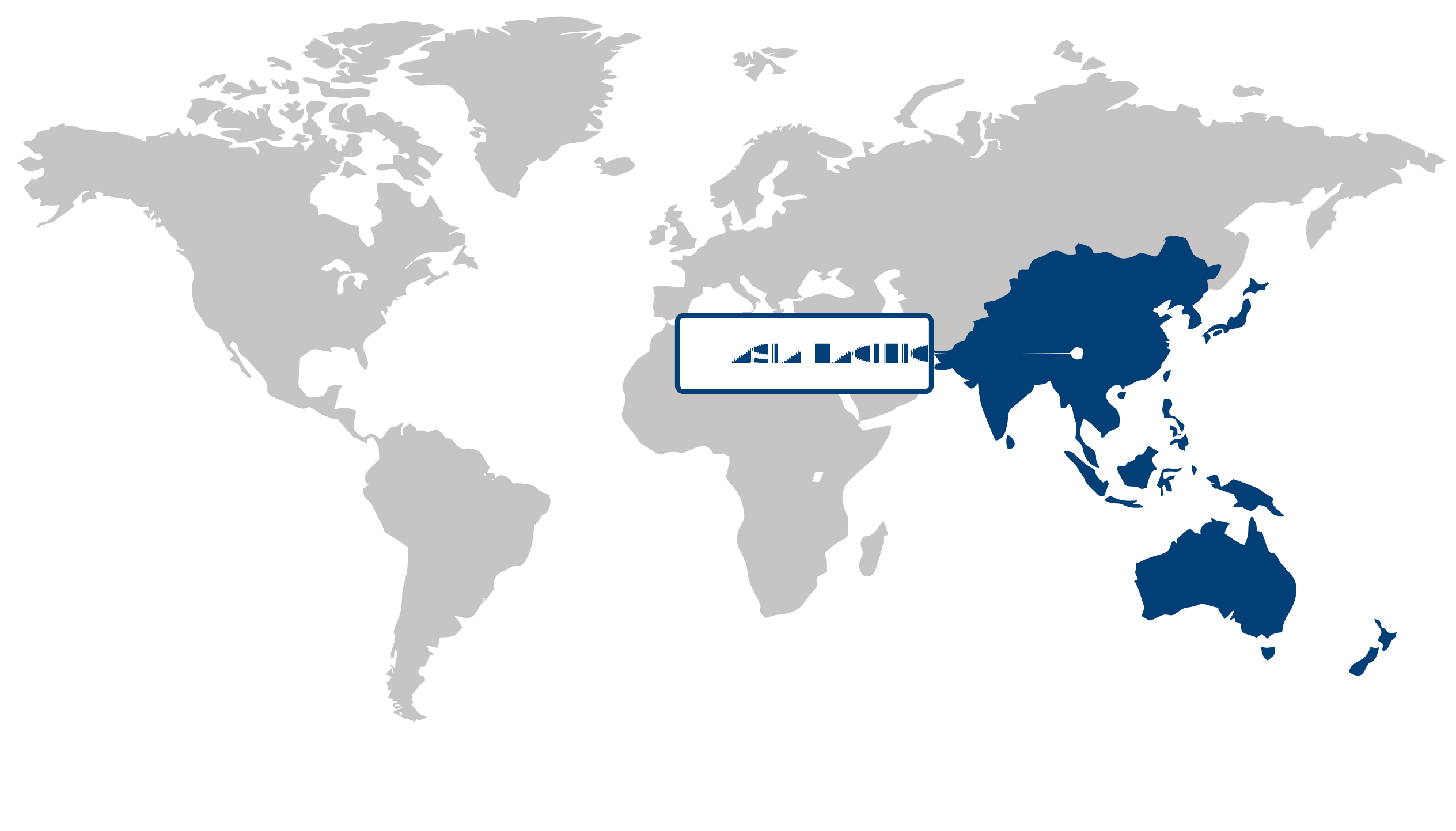
Largest Region
Asia Pacific
41.02% Market Share in 2026
Asia Pacific (Largest & Fastest-Growing Region)
Asia Pacific dominated the automotive supercharger market, accounting for 41.02% share in 2026, while also representing the fastest-growing regional market. The region's leading position is supported by its extensive automotive manufacturing base, strong consumer demand for performance-oriented vehicles, and continued development of high-output powertrain technologies. Superchargers remain attractive for applications requiring improved engine responsiveness and power delivery, particularly where manufacturers seek enhanced performance without relying solely on larger engine configurations. The region's expanding automotive ecosystem, together with growing investment in vehicle engineering and powertrain innovation, is supporting demand across passenger and performance-focused vehicle applications. Increasing interest in driving performance, alongside ongoing efforts to improve engine efficiency and optimize power output, is further strengthening the role of forced-induction technologies in regional automotive development.
Key Country Insights
The U.S. automotive supercharger market is supported by strong demand for high-performance vehicles, aftermarket upgrades, and motorsports applications. U.S. manufacturers continue developing efficient forced induction systems that improve engine output while addressing evolving emissions requirements.
Japan utilizes automotive superchargers in selected passenger vehicles and performance applications where engine downsizing remains important. Japanese manufacturers prioritize compact, efficient supercharging systems that deliver improved driving performance without significantly increasing fuel consumption.
South Korea explores automotive supercharger technologies within performance-oriented vehicle development and advanced engine platforms. South Korean suppliers continue emphasizing lightweight components and efficient power delivery to complement evolving automotive engineering priorities.
Germany integrates automotive superchargers into premium performance vehicles and advanced engine development programs. German automotive companies focus on improving engine efficiency, responsiveness, and compliance with stringent environmental standards through optimized supercharging technologies.
France maintains demand for automotive superchargers primarily in specialty vehicle segments and performance engineering projects. French market participants increasingly focus on technologies that balance enhanced engine performance with regulatory expectations for efficiency and emissions.
Italy applies automotive superchargers in performance engineering and specialty automotive manufacturing where driving dynamics remain a core design priority. Italian manufacturers continue refining supercharger technologies that complement premium vehicle performance and distinctive engine characteristics.
Segment Leadership and Growth Trends
Technology Segment Analysis: Centrifugal Supercharger (Largest Segment) vs Twin Supercharger (Fastest-Growing Segment)
The centrifugal supercharger segment led the automotive supercharger market with a 54.29% share in 2026, supported by its ability to deliver substantial power enhancement while maintaining a relatively compact and efficient design. Its compatibility with high-performance gasoline engines, progressive boost delivery, and suitability for applications requiring improved acceleration and engine responsiveness continue to sustain demand. The segment also benefits from established integration practices and consumer interest in performance-oriented vehicles, reinforcing its position across automotive applications.
Twin superchargers are gaining momentum as automakers and performance-focused vehicle users seek stronger and more immediate power delivery across a broader engine operating range. The combination of complementary supercharging characteristics can improve low-speed response while maintaining higher-output performance, making the technology attractive for engines where consistent boost availability is important. Growing interest in advanced engine performance, responsive driving characteristics, and optimized power delivery is supporting the expanding adoption of twin supercharger configurations.
Vehicle Segment Analysis: Passenger Vehicle (Largest & Fastest-Growing Segment)
Passenger vehicles represented the largest and fastest-growing vehicle segment in the automotive supercharger market, reflecting sustained demand for enhanced acceleration, responsive engine performance, and improved driving dynamics in personal vehicles. Superchargers provide immediate boost without relying solely on exhaust-driven pressure, making them attractive for applications where rapid throttle response and stronger power delivery are valued. Continued consumer preference for performance-oriented passenger vehicles, combined with ongoing improvements in engine technology and vehicle powertrain design, supports the segment's leading position and growth momentum.
| Report Segmentation | |||
| Segment | Sub-Segment | Largest Segment | Fastest Growing Segment |
|---|---|---|---|
| Technology | Centrifugal Supercharger, Twin Supercharger, Root Supercharger | Centrifugal Supercharger | Twin Supercharger |
| Vehicle | Passenger Vehicle, Commercial Vehicle | Passenger Vehicle | Passenger Vehicle |
| Sales Channel | OEM, Aftermarket | OEM | Aftermarket |
 Read our Research Approach
Competitive Landscape and Market Positioning
Leading companies in the automotive supercharger market:
1. Eaton Corporation plc (Ireland)
2. IHI Corporation (Japan)
3. Honeywell International Inc. (United States)
4. Mitsubishi Heavy Industries Ltd. (Japan)
5. Vortech Engineering Inc. (United States)
6. Mercedes-Benz Group AG (Germany)
7. Ford Motor Company (United States)
8. Koenigsegg Automotive AB (Sweden)
9. A&A Corvette Performance Ltd. (United States)
10. Rotrex A/S (Denmark)
The automotive supercharger market is evolving as performance enhancement systems increasingly align with efficiency and electrification goals. Innovation efforts are concentrated on improving air delivery precision and optimizing engine output under varying load conditions. Continuous engineering advancements are also reshaping component design, enabling better adaptability across modern powertrain architectures.
Industry Development/News
| Company Name | Date | Key Development |
|---|---|---|
| Hennessey | Dec-23 | Hennessey enhanced General Motors V8-powered pickup trucks by integrating a performance supercharger system, increasing output to 650 bhp and 658 lb-ft of torque. The modification delivers a reported 55% horsepower improvement over stock configurations, reflecting continued aftermarket demand for high-output forced induction upgrades in full-size pickup performance applications. |
| Lingenfelter | Oct-21 | Lingenfelter introduced supercharger kits for General Motors pickup trucks equipped with 5.3L V8 L84 and 6.2L V8 L87 engines. The kits are offered with a three-year/36,000-mile warranty, indicating a structured aftermarket commercialization approach aimed at improving engine performance and reliability across widely deployed light truck platforms. |
| HySE | Oct-23 | HySE, a Japanese hydrogen engine research consortium, announced development of a hydrogen ICE-powered side-by-side vehicle planned for Dakar 2024. The 1.0-liter inline-four hydrogen engine is paired with a supercharger to improve combustion efficiency and performance consistency, reflecting experimentation with forced induction in alternative fuel powertrain architectures. |
| Late Model Engines | Jun-23 | Late Model Engines introduced integration of Whipple’s Gen 5 3.0L supercharger into its Gen V L8T engine platform. The configuration enables outputs up to 1,400 horsepower when paired with appropriate fuel systems, expanding applicability across passenger and sports car segments and reinforcing the role of aftermarket forced induction in high-performance engine builds. |
| Eaton Corporation | Nov-22 | Eaton Corporation launched the Twin Vortices Series X3100 supercharger for aftermarket applications, developed to meet demand for higher airflow within compact engine packages. Distribution is structured through established partners including Magnuson Products and Edelbrock, highlighting an ecosystem-based commercialization strategy across performance and aftermarket supercharging networks. |
Why Choose Us
Specialized Expertise: Our team comprises industry experts with a deep understanding of your market segment. We bring specialized knowledge and experience that ensures our research and consulting services are tailored to your unique needs.
Customized Solutions: We understand that every client is different. That's why we offer customized research and consulting solutions designed specifically to address your challenges and capitalize on opportunities within your industry.
Proven Results: With a track record of successful projects and satisfied clients, we have demonstrated our ability to deliver tangible results. Our case studies and testimonials speak to our effectiveness in helping clients achieve their goals.
Cutting-Edge Methodologies: We leverage the latest methodologies and technologies to gather insights and drive informed decision-making. Our innovative approach ensures that you stay ahead of the curve and gain a competitive edge in your market.
Client-Centric Approach: Your satisfaction is our top priority. We prioritize open communication, responsiveness, and transparency to ensure that we not only meet but exceed your expectations at every stage of the engagement.
Continuous Innovation: We are committed to continuous improvement and staying at the forefront of our industry. Through ongoing learning, professional development, and investment in new technologies, we ensure that our services are always evolving to meet your evolving needs.
Value for Money: Our competitive pricing and flexible engagement models ensure that you get maximum value for your investment. We are committed to delivering high-quality results that help you achieve a strong return on your investment.
Select Licence Type

