Bakery Products Market Size & Growth Forecast 2027–2036, By Segments (Product, Distribution Channel), Regional Demand Trends (North America, Asia Pacific, Europe), Key Country Insights (U.S., Japan, South Korea, Germany, France, Italy), and Competitive Landscape
Jump to Content
Market Size and Growth Outlook
Bakery Products Market size was estimated at USD 578.1 billion in 2026 and is projected to grow at a 5.13% CAGR from 2027 to 2036, attaining USD 953.39 billion by 2036. The industry revenue for 2027 is calculated at USD 603.07 billion.
Get more details on this report
Request Free Sample ReportBakery Products Market Intelligence Snapshot
Regional Market Dynamics
- Europe held a 36.59% market share in 2026, supported by strong demand for baked staples, a mature bakery ecosystem, extensive retail availability, and continued premiumization across branded and private-label products.
- Asia Pacific is projected to grow at a 6.22% CAGR, driven by changing eating habits, expanding organized retail, and rising consumer demand for packaged, convenience-oriented, and internationally inspired bakery products.
Segment Momentum
- Cakes & Pastries held a 30.46% share in 2026 due to strong demand across everyday consumption, celebrations, and foodservice, supported by broad availability in retail, bakery counters, and packaged formats.
- Online distribution is growing fastest as consumers increasingly prefer convenient ordering, home delivery, easy product comparison, and repeat purchases across a wider selection of bakery products.
Market Expansion Drivers
- Increasing consumer preference for convenient ready-to-eat food products driving bakery consumption.
- Rising demand for healthier and additive-free bakery items accelerating product innovation.
- Expansion of café chains and online bakery retail improving product accessibility and sales penetration.
Leading Market Participants
- Major players in the bakery products market include Grupo Bimbo S.A.B. de C.V. (Mexico), Associated British Foods plc (United Kingdom), Britannia Industries Limited (India), General Mills, Inc. (United States), Mondelez International, Inc. (United States), Campbell Soup Company (United States), ITC Limited (India), Yamazaki Baking Co., Ltd. (Japan), Finsbury Food Group Limited (United Kingdom).
Global Market Forecast Snapshot
Market Outlook
- 2026 Market Size: USD 578.1 billion
- 2027 Estimated Market Size: USD 603.07 billion.
- Projected Market Size: USD 953.39 billion by 2036
- Growth Forecast: 5.13% CAGR (2027-2036)
Regional and Segment Outlook
- Leading Regional Market: Europe
- High-Growth Regional Hub: Asia Pacific
- Core Revenue Segment: Cakes & Pastries (Product) | Hypermarkets & Supermarkets (Distribution Channel)
- Emerging Opportunity Segment: Cookies (Product) | Online (Distribution Channel)
Market Growth Drivers and Industry Trends
Increasing consumer preference for convenient ready-to-eat food products driving bakery consumption
The growing preference for convenient meal and snack options will drive the bakery products market growth as consumers increasingly seek ready-to-eat foods that fit busy lifestyles. Bakery items such as packaged breads, pastries, cakes, and other prepared products offer quick consumption with minimal preparation, making them suitable for on-the-go eating and routine household use. This shift in consumption habits supports higher purchase frequency across retail channels while encouraging producers to expand convenient formats, portion sizes, packaging solutions, and product varieties aligned with changing consumer routines.
Rising demand for healthier and additive-free bakery items accelerating product innovation
Health-conscious consumption trends are reshaping the bakery products market, with rising demand for products perceived as cleaner, more nutritious, and suitable for wellness-oriented diets. Consumers are increasingly attentive to ingredients and may favor bakery items with fewer artificial additives, simpler formulations, and improved nutritional characteristics. This preference is encouraging manufacturers to reformulate existing products and introduce alternatives incorporating natural ingredients, reduced additives, and health-focused attributes, while expanding product choices for consumers seeking to balance convenience with dietary considerations.
Expansion of café chains and online bakery retail improving product accessibility and sales penetration
Greater availability through café chains and digital purchasing channels will boost the bakery products market demand by bringing a broader range of baked goods closer to consumers across both physical and online environments. Café expansion increases consumer exposure to fresh bakery products while creating additional occasions for consumption, whereas online bakery retail enables convenient ordering, delivery, and access to specialized products beyond traditional store locations. The combination of expanding café networks and digital retail channels also allows producers and sellers to reach new customer segments and geographic markets more efficiently.
| Growth Driver | Impact on CAGR | Regulatory Influence | Geographic Relevance | Adoption Rate | Impact Timeline |
|---|---|---|---|---|---|
| Increasing consumer preference for convenient ready-to-eat food products driving bakery consumption | 1.90% | Low | North America, Asia Pacific | High | Near Term |
| Rising demand for healthier and additive-free bakery items accelerating product innovation | 1.60% | Moderate | Europe, North America | Medium | Mid Term |
| Expansion of café chains and online bakery retail improving product accessibility and sales penetration | 1.20% | Low | Asia Pacific, North America | High | Near Term |
Unlock insights tailored to your business with our bespoke market research solutions.
Click to get your customized report now.
Regional Demand Dynamics
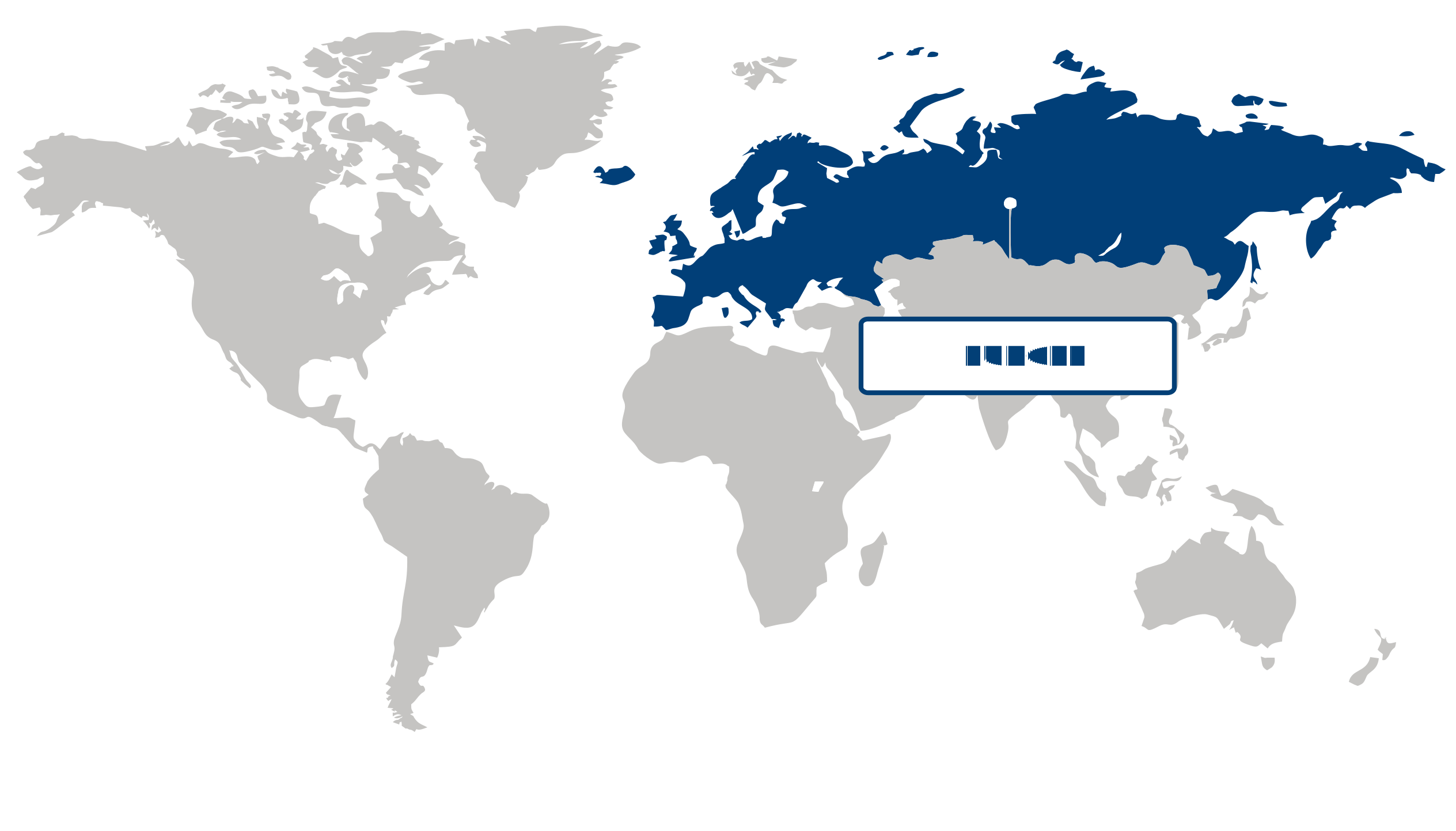
Europe (Largest Region)
Europe held the largest share of the bakery products market at 36.59% in 2026, supported by deeply established bread and bakery consumption habits, a mature food processing industry, and broad availability of products across retail and foodservice channels. The region's strong baking heritage sustains demand for traditional products while evolving consumer preferences are encouraging manufacturers to expand healthier, premium, artisanal, and convenience-oriented offerings. Growing interest in clean-label ingredients, whole grains, reduced-sugar formulations, and specialty baked goods is also influencing product development. Well-developed retail infrastructure and sophisticated distribution networks further enable bakeries and food manufacturers to respond efficiently to changing dietary preferences and premiumization trends.
Asia Pacific (Fastest-Growing Region)
Asia Pacific represents the fastest-growing regional market, driven by urbanization, changing lifestyles, expanding organized retail, and rising demand for convenient packaged foods. Increasing disposable incomes and the influence of western-style eating habits are broadening bakery consumption beyond traditional products, while local manufacturers are adapting offerings to regional tastes and dietary preferences. Growth in modern supermarkets, convenience stores, foodservice outlets, and online grocery channels is improving product accessibility across both established and emerging markets. At the same time, expanding food processing capabilities and innovation in packaged and ready-to-eat bakery products are creating favorable conditions for continued market development.
| Parameter | North America | Asia Pacific | Europe | Latin America | MEA |
|---|---|---|---|---|---|
| Innovation HubiScaleNascentDeveloping Advanced | |||||
| Cost-Sensitive RegioniScaleLowMedium High | |||||
| Regulatory EnvironmentiScaleRestrictiveNeutral Supportive | |||||
| Demand DriversiScaleWeakModerate Strong | |||||
| Development StageiScaleEmergingDeveloping Developed | |||||
| Adoption RateiScaleLowMedium High | |||||
| New Entrants/StartupsiScaleLowMedium High | |||||
| Macro IndicatorsiScaleWeakStable Strong |
Key Country Insights
Germany 🇩🇪
Traditional Baking ExcellenceGermany continues to prioritize high-quality bakery products that combine traditional methods with modern production efficiency. Bakers in Germany are expanding specialty breads and premium baked goods while responding to demand for natural ingredients and product freshness.
France 🇫🇷
Artisan Product HeritageFrance maintains strong demand for bakery products rooted in artisanal quality and authentic production techniques. Bakeries in France are balancing traditional recipes with product innovation by incorporating healthier ingredients and convenient consumption formats.
Italy 🇮🇹
Premium Artisan OfferingsItaly emphasizes bakery products that reflect regional recipes while adapting to modern retail and consumer expectations. Producers in Italy are enhancing premium breads, pastries, and specialty baked goods with high-quality ingredients and flexible packaging solutions.
Japan 🇯🇵
Premium Fresh BakeryJapan emphasizes bakery products with superior freshness, texture, and refined product presentation. Manufacturers in Japan are introducing smaller portion sizes and premium formulations that align with changing consumer preferences for convenience and quality.
South Korea 🇰🇷
Modern Bakery FormatsSouth Korea is expanding innovative bakery concepts that combine local flavors with international product styles. Bakery companies in South Korea are introducing premium ready-to-eat products and seasonal offerings to strengthen consumer engagement across retail channels.
United States 🇺🇸
Convenience Product InnovationThe U.S. bakery products market is focusing on convenient, premium, and health-oriented offerings across retail and foodservice channels. Bakeries in the U.S. are introducing clean-label recipes, portion-controlled formats, and value-added products to address evolving consumer purchasing habits.
Bakery Products Market Share (%), by Product, 2026
Go beyond the chart, access full insights & data tables
Request Free Sample ReportProduct Segment Analysis: Cakes & Pastries (Largest Segment) vs Cookies (Fastest-Growing Segment)
The cakes & pastries segment led the bakery products market, accounting for 30.46% share in 2026, supported by strong consumer demand for indulgent, convenient, and occasion-oriented bakery products. Cakes and pastries serve a broad range of consumption occasions, including celebrations, gifting, snacking, and everyday consumption, giving the category wide market reach. Product innovation across flavors, fillings, formats, and premium presentations further strengthens its appeal among diverse consumer groups.
The cookies segment is growing at the fastest pace, supported by their portability, extended convenience, and suitability for both snacking and on-the-go consumption. Manufacturers are broadening cookie offerings through new flavors, textures, ingredient combinations, and positioning around changing consumer preferences. Their adaptability across mass-market and premium product categories is also helping expand consumption opportunities.
Distribution Channel Segment Analysis: Hypermarkets & Supermarkets (Largest Segment) vs Online (Fastest-Growing Segment)
Holding the largest share of the bakery products market in 2026, the hypermarkets & supermarkets segment benefits from broad product assortments, convenient one-stop shopping, and strong visibility for packaged and fresh bakery products. These outlets allow consumers to compare brands and product varieties while benefiting from established purchasing routines and frequent store visits. Their ability to accommodate both everyday bakery purchases and larger household shopping trips continues to support channel strength.
The online channel is experiencing the fastest growth as consumers increasingly prioritize convenience, home delivery, and easy access to a wide range of bakery products. Digital platforms also enable consumers to discover specialty, premium, and niche offerings that may have limited availability through traditional retail outlets. Improvements in digital ordering and fulfillment are further supporting the expansion of online bakery purchases.
| Segment | Sub-Segment | Largest Segment | Fastest Growing |
|---|---|---|---|
| Product | Bread & Rolls, Cakes & Pastries, Cookies, Tortillas, Pretzels, Others | Cakes & Pastries | Cookies |
| Distribution Channel | Hypermarkets & Supermarkets, Bakery Stores, Convenience Stores, Online, Others | Hypermarkets & Supermarkets | Online |
Competitive Landscape and Market Positioning
Prominent players in the bakery products market:
1. Grupo Bimbo S.A.B. de C.V. (Mexico)
2. Associated British Foods plc (United Kingdom)
3. Britannia Industries Limited (India)
4. General Mills Inc. (United States)
5. Mondelez International Inc. (United States)
6. Campbell Soup Company (United States)
7. ITC Limited (India)
8. Yamazaki Baking Co. Ltd. (Japan)
9. Finsbury Food Group Limited (United Kingdom)
The bakery products market is evolving with increased focus on healthier formulations and clean-label ingredients. Continuous product diversification is enhancing taste variety and nutritional value. The bakery products market is also influenced by rising demand for convenience and ready-to-eat baked goods.
| Company | Market Share | Company Revenue | Revenue CAGR (%) | Product Portfolio | Geographic Presence | Innovation / R&D Focus | Strategic Developments |
|---|---|---|---|---|---|---|---|
| Grupo Bimbo S.A.B. de C.V. (Mexico) | |||||||
| Associated British Foods plc (United Kingdom) | |||||||
| Britannia Industries Limited (India) | |||||||
| General Mills Inc. (United States) | |||||||
| Mondelez International Inc. (United States) | |||||||
| Campbell Soup Company (United States) | |||||||
| ITC Limited (India) | |||||||
| Yamazaki Baking Co. Ltd. (Japan) | |||||||
| Finsbury Food Group Limited (United Kingdom). |
Industry Development/News
| Company Name | Date | Key Development |
|---|---|---|
| Bridor | Mar-26 | Bridor finalized an agreement to acquire frozen bakery manufacturer Panamar in its largest acquisition to date. This strategic transaction significantly expands the company’s international production and distribution footprint while strengthening its competitive positioning within the premium frozen bakery and viennoiserie segments. |
| Paris Baguette | Mar-26 | Paris Baguette broke ground on a $200 million production facility in Texas, marking a significant investment in manufacturing capacity. This facility is designed to support the chain's ongoing store network growth and operational expansion across key North American markets. |
| Genesis Bakery | Feb-26 | Genesis Bakery entered a shared distribution partnership with Brennans Bakeries to streamline logistics across Northern Ireland. By leveraging combined distribution networks, the companies aim to improve operational resilience and enhance service delivery capabilities for their retail customer base. |
| Eshbal | Jan-26 | Eshbal established a production partnership with Queen St. Bakery to manage manufacturing operations for the North American market. This agreement is designed to optimize supply chain efficiency and broaden commercial access for gluten-free bakery products. |
| Vandemoortele | Mar-25 | Vandemoortele entered a definitive agreement to acquire Délifrance from Vivescia, a move that significantly scales its frozen bakery portfolio. The transaction bolsters the company’s position as a leading European producer of frozen bakery goods and deepens its market presence across multiple regional territories. |
| CraftMark Bakery | Mar-25 | CraftMark Bakery secured an acquisition by One Equity Partners to support its long-term growth strategy. This investment reinforces the manufacturer's operational development and expands resources dedicated to its frozen baked goods business, which serves both the foodservice and in-store bakery channels. |
| Rise Baking Company | Sep-24 | Rise Baking Company was acquired by private equity firms Platinum Equity and Butterfly. This transaction provides significant capital resources intended to fuel organizational expansion and strengthen the company’s competitive positioning within the North American baked goods sector. |
| La Lorraine Bakery | Jun-24 | La Lorraine Bakery acquired a stake in Bakery de France and formalized a strategic partnership to accelerate growth in North America. This joint effort combines their regional expertise to enhance manufacturing capabilities and expand their collective footprint in the North American bakery market. |
| Vandemoortele | Apr-24 | Vandemoortele acquired a majority stake in Banneton Bakery as part of a strategic partnership agreement. This investment serves to accelerate the company’s North American expansion and consolidates its market share within the premium frozen bakery category. |
| Campbell Soup | Jul-23 | Campbell Soup announced a $160 million capital investment in its Richmond, Utah, production facility. The project is focused on expanding manufacturing capacity to meet rising consumer demand for bakery products, demonstrating a long-term commitment to scaling domestic production and strengthening the supply chain. |
Customize Your Report
Explore examples of how this report can be tailored to different research needs, including custom segments, additional topics or chapters, and related reports. Click a section of the wheel or its numbered marker to explore the available options.
Bakery Products Market — Custom Segments
| Segment | Sub-Segment |
|---|---|
| Dietary & Functional Attributes | Conventional, Gluten-Free, Organic, Reduced Sugar & Low-Carbohydrate, High-Protein & Fortified |
| Consumption Occasion | Breakfast & Snacking, Main Meals, Celebrations & Special Occasions, On-the-Go Consumption |
| Production Model | Industrial & Mass-Produced, Artisanal & Craft, In-Store Fresh Production, Foodservice Production |
Bakery Products Market — Custom TOC
| Custom Chapter | Chapter Details |
|---|---|
| Consumer Eating Occasion and Demand Opportunity Analysis |
|
| Private Label Competitive Strategy |
|
| Premium and Better-for-You Positioning Landscape |
|
Need a different cut of the data?
Request Custom ResearchFrequently Asked Questions
How much revenue does the bakery products market generate?
How much is the bakery products industry expected to grow by 2036?
How is convenience-led consumption reshaping purchasing behavior in the bakery products market?
How is health-driven reformulation influencing product differentiation in the bakery products market?
Why do Cakes & Pastries lead the bakery products market?
Why is the Online channel the fastest-growing distribution channel in the bakery products market?
Why does Europe lead the bakery products market?
Why is Asia Pacific the fastest-growing bakery products market?
What are the prominent companies operating in the bakery products landscape?
Our Clients
"The report provided a thorough look at market trends, technological advancements, and the competitive landscape. The depth of insights was really valuable."
ITC Limited
"We would highly recommend Fundamental Business Insights & Consulting to anyone looking for reliable, detailed, and comprehensive market research in the Food industry."
Tyson Foods
"The clarity and presentation of the information were commendable. The report was delivered timely, which made the overall experience smooth and convenient."
Mondelēz International
Our Research Team & Methodology
Every Fundamental Business Insights report is built by a dedicated vertical research team, validated through a structured primary-and-secondary methodology, and reviewed for accuracy before it reaches you.
Delivery
Published
Available
Support
- Market Size & Forecast
- Market Segmentation
- Regional Analysis
- Growth Drivers & Challenges
- Market Dynamics
- Competitive Landscape
- Company Profiles
- Competitive Benchmarking
- Mergers & Acquisitions
- Market Share Analysis or Key Company Strategies
- Value Chain Analysis
- Porter's Five Forces
- PESTLE Analysis
- Pricing Trends
- Supply-Demand Analysis
- Technology Landscape
- Regulatory Landscape
- Investment & Funding Landscape
- Emerging Opportunities
- Future Market Outlook