Balustrade Market Size & Forecasts 2026-2035, By Segments (Material, Design, Application, Functionality), Growth Opportunities, Innovation Landscape, Regulatory Shifts, Strategic Regional Insights (U.S., Japan, China, South Korea, UK, Germany, France), and Competitive Dynamics (Assa Abloy, Allegion, Bronze Elegance, Q-railing, Railing Systems Europe)
Market Size and Growth Outlook
Balustrade Market size is predicted to expand from USD 11.45 billion in 2025 to USD 17.44 billion by 2035, with growth underpinned by a CAGR above 4.3% between 2026 and 2035. The industry revenue outlook for 2026 is USD 11.88 billion.
Get more details on this report
Request Free Sample ReportBalustrade Market Intelligence Snapshot
Regional Market Dynamics
Segment Momentum
Market Expansion Drivers
Leading Market Participants
Global Market Forecast Snapshot
Market Outlook
Regional and Segment Outlook
Market Growth Drivers and Industry Trends
The expansion of urban infrastructure and renewed focus on balcony safety initiatives are pivotal growth drivers in the balustrade market. As cities intensify vertical development, local governments are increasingly integrating safety projects into urban planning to mitigate fall-related accidents. For instance, the National Safety Council (NSC) in the United States emphasizes stringent guidelines for balcony guardrails, influencing widespread adoption of standardized balustrade systems. This trend compels manufacturers to innovate durable, compliant designs combining aesthetics with enhanced safety, opening avenues for advanced materials and smart technology integration. Established players can leverage regulatory alignment to deepen partnerships with construction firms, while new entrants may capitalize on niche demands for retrofit and renovation projects. As urban densification continues, the focus on balcony safety remains a structural imperative, embedding sustained demand for reliable balustrade solutions.
Rise in Residential & Commercial Construction
The global uptick in residential and commercial construction projects directly fuels the balustrade market's expansion. Organizations like the U.S. Census Bureau report robust growth in new housing permits and commercial building approvals, reflecting strong demand for architectural components, including balustrades. This construction boom is partly driven by post-pandemic recovery efforts and the rise of mixed-use developments, which elevate the requirement for customized, aesthetically appealing balustrades that comply with modern design standards. For market participants, this environment encourages scalability and diversification in product lines, especially toward modular and prefabricated balustrade systems that reduce installation time. Both incumbents and startups can gain competitive advantage by aligning offerings with the evolving architectural trends and construction timelines reinforced by ongoing infrastructure investments.
Regulatory & Safety Standards Enforcement
Stringent enforcement of regulatory and safety standards remains a crucial factor shaping the balustrade market. Agencies such as the European Committee for Standardization (CEN) continuously update balustrade-related codes—like EN 1991-1-1 for load requirements—driving manufacturers to meet higher compliance thresholds. This regulatory rigor enhances product reliability and customer trust while simultaneously raising entry barriers. Companies adept at navigating complex certifications and adapting to jurisdictional variations create strategic differentiation in tender-based projects. Moreover, compliance requirements stimulate innovation in materials—such as corrosion-resistant alloys and impact-absorbent composites—aligning with sustainable practices highlighted by environmental agencies like the EPA. In a landscape of rising safety consciousness, the regulatory framework ensures a quality-centric market evolution, offering a stable foundation for growth anchored in legal and ethical imperatives.
Industry Restraints:
Stringent Safety and Building Code Regulations
The balustrade market faces significant headwinds from increasingly rigid safety and building code requirements, which complicate design and installation processes. Agencies like the International Code Council (ICC) and the European Committee for Standardization (CEN) enforce strict standards on height, load resistance, and materials, limiting manufacturers’ flexibility and elevating compliance costs. For example, the ICC’s evolving requirements on guardrail heights and impact resistance compel producers to invest in costly testing and certification, slowing product rollout. Both incumbent firms and new entrants must navigate these regulatory complexities, often stretching development timelines and capital expenditures. This environment disproportionately impacts smaller manufacturers lacking regulatory expertise. As safety standards evolve with heightened urbanization and construction safety demands, regulatory oversight will remain a defining constraint, compelling market participants to prioritize compliance-driven innovation and strategic partnerships to sustain growth.
Supply Chain and Raw Material Price Volatility
Fluctuations in the availability and cost of raw materials, notably steel and aluminum, continue to restrain the balustrade market by inducing operational inefficiencies and pricing unpredictability. According to the World Steel Association, global steel prices experienced sharp volatility over recent years due to geopolitical tensions and supply disruptions, directly increasing input costs for balustrade producers. This dynamic constrains profit margins and complicates contract negotiations, dampening investment appetite for capacity expansion or product diversification. Established manufacturers with diversified sourcing can partially mitigate risks, but smaller or regionally focused players face heightened vulnerability. As global supply chains remain susceptible to disruptions from trade policies and resource scarcity, volatility will persist as a macroeconomic challenge, compelling companies to enhance supply chain resilience through localized sourcing, inventory optimization, and strategic supplier alliances.
| Growth Driver | Impact on CAGR | Regulatory Influence | Geographic Relevance | Adoption Rate | Impact Timeline |
|---|---|---|---|---|---|
| Urban Development & Balcony Safety Projects | 1.50% | Short term (≤ 2 yrs) | Europe, North America | Medium | Fast |
| Rise in Residential & Commercial Construction | 1.50% | Medium term (2–5 yrs) | Asia Pacific, Europe | Low | Moderate |
| Regulatory & Safety Standards Enforcement | 1.30% | Long term (5+ yrs) | Europe, North America | High | Slow |
Explore Growth Opportunities
Request Free Sample ReportRegional Demand Dynamics
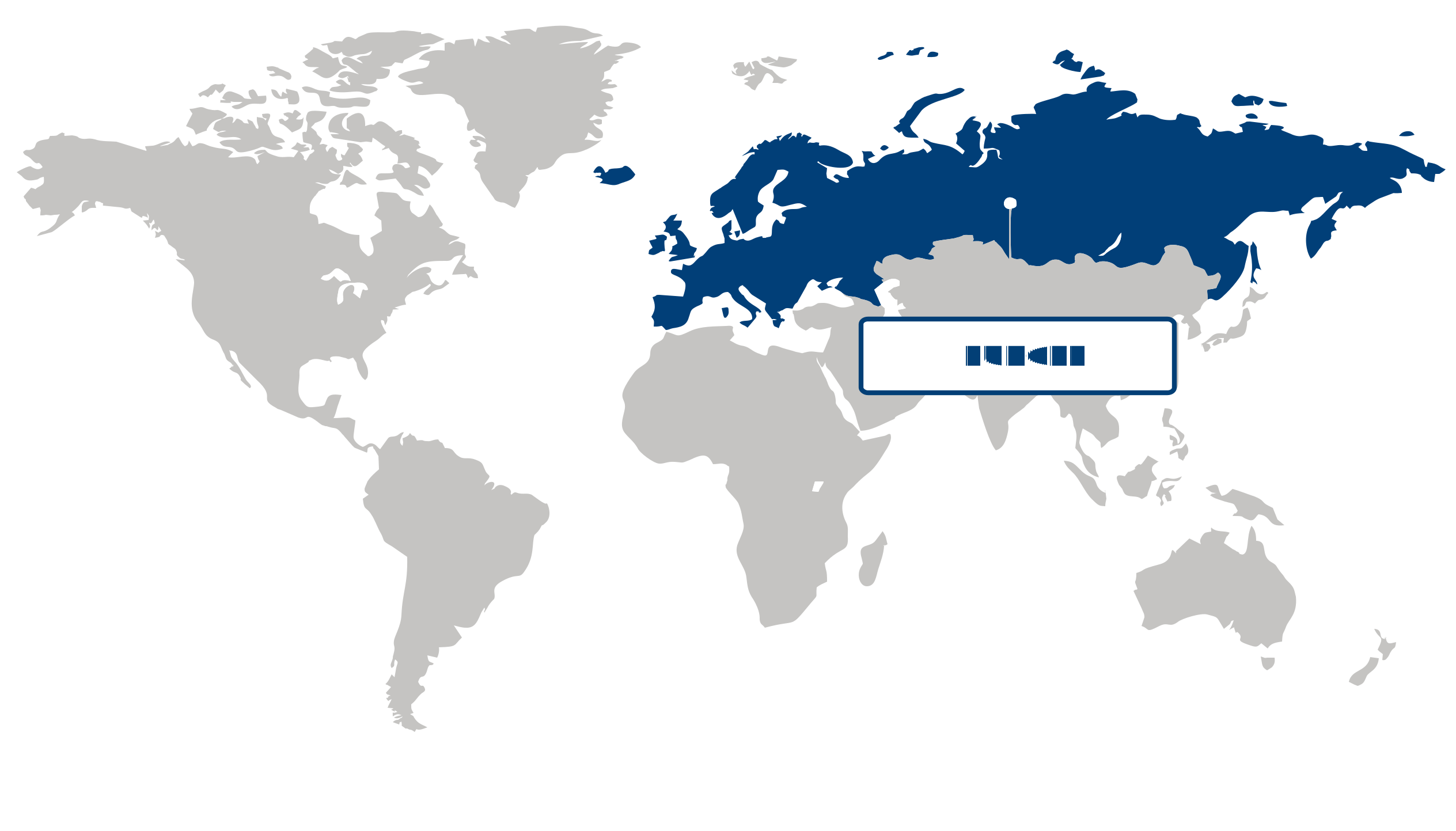
Europe captured more than 36% of the global balustrade market in 2025, establishing itself as the largest regional contributor. The region’s dominance is largely driven by its pronounced architectural legacy and a strong preference for aesthetically refined balustrade designs, as reflected in historic urban renewal projects across cities like Paris and Berlin. This demand is further reinforced by stringent safety and design standards promoted by the European Committee for Standardization (CEN), which encourage adoption of advanced, visually appealing materials and technologies. Companies such as Jansen AG emphasize innovative metal balustrades that blend heritage with modernity, elevating market appeal. As governments increase investments in public infrastructure restoration, and private sectors focus on premium residential upgrades, Europe’s balustrade market is positioned to thrive, presenting significant opportunities in sophisticated architectural applications and sustainable product offerings.
Germany anchors the European balustrade market with its robust construction sector and emphasis on engineering excellence. German regulatory frameworks prioritize both safety and design innovation, encouraging adoption of cutting-edge materials like stainless steel and glass, as exemplified by BALUSTRADA’s project showcasing in Frankfurt. This synergy of tradition and technology cultivates demand for durable yet elegant balustrades, securing Germany’s leadership. Concurrently, France plays a pivotal role by integrating cultural heritage preservation with contemporary urban developments, supported by initiatives from the French Ministry of Culture to maintain historic façades. Premium developments in Paris have embraced bespoke balustrade solutions by companies like Metalglas, adapting classic styles to modern sustainability standards. These country-level insights underscore Europe’s ongoing market potential, driven by a blend of architectural prestige and progressive design mandates.
Asia Pacific Market Analysis:
Asia Pacific emerged as the fastest-growing region in the balustrade market, registering a robust CAGR of 6.02%. This rapid growth is primarily driven by swift urbanization and escalating investments in contemporary infrastructure across the region. Rising demand for modern architectural designs combined with increased spending on residential, commercial, and public projects has intensified the need for advanced balustrade solutions. Additionally, evolving consumer preferences toward aesthetically pleasing yet safe railing systems, alongside stricter building codes enforced by regional bodies such as the Asia Pacific Economic Cooperation (APEC), have propelled this momentum. Industry leaders like LIXIL Corporation and Saint-Gobain India have announced expansions and new product launches tailored to these trends, reflecting digitization and sustainability priorities. As the urban population swells, and governments prioritize smart city initiatives, Asia Pacific offers substantial opportunities for innovative and durable balustrade products that align with future-ready infrastructure developments.
Japan plays an instrumental role in Asia Pacific’s balustrade market, driven by a mature construction sector focused on safety and design innovation. Consumer preference for earthquake-resistant and corrosion-proof materials complements public infrastructure modernization endorsed by Japan’s Ministry of Land, Infrastructure, Transport and Tourism (MLIT). Leading firms like Tostem Corporation have introduced cutting-edge aluminum balustrades incorporating smart sensor technology, reflecting Japan’s trend toward integrating technology and durability. This high demand for premium quality and technologically advanced railing solutions strengthens Japan’s market stature, feeding into the region’s overall growth trajectory.
China’s contribution to the Asia Pacific balustrade market is marked by massive urban expansion and aggressive infrastructure spending, spearheaded by government urbanization policies under the National Development and Reform Commission (NDRC). The emphasis on large-scale residential complexes, commercial hubs, and transportation networks has boosted demand for cost-effective, scalable balustrade installations. Innovations in modular and prefabricated systems by companies such as Xinyi Glass Holdings Ltd. have accelerated project timelines and enhanced supply chain efficiency. China’s rapid construction pace and evolving regulatory frameworks to ensure safety and aesthetic standards highlight its strategic importance in propelling the Asia Pacific regional market forward.
North America Market Trends:
North America has held a commanding share in the balustrade market, driven by the region’s advanced construction sector and growing emphasis on architectural aesthetics and safety standards. The steady shift toward modern residential and commercial developments, particularly in urban centers, is encouraging the adoption of innovative balustrade materials and designs. Market participation by leading players such as the American Architectural Manufacturers Association and compliance with stringent building codes underscore a commitment to quality and durability. Additionally, rising investments in infrastructure refurbishment, coupled with a preference for sustainable and low-maintenance solutions, are reinforcing the market’s resilience. Logistics efficiency and skilled workforce availability further enhance regional competitiveness. As digital design tools and manufacturing automation advance, North America is poised to capitalize on evolving consumer preferences and regulatory frameworks, solidifying its prominence in the global balustrade market.
The U.S. serves as a pivotal force within North America’s balustrade market, propelled by robust residential remodeling activities and commercial real estate expansions. Rising consumer demand for customizable, safety-compliant balustrades is complemented by regulatory oversight from organizations like the International Code Council (ICC), which enforces rigorous building safety standards. Companies such as Feeney, Inc. actively innovate with aluminum and stainless-steel options, addressing durability concerns and aesthetic trends. The growth of green building certifications—promoted by the U.S. Green Building Council—also encourages the adoption of environmentally-friendly materials, creating a competitive edge for suppliers aligned with sustainability objectives. Given the U.S.’s market volume and innovation capacity, it remains a cornerstone of North America’s balustrade market, driving regional opportunities through its scale and regulatory-driven quality emphasis.
| Parameter | North America | Asia Pacific | Europe | Latin America | MEA |
|---|---|---|---|---|---|
| Innovation Hub i Scale Nascent Developing Advanced | |||||
| Cost-Sensitive Region i Scale Low Medium High | |||||
| Regulatory Environment i Scale Restrictive Neutral Supportive | |||||
| Demand Drivers i Scale Weak Moderate Strong | |||||
| Development Stage i Scale Emerging Developing Developed | |||||
| Adoption Rate i Scale Low Medium High | |||||
| New Entrants / Startups i Scale Sparse Moderate Dense | |||||
| Macro Indicators i Scale Weak Stable Strong |
Segment Leadership and Growth Trends
Balustrade Market Share (%), by Material, 2026
Go beyond the chart, access full insights & data tables
Request Free Sample ReportThe metal segment held largest share in the balustrade market in 2025, propelled by its unmatched strength, durability, and sleek modern aesthetics. Metal balustrades meet evolving consumer preferences for long-lasting and visually striking solutions, supported by enhanced corrosion resistance technologies from manufacturers like Tata Steel. Regulatory standards promoting structural safety in urban infrastructure also lift metal’s prominence, with agencies such as the International Code Council emphasizing metal’s resilience. This segment offers strategic advantages for established firms to invest in innovative metal alloys and for new entrants adopting sustainable metal sourcing. Given ongoing urbanization and demand for robust yet stylish building components, metal balustrades are poised to maintain their leadership in practical and premium markets.
Analysis by Design
Glass panels represented largest share in the balustrade market due to their seamless integration with contemporary architectural designs emphasizing transparency and minimalism. The segment capitalizes on shifting demand patterns favoring open, light-filled spaces commonly seen in commercial and luxury residential projects. Compliance with safety regulations such as the European Standard EN 12600 ensures durability without compromising aesthetics. Industry leaders like CR Laurence highlight advancements in laminated and tempered glass technologies, enhancing performance against impacts. This segment provides strong growth prospects for firms innovating in decorative coatings and custom fabrication. Continued adoption of modern architectural trends guarantees glass panel balustrades’ enduring relevance.
Analysis by Application
The residential segment dominated the balustrade market, energized by escalating construction and renovation activities across global housing sectors. Consumer demand for personalized home aesthetics and enhanced safety aligns with versatile balustrade offerings tailored for balconies, staircases, and terraces. Government housing initiatives such as the U.S. Department of Housing and Urban Development’s incentives stimulate investment, while digital tools streamline customer customization preferences. Residential applications allow both legacy manufacturers and startups to expand product lines addressing diverse stylistic and regulatory requirements. Given stable growth in housing markets and homeowners’ focus on quality finishes, the residential segment is set to remain vital to the balustrade market ecosystem.
| Segment | Sub-Segment | Largest Segment | Fastest Growing |
|---|---|---|---|
| Material | Metal, Glass, Wood, Composite, Stone | ||
| Design | Vertical Balusters, Horizontal Balusters, Cable Railings, Glass Panels, Custom Designs | ||
| Application | Residential, Commercial, Architectural, Marine, Industrial | ||
| Functionality | Security, Fall Protection, Aesthetics, Privacy, Ventilation |
Unlock insights tailored to your business with our bespoke market research solutions.
Click to get your customized report now.
Competitive Landscape and Market Positioning
The competitive environment is characterized by ongoing innovation and integrated offerings from these key players. Several have broadened their capabilities via strategic integrations, enhancing product portfolios and streamlining supply chains to improve responsiveness. There is a visible emphasis on introducing technologically advanced balustrade systems featuring enhanced safety and design flexibility. Collaborative efforts with construction and architectural firms position players as comprehensive solution providers. Such initiatives reinforce differentiation and responsiveness to evolving consumer preferences, underpinning stronger footholds in their respective territories. By enhancing material innovation and aesthetics, these companies nurture sustainable growth and share expansion.
Strategic / Actionable Recommendations for Regional Players
North American enterprises could benefit from forging deeper alliances with architectural firms and technology providers, enriching their solution offerings and customizing products for urban infrastructure projects. Capturing synergies with cutting-edge materials research would enhance product longevity and appeal to environmentally conscious segments.
In Asia Pacific, tapping into rapid urban growth through collaborations with local manufacturers may accelerate market penetration. Emphasizing modular designs and scalability can effectively address diverse regulatory environments and project scales seen across this varied region.
European stakeholders should focus on elevating design innovation and sustainability through partnerships with design institutes and leveraging digital manufacturing processes. Targeting premium residential and commercial sub-segments that prioritize aesthetics and compliance will help consolidate high-value clientele.
| Company | Market Share | Company Revenue | Revenue CAGR (%) | Product Portfolio | Geographic Presence | Innovation / R&D Focus | Strategic Developments |
|---|---|---|---|---|---|---|---|
| No companies available. | |||||||
Customize Your Report
Explore examples of how this report can be tailored to different research needs, including custom segments, additional topics or chapters, and related reports. Click a section of the wheel or its numbered marker to explore the available options.
Balustrade Market — Custom Segments
| Segment | Sub-Segment |
|---|---|
| No segment data available. | |
Balustrade Market — Custom TOC
| Custom Chapter | Chapter Details | ||
|---|---|---|---|
| No custom TOC data available. | |||
Need a different cut of the data?
Request Custom ResearchWhat are the growth projections for the balustrade industry?
Which region emerges as the top contributor to the balustrade market revenue?
Which region has emerged as the fastest-growing for the balustrade sector?
Why is the metal segment leading in the balustrade industry?
Why does glass panels sub-segment dominate the design segment of balustrade sector?
How much is the residential segment expected to grow in the balustrade industry beyond 2025?
What factors give security segment a competitive edge in the balustrade sector?
What are the prominent companies operating in the balustrade landscape?
Our Clients
"Your insights on workforce structures were spot-on. The analysis on mid-to-senior level roles validated some of our hiring decisions and highlighted gaps."
Ateliers De France
"The report gave us insights on competitors in the market. It helped our team refine our bidding strategy for upcoming contracts."
Clark Construction
"The reports provided a deep dive into market trends, and competitive landscape. The strategic insights and recommendations have been very helpful."
Rudolph and Sletten
Our Research Team & Methodology
Every Fundamental Business Insights report is built by a dedicated vertical research team, validated through a structured primary-and-secondary methodology, and reviewed for accuracy before it reaches you.
Research Team Overview
Prepared by the Construction & Manufacturing Research Team
Delivery
Published
Demand
Available
Support
Trust & Compliance
Research Intelligence
| Source | Reference |
|---|---|
| International Organization for Standardization (ISO) | www.iso.org |
| ASTM International | www.astm.org |
| National Institute of Standards and Technology (NIST) | www.nist.gov |
| International Code Council (ICC) | www.iccsafe.org |
| American Concrete Institute (ACI) | www.concrete.org |
| American Institute of Steel Construction (AISC) | www.aisc.org |
| Construction Industry Institute (CII) | www.construction-institute.org |
| Associated General Contractors of America (AGC) | www.agc.org |
| Association of Equipment Manufacturers (AEM) | www.aem.org |
| Building Owners and Managers Association (BOMA) | www.boma.org |
| American Society of Civil Engineers (ASCE) | www.asce.org |
| National Ready Mixed Concrete Association (NRMCA) | www.nrmca.org |
| International Facility Management Association (IFMA) | www.ifma.org |
| World Green Building Council (WorldGBC) | worldgbc.org |
| International Federation of Consulting Engineers (FIDIC) | fidic.org |
| International Labour Organization (ILO) | www.ilo.org |
| American Society of Mechanical Engineers (ASME) | www.asme.org |
| Society of Manufacturing Engineers (SME) | www.sme.org |
| National Association of Home Builders (NAHB) | www.nahb.org |
| European Construction Industry Federation (FIEC) | www.fiec.eu |
Research Workflow & Quality Assurance
Data Collection
Verified information gathered through primary and secondary research.
Data Triangulation
Cross-validation using multiple independent data sources.
Forecast Modelling
Market estimates developed using historical trends and analytical models.
Analyst Validation
Findings reviewed by domain experts for accuracy and consistency.
Editorial & Quality Review
Final editorial, quality, and compliance checks before publication.
Final Publication
Released after successful completion of the internal review process.
Report Coverage
📊 Market Assessment
- Market Size & Forecast
- Market Segmentation
- Regional Analysis
- Growth Drivers & Challenges
- Market Dynamics
🏢 Competitive Intelligence
- Competitive Landscape
- Company Profiles
- Competitive Benchmarking
- Mergers & Acquisitions
- Market Share Analysis or Key Company Strategies
🔍 Strategic Analysis
- Value Chain Analysis
- Porter's Five Forces
- PESTLE Analysis
- Pricing Trends
- Supply-Demand Analysis
🚀 Future Outlook
- Technology Landscape
- Regulatory Landscape
- Investment & Funding Landscape
- Emerging Opportunities
- Future Market Outlook
Have a question about this report or need a custom scope?
Request Customization