Bed Head Panel Market Size & Growth Forecast 2027–2036, By Segments (Specialty, End Use), Regional Demand Trends (North America, Asia Pacific, Europe), Key Country Insights (U.S., Japan, South Korea, Germany, France, Italy), and Competitive Landscape
Jump to content
Market Size and Growth Outlook
Bed Head Panel Market size stood at USD 3.2 billion in 2026 and is predicted to grow at a 3.04% CAGR from 2027 to 2036, exceeding USD 4.32 billion by 2036. The industry revenue for 2027 is assessed at USD 3.28 billion.
Get more details on this report
Request Free Sample ReportBed Head Panel Market Intelligence Snapshot
Regional Market Dynamics
- Europe leads with 37.10% share due to established hospital infrastructure, refurbishment activity, and consistent demand for integrated patient-room systems supported by mature procurement and compliance-driven upgrades.
- Asia Pacific grows at 3.76% CAGR driven by hospital capacity expansion and increasing adoption of modern patient-room infrastructure in newly built and upgraded healthcare facilities.
Segment Momentum
- ICU accounted for 42.4% of the market in 2026 because intensive care environments depend on integrated access to medical gases, power, monitoring systems, and equipment organization for continuous patient care.
- Clinics are the fastest-growing end-use segment as outpatient facilities increasingly adopt compact, utility-integrated infrastructure that supports efficient treatment delivery while optimizing space and investment requirements.
Market Expansion Drivers
- Rising hospital infrastructure expansion increasing ICU and critical care bed installations.
- Growing demand for integrated medical gas and oxygen delivery systems in hospitals.
- Aging population driving hospital modernization and advanced bedside care system adoption.
Leading Market Participants
- Leading players in the bed head panel market include Precision UK Ltd. (United Kingdom), Baxter International Inc. (United States), Novair Medical (France), Amcaremed Medical (China), Amico Group of Companies (Canada), Drägerwerk AG & Co. KGaA (Germany), BIOLUME (France), BeaconMedaes (United Kingdom), Silbermann (Israel), INMED (Poland).
Global Market Forecast Snapshot
Market Outlook
- 2026 Market Size: USD 3.2 billion
- 2027 Estimated Market Size: USD 3.28 billion.
- Projected Market Size: USD 4.32 billion by 2036
- Growth Forecast: 3.04% CAGR (2027-2036)
Regional and Segment Outlook
- Leading Regional Market: Europe
- High-Growth Regional Hub: Asia Pacific
- Core Revenue Segment: ICU (Specialty) | Hospitals (End Use)
- Emerging Opportunity Segment: ICU (Specialty) | Clinics (End Use)
Market Growth Drivers and Industry Trends
Rising hospital infrastructure expansion increasing ICU and critical care bed installations
Rising hospital infrastructure expansion will drive the bed head panel market growth as new and upgraded healthcare facilities require integrated bedside infrastructure for intensive and critical care environments. ICU and critical care beds depend on convenient access to electrical connections, medical gases, communication systems, lighting, and other utilities, creating demand for bed head panels that consolidate these functions around the patient. Expansion of treatment capacity also encourages hospitals to adopt organized bedside configurations that simplify clinical access while supporting efficient use of limited care-space layouts.
Growing demand for integrated medical gas and oxygen delivery systems in hospitals
The growing demand for integrated medical gas and oxygen delivery systems is strengthening the bed head panel market by making centralized bedside utility access an increasingly important component of hospital infrastructure. Bed head panels can provide organized connection points for oxygen, medical air, vacuum, and other gases required during patient treatment, reducing the need for dispersed utility arrangements around the bed. Their integration with electrical outlets and communication features further supports clinical workflows, particularly in critical care areas where uninterrupted access to essential services is important for patient management.
Aging population driving hospital modernization and advanced bedside care system adoption
An aging population is encouraging hospital modernization and will support the bed head panel market as healthcare facilities adapt their infrastructure to accommodate patients requiring more complex and prolonged care. Older patients frequently require closer monitoring, multiple clinical interventions, and greater access to medical utilities, increasing the importance of well-organized bedside systems. Modern bed head panels can integrate medical gases, power, lighting, and communication functions within a single installation, helping hospitals improve the functionality of patient rooms and treatment areas during infrastructure upgrades.
| Growth Driver | Impact on CAGR | Regulatory Influence | Geographic Relevance | Adoption Rate | Impact Timeline |
|---|---|---|---|---|---|
| Rising hospital infrastructure expansion increasing ICU and critical care bed installations | 2.30% | Moderate | North America, Europe, Asia Pacific | High | Near Term |
| Growing demand for integrated medical gas and oxygen delivery systems in hospitals | 2.00% | High | Global | High | Near Term |
| Aging population driving hospital modernization and advanced bedside care system adoption | 1.60% | Low | Europe, Asia Pacific, North America | Medium | Mid Term |
Unlock insights tailored to your business with our bespoke market research solutions.
Click to get your customized report now.
Regional Demand Dynamics
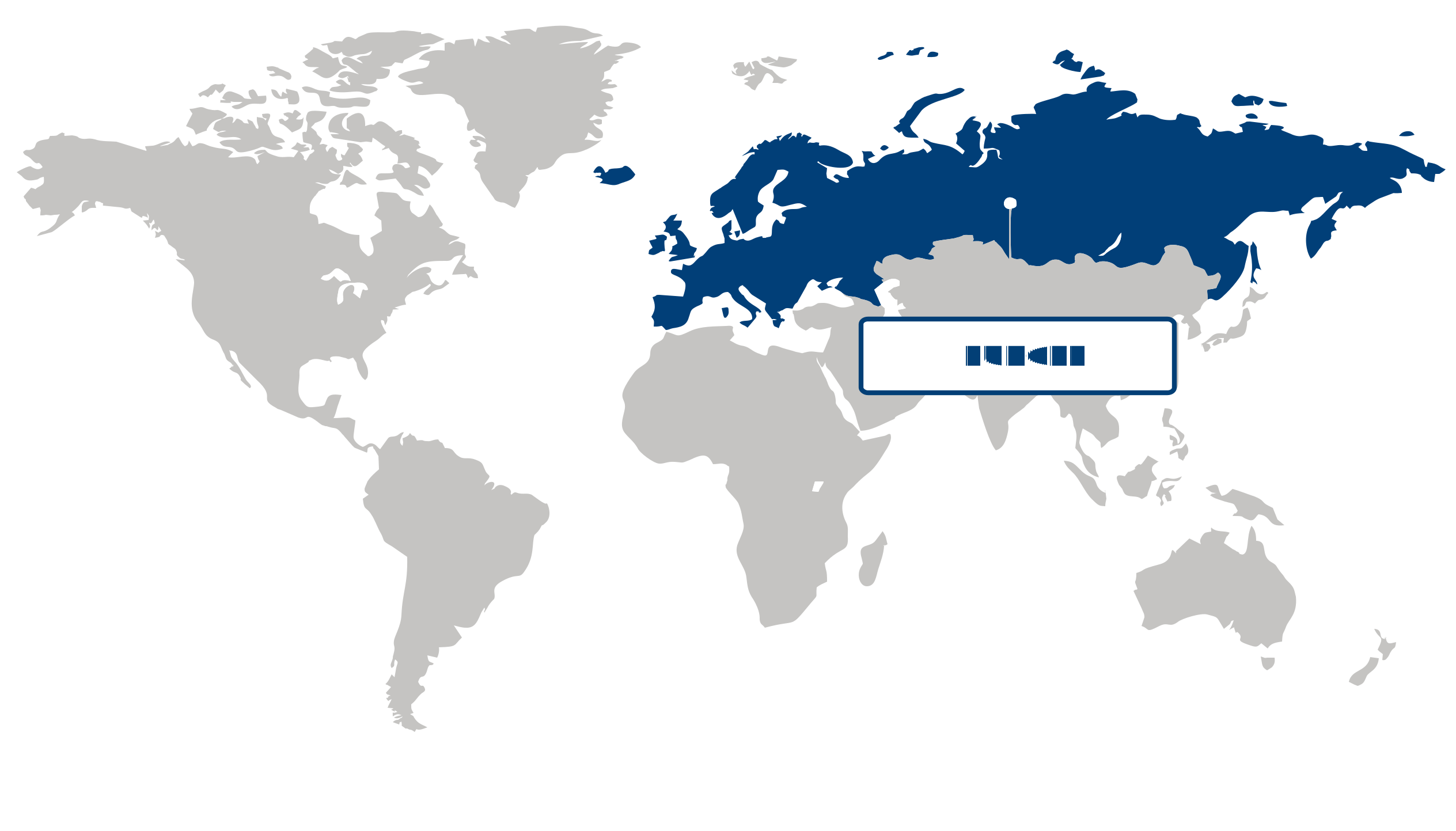
Europe (Largest Region)
Europe accounted for a 37.10% share of the bed head panel market in 2026, reflecting its mature hospital infrastructure, established standards for patient-care environments, and strong emphasis on efficient integration of medical utilities. Bed head panels support organized access to electrical connections, medical gases, lighting, and other essential services at the patient bedside, helping healthcare facilities optimize clinical workflows and space utilization. Ongoing hospital modernization, refurbishment of healthcare facilities, and demand for safer and more efficient patient environments are supporting continued regional adoption.
Asia Pacific (Fastest-Growing Region)
Asia Pacific represents the fastest-growing regional market, supported by rapid hospital construction, expanding healthcare infrastructure, and increasing investment in modern patient-care facilities. As healthcare providers upgrade clinical environments, demand is rising for integrated bedside systems that improve accessibility to medical utilities while supporting efficient use of hospital space. Growing healthcare expenditure, expansion of critical care and specialized treatment capacity, and modernization of existing hospitals are further creating opportunities for bed head panel deployment.
| Parameter | North America | Asia Pacific | Europe | Latin America | MEA |
|---|---|---|---|---|---|
| Innovation HubiScaleNascentDeveloping Advanced | |||||
| Cost-Sensitive RegioniScaleLowMedium High | |||||
| Regulatory EnvironmentiScaleRestrictiveNeutral Supportive | |||||
| Demand DriversiScaleWeakModerate Strong | |||||
| Development StageiScaleEmergingDeveloping Developed | |||||
| Adoption RateiScaleLowMedium High | |||||
| New Entrants / StartupsiScaleSparseModerate Dense | |||||
| Macro IndicatorsiScaleWeakStable Strong |
Key Country Insights
Germany 🇩🇪
Integrated Hospital SystemsGermany focuses on bed head panels that combine functionality, safety, and efficient utility management in healthcare environments. German healthcare providers value high-quality integrated systems that support patient care while streamlining installation and facility operations.
France 🇫🇷
Care Environment OptimizationFrance values bed head panels that improve patient room organization and simplify access to clinical utilities. Healthcare providers across France increasingly adopt modular installations that enhance operational efficiency while supporting patient-centered care environments.
Italy 🇮🇹
Modular Facility PlanningItaly emphasizes bed head panel systems that support hospital renovation and efficient space utilization. Italian healthcare facilities favor adaptable installations that improve maintenance access while ensuring reliable delivery of essential bedside services.
Japan 🇯🇵
Compact Ward IntegrationJapan emphasizes bed head panel designs that optimize utility access within space-efficient hospital layouts. Healthcare facilities in Japan increasingly select configurable systems that improve caregiver accessibility while maintaining organized patient care environments.
South Korea 🇰🇷
Healthcare Infrastructure ModernizationSouth Korea continues upgrading healthcare facilities with bed head panels that integrate essential medical utilities into patient rooms. Hospitals in South Korea prioritize flexible configurations that support efficient care delivery and accommodate evolving clinical requirements.
United States 🇺🇸
Smart Patient InfrastructureThe U.S. bed head panel market is driven by healthcare facilities modernizing patient rooms with integrated medical gas, electrical, and communication systems. Hospitals in the U.S. prioritize modular solutions that improve clinical workflow and simplify maintenance.
Bed Head Panel Market Share (%), by Specialty, 2026
Go beyond the chart, access full insights & data tables
Request Free Sample ReportSpecialty Segment Analysis: ICU (Largest & Fastest-Growing Segment)
In the bed head panel market, the ICU segment accounted for the largest share of 42.4% in 2026 and is also expected to be the fastest-growing specialty segment. Its leading position is supported by the highly complex care environment of intensive care units, where continuous access to medical gases, electrical connections, communication systems, and patient monitoring infrastructure is essential. Bed head panels help consolidate these critical utilities into an organized and accessible configuration, supporting efficient clinical workflows while improving safety and space utilization. The continued emphasis on advanced critical care infrastructure, rising demand for well-equipped intensive care settings, and the need for integrated patient support systems are expected to reinforce the segment's growth.
End Use Segment Analysis: Hospitals (Largest Segment) vs Clinics (Fastest-Growing Segment)
The hospitals segment held the largest share of the market in 2026, driven by the extensive use of bed head panels across emergency departments, intensive care units, surgical recovery areas, and general inpatient wards. Hospitals require integrated infrastructure capable of supporting diverse patient care needs while enabling healthcare personnel to access essential utilities efficiently. Ongoing investments in hospital construction, modernization, and capacity expansion, together with increasing attention to patient safety and workflow efficiency, continue to support the strong position of this end-use segment.
The clinics segment is anticipated to be the fastest-growing end-use segment as outpatient and specialized care facilities increasingly invest in modern treatment infrastructure. The expansion of ambulatory care, diagnostic centers, and specialty clinics is creating demand for compact and adaptable bed head panel configurations that support clinical functionality within space-constrained settings. Growing preference for decentralized healthcare delivery and the modernization of smaller medical facilities are further expected to accelerate adoption within the clinics segment.
| Segment | Sub-Segment | Largest Segment | Fastest Growing |
|---|---|---|---|
| Specialty | ICU, Surgical, Others | ICU | ICU |
| End Use | Hospitals, Clinics, Others | Hospitals | Clinics |
Competitive Landscape and Market Positioning
Key companies in the bed head panel market:
1. Precision UK Ltd. (United Kingdom)
2. Baxter International Inc. (United States)
3. Novair Medical (France)
4. Amcaremed Medical (China)
5. Amico Group of Companies (Canada)
6. Drägerwerk AG & Co. KGaA (Germany)
7. BIOLUME (France)
8. BeaconMedaes (United Kingdom)
9. Silbermann (Israel)
10. INMED (Poland)
The bed head panel market is evolving through increasing demand for integrated healthcare infrastructure solutions that optimize space utilization and patient care efficiency. Companies are introducing modular and technologically enhanced panel systems designed to improve accessibility, equipment management, and workflow organization within healthcare settings. Continuous innovation in design and functionality is strengthening competitiveness across the bed head panel market.
| Company | Market Share | Company Revenue | Revenue CAGR (%) | Product Portfolio | Geographic Presence | Innovation / R&D Focus | Strategic Developments |
|---|---|---|---|---|---|---|---|
| Precision UK Ltd. (United Kingdom) | |||||||
| Baxter International Inc. (United States) | |||||||
| Novair Medical (France) | |||||||
| Amcaremed Medical (China) | |||||||
| Amico Group of Companies (Canada) | |||||||
| Drägerwerk AG & Co. KGaA (Germany) | |||||||
| BIOLUME (France) | |||||||
| BeaconMedaes (United Kingdom) | |||||||
| Silbermann (Israel) | |||||||
| INMED (Poland). |
Industry Development / News
| Company Name | Date | Key Development |
|---|---|---|
| Baxter International, Inc. | Dec-21 | Baxter International, Inc. completed the strategic acquisition of Hill-Rom for approximately USD 10.5 billion. The consolidation unifies medical infrastructure portfolios to scale connected care delivery and accelerate the international expansion of historical Hill-Rom bed head panels, patient positioning systems, and clinical technologies into new emerging healthcare markets. |
| BeaconMedaes | May-19 | BeaconMedaes secured official equipment registration from the Saudi Food and Drug Administration Authority for its entire portfolio of medical gas delivery systems. The regulatory approval expands the manufacturer's commercial footprint and operations within Middle Eastern hospital infrastructure networks, driving regional adoption of specialized clinical bed head solutions. |
Customize Your Report
Explore examples of how this report can be tailored to different research needs, including custom segments, additional topics or chapters, and related reports. Click a section of the wheel or its numbered marker to explore the available options.
Bed Head Panel Market — Custom Segments
| Segment | Sub-Segment |
|---|---|
| Panel Configuration | Horizontal Panels, Vertical Panels, Modular Panels |
| Purchasing Channel | Direct Sales, Medical Equipment Distributors, Healthcare Procurement Platforms |
| Price Tier | Economy, Mid-Range, Premium |
Bed Head Panel Market — Custom TOC
| Custom Chapter | Chapter Details |
|---|---|
| Healthcare Facility Procurement & Specification Benchmarking |
|
| Retrofit vs. New Construction Demand Assessment |
|
| Medical Gas & Electrical Integration Ecosystem Analysis |
|
Need a different cut of the data?
Request Custom ResearchFrequently Asked Questions
How big is the bed head panel market?
What is the expected industry size of bed head panel by 2036?
Why is hospital infrastructure expansion accelerating demand for bed head panels?
How are integrated medical gas systems shaping procurement trends in the bed head panel market?
What makes ICU the leading specialty segment in the bed head panel market?
Which end-use segment is expanding fastest in the bed head panel market?
Why does Europe dominate the bed head panel market?
What is driving Asia Pacific growth in the bed head panel market?
Who are the major participants shaping the bed head panel landscape?
Our Clients
"The team took the time to understand our specific business needs and delivered a report that was well aligned with our objectives. Their expertise and understanding of the industry were clearly reflected in the quality and relevance of the insights provided."
Siemens Healthcare
"Our experience in acquiring the research report has been excellent. The depth of analysis, and actionable insights provided have been extremely valuable in supporting our ongoing R&D efforts."
GC Biopharma
"The report offered a comprehensive view of the market trends. The in-depth segmentation and analysis of emerging opportunities gave us a better understanding of the market."
Medtronic
Our Research Team & Methodology
Every Fundamental Business Insights report is built by a dedicated vertical research team, validated through a structured primary-and-secondary methodology, and reviewed for accuracy before it reaches you.
Delivery
Published
Available
Support
- Market Size & Forecast
- Market Segmentation
- Regional Analysis
- Growth Drivers & Challenges
- Market Dynamics
- Competitive Landscape
- Company Profiles
- Competitive Benchmarking
- Mergers & Acquisitions
- Market Share Analysis or Key Company Strategies
- Value Chain Analysis
- Porter's Five Forces
- PESTLE Analysis
- Pricing Trends
- Supply-Demand Analysis
- Technology Landscape
- Regulatory Landscape
- Investment & Funding Landscape
- Emerging Opportunities
- Future Market Outlook