Bio-Based Emulsion Polymers Market Size & Forecasts 2026-2035, By Segments (End User, Material Compositions), Growth Opportunities, Innovation Landscape, Regulatory Shifts, Strategic Regional Insights (U.S., Japan, China, South Korea, UK, Germany, France), and Competitive Dynamics (Arkema, BASF, Dow Inc., Huntsman Corporation, Wacker Chemie)
Market Size and Growth Outlook
Bio-Based Emulsion Polymers Market size is forecast to climb from USD 4.04 billion in 2025 to USD 8.97 billion by 2035, expanding at a CAGR of over 8.3% during 2026-2035. Industry revenue in 2026 is projected at USD 4.33 billion.
Get more details on this report
Request Free Sample ReportBio-Based Emulsion Polymers Market Intelligence Snapshot
Regional Market Dynamics
Segment Momentum
Market Expansion Drivers
Leading Market Participants
Global Market Forecast Snapshot
Market Outlook
Regional and Segment Outlook
Market Growth Drivers and Industry Trends
Corporate sustainability mandates and tighter regulation are increasing procurement of renewable materials, directly lifting demand in the bio-based emulsion polymers market; the European Commission’s Packaging and Packaging Waste Regulation alongside brand commitments from Unilever and Nestlé to reduce fossil-based plastic use illustrate clear upstream demand signals. Consumer preference for compostable or recycled-packaging claims drives formulation shifts toward bio-based dispersions, creating opportunities for formulators to secure long-term supply contracts with consumer goods companies and for new entrants to win niche branded partnerships. Observed regulatory milestones and continuing CPG commitments indicate steady, policy-driven commercial adoption rather than ad hoc interest.
Innovation in bio-emulsion polymer formulations
Advances in monomer sourcing and emulsion technology from research centers such as the Fraunhofer Institute for Applied Polymer Research and the National Renewable Energy Laboratory (NREL), together with R&D investments by BASF, are delivering bio-based binders and performance parity needed by coatings and specialty applications, reshaping the bio-based emulsion polymers market. These technical improvements lower switching risk for large buyers and create licensing, co-development, and premium-product opportunities for incumbents and agile startups that can commercialize differentiated chemistry. Given ongoing collaborative research and published pilot successes, expect continued incremental substitution as performance gaps narrow and application approvals accumulate.
Expansion of bio-based polymer production facilities
Capacity additions announced by producers including Braskem and NatureWorks, and joint ventures such as TotalEnergies and Corbion, are increasing industrial-scale availability of renewable feedstocks and intermediates that feed into the bio-based emulsion polymers market. Greater local production reduces logistics risk and enables cost-competitive supply chains, benefitting established vertically integrated players while enabling contract-manufacturing and tolling opportunities for new entrants. With multiple announced plant projects and public funding mechanisms from the European Commission and others, the immediate outlook points to improving feedstock security and commercial scalability rather than demand-driven volatility.
Industry Restraints:
Regulatory Compliance Burdens
Evolving chemical regulations and sustainability standards materially slow commercialization of bio‑based emulsion polymers by increasing time-to-market and compliance cost. The European Chemicals Agency (ECHA) and the European Commission’s Chemicals Strategy for Sustainability have tightened restrictions and hazard assessments under REACH, while the U.S. Environmental Protection Agency’s (EPA) TSCA oversight and ASTM International bio-based content standards (e.g., ASTM D6866) add certification and testing burdens. These requirements force formulation redesigns, extended safety dossiers, and higher regulatory spend, disadvantaging smaller entrants without compliance infrastructure and pressuring incumbents to absorb costs or delay launches. Expect continued tiered consolidation as firms invest in regulatory affairs or strategic partnerships; near‑term, regulatory alignment and clear standardization will dictate which technologies scale fastest.
Feedstock Availability and Price Volatility
Dependence on agricultural and renewable feedstocks constrains scale and margin stability for bio‑based emulsion polymers as crop yields, land competition, and commodity prices fluctuate. The Food and Agriculture Organization of the United Nations (FAO) and the OECD‑FAO Agricultural Outlook highlight land‑use competition between food, feed, and industrial demand; USDA reporting documents weather‑driven yield variability affecting oilseed and starch supplies. Price swings and regional shortages raise raw‑material risk, favoring vertically integrated players or those with long‑term offtake agreements, while capital‑constrained startups face supply insecurity. As demand for renewable inputs grows, feedstock diversification and strategic procurement will remain decisive levers shaping market share over the near to medium term.
| Growth Driver | Impact on CAGR | Regulatory Influence | Geographic Relevance | Adoption Rate | Impact Timeline |
|---|---|---|---|---|---|
| Demand for bio-based polymers in packaging & coatings | 3.00% | Short term (≤ 2 yrs) | Europe, North America | High | Fast |
| Innovation in bio-emulsion polymer formulations | 2.00% | Medium term (2–5 yrs) | Asia Pacific, Europe | Medium | Moderate |
| Expansion of bio-based polymer production facilities | 3.00% | Long term (5+ yrs) | Asia Pacific; Spillover: North America | Low | Moderate |
Explore Growth Opportunities
Request Free Sample ReportRegional Demand Dynamics
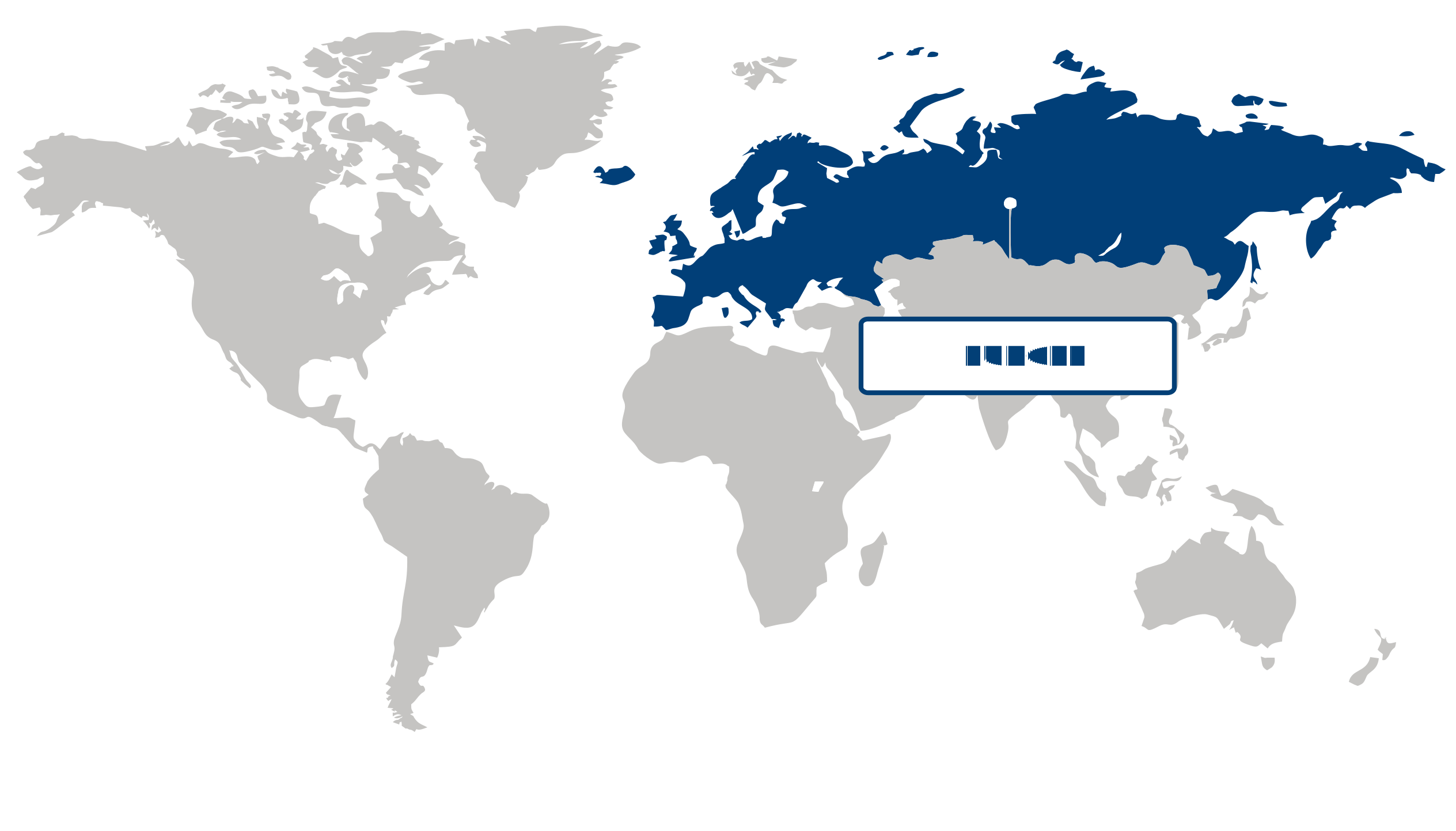
Europe captured over 46.00% of the global bio-based emulsion polymers market in 2025, remaining the largest regional market as regulatory pressure accelerates substitution of petrochemical emulsions. Stringent frameworks such as REACH, administered by the European Chemicals Agency (ECHA), together with recent VOC emission directives from the European Commission, have compelled formulators and downstream buyers to accelerate adoption of bio-based alternatives; this regulatory push is echoed in policy positions from the European Environment Agency and in trade commentary from Cefic. Leading European producers and technology developers—including BASF, Evonik, and Arkema—have signaled R&D and portfolio shifts toward renewable binders and lower-VOC systems, reinforcing supply-side readiness. Given strong public procurement preferences, established chemical clusters, and active R&D networks, Europe offers sustained commercial openings for scale-up, premium product placement, and feedstock innovation across the value chain.
Germany anchors the Europe bio-based emulsion polymers market, where large industrial end-users and rigorous national enforcement of REACH create early-adopter demand for compliant, lower-VOC formulations. German policy engagement—through the Federal Ministry for the Environment, Nature Conservation, Nuclear Safety and Consumer Protection (Bundesumweltministerium)—and industry coordination via Verband der Chemischen Industrie (VCI) have encouraged manufacturers to pilot bio-based emulsions in coatings and paper sizing. Industrial champions such as BASF, headquartered in Germany, plus applied-research support from Fraunhofer institutes, are translating regulatory-driven requirements into scalable production processes and detailed technical data sheets that facilitate customer qualification. Strategically, Germany’s combination of procurement scale and technology transfer capability accelerates commercialization across neighboring markets, reinforcing Europe’s leadership.
France is positioned as a pivotal hub in the Europe bio-based emulsion polymers market through targeted public support and strong downstream demand from consumer and construction segments seeking low-VOC solutions. French agencies—notably ADEME (Agence de la transition écologique) and policy platforms under the Ministère de la Transition écologique—have funded pilot programs and circular-feedstock trials, while national industrial initiatives such as France Relance have prioritized green chemicals investment. Domestic players like Arkema have announced R&D and product initiatives from French sites that align with national incentives, and the Union des Industries Chimiques (UIC) has advocated practical transition pathways for formulators. These policy and industry levers make France a testbed for market-ready bio-based emulsions, enhancing regional supply diversity and accelerating uptake across Europe.
Asia Pacific Market Analysis:
Asia Pacific emerged as the fastest-growing region in the bio-based emulsion polymers market, registering a robust CAGR of 10.3% driven by rising consumer awareness of green building and low-VOC interior decor. Demand is being lifted by stronger specification of low-emission materials in commercial and residential projects and by manufacturers reformulating coatings and adhesives to meet indoor air-quality preferences; the World Green Building Council has documented accelerating green building commitments across Asia Pacific, and large coatings players such as Nippon Paint Holdings Co., Ltd. have expanded low-VOC portfolios to capture interior décor demand. Combined policy signals and buyer preferences create a timely opportunity for suppliers to scale bio-based formulations across adhesive, architectural and paper-coating applications in the region.
Japan plays a leading role in the bio-based emulsion polymers market as a high-value, regulation-driven adopter of low-VOC interior decor. Japanese consumers and building owners prioritize indoor air quality and product transparency, and the Ministry of Land, Infrastructure, Transport and Tourism (MLIT) has promoted energy- and health-conscious housing programs that favor low-emission materials; Nippon Paint Holdings Co., Ltd. and medium-sized specialty formulators are positioning bio-based emulsions into renovation and premium new-build segments. Japan’s combination of stringent buyer expectations, renovation-led demand from an aging housing stock, and strong R&D capabilities makes it a launchpad for premium bio-based formulations that can be scaled regionally.
China serves as the volume engine for the bio-based emulsion polymers market, driven by large-scale new construction, retrofit waves and formal green-building requirements. The Ministry of Housing and Urban-Rural Development (MOHURD) continues to implement the Three-Star green building standard, increasingly referencing material emission performance, while national urbanization and retrofit programs sustain demand for low-VOC interior products. Domestic and multinational producers operating in China are investing in local production and supply-chain integration to meet fast-moving specification changes. For investors and suppliers, China’s scale and regulatory alignment with green-building criteria offer a critical pathway to cost reductions and market-share gains across Asia Pacific.
North America Market Trends:
North America maintained notable presence in the bio-based emulsion polymers market, supported by an integrated combination of policy incentives, feedstock access and established industrial demand across coatings, adhesives and specialty applications. Federal and provincial programs such as the USDA BioPreferred Program, the U.S. Department of Energy Bioenergy Technologies Office and Natural Resources Canada’s Clean Growth initiatives underpin procurement and R&D funding, while regulatory pressure from agencies like the California Air Resources Board and Environment and Climate Change Canada has accelerated low-VOC and renewable-material uptake. Industry organizations including the American Coatings Association and the Adhesive and Sealant Council have amplified demand signals to suppliers, and major chemical manufacturers’ sustainability roadmaps have shifted supply strategies. These dynamics position the region for continued conversion of legacy formulations to bio-based systems and attractive scale-up opportunities for investors and tier‑1 suppliers.
The U.S. is the regional leader in the bio-based emulsion polymers market, driven by concentrated end‑market scale, active federal research funding and aggressive state-level regulation that together accelerate commercial adoption. Federal programs such as the U.S. Department of Energy Bioenergy Technologies Office and the USDA BioPreferred Program provide targeted support for bioproduct scale-up, while state regulators like the California Air Resources Board create near-term specification demand for low‑emission, renewable-content coatings and adhesives; the American Coatings Association has documented rising formulators’ interest in bio-based raw materials. Strong private R&D and large construction and packaging markets mean successful U.S. commercialization often signals broader North American uptake, making U.S. partnerships and pilot deployments strategically critical for regional expansion.
| Parameter | North America | Asia Pacific | Europe | Latin America | MEA |
|---|---|---|---|---|---|
| Innovation Hub i Scale Nascent Developing Advanced | |||||
| Cost-Sensitive Region i Scale Low Medium High | |||||
| Regulatory Environment i Scale Restrictive Neutral Supportive | |||||
| Demand Drivers i Scale Weak Moderate Strong | |||||
| Development Stage i Scale Emerging Developing Developed | |||||
| Adoption Rate i Scale Low Medium High | |||||
| New Entrants / Startups i Scale Sparse Moderate Dense | |||||
| Macro Indicators i Scale Weak Stable Strong |
Segment Leadership and Growth Trends
Bio-Based Emulsion Polymers Market Share (%), by End User, 2026
Go beyond the chart, access full insights & data tables
Request Free Sample ReportPaint dominated the bio-based emulsion polymers market End User segment in 2025, reflecting the largest share as demand shifts toward eco-friendly, low-VOC formulations. This leadership is driven by rising consumer and regulatory pressure for low-VOC interior and exterior coatings, with the U.S. Environmental Protection Agency (EPA) guidelines and European Commission VOC limits prompting manufacturers such as AkzoNobel and PPG to expand bio-based, waterborne offerings. Customer preference for healthier indoor environments, supply-chain moves toward renewable feedstocks, and competitive product differentiation have reinforced adoption. Established producers can scale low‑VOC platforms while niche suppliers can supply specialty binders and additives, and continued regulatory tightening and product innovation support its near- to medium-term relevance.
Analysis by Material Compositions
Polyacrylic acid (PAA) represented largest share in the bio-based emulsion polymers market Material Compositions segment in 2025, propelled by the migration to water-based and biodegradable polymer systems. PAA’s performance in waterborne emulsions and compatibility with biodegradable formulations has led firms such as BASF and Dow to prioritize acrylic emulsion development for coatings and adhesives, aided by European Commission circular economy policies encouraging sustainable polymers. Improvements in bio-based monomer sourcing, process digitalization for emulsion control, and demand for lower-environmental-impact chemistries strengthen PAA’s position. This creates scale-up opportunities for incumbents and specialized entry points for start-ups offering bio-derived monomers, and ongoing R&D and commercial deployment suggest sustained relevance into the near and medium term.
| Segment | Sub-Segment | Largest Segment | Fastest Growing |
|---|---|---|---|
| End User | Paint, Coating, Paper Industry and Paper Coatings, Adhesives, Textiles | ||
| Material Compositions | Acrylonitrile Butadiene Styrene (ABS), Ethylene Vinyl Acetate (EVA), Polyacrylic Acid (PAA), Polyamide (PA), Poly Methyl Methacrylate (PMMA), Polybutylene (PB), Polybutylene Terephthalate |
Unlock insights tailored to your business with our bespoke market research solutions.
Click to get your customized report now.
Competitive Landscape and Market Positioning
The competitive environment is marked by targeted activity to convert sustainability credentials into commercial differentiation. Several incumbents have accelerated cross-industry development pathways and selectively realigned portfolios to emphasize bio-derived resin lines, while others have intensified application-focused launches and pilot deployments to address formulation challenges in coatings, adhesives and paper coatings. Investment in bespoke lab capabilities and tighter supply-chain linkages has sharpened product positioning, and selective commercial alliances have expanded route-to-market access, raising the technical and go-to-market bar for smaller entrants while creating collaboration opportunities for specialist partners.
Strategic / Actionable Recommendations for Regional Players
North America: Prioritize co-development with large downstream formulators and converters to capitalize on local feedstock advantages and advanced processing know-how. Focus pilot-scale deployments adjacent to specialty coatings and adhesive clusters, and leverage digital formulation platforms to accelerate adoption among industrial customers seeking lower-carbon binder replacements.
Asia Pacific: Emphasize cost-competitive scale-up combined with targeted alliances with regional resin producers and major OEMs to embed bio-based emulsions in high-volume applications such as packaging and industrial coatings. Adopt flexible manufacturing modules and local testing partnerships to meet diverse regulatory and performance requirements quickly.
Europe: Concentrate on premium, high-performance niches—architectural coatings, healthcare adhesives and eco-sensitive paper coatings—by deepening research collaborations with institutes and brand owners and integrating circular feedstock streams. Strengthen traceability and sustainability credentials through transparent supply-chain linkages to defend value-based pricing and maintain differentiation.
| Company | Market Share | Company Revenue | Revenue CAGR (%) | Product Portfolio | Geographic Presence | Innovation / R&D Focus | Strategic Developments |
|---|---|---|---|---|---|---|---|
| No companies available. | |||||||
Industry Development/News
| Company Name | Date | Key Development |
|---|
Customize Your Report
Explore examples of how this report can be tailored to different research needs, including custom segments, additional topics or chapters, and related reports. Click a section of the wheel or its numbered marker to explore the available options.
Bio-Based Emulsion Polymers Market — Custom Segments
| Segment | Sub-Segment |
|---|---|
| No segment data available. | |
Bio-Based Emulsion Polymers Market — Custom TOC
| Custom Chapter | Custom Details | ||
|---|---|---|---|
| No custom TOC data available. | |||
Need a different cut of the data?
Request Custom ResearchWhat is the current size of the bio-based emulsion polymers market?
What is the forecasted size of the bio-based emulsion polymers industry?
Which geographical area accounts for the highest portion of the bio-based emulsion polymers market?
Which area is showing the greatest surge in bio-based emulsion polymers sector?
Why is the paint segment leading in the bio-based emulsion polymers industry?
Why does polyacrylic acid (PAA) sub-segment dominate the material compositions segment of bio-based emulsion polymers sector?
Who are the leading players in the bio-based emulsion polymers landscape?
Our Clients
"The report helped us understand emerging consumer trends in our product category. It clarified where to focus innovation for the next product launch."
LyondellBasell
"The regional forecast section was incredibly useful. We were able to identify two new potential partners in Europe thanks to the vendor mapping you included."
SABIC
"We appreciated how actionable the recommendations were. It guided us to improve supply chain resilience."
Olin Corporation
Our Research Team & Methodology
Every Fundamental Business Insights report is built by a dedicated vertical research team, validated through a structured primary-and-secondary methodology, and reviewed for accuracy before it reaches you.
Research Team Overview
Prepared by the Chemicals & Materials Research Team
Delivery
Published
Demand
Available
Support
Trust & Compliance
Research Intelligence
Research Workflow & Quality Assurance
Data Collection
Verified information gathered through primary and secondary research.
Data Triangulation
Cross-validation using multiple independent data sources.
Forecast Modelling
Market estimates developed using historical trends and analytical models.
Analyst Validation
Findings reviewed by domain experts for accuracy and consistency.
Editorial & Quality Review
Final editorial, quality, and compliance checks before publication.
Final Publication
Released after successful completion of the internal review process.
Report Coverage
📊 Market Assessment
- Market Size & Forecast
- Market Segmentation
- Regional Analysis
- Growth Drivers & Challenges
- Market Dynamics
🏢 Competitive Intelligence
- Competitive Landscape
- Company Profiles
- Competitive Benchmarking
- Mergers & Acquisitions
- Market Share Analysis or Key Company Strategies
🔍 Strategic Analysis
- Value Chain Analysis
- Porter's Five Forces
- PESTLE Analysis
- Pricing Trends
- Supply-Demand Analysis
🚀 Future Outlook
- Technology Landscape
- Regulatory Landscape
- Investment & Funding Landscape
- Emerging Opportunities
- Future Market Outlook
Have a question about this report or need a custom scope?
Request Customization