Biocontrol Agents Market Size & Growth Forecast 2027–2036, By Segments (Active Substance, Application, Crop), Regional Demand Trends (North America, Asia Pacific, Europe), Key Country Insights (U.S., Japan, South Korea, Germany, France, Italy), and Competitive Landscape
Jump to Content
Market Size and Growth Outlook
Biocontrol Agents Market size was valued at USD 7.73 Billion in 2026 and is anticipated to grow at 16.54% CAGR from 2027 to 2036, reaching USD 35.72 Billion by 2036. The industry revenue for 2027 is estimated at USD 8.84 Billion.
Get more details on this report
Request Free Sample ReportBiocontrol Agents Market Intelligence Snapshot
Regional Market Dynamics
- Europe held 35.96% in 2026, supported by sustainable agriculture, favorable regulatory conditions, residue-conscious food production, and growing adoption of integrated pest management.
- Expanding agricultural production, rising food demand, government support, and increasing awareness of sustainable crop protection are encouraging broader regional deployment.
Segment Momentum
- Microbials held 63.6% of the market in 2026 due to their effective pest and disease control, compatibility with integrated pest management, and strong support for sustainable agricultural practices.
- Seed treatment is the fastest-growing application because it protects crops during early development, improves germination, enhances resistance to soil-borne pathogens, and reduces reliance on synthetic chemical treatments.
Market Expansion Drivers
- Rising organic farming adoption in Europe accelerating biocontrol agent utilization
- Stringent regulations restricting chemical fertilizer usage driving biological alternatives demand
- Expansion of sustainable agriculture practices increasing biological pest management solutions
Leading Market Participants
- Prominent players in the biocontrol agents market include BASF SE (Germany), Bayer AG (Germany), Syngenta Group (Switzerland), Koppert Biological Systems (Netherlands), Corteva Agriscience (United States), UPL Limited (India), Novozymes A/S (Denmark), FMC Corporation (United States), Marrone Bio Innovations, Inc. (United States), Certis Biologicals (United States)
Global Market Forecast Snapshot
Market Outlook
- 2026 Market Size: USD 7.73 Billion
- 2027 Estimated Market Size: USD 8.84 Billion
- Projected Market Size: USD 35.72 Billion by 2036
- Growth Forecast: 16.54% CAGR (2027-2036)
Regional and Segment Outlook
- Leading Regional Market: Europe
- High-Growth Regional Hub: Asia Pacific
- Core Revenue Segment: Microbials (Active Substance) | On-Field (Application) | Fruits and Vegetables (Crop)
- Emerging Opportunity Segment: Microbials (Active Substance) | Seed Treatment (Application) | Fruits and Vegetables (Crop)
Market Growth Drivers and Industry Trends
Rising organic farming adoption in Europe accelerating biocontrol agent utilization
The expansion of organic agriculture practices is increasing the need for natural crop protection methods that align with sustainable farming requirements. The biocontrol agents market growth is driven by rising organic farming adoption in Europe, where growers are increasingly incorporating biological solutions to manage pests and diseases while maintaining compliance with organic production standards. These agents provide farmers with alternatives to conventional chemical inputs and support environmentally focused agricultural practices.
Stringent regulations restricting chemical fertilizer usage driving biological alternatives demand
Growing regulatory pressure on chemical agricultural inputs is encouraging farmers to transition toward safer and more sustainable crop management approaches. The biocontrol agents market will gain momentum as restrictions on chemical fertilizer and pesticide usage increase demand for biological alternatives that support soil health and reduce environmental impact. Regulatory changes are prompting agricultural stakeholders to explore microbial, botanical, and other biological solutions for maintaining productivity while meeting evolving standards.
Expansion of sustainable agriculture practices increasing biological pest management solutions
The broader shift toward sustainable farming is creating opportunities for biological pest management technologies that improve crop protection while reducing dependence on synthetic chemicals. Sustainable agriculture adoption will propel the biocontrol agents market growth as farmers integrate biological products into integrated pest management strategies. These solutions help address environmental concerns, promote ecological balance, and support long-term agricultural productivity across diverse farming systems.
| Growth Driver | Impact on CAGR | Regulatory Influence | Geographic Relevance | Adoption Rate | Impact Timeline |
|---|---|---|---|---|---|
| Rising organic farming adoption in Europe accelerating biocontrol agent utilization | 2% | High | Europe | High | Near Term |
| Stringent regulations restricting chemical fertilizer usage driving biological alternatives demand | 1.9% | High | Europe, North America | High | Near Term |
| Expansion of sustainable agriculture practices increasing biological pest management solutions | 1.7% | Moderate | Asia Pacific, Latin America | Medium | Mid Term |
Go beyond the chart, access full insights & data tables
Request Free Sample ReportRegional Demand Dynamics
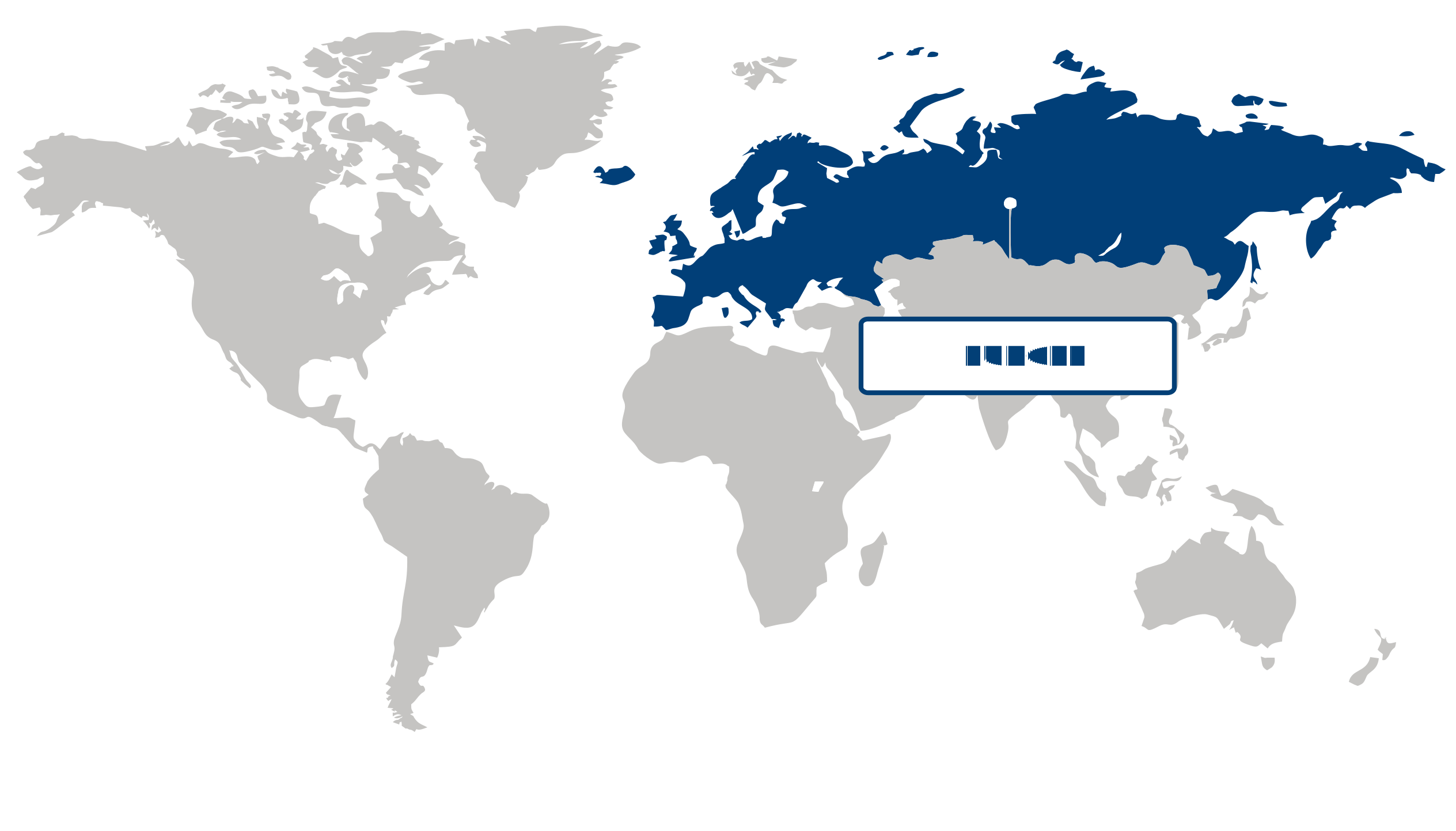
Europe (Largest Region)
Europe held the largest share of 35.96% in the biocontrol agents market in 2026, supported by strong emphasis on sustainable agriculture, reduced reliance on conventional chemical pesticides, and favorable regulatory conditions for environmentally responsible crop protection. The region's agricultural sector is increasingly adopting biological solutions to address pest management while meeting consumer and environmental expectations. In addition, growing demand for residue-conscious food production, integrated pest management practices, and sustainable farming systems is encouraging the wider use of microbial and other biological control solutions.
Asia Pacific (Fastest-Growing Region)
Asia Pacific is anticipated to experience the fastest growth, driven by expanding agricultural production, increasing food demand, and growing awareness of sustainable crop protection practices. The need to improve farm productivity while managing pest-related losses is encouraging farmers to explore biological alternatives alongside conventional crop protection methods. Furthermore, increasing adoption of modern agricultural technologies, government support for sustainable farming, and growing concerns regarding soil and environmental health are creating favorable conditions for broader deployment of biocontrol agents across the region.
| Parameter | North America | Asia Pacific | Europe | Latin America | MEA |
|---|---|---|---|---|---|
| Innovation HubiScaleNascentDeveloping Advanced | |||||
| Cost-Sensitive RegioniScaleLowMedium High | |||||
| Regulatory EnvironmentiScaleRestrictiveNeutral Supportive | |||||
| Demand DriversiScaleWeakModerate Strong | |||||
| Development StageiScaleEmergingDeveloping Developed | |||||
| Adoption RateiScaleLowMedium High | |||||
| New Entrants / StartupsiScaleSparseModerate Dense | |||||
| Macro IndicatorsiScaleWeakStable Strong |
Key Country Insights
United States 🇺🇸
Precision Agriculture IntegrationThe U.S. biocontrol agents market is driven by the integration of biological crop protection into precision farming and sustainable pest management programs. Manufacturers continue expanding microbial and botanical product portfolios that align with evolving grower preferences and integrated pest management practices.
Germany 🇩🇪
Sustainable Crop ProtectionGermany emphasizes environmentally responsible crop protection, encouraging wider adoption of biocontrol agents across horticulture and field crops. The country's regulatory focus and demand for residue-conscious farming support continued investment in biologically derived pest management solutions.
Japan 🇯🇵
Specialty Agriculture FocusJapan prioritizes biocontrol agents for high-value crops where consistent quality and reduced chemical residues are important. Domestic producers and agricultural stakeholders continue refining biological solutions suited to intensive cultivation and controlled-environment farming systems.
South Korea 🇰🇷
Smart Farming ApplicationsSouth Korea incorporates biocontrol agents into smart farming initiatives that emphasize efficient and environmentally conscious crop production. The country is strengthening commercial deployment of microbial products compatible with advanced greenhouse and precision cultivation technologies.
France 🇫🇷
Integrated Vineyard SolutionsFrance promotes biocontrol agents across vineyards, orchards, and specialty crops as growers seek practical alternatives to conventional pesticides. The market increasingly values biological products that complement integrated pest management while maintaining crop quality standards.
Italy 🇮🇹
High-Value Crop ProtectionItaly focuses on biocontrol agents for fruit, vegetable, and vineyard production where sustainable pest management supports premium agricultural output. Italian growers continue adopting biological inputs that balance productivity with stricter environmental and food quality expectations.
Biocontrol Agents Market Share (%), by Active Substance, 2026
Unlock insights tailored to your business with our bespoke market research solutions.
Click to get your customized report now.
Go beyond the chart, access full insights & data tables
Request Free Sample ReportActive Substance Segment Analysis: Microbials (Largest & Fastest-Growing Segment)
The biocontrol agents market was led by the microbial segment, which held the largest share of 63.6% in 2026, while also emerging as the fastest-growing segment. Microbial biocontrol agents are widely adopted because they provide effective control of pests and plant diseases while supporting sustainable agricultural practices. Their compatibility with integrated pest management programs, ability to improve crop health, and reduced environmental impact compared with conventional chemical solutions have accelerated their adoption across diverse farming systems. Continuous advancements in microbial strain development, expanding regulatory support for biological crop protection, and increasing demand for environmentally responsible agricultural inputs continue to strengthen the segment's market position.
Application Segment Analysis: On-Field (Largest Segment) vs Seed Treatment (Fastest-Growing Segment)
The on-field application segment held the largest share of 49.8% in 2026, reflecting its extensive use in protecting crops throughout the cultivation cycle. Farmers increasingly rely on on-field application methods to manage pests and diseases directly during crop growth, enabling broader coverage and timely intervention. The growing adoption of sustainable farming practices, coupled with rising awareness of biological crop protection, continues to support the dominance of this application segment.
The seed treatment segment represents the fastest-growing application in the biocontrol agents market. Growth is supported by increasing emphasis on protecting seeds during the earliest stages of crop development, improving germination, and enhancing resistance against soil-borne pathogens. Agricultural producers are increasingly incorporating biological seed treatment solutions to improve crop establishment while reducing dependence on synthetic chemical treatments, supporting wider adoption of this application method.
Crop Segment Analysis: Fruits and Vegetables (Largest & Fastest-Growing Segment)
The fruits and vegetables segment dominated the biocontrol agents market, accounting for the largest share of 45.9% in 2026, while also representing the fastest-growing crop segment. High-value fruit and vegetable production requires effective pest and disease management to maintain quality, yield, and marketability, encouraging widespread adoption of biological control solutions. Increasing consumer preference for residue-conscious produce, expanding cultivation of horticultural crops, and greater implementation of sustainable farming practices continue to drive demand. Ongoing improvements in biological crop protection technologies further reinforce the strong position of this segment across commercial agriculture.
| Segment | Sub-Segment | Largest Segment | Fastest Growing |
|---|---|---|---|
| Active Substance | Microbials, Macro-organisms, Bio-chemicals | Microbials | Microbials |
| Application | Seed Treatment, On-Field, Post-harvest | On-Field | Seed Treatment |
| Crop | Fruits and Vegetables, Cereals & Grains, Pulses, Others | Fruits and Vegetables | Fruits and Vegetables |
Competitive Landscape and Market Positioning
Top players in the biocontrol agents market:
- BASF SE (Germany)
- Bayer AG (Germany)
- Syngenta Group (Switzerland)
- Koppert Biological Systems (Netherlands)
- Corteva Agriscience (United States)
- UPL Limited (India)
- Novozymes A/S (Denmark)
- FMC Corporation (United States)
- Marrone Bio Innovations, Inc. (United States)
- Certis Biologicals (United States)
Shifts in agricultural practices are reshaping competition in the biocontrol agents market, with suppliers moving beyond individual biological formulations toward broader crop protection portfolios tailored to regional cultivation conditions and integrated pest management strategies. Differentiation increasingly depends on the consistency of field performance across varying climates, formulation stability, and the ability to support growers with application guidance that improves adoption. At the same time, innovation is extending into strain selection, delivery technologies, and compatibility with conventional farming inputs, encouraging participants to build more comprehensive solutions rather than competing solely on biological efficacy. Regulatory alignment and scalable production capabilities are also becoming important strategic levers as commercialization timelines and product reliability influence market positioning.
| Company | Market Share | Company Revenue | Revenue CAGR (%) | Product Portfolio | Geographic Presence | Innovation / R&D Focus | Strategic Developments |
|---|---|---|---|---|---|---|---|
| BASF SE (Germany) | |||||||
| Bayer AG (Germany) | |||||||
| Syngenta Group (Switzerland) | |||||||
| Koppert Biological Systems (Netherlands) | |||||||
| Corteva Agriscience (United States) | |||||||
| UPL Limited (India) | |||||||
| Novozymes A/S (Denmark) | |||||||
| FMC Corporation (United States) | |||||||
| Marrone Bio Innovations Inc. (United States) | |||||||
| Certis Biologicals (United States) |
Industry Development/News
| Company Name | Date | Key Development |
|---|---|---|
| CSIRO | Feb-26 | CSIRO secured A$1 million in funding from the New South Wales Government to advance biological control research. The investment will support the development, field testing, and deployment of targeted biological control agents to manage invasive weed species sustainably. |
| Rhodes University Centre for Biological Control | Nov-25 | The Centre for Biological Control at Rhodes University introduced a new insect-based biological control agent to manage invasive silver wattle. The development expands the practical application of insect vectors within the broader biopesticide and vegetation management sectors. |
| ICAR-NBAIR | Oct-25 | ICAR-NBAIR deployed biological pest management and biocontrol initiatives under India's national agricultural frameworks, including the PM Dhan Dhaanya Krishi Yojana. The deployment scales up technical infrastructure and commercial viability for biological crop protection solutions in regional production. |
| Vestaron | Aug-25 | Vestaron initiated commercialization advocacy for its proprietary peptide-based biopesticides, targeting broader regulatory framework recognition. The strategy aims to establish a distinct regulatory category for peptide innovations, accelerating time-to-market and commercial scalability for advanced biocontrol products. |
| CSIRO | Mar-25 | CSIRO, in partnership with the Grains Research and Development Corporation, initiated targeted rust fungus trials. The program focuses on developing biological control agents for flaxleaf fleabane, establishing viable, long-term biological alternatives to conventional chemical weed management systems. |
| Biobest | Nov-24 | Biobest expanded its commercial sustainable crop protection portfolio through the market integration of predatory mite species, specifically Stratiolaelaps scimitus and Gaeolaelaps gillespiei. The launch provides commercial agricultural producers with specialized biological options for soil-dwelling pest management. |
| Andermatt Biocontrol Ltd. | Jun-24 | Andermatt Biocontrol Ltd. strengthened its competitive positioning within the European Union by launching a new series of microbial biocontrol agents. The product rollout specifically targets major agricultural pests, expanding commercial access to specialized bio-input alternatives across the region. |
| Bayer AG | Sep-23 | Bayer AG launched and implemented its BioAct program, establishing a digital and commercial framework to accelerate farmer adoption of biocontrol techniques. The initiative strategically improves supply chain connectivity between agricultural producers and suppliers of advanced, eco-friendly crop protection products. |
| BASF | Jul-23 | BASF completed the acquisition of US-based biocontrol agents and natural pest control solutions manufacturer Verdesian Life Sciences. The transaction significantly strengthens BASF's biological crop protection portfolio, expanding its market footprint in sustainable agricultural inputs and advanced pest management technologies. |
| Syngenta AG | May-22 | Syngenta AG expanded its agricultural biologicals footprint in Southern Europe by acquiring Italian biocontrol solutions firm Valagro. This strategic transaction enhances Syngenta's regional market share in Italy and integrates specialized biostimulant and biocontrol technologies into its global crop protection network. |
Customize Your Report
Explore examples of how this report can be tailored to different research needs, including custom segments, additional topics or chapters, and related reports. Click a section of the wheel or its numbered marker to explore the available options.
Biocontrol Agents Market — Custom Segments
| Segment | Sub-Segment |
|---|---|
| Target Pest | Insects, Mites, Nematodes, Fungal Pathogens, Bacterial Pathogens, Weeds |
| Farming Practice | Conventional Farming, Integrated Pest Management, Organic Farming, Protected Cultivation |
| Distribution Channel | Direct Sales, Agricultural Cooperatives, Agrochemical Distributors, Retail & E-commerce |
Biocontrol Agents Market — Custom TOC
| Custom Chapter | Chapter Details |
|---|---|
| Biocontrol Commercialization Pathways |
|
| Grower Adoption Economics |
|
| Registration and Market Access Roadmap |
|
Need a different cut of the data?
Request Custom ResearchFrequently Asked Questions
How big is the biocontrol agents market?
How will the biocontrol agents industry grow in terms of size and CAGR by 2036?
How are sustainability initiatives influencing adoption in the biocontrol agents market?
Why are regulatory changes accelerating demand for biocontrol agents?
Why do microbial active substances dominate the biocontrol agents market?
Why is seed treatment the fastest-growing application in the biocontrol agents market?
Why does Europe lead the biocontrol agents market?
What is driving faster biocontrol agents growth in Asia Pacific?
Who are the major participants shaping the biocontrol agents landscape?
Our Clients
"The report helped us understand emerging consumer trends in our product category. It clarified where to focus innovation for the next product launch."
LyondellBasell
"The regional forecast section was incredibly useful. We were able to identify two new potential partners in Europe thanks to the vendor mapping you included."
SABIC
"We appreciated how actionable the recommendations were. It guided us to improve supply chain resilience."
Olin Corporation
Our Research Team & Methodology
Every Fundamental Business Insights report is built by a dedicated vertical research team, validated through a structured primary-and-secondary methodology, and reviewed for accuracy before it reaches you.
Delivery
Published
Available
Support
- Market Size & Forecast
- Market Segmentation
- Regional Analysis
- Growth Drivers & Challenges
- Market Dynamics
- Competitive Landscape
- Company Profiles
- Competitive Benchmarking
- Mergers & Acquisitions
- Market Share Analysis or Key Company Strategies
- Value Chain Analysis
- Porter's Five Forces
- PESTLE Analysis
- Pricing Trends
- Supply-Demand Analysis
- Technology Landscape
- Regulatory Landscape
- Investment & Funding Landscape
- Emerging Opportunities
- Future Market Outlook