Bread Improvers Market Size & Growth Forecast 2027–2036, By Segments (Form, Product Type, Application), Regional Demand Trends (North America, Asia Pacific, Europe), Key Country Insights (U.S., Japan, South Korea, Germany, France, Italy), and Competitive Landscape
Market Size and Growth Outlook
Bread Improvers Market size was estimated at USD 4.24 Billion in 2026 and is projected to grow at 5.83% CAGR from 2027 to 2036, attaining USD 7.47 Billion by 2036. The industry revenue for 2027 is calculated at USD 4.45 Billion.
Get more details on this report
Request Free Sample ReportBread Improvers Market Intelligence Snapshot
Regional Market Dynamics
- Europe led in 2026, supported by its established bakery industry, sophisticated food-processing infrastructure, and demand for consistent quality, production efficiency, and specialty bakery products.
- Asia Pacific is growing fastest as urbanization, changing diets, organized bakery channels, packaged bread consumption, and investment in modern food-processing facilities expand.
Segment Momentum
- Emulsifiers captured 60.74% of the market share in 2026 because they improve dough stability, texture, loaf volume, and freshness while helping commercial bakeries maintain consistent quality and processing efficiency.
- Artisan bread is the fastest-growing application as demand rises for premium bakery products with distinctive textures and flavors, encouraging bakers to use specialized bread improvers for better fermentation and product consistency.
Market Expansion Drivers
- Demand for consistent bakery quality driving adoption of advanced bread improver formulations
- Rising consumer preference for healthier bread variants boosting functional ingredient usage in baking
- Expansion of commercial bakery production in emerging economies increasing process optimization additive demand
Leading Market Participants
- Key companies in the bread improvers market include Lesaffre et Compagnie SA (France), Associated British Foods plc (United Kingdom), Archer Daniels Midland Company (United States), Kerry Group plc (Ireland), Corbion N.V. (Netherlands), AB Mauri (United Kingdom), Bakels Worldwide (Switzerland), AB Enzymes GmbH (Germany), DSM-Firmenich AG (Switzerland), Puratos Group (Belgium)
Global Market Forecast Snapshot
Market Outlook
- 2026 Market Size: USD 4.24 Billion
- 2027 Estimated Market Size: USD 4.45 Billion
- Projected Market Size: USD 7.47 Billion by 2036
- Growth Forecast: 5.83% CAGR (2027-2036)
Regional and Segment Outlook
- Leading Regional Market: Europe
- High-Growth Regional Hub: Asia Pacific
- Core Revenue Segment: Powder (Form) | Emulsifiers (Product Type) | White Bread (Application)
- Emerging Opportunity Segment: Powder (Form) | Enzymes (Product Type) | Artisan Bread (Application)
Market Growth Drivers and Industry Trends
Demand for consistent bakery quality driving adoption of advanced bread improver formulations
Maintaining uniform product quality across large-scale baking operations has become a key priority, and the bread improvers market is benefiting as manufacturers adopt advanced formulations that help standardize dough performance and finished product characteristics. Bread improvers enhance dough stability, improve fermentation consistency, strengthen gluten development, and support desirable texture and volume despite variations in raw material quality or production conditions. Commercial bakeries rely on these functional ingredients to reduce production variability, optimize processing efficiency, and deliver baked goods that consistently meet consumer expectations for appearance, softness, and shelf performance across multiple production batches.
Rising consumer preference for healthier bread variants boosting functional ingredient usage in baking
Evolving dietary preferences are encouraging bakeries to reformulate products with enhanced nutritional profiles, creating favorable conditions for the bread improvers market through greater use of functional baking ingredients. As consumers increasingly seek whole-grain, high-fiber, reduced-additive, and specialty bread varieties, manufacturers require ingredient solutions that preserve texture, volume, and freshness while accommodating more complex formulations. Bread improvers support these objectives by helping maintain processing efficiency and product quality even when recipes incorporate alternative grains, fiber-rich ingredients, or other health-oriented components that can influence dough behavior during production.
Expansion of commercial bakery production in emerging economies increasing process optimization additive demand
The rapid expansion of organized bakery manufacturing in emerging economies will drive the bread improvers market as producers invest in technologies and ingredient systems that improve operational consistency and production efficiency. Growing commercial bakery networks require reliable processing aids that simplify large-scale manufacturing, minimize waste, and support stable product quality across diverse production facilities. Bread improvers contribute to streamlined operations by enhancing dough handling, reducing processing inconsistencies, and enabling manufacturers to maintain efficient production schedules while supplying expanding retail and foodservice distribution channels.
| Growth Driver | Impact on CAGR | Regulatory Influence | Geographic Relevance | Adoption Rate | Impact Timeline |
|---|---|---|---|---|---|
| Demand for consistent bakery quality driving adoption of advanced bread improver formulations | 1.9% | Moderate | Europe, Asia Pacific | High | Near Term |
| Rising consumer preference for healthier bread variants boosting functional ingredient usage in baking | 1.7% | Moderate | North America, Europe | High | Near Term |
| Expansion of commercial bakery production in emerging economies increasing process optimization additive demand | 1.5% | Low | Asia Pacific, Latin America | High | Mid Term |
Unlock insights tailored to your business with our bespoke market research solutions.
Click to get your customized report now.
Regional Demand Dynamics
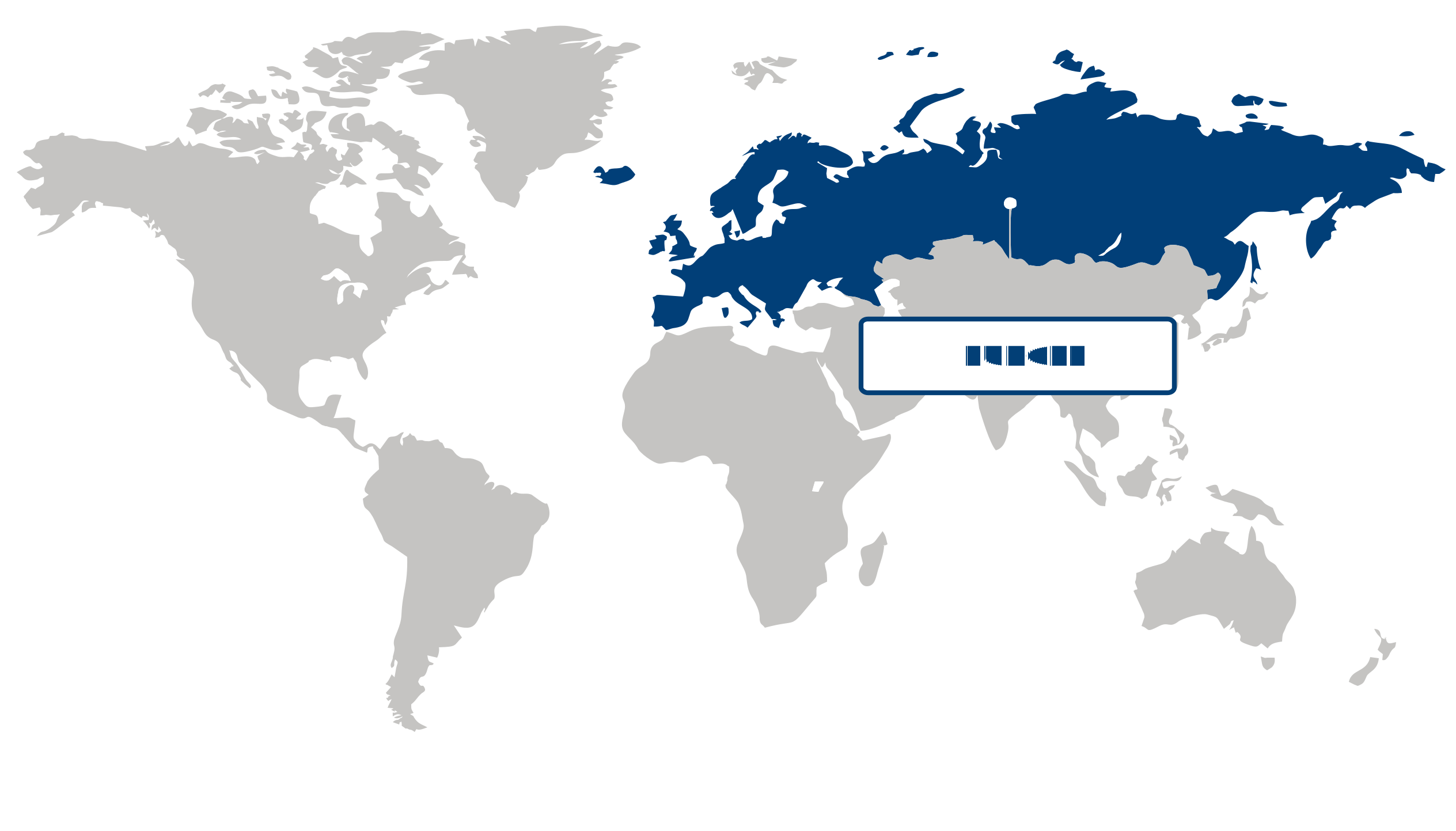
Europe (Largest Region)
Europe maintained the largest position in the bread improvers market in 2026, supported by its well-established bakery industry and strong consumer demand for consistent-quality bread and baked products. Commercial bakeries increasingly rely on functional ingredients to improve dough handling, texture, volume, freshness, and production efficiency while adapting products to changing consumer preferences. The region's sophisticated food processing infrastructure and continued development of clean-label and specialty bakery products are also supporting demand for advanced bread-improving solutions.
Asia Pacific (Fastest-Growing Region)
Asia Pacific is the fastest-growing region as urbanization, changing dietary habits, and the expansion of organized bakery and foodservice channels increase demand for convenient and consistently produced baked goods. Growing consumption of packaged bread and western-style bakery products is encouraging manufacturers to improve production efficiency and product quality. Rising investment in modern food processing facilities, together with greater consumer interest in varied bakery formats, is creating additional opportunities for bread improvers across the region.
| Parameter | North America | Asia Pacific | Europe | Latin America | MEA |
|---|---|---|---|---|---|
| Innovation Hub i Scale Nascent Developing Advanced | |||||
| Cost-Sensitive Region i Scale Low Medium High | |||||
| Regulatory Environment i Scale Restrictive Neutral Supportive | |||||
| Demand Drivers i Scale Weak Moderate Strong | |||||
| Development Stage i Scale Emerging Developing Developed | |||||
| Adoption Rate i Scale Low Medium High | |||||
| New Entrants / Startups i Scale Sparse Moderate Dense | |||||
| Macro Indicators i Scale Weak Stable Strong |
Key Country Insights
United States 🇺🇸
Clean-Label FormulationThe U.S. bread improvers market is evolving around clean-label bakery products that maintain texture, freshness, and production efficiency. Commercial bakeries increasingly adopt multifunctional improvers that support consistent quality while accommodating changing ingredient preferences.
Germany 🇩🇪
Artisan Baking SupportGermany's bread improvers market balances traditional baking practices with industrial-scale efficiency. Manufacturers prioritize formulations that preserve authentic bread characteristics while improving dough handling, shelf life, and production consistency across diverse bakery applications.
Japan 🇯🇵
Premium Texture OptimizationJapan emphasizes bread improvers that enhance softness, moisture retention, and product uniformity for premium bakery offerings. Bakeries continue refining formulations that deliver consistent quality across packaged bread and specialty baked products.
South Korea 🇰🇷
Convenience Bakery InnovationSouth Korea's growing demand for convenience bakery products encourages adoption of bread improvers that extend freshness and improve production flexibility. Suppliers increasingly develop solutions compatible with automated baking operations and premium product positioning.
France 🇫🇷
Quality Dough PerformanceFrance focuses on bread improvers that support reliable dough fermentation while maintaining expected bakery quality standards. Professional bakers increasingly seek formulations that improve process efficiency without compromising product appearance or eating characteristics.
Italy 🇮🇹
Specialty Bread EnhancementItaly utilizes bread improvers across traditional and specialty bakery production where dough stability and product consistency remain important. Manufacturers develop application-specific solutions that support efficient processing while preserving distinctive bakery product qualities.
Segment Leadership and Growth Trends
Bread Improvers Market Share (%), by Form, 2026
Go beyond the chart, access full insights & data tables
Request Free Sample ReportForm Segment Analysis: Powder (Largest & Fastest-Growing Segment)
In the bread improvers market, the powder form segment accounted for 88.2% of the market share in 2026 while also remaining the fastest-growing segment. Powdered bread improvers are widely preferred because they provide accurate dosing, extended storage stability, and seamless integration into commercial baking processes. Their ease of handling and compatibility with automated production systems enable bakeries to achieve consistent dough performance and finished product quality. Growing demand for standardized baking ingredients and efficient manufacturing practices continues to strengthen the dominance of this segment.
Product Type Segment Analysis: Emulsifiers (Largest Segment) vs Enzymes (Fastest-Growing Segment)
The emulsifiers segment held the largest share of the market at 60.74% in 2026. Its dominant position is supported by its ability to improve dough stability, enhance texture, increase loaf volume, and extend product freshness. Commercial bakeries rely extensively on emulsifiers to deliver consistent product quality while improving processing efficiency across high-volume production environments. Their broad functionality across different bread varieties continues to sustain widespread adoption.
The enzymes segment is anticipated to witness the fastest growth owing to increasing demand for clean-label baking solutions and improved production efficiency. Enzymes enhance dough characteristics through naturally occurring biochemical processes, allowing manufacturers to optimize texture, softness, and shelf life while reducing reliance on synthetic additives. Growing consumer preference for ingredient transparency and advancements in enzyme technology are expected to further accelerate the adoption of this product type.
Application Segment Analysis: White Bread (Largest Segment) vs Artisan Bread (Fastest-Growing Segment)
The white bread application segment held the largest share of the market in 2026. Its leadership is driven by consistently high consumer demand, large-scale commercial production, and widespread availability across retail and foodservice channels. Bread improvers are extensively used in white bread manufacturing to enhance dough consistency, improve loaf structure, and maintain uniform product quality throughout large production batches, supporting the continued dominance of this application.
The artisan bread segment is projected to experience the fastest growth in the bread improvers market as consumer preferences increasingly shift toward premium bakery products with distinctive textures, flavors, and handcrafted characteristics. Bakers are adopting specialized bread improvers to achieve greater fermentation control, improve crumb structure, and maintain product consistency while preserving the authentic qualities expected from artisan-style breads. Growing interest in premium baked goods and product differentiation continues to drive expansion within this application segment.
| Segment | Sub-Segment | Largest Segment | Fastest Growing |
|---|---|---|---|
| Form | Powder, Liquid | Powder | Powder |
| Product Type | Emulsifiers, Enzymes, Stabilizers, Others | Emulsifiers | Enzymes |
| Application | White Bread, Whole Wheat Bread, Baguettes, Buns and Rolls, Multigrain Bread, Artisan Bread, Flatbreads, Others | White Bread | Artisan Bread |
Competitive Landscape and Market Positioning
Top players in the bread improvers market:
- Lesaffre et Compagnie SA (France)
- Associated British Foods plc (United Kingdom)
- Archer Daniels Midland Company (United States)
- Kerry Group plc (Ireland)
- Corbion N.V. (Netherlands)
- AB Mauri (United Kingdom)
- Bakels Worldwide (Switzerland)
- AB Enzymes GmbH (Germany)
- DSM-Firmenich AG (Switzerland)
- Puratos Group (Belgium)
Innovation within the bread improvers market increasingly revolves around helping bakeries achieve consistent product quality while adapting to changing ingredient preferences and production methods. Suppliers are developing multifunctional formulations that enhance dough performance, extend freshness, and maintain texture across diverse baking processes, reducing the need for complex ingredient combinations. Competition is also shifting toward technical collaboration with commercial bakers, where formulation expertise, customization capabilities, and compatibility with automated production environments play a greater role in securing long-term customer relationships than standardized product offerings alone.
| Company | Market Share | Company Revenue | Revenue CAGR (%) | Product Portfolio | Geographic Presence | Innovation / R&D Focus | Strategic Developments |
|---|---|---|---|---|---|---|---|
| Lesaffre et Compagnie SA (France) | |||||||
| Associated British Foods plc (United Kingdom) | |||||||
| Archer Daniels Midland Company (United States) | |||||||
| Kerry Group plc (Ireland) | |||||||
| Corbion N.V. (Netherlands) | |||||||
| AB Mauri (United Kingdom) | |||||||
| Bakels Worldwide (Switzerland) | |||||||
| AB Enzymes GmbH (Germany) | |||||||
| DSM-Firmenich AG (Switzerland) | |||||||
| Puratos Group (Belgium) |
Industry Development/News
| Company Name | Date | Key Development |
|---|---|---|
| Tate & Lyle | Nov-24 | Tate & Lyle completed its USD 1.8 billion acquisition of CP Kelco, incorporating nature-based hydrocolloids such as pectin and citrus fiber into its functional ingredient portfolio. The transaction expands the company's technical capabilities in clean-label food preservation, texture modification, and functional dough system applications. |
| Kerry Group plc | Jun-23 | Kerry Group launched Biobake, an innovative enzyme solution formulated to replace up to 30% of egg content in industrial baking formulations. The enzyme technology maintains original baking performance, crumb structure, and sensory attributes while optimizing raw material costs and addressing sustainability demands in bakery manufacturing. |
| Corbion | Jul-22 | Corbion inaugurated a 350-square-meter customer support and innovation center in Singapore to strengthen its functional bakery ingredient presence in the Asia-Pacific region. The facility accelerates regional co-development, product testing, and application support for industrial baking and food formulation clients. |
| Bakels Worldwide | Nov-21 | Bakels Worldwide expanded its global production footprint by investing in a dedicated commercial bakery facility in Zeewolde, Netherlands. Operating under Bakels Senior, the modernized center enhances product development, technical service capacity, and supply distribution for the European commercial baking market. |
| Corbion | Aug-21 | Corbion expanded its clean-label ingredient lineup with Pristine 3000, a functional dough conditioning solution designed to eliminate diacetyl tartaric acid ester of monoglycerides (DATEM). The solution provides commercial bakers with chemical-free dough stability and gluten network reinforcement. |
| Puratos | Jul-20 | Puratos expanded its African operational footprint by opening four new regional subsidiaries in Kenya, Ivory Coast, Ethiopia, and Nigeria. The expansion strengthens local supply chains, reduces reliance on imported bakery ingredients, and enables localized product adaptation for commercial bakeries across Africa. |
| Fazer Group | Feb-19 | Fazer Group invested EUR 40 million to construct a new production facility in Lahti, Finland. The strategic investment scales up capacity for value-added grain products and specialized functional ingredients, strengthening the company's positioning within the industrial bakery supply network. |
Customize Your Report
Explore examples of how this report can be tailored to different research needs, including custom segments, additional topics or chapters, and related reports. Click a section of the wheel or its numbered marker to explore the available options.
Bread Improvers Market — Custom Segments
| Segment | Sub-Segment |
|---|---|
| End-User Type | Industrial Bakeries, Commercial Bakeries, Artisan & Craft Bakeries, Foodservice Operators |
| Clean-Label Status | Conventional, Clean-Label, Organic-Certified |
| Pricing Tier | Economy, Mid-Range, Premium |
Bread Improvers Market — Custom TOC
| Custom Chapter | Custom Details |
|---|---|
| Bakery Formulation Optimization |
|
| Clean-Label Transition Strategies |
|
| Industrial Bakery Procurement Dynamics |
|
Need a different cut of the data?
Request Custom ResearchHow large is the bread improvers market?
How is the bread improvers industry projected to perform over the next decade?
Why are bread improvers becoming essential for commercial bakery operations?
How are healthier bread formulations driving innovation in the bread improvers market?
Why are emulsifiers the leading product type in the bread improvers market?
Which application is expected to grow the fastest in the bread improvers market?
What supports Europe's leadership in the bread improvers market?
Why is Asia Pacific the fastest-growing region for bread improvers?
Who holds a significant market share in the bread improvers landscape?
Our Clients
"The report provided a thorough look at market trends, technological advancements, and the competitive landscape. The depth of insights was really valuable."
ITC Limited
"We would highly recommend Fundamental Business Insights & Consulting to anyone looking for reliable, detailed, and comprehensive market research in the Food industry."
Tyson Foods
"The clarity and presentation of the information were commendable. The report was delivered timely, which made the overall experience smooth and convenient."
Mondelēz International
Our Research Team & Methodology
Every Fundamental Business Insights report is built by a dedicated vertical research team, validated through a structured primary-and-secondary methodology, and reviewed for accuracy before it reaches you.
Research Team Overview
Prepared by the Food & Beverage Research Team
Delivery
Published
Demand
Available
Support
Trust & Compliance
Research Domains
10 coverage areasResearch Intelligence
| Source | Reference |
|---|---|
| Food and Agriculture Organization (FAO) | www.fao.org |
| World Health Organization (WHO) | www.who.int |
| U.S. Food & Drug Administration (FDA) | www.fda.gov |
| European Food Safety Authority (EFSA) | www.efsa.europa.eu |
| U.S. Department of Agriculture (USDA) | www.usda.gov |
| Codex Alimentarius Commission | www.fao.org/fao-who-codexalimentarius |
| International Organization for Standardization (ISO) | www.iso.org |
| AOAC INTERNATIONAL | www.aoac.org |
| Institute of Food Technologists (IFT) | www.ift.org |
| International Dairy Foods Association (IDFA) | www.idfa.org |
| International Sweeteners Association (ISA) | www.sweeteners.org |
| International Probiotics Association (IPA) | internationalprobiotics.org |
| Good Food Institute (GFI) | gfi.org |
| American Feed Industry Association (AFIA) | www.afia.org |
| International Feed Industry Federation (IFIF) | ifif.org |
| Specialty Food Association (SFA) | www.specialtyfood.com |
| Brewers Association | www.brewersassociation.org |
| International Bottled Water Association (IBWA) | bottledwater.org |
| International Alliance for Dietary/Food Supplement Associations (IADSA) | www.iadsa.org |
| OECD Agriculture & Food | www.oecd.org/agriculture |
Research Workflow & Quality Assurance
Data Collection
Verified information gathered through primary and secondary research.
Data Triangulation
Cross-validation using multiple independent data sources.
Forecast Modelling
Market estimates developed using historical trends and analytical models.
Analyst Validation
Findings reviewed by domain experts for accuracy and consistency.
Editorial & Quality Review
Final editorial, quality, and compliance checks before publication.
Final Publication
Released after successful completion of the internal review process.
Report Coverage
📊 Market Assessment
- Market Size & Forecast
- Market Segmentation
- Regional Analysis
- Growth Drivers & Challenges
- Market Dynamics
🏢 Competitive Intelligence
- Competitive Landscape
- Company Profiles
- Competitive Benchmarking
- Mergers & Acquisitions
- Market Share Analysis or Key Company Strategies
🔍 Strategic Analysis
- Value Chain Analysis
- Porter's Five Forces
- PESTLE Analysis
- Pricing Trends
- Supply-Demand Analysis
🚀 Future Outlook
- Technology Landscape
- Regulatory Landscape
- Investment & Funding Landscape
- Emerging Opportunities
- Future Market Outlook
Have a question about this report or need a custom scope?
Request Customization