Brewery Equipment Market Size & Growth Forecast 2027–2036, By Segments (Type), Regional Demand Trends (North America, Asia Pacific, Europe), Key Country Insights (U.S., Japan, South Korea, Germany, France, Italy), and Competitive Landscape
Market Size and Growth Outlook
Brewery Equipment Market size stood at USD 20.51 billion in 2026 and is predicted to grow at a 5.8% CAGR from 2027 to 2036, crossing USD 36.04 billion by 2036. The industry revenue for 2027 is calculated at USD 21.51 billion.
Get more details on this report
Request Free Sample ReportBrewery Equipment Market Intelligence Snapshot
Regional Market Dynamics
- Europe led the market in 2026, supported by its established brewing industry, regular equipment upgrades, and continued investment in efficient production and packaging systems across commercial breweries.
- Asia Pacific is projected to grow at a 7.01% CAGR as brewery capacity expands, new brewing businesses invest in complete production systems, and modern brewing infrastructure continues to develop.
Segment Momentum
- Macrobrewery Equipment accounted for 77.9% of the market in 2026 because large breweries depend on high-capacity, integrated systems that ensure continuous production, process consistency, and efficient operations.
- Craft Brewery Equipment is growing fastest as independent brewers expand capacity with flexible, smaller-batch systems that support recipe innovation, local production, and gradual operational scaling.
Market Expansion Drivers
- Growing global craft beer production expansion driving demand for brewery equipment installations.
- Automation and process optimization technologies improving brewing efficiency and consistency outcomes.
- Rising premium beer consumption trends encouraging advanced brewery equipment modernization investments.
Leading Market Participants
- Prominent players in the brewery equipment market include Alfa Laval AB (Sweden), GEA Group AG (Germany), Krones AG (Germany), Paul Mueller Company (U.S.), Praj Industries Limited (India), Criveller Group (Canada), Della Toffola S.p.A. (Italy), MEURA S.A. (Belgium), Deutsche Beverage Technology GmbH (Germany), Lehui International Co., Ltd. (China).
Global Market Forecast Snapshot
Market Outlook
- 2026 Market Size: USD 20.51 billion
- 2027 Estimated Market Size: USD 21.51 billion.
- Projected Market Size: USD 36.04 billion by 2036
- Growth Forecast: 5.8% CAGR (2027-2036)
Regional and Segment Outlook
- Leading Regional Market: Europe
- High-Growth Regional Hub: Asia Pacific
- Core Revenue Segment: Macrobrewery Equipment (Type)
- Emerging Opportunity Segment: Craft Brewery Equipment (Type)
Market Growth Drivers and Industry Trends
Growing global craft beer production expansion driving demand for brewery equipment installations
The expansion of craft beer production across established and emerging markets is creating new capacity requirements, which will drive the brewery equipment market growth as producers invest in brewing, fermentation, filtration, packaging, and storage systems. The continued emergence of independent breweries and the expansion of existing craft operations are increasing demand for equipment that can support flexible production volumes while maintaining product quality. Breweries are also upgrading production facilities to accommodate broader beer portfolios, improve process control, and meet changing consumer preferences for differentiated styles, creating installation opportunities across both new and expanding brewing facilities.
Automation and process optimization technologies improving brewing efficiency and consistency outcomes
Increasing adoption of automated brewing and process-control technologies is strengthening the brewery equipment market by enabling producers to improve operational efficiency, minimize process variability, and maintain consistent brewing conditions. Automated systems can support precise control of temperature, fermentation parameters, ingredient handling, cleaning cycles, and packaging operations, reducing reliance on manual intervention throughout production. As breweries seek to improve resource utilization and streamline workflows, equipment incorporating sensors, programmable controls, monitoring systems, and integrated process-management capabilities is becoming increasingly relevant for modern production environments.
Rising premium beer consumption trends encouraging advanced brewery equipment modernization investments
Growing consumer interest in premium and differentiated beer products is encouraging producers to enhance production capabilities, which will boost brewery equipment market demand for advanced and flexible brewing systems. Premium positioning often requires greater attention to ingredient handling, recipe precision, fermentation control, and packaging quality, prompting breweries to modernize equipment to support more controlled production processes. Producers are also seeking systems that allow greater flexibility in developing specialty offerings and maintaining consistent sensory characteristics, supporting investment in equipment capable of precise process management and adaptable production configurations.
| Growth Driver | Impact on CAGR | Regulatory Influence | Geographic Relevance | Adoption Rate | Impact Timeline |
|---|---|---|---|---|---|
| Growing global craft beer production expansion driving demand for brewery equipment installations | 2.00% | Moderate | Asia Pacific, Latin America, Africa | Medium | Mid Term |
| Automation and process optimization technologies improving brewing efficiency and consistency outcomes | 1.70% | Moderate | Europe, North America | High | Near Term |
| Rising premium beer consumption trends encouraging advanced brewery equipment modernization investments | 1.50% | Moderate | Global | Medium | Mid Term |
Unlock insights tailored to your business with our bespoke market research solutions.
Click to get your customized report now.
Regional Demand Dynamics
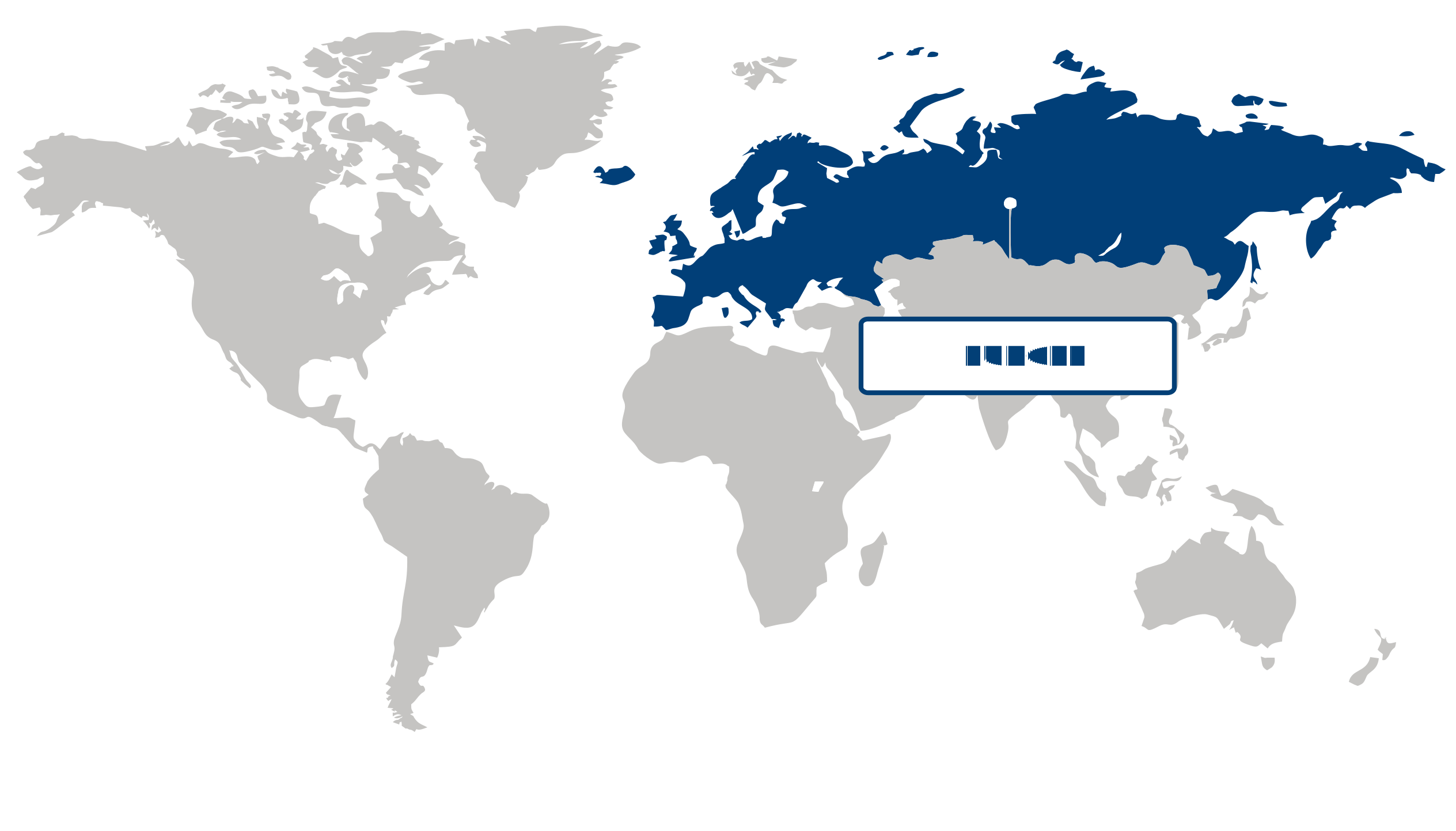
Europe (Largest Region)
Europe held the largest share of the brewery equipment market in 2026, supported by its established brewing industry, strong demand for advanced production systems, and a mature base of breweries focused on operational efficiency and product quality. The region benefits from widespread adoption of automated brewing, fermentation, filling, and packaging equipment, while stringent standards related to food safety, energy efficiency, and production processes encourage breweries to modernize equipment and improve resource utilization. Growing interest in craft beer and specialty brewing also supports demand for flexible systems capable of handling varied production requirements.
Asia Pacific (Fastest-Growing Region)
Asia Pacific is emerging as the fastest-growing regional market, driven by expanding beer consumption, urbanization, and increasing investment in modern beverage manufacturing infrastructure. Rising disposable incomes and changing consumer preferences are encouraging the development of new brewing capacities, while breweries are increasingly adopting automated and energy-efficient equipment to improve consistency and manage operating costs. Expanding hospitality, tourism, and foodservice industries across the region further support brewery capacity additions, creating favorable conditions for sustained equipment demand.
| Parameter | North America | Asia Pacific | Europe | Latin America | MEA |
|---|---|---|---|---|---|
| Innovation Hub i Scale Nascent Developing Advanced | |||||
| Cost-Sensitive Region i Scale Low Medium High | |||||
| Regulatory Environment i Scale Restrictive Neutral Supportive | |||||
| Demand Drivers i Scale Weak Moderate Strong | |||||
| Development Stage i Scale Emerging Developing Developed | |||||
| Adoption Rate i Scale Low Medium High | |||||
| New Entrants / Startups i Scale Sparse Moderate Dense | |||||
| Macro Indicators i Scale Weak Stable Strong |
Key Country Insights
Germany 🇩🇪
Precision Brewing SystemsGermany emphasizes brewery equipment engineered for production precision, process reliability, and long equipment lifecycles. German manufacturers and breweries continue to modernize facilities with digital monitoring, resource-efficient technologies, and advanced fermentation solutions that strengthen operational performance.
France 🇫🇷
Sustainable Brewing ModernizationFrance is advancing brewery equipment upgrades that balance production quality with environmental performance. French breweries are investing in energy-efficient processing, water management technologies, and adaptable equipment to support evolving consumer demand for premium beverages.
Italy 🇮🇹
Specialty Brewery UpgradesItaly is strengthening its brewery equipment base through investments in flexible production technologies suited to specialty and regional beer styles. Italian breweries prioritize equipment that enhances product consistency while supporting smaller production batches and operational efficiency.
Japan 🇯🇵
Compact Process InnovationJapan focuses on brewery equipment designed for space-efficient production and premium beverage quality. Japanese breweries are adopting compact automation, precise temperature control, and flexible brewing configurations to support product differentiation across diverse beverage categories.
South Korea 🇰🇷
Automated Brewing FacilitiesSouth Korea is expanding the use of automated brewery equipment to improve production flexibility and reduce operating complexity. Local breweries increasingly integrate smart process controls and modular systems that enable efficient production of premium and craft beverage offerings.
United States 🇺🇸
Craft Production ExpansionThe U.S. brewery equipment market is shaped by sustained investments in flexible brewing systems that support craft, specialty, and contract production. U.S. breweries increasingly prioritize automation, energy efficiency, and scalable equipment to improve operational consistency while accommodating changing consumer preferences.
Segment Leadership and Growth Trends
Brewery Equipment Market Share (%), by Type, 2026
Go beyond the chart, access full insights & data tables
Request Free Sample ReportType Segment Analysis: Macrobrewery Equipment (Largest Segment) vs Craft Brewery Equipment (Fastest-Growing Segment)
Macrobrewery equipment led the brewery equipment market in 2026 with a 77.9% share, reflecting the extensive production requirements of large-scale brewing operations. High-volume breweries require robust, automated, and integrated equipment capable of supporting consistent production, process efficiency, and reliable quality control across major brewing stages. The need to optimize throughput while maintaining standardized product characteristics continues to support investment in large-capacity brewing systems. Modernization initiatives and demand for improved operational efficiency are also reinforcing the dominant position of macrobrewery equipment.
Craft brewery equipment is the fastest-growing segment, driven by increasing demand for differentiated beer varieties and the expansion of smaller-scale brewing operations focused on experimentation and product diversity. Craft producers require flexible equipment that can accommodate varied recipes, smaller production batches, and frequent changes in brewing processes. Growing consumer interest in distinctive flavors, locally produced beverages, and premium brewing experiences is encouraging investment in specialized craft brewing systems. The ability of modular and adaptable equipment to support product innovation is further accelerating growth in this segment.
| Segment | Sub-Segment | Largest Segment | Fastest Growing |
|---|---|---|---|
| Type | Macrobrewery Equipment, Craft Brewery Equipment | Macrobrewery Equipment | Craft Brewery Equipment |
Competitive Landscape and Market Positioning
Leading companies in the brewery equipment market:
1. Alfa Laval AB (Sweden)
2. GEA Group AG (Germany)
3. Krones AG (Germany)
4. Paul Mueller Company (U.S.)
5. Praj Industries Limited (India)
6. Criveller Group (Canada)
7. Della Toffola S.p.A. (Italy)
8. MEURA S.A. (Belgium)
9. Deutsche Beverage Technology GmbH (Germany)
10. Lehui International Co. Ltd. (China)
The brewery equipment market is being shaped by increasing adoption of automated brewing systems, energy-efficient processing technologies, and precision fermentation solutions. Manufacturers are investing in advanced equipment designs that improve production consistency, scalability, and sustainability across brewing operations. Growing demand for craft beverages and customized brewing capabilities is also encouraging continuous product innovation.
| Company | Market Share | Company Revenue | Revenue CAGR (%) | Product Portfolio | Geographic Presence | Innovation / R&D Focus | Strategic Developments |
|---|---|---|---|---|---|---|---|
| Alfa Laval AB (Sweden) | |||||||
| GEA Group AG (Germany) | |||||||
| Krones AG (Germany) | |||||||
| Paul Mueller Company (U.S.) | |||||||
| Praj Industries Limited (India) | |||||||
| Criveller Group (Canada) | |||||||
| Della Toffola S.p.A. (Italy) | |||||||
| MEURA S.A. (Belgium) | |||||||
| Deutsche Beverage Technology GmbH (Germany) | |||||||
| Lehui International Co. Ltd. (China). |
Industry Development/News
| Company Name | Date | Key Development |
|---|---|---|
| Krones | Jul-25 | Krones AG acquired W.M. Sprinkman Corporation to strengthen its position in the food and beverage processing equipment market. This strategic acquisition incorporates Sprinkman’s specialized expertise in engineered brewing and dairy systems into Krones’ global portfolio, enhancing its capability to deliver comprehensive, turnkey processing solutions for both industrial and craft brewery clients. |
| Diversified Metal Engineering LP | Jun-25 | Diversified Metal Engineering (DME) acquired Accent Stainless Steel Manufacturing Group to secure comprehensive turnkey manufacturing capabilities for the craft brewing sector. This integration expands DME’s footprint by adding specialized production for small-to-large-scale brewery systems and food processing equipment, enabling the company to better serve the growing demand for custom, integrated brewery infrastructure. |
| Praj Industries | 2025 | Praj Industries expanded its portfolio of modular craft brewery equipment solutions, catering to the growing market demand for flexible and scalable production systems. By focusing on modular design, the company provides breweries with the ability to rapidly deploy or expand capacity, optimizing capital expenditure and operational efficiency for craft operators looking for reliable, standardized equipment. |
| LEHUI | 2025 | LEHUI introduced new intelligent bottling and packaging systems designed to increase automation in large-scale brewery operations. The systems feature high-speed handling and integrated quality control mechanisms to improve packaging accuracy and output. This development bolsters the company’s competitiveness in the industrial equipment segment by providing robust, technology-driven solutions that address the scaling requirements of major beverage producers. |
| Brew Bomb | Sep-24 | Brew Bomb partnered with TORR Industries following TORR’s acquisition of a controlling interest in Gunga LLC. This collaboration merges Brew Bomb’s specialized cold-brew coffee expertise with TORR’s engineering and manufacturing infrastructure. The partnership aims to accelerate product development and innovation in cold coffee processing technology, enhancing the combined firm’s competitive reach in the growing beverage equipment market. |
| GEA Group | 2024 | GEA Group launched an advanced digital fermentation monitoring platform to support large-scale beverage production. This system utilizes real-time data analytics to optimize the fermentation process, enhancing batch consistency and production yields. The rollout reflects the broader industry shift toward digital transformation and intelligent manufacturing systems aimed at improving operational performance in industrial-scale brewery environments. |
| Alfa Laval | 2024 | Alfa Laval introduced new energy-efficient heat exchange systems specifically designed for high-performance brewing operations. These systems focus on reducing thermal energy consumption and optimizing utility usage within the brewhouse. This development aligns with the company’s strategic commitment to providing sustainable, cost-reducing technologies that improve the environmental footprint and operational profitability of beverage manufacturing facilities. |
| Ziemann Holvrieka | Nov-23 | Ziemann Holvrieka acquired a majority stake in Künzel Maschinenbau, a specialist in malt management and grist mill technology. This acquisition allows Ziemann to vertically integrate key upstream processing components into its existing brewery solutions portfolio. By streamlining malt handling and milling capabilities, the company strengthens its position as a provider of full-scope, turnkey brewhouse engineering services. |
Customize Your Report
Explore examples of how this report can be tailored to different research needs, including custom segments, additional topics or chapters, and related reports. Click a section of the wheel or its numbered marker to explore the available options.
Brewery Equipment Market — Custom Segments
| Segment | Sub-Segment |
|---|---|
| Brewery Capacity | Small-Scale Breweries, Mid-Scale Breweries, Large-Scale Breweries |
| Equipment Function | Brewing and Mashing, Fermentation and Conditioning, Filtration and Separation, Packaging and Filling, Utilities and Material Handling |
| Automation Level | Manual and Semi-Automated, Fully Automated, Advanced Automated and Process-Controlled |
Brewery Equipment Market — Custom TOC
| Custom Chapter | Custom Details |
|---|---|
| Craft Brewery Modernization Roadmap |
|
| Brewery Automation Adoption Benchmark |
|
| Sustainable Brewing Equipment Strategies |
|
Need a different cut of the data?
Request Custom ResearchHow big is the brewery equipment market?
How will the brewery equipment industry grow in terms of size and CAGR by 2036?
How is craft beer expansion driving equipment demand in the brewery equipment market?
How is automation improving efficiency and consistency in brewery operations?
Why does macrobrewery equipment lead the brewery equipment market?
Why is craft brewery equipment the fastest-growing segment?
Why is Europe the largest regional market for brewery equipment?
What factors are driving brewery equipment market growth in Asia Pacific?
Who are the major participants shaping the brewery equipment landscape?
Our Clients
"The team at Fundamental Business Insights & Consulting demonstrated a commitment to excellence, not only in the quality of the report but also in their client-centric approach."
FANUC
"The level of detail in the market segmentation provided were particularly noteworthy. The detailed country-level insights were also very helpful."
B&R Industrial Automation GmbH
"The consultant took the time to understand our specific business objectives, ensuring that the reports were tailored to address our unique challenges and opportunities."
KUKA SE & Co. KGaA
Our Research Team & Methodology
Every Fundamental Business Insights report is built by a dedicated vertical research team, validated through a structured primary-and-secondary methodology, and reviewed for accuracy before it reaches you.
Research Team Overview
Prepared by the Industrial Automation & Equipment Research Team
Delivery
Published
Demand
Available
Support
Trust & Compliance
Research Domains
10 coverage areasResearch Intelligence
| Source | Reference |
|---|---|
| International Society of Automation (ISA) | www.isa.org |
| International Organization for Standardization (ISO) | www.iso.org |
| National Institute of Standards and Technology (NIST) | www.nist.gov |
| IEEE | www.ieee.org |
| VDMA (German Mechanical Engineering Industry Association) | www.vdma.org |
| Association for Advancing Automation (A3) | www.automate.org |
| International Federation of Robotics (IFR) | ifr.org |
| ASME (American Society of Mechanical Engineers) | www.asme.org |
| ASHRAE | www.ashrae.org |
| American Society of Heating, Refrigerating and Air-Conditioning Engineers (ASHRAE) | www.ashrae.org |
| Material Handling Industry (MHI) | www.mhi.org |
| OSHA (Occupational Safety and Health Administration) | www.osha.gov |
| National Fire Protection Association (NFPA) | www.nfpa.org |
| ASTM International | www.astm.org |
| International Electrotechnical Commission (IEC) | www.iec.ch |
| Open Process Automation Forum (The Open Group) | www.opengroup.org/open-process-automation-forum |
| AGMA (American Gear Manufacturers Association) | www.agma.org |
| Association of Equipment Manufacturers (AEM) | www.aem.org |
| Food and Agriculture Organization (FAO) | www.fao.org |
| International Labour Organization (ILO) | www.ilo.org |
Research Workflow & Quality Assurance
Data Collection
Verified information gathered through primary and secondary research.
Data Triangulation
Cross-validation using multiple independent data sources.
Forecast Modelling
Market estimates developed using historical trends and analytical models.
Analyst Validation
Findings reviewed by domain experts for accuracy and consistency.
Editorial & Quality Review
Final editorial, quality, and compliance checks before publication.
Final Publication
Released after successful completion of the internal review process.
Report Coverage
📊 Market Assessment
- Market Size & Forecast
- Market Segmentation
- Regional Analysis
- Growth Drivers & Challenges
- Market Dynamics
🏢 Competitive Intelligence
- Competitive Landscape
- Company Profiles
- Competitive Benchmarking
- Mergers & Acquisitions
- Market Share Analysis or Key Company Strategies
🔍 Strategic Analysis
- Value Chain Analysis
- Porter's Five Forces
- PESTLE Analysis
- Pricing Trends
- Supply-Demand Analysis
🚀 Future Outlook
- Technology Landscape
- Regulatory Landscape
- Investment & Funding Landscape
- Emerging Opportunities
- Future Market Outlook
Have a question about this report or need a custom scope?
Request Customization