Building-integrated Photovoltaics Facade Market Size & Growth Forecast 2027–2036, By Segments (Type, End-use), Regional Demand Trends (North America, Asia Pacific, Europe), Key Country Insights (U.S., Japan, South Korea, Germany, France, Italy), and Competitive Landscape
Market Size and Growth Outlook
Building-integrated Photovoltaics Facade Market size was worth USD 5.9 billion in 2026 and is expected to grow at a 29.83% CAGR between 2027 and 2036, reaching USD 80.28 billion by 2036. The industry revenue for 2027 is calculated at USD 7.38 billion.
Get more details on this report
Request Free Sample ReportBuilding-integrated Photovoltaics Facade Market Intelligence Snapshot
Regional Market Dynamics
- Europe holds 42.19% share due to mature green building ecosystems, strict energy-efficiency regulations, and strong adoption of low-carbon façade-integrated energy solutions.
- Asia Pacific is expanding at a 33.22% CAGR, supported by rapid urban construction, rising demand for energy-generating building skins, and space-efficient architectural integration.
Segment Momentum
- Crystalline materials accounted for 78.19% of the market in 2026, supported by proven power output, long operating life, and established installation practices that align with commercial procurement and project requirements.
- Utility is the fastest-growing end-use segment as developers increasingly integrate building facades into broader power generation strategies and larger-scale energy infrastructure planning.
Market Expansion Drivers
- Strong government incentives accelerating adoption of zero-emission building facade systems.
- Rising commercial construction integrating solar facades for energy cost optimization.
- Advancements in architectural solar materials improving aesthetic renewable building integration.
Leading Market Participants
- Major companies in the building-integrated photovoltaics facade market include AGC Inc. (Japan), Onyx Solar Group LLC (Spain), Heliatek GmbH (Germany), AVANCIS GmbH (Germany), Maxeon Solar Technologies, Ltd. (Singapore), ISSOL sa (Belgium), SUNOVATION GmbH (Germany), Ertex Solartechnik GmbH (Austria), Polysolar Ltd. (United Kingdom).
Global Market Forecast Snapshot
Market Outlook
- 2026 Market Size: USD 5.9 billion
- 2027 Estimated Market Size: USD 7.38 billion.
- Projected Market Size: USD 80.28 billion by 2036
- Growth Forecast: 29.83% CAGR (2027-2036)
Regional and Segment Outlook
- Leading Regional Market: Europe
- High-Growth Regional Hub: Asia Pacific
- Core Revenue Segment: Crystalline Materials (Type) | Commercial & Industrial (End-use)
- Emerging Opportunity Segment: Thin Film (Type) | Utility (End-use)
Market Growth Drivers and Industry Trends
Strong government incentives accelerating adoption of zero-emission building facade systems
Government incentives, financial support programs, and regulatory initiatives promoting low-carbon construction are strengthening demand for integrated renewable energy solutions, which will drive the building-integrated photovoltaics facade market growth. Policies focused on reducing building emissions and improving energy performance are encouraging developers and property owners to consider facades that can generate electricity while serving as part of the building envelope. Incentive mechanisms can improve the economic attractiveness of photovoltaic facade installations by reducing initial investment barriers and supporting compliance with increasingly stringent sustainability objectives. As governments place greater emphasis on zero-emission and energy-efficient buildings, solar-integrated facade systems are becoming relevant for new developments as well as renovation projects seeking improved environmental performance.
Rising commercial construction integrating solar facades for energy cost optimization
Growing commercial construction activity is creating additional opportunities for photovoltaic technologies that can be incorporated directly into building exteriors, supporting the building-integrated photovoltaics facade market. Commercial property developers are increasingly evaluating building systems based on their ability to reduce operating expenses while supporting energy-efficiency objectives. Solar facades can utilize otherwise underused vertical building surfaces to generate electricity, complementing rooftop photovoltaic installations where available roof area may be constrained by mechanical equipment, design requirements, or building configuration. Their integration into offices, retail facilities, hospitality properties, and other commercial structures can help property owners manage electricity consumption while incorporating renewable energy generation into the architectural design.
Advancements in architectural solar materials improving aesthetic renewable building integration
Innovation in photovoltaic materials and architectural design is enabling renewable energy systems to become more visually compatible with contemporary building concepts, creating stronger demand for the building-integrated photovoltaics facade market. Improvements in module appearance, surface finishes, transparency, color options, form factors, and integration methods provide architects with greater flexibility when incorporating solar functionality into exterior surfaces. These developments reduce the visual constraints traditionally associated with conventional photovoltaic panels and allow energy-generating components to complement rather than disrupt facade designs. Greater material flexibility is particularly valuable for projects where architectural appearance, daylight management, and sustainability objectives need to be addressed within the same building envelope.
| Growth Driver | Impact on CAGR | Regulatory Influence | Geographic Relevance | Adoption Rate | Impact Timeline |
|---|---|---|---|---|---|
| Strong government incentives accelerating adoption of zero-emission building facade systems | 2.40% | High | Europe, Asia Pacific | High | Near Term |
| Rising commercial construction integrating solar facades for energy cost optimization | 2.10% | High | Europe, North America | High | Near Term |
| Advancements in architectural solar materials improving aesthetic renewable building integration | 1.60% | Moderate | Europe, Asia Pacific | Medium | Mid Term |
Unlock insights tailored to your business with our bespoke market research solutions.
Click to get your customized report now.
Regional Demand Dynamics
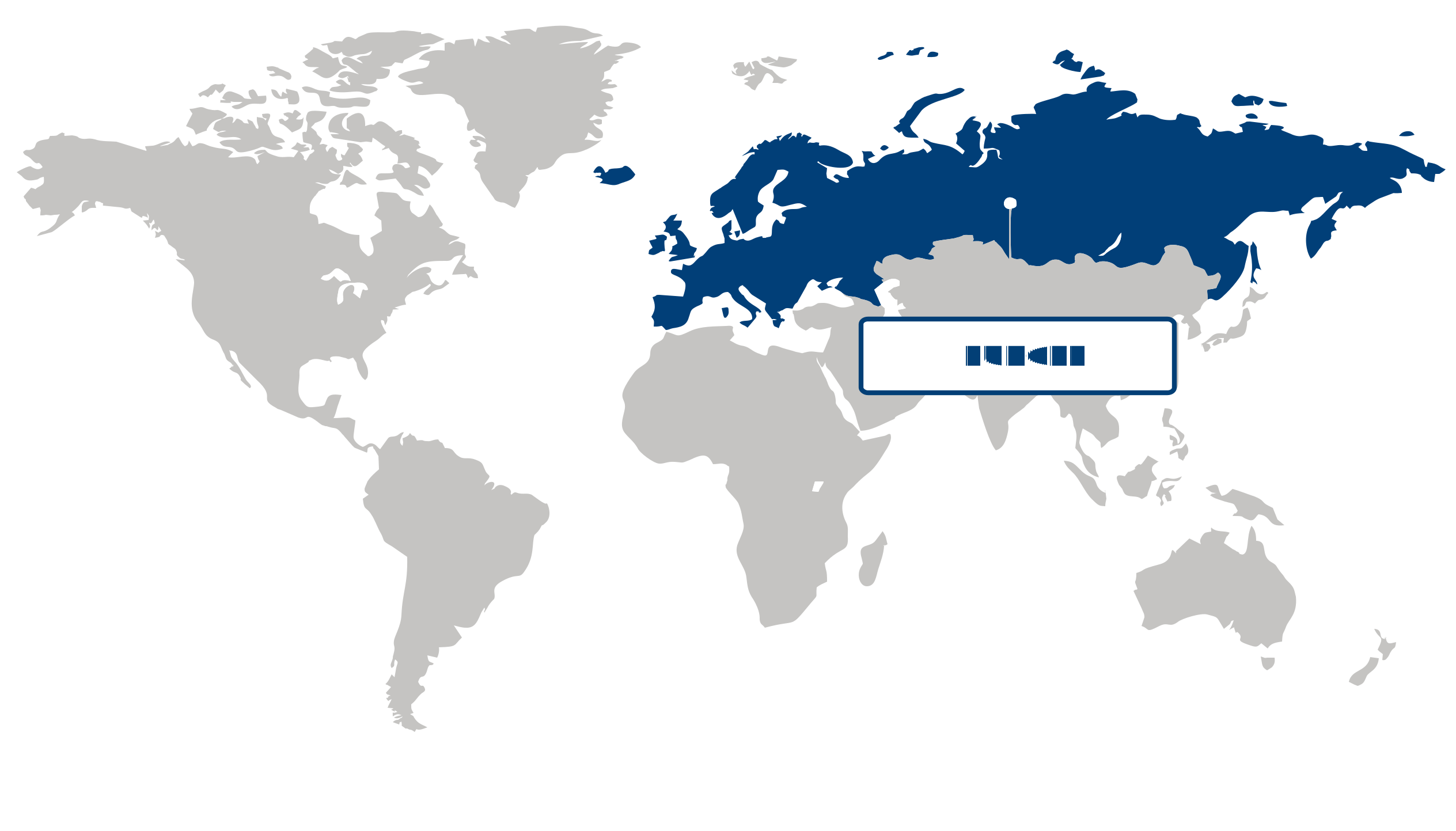
Europe (Largest Region)
Europe held the largest share of the building-integrated photovoltaics facade market at 42.19% in 2026, supported by strong emphasis on energy-efficient buildings, renewable energy integration, and sustainable urban development. The region's architectural and construction sectors increasingly prioritize solutions that combine building functionality with on-site renewable power generation, making photovoltaic facades attractive for commercial, institutional, and high-density urban projects. Supportive environmental policies and decarbonization objectives are encouraging developers and building owners to incorporate renewable technologies directly into building envelopes. Europe's mature construction industry, established expertise in energy-efficient design, and growing preference for low-carbon building materials further support adoption. The integration of solar generation into facades also offers value where conventional rooftop space is limited, strengthening the relevance of facade-based photovoltaic systems in urban construction.
Asia Pacific (Fastest-Growing Region)
Asia Pacific is the fastest-growing region, driven by rapid urbanization, expanding construction activity, and increasing investment in renewable energy infrastructure. The region's growing cities are creating demand for building solutions that can address both rising energy requirements and sustainability objectives. Building-integrated photovoltaic facades can utilize otherwise underused exterior surfaces for power generation while maintaining architectural functionality, making them increasingly relevant for modern commercial and high-rise developments. Government support for renewable energy and energy-efficient construction is also encouraging developers to consider integrated solar technologies. As green building practices gain wider acceptance and construction markets adopt more advanced building-envelope solutions, the region is creating significant opportunities for photovoltaic facade deployment.
| Parameter | North America | Asia Pacific | Europe | Latin America | MEA |
|---|---|---|---|---|---|
| Innovation Hub i Scale Nascent Developing Advanced | |||||
| Cost-Sensitive Region i Scale Low Medium High | |||||
| Regulatory Environment i Scale Restrictive Neutral Supportive | |||||
| Demand Drivers i Scale Weak Moderate Strong | |||||
| Development Stage i Scale Emerging Developing Developed | |||||
| Adoption Rate i Scale Low Medium High | |||||
| New Entrants / Startups i Scale Sparse Moderate Dense | |||||
| Macro Indicators i Scale Weak Stable Strong |
Key Country Insights
Germany 🇩🇪
Energy-Efficient Facade FocusGermany continues to prioritize photovoltaic facade solutions that align with stringent building efficiency standards and renovation programs. The country is encouraging the integration of aesthetically compatible solar facades into both new developments and modernization projects across urban environments.
France 🇫🇷
Low-Carbon Building SolutionsFrance is encouraging photovoltaic facade adoption in sustainable construction projects that support environmental performance targets. Building owners are increasingly selecting integrated solar facades that combine renewable energy generation with contemporary building aesthetics.
Italy 🇮🇹
Heritage-Compatible InnovationItaly is expanding the use of photovoltaic facade systems that complement both modern developments and sensitive renovation projects. Market participants are focusing on visually integrated solutions that address energy efficiency while respecting architectural character.
Japan 🇯🇵
Urban Space OptimizationJapan is integrating photovoltaic facades into high-density urban construction where rooftop space is limited and building surfaces offer additional energy generation potential. Developers are focusing on advanced materials that balance architectural appearance with long-term energy performance.
South Korea 🇰🇷
Smart Infrastructure AdoptionSouth Korea is incorporating building-integrated photovoltaic facades into smart buildings and mixed-use developments as part of broader digital infrastructure initiatives. Local construction companies are investing in facade technologies that improve both building efficiency and modern architectural appeal.
United States 🇺🇸
Sustainable Building IntegrationThe U.S. is emphasizing building-integrated photovoltaics facades in commercial and institutional projects where energy efficiency and architectural flexibility are valued. Adoption is supported by green building initiatives, innovative facade designs, and increasing collaboration between construction firms and solar technology providers.
Segment Leadership and Growth Trends
Building-integrated Photovoltaics Facade Market Share (%), by Type, 2026
Go beyond the chart, access full insights & data tables
Request Free Sample ReportType Segment Analysis: Crystalline Materials (Largest Segment) vs Thin Film (Fastest-Growing Segment)
Crystalline materials led the building-integrated photovoltaics facade market with a 78.19% share in 2026, supported by their established photovoltaic performance, widespread manufacturing capabilities, and familiarity across solar applications. Crystalline-based technologies provide building designers and project developers with a proven approach to integrating electricity generation into facade surfaces while maintaining the functional role of the building envelope. Their established supply ecosystem and recognized performance characteristics also facilitate adoption in projects where energy generation and long-term reliability are key considerations. Growing interest in incorporating renewable power generation directly into buildings continues to reinforce the position of crystalline materials in facade applications.
Thin film is the fastest-growing type segment as its lightweight and adaptable characteristics create opportunities for photovoltaic integration across facade designs where conventional rigid modules may be less suitable. Thin-film technologies can offer greater design flexibility and can be incorporated into surfaces with architectural requirements that favor reduced weight or alternative form factors. Increasing demand for aesthetically integrated renewable-energy solutions is encouraging architects and developers to consider photovoltaic materials as part of the building envelope rather than as separate energy equipment. This convergence of architectural design and distributed power generation is supporting stronger momentum for thin-film facade applications.
End-use Segment Analysis: Commercial & Industrial (Largest Segment) vs Utility (Fastest-Growing Segment)
Commercial & industrial applications represented the largest share of the building-integrated photovoltaics facade market, accounting for 47.7% in 2026, driven by the substantial opportunity to combine building functionality with on-site renewable electricity generation. Commercial and industrial structures often provide significant facade surface areas that can be integrated with photovoltaic technologies while supporting broader sustainability and energy-efficiency objectives. Building owners are increasingly considering renewable generation as part of building design and energy management strategies, creating demand for facade solutions that contribute to electricity production without requiring separate land allocation. The ability to integrate energy generation into existing architectural elements strengthens the segment's market position.
Utility is the fastest-growing end-use segment as the expanding focus on large-scale renewable energy deployment creates opportunities for photovoltaic technologies to be integrated into broader power-generation projects. Utility-oriented applications can benefit from the increasing need to expand renewable generation capacity while exploring alternative deployment configurations. Greater attention to land utilization, system integration, and diversified solar infrastructure is encouraging interest in technologies that can complement conventional ground-mounted installations. This broader transition toward renewable electricity generation is creating additional opportunities for building-integrated photovoltaic facade technologies within utility-scale applications.
| Segment | Sub-Segment | Largest Segment | Fastest Growing |
|---|---|---|---|
| Type | Thin Film, Crystalline Materials, Others | Crystalline Materials | Thin Film |
| End-use | Residential, Commercial & Industrial, Utility | Commercial & Industrial | Utility |
Competitive Landscape and Market Positioning
Top players in the building-integrated photovoltaics facade market:
1. AGC Inc. (Japan)
2. Onyx Solar Group LLC (Spain)
3. Heliatek GmbH (Germany)
4. AVANCIS GmbH (Germany)
5. Maxeon Solar Technologies Ltd. (Singapore)
6. ISSOL sa (Belgium)
7. SUNOVATION GmbH (Germany)
8. Ertex Solartechnik GmbH (Austria)
9. Polysolar Ltd. (United Kingdom)
The building-integrated photovoltaics facade market is evolving through architectural-energy integration and advanced solar design innovations. Strong collaborative development efforts are enabling more efficient and aesthetically adaptable solutions. The building-integrated photovoltaics facade market is also driven by new product concepts aligned with sustainable construction trends.
| Company | Market Share | Company Revenue | Revenue CAGR (%) | Product Portfolio | Geographic Presence | Innovation / R&D Focus | Strategic Developments |
|---|---|---|---|---|---|---|---|
| AGC Inc. (Japan) | |||||||
| Onyx Solar Group LLC (Spain) | |||||||
| Heliatek GmbH (Germany) | |||||||
| AVANCIS GmbH (Germany) | |||||||
| Maxeon Solar Technologies Ltd. (Singapore) | |||||||
| ISSOL sa (Belgium) | |||||||
| SUNOVATION GmbH (Germany) | |||||||
| Ertex Solartechnik GmbH (Austria) | |||||||
| Polysolar Ltd. (United Kingdom). |
Industry Development/News
| Company Name | Date | Key Development |
|---|---|---|
| AGC Glass Europe | Oct-24 | AGC Glass Europe partnered with ROSI to advance circular recycling of end-of-life photovoltaic panels into high-purity raw materials for flat glass production. The initiative strengthens material recovery within the solar value chain, reducing reliance on virgin inputs and supporting decarbonization of glass manufacturing processes used in building-integrated photovoltaic applications. |
| LONGi | Jul-24 | LONGi formed a strategic partnership with Kingspan to develop integrated and applied solar photovoltaic systems for building envelopes. The collaboration combines solar technology and insulation expertise to deliver tested, compatible BIPV and BAPV solutions, supporting net-zero building initiatives and expanding solar integration across construction applications. |
| JinkoSolar | Jul-24 | JinkoSolar partnered with RELC and Vision Industries to establish a USD 1 billion solar manufacturing joint venture in Saudi Arabia. The facility targets 10 GW annual production capacity, strengthening global solar supply chains supporting BIPV deployment. |
| Heliatek | May-24 | Heliatek installed HeliaSol solar films on Erlanger Stadtwerke buildings in Germany using a double-façade system, deploying nearly 100 solar film units over a multi-building installation. The project demonstrates scalable façade-integrated solar deployment, supporting broader adoption of lightweight organic photovoltaic solutions in urban building retrofitting applications. |
| YKK AP Inc. | May-24 | YKK AP Inc. and Kandenko formed a strategic alliance to develop and promote BIPV systems for commercial buildings. The collaboration focuses on integrating solar technology into building envelopes and advancing commercialization of perovskite-based applications. |
| KANEKA CORPORATION | Apr-24 | KANEKA CORPORATION and Taisei launched G.G. Energy Corporation to commercialize Green Multi Solar systems integrated into building walls and windows. The initiative targets commercial and government buildings, promoting expanded adoption of integrated photovoltaic solutions as part of broader carbon-neutral construction strategies. |
| SUNOVATION GmbH | Mar-24 | SUNOVATION introduced BIPV modules incorporating quarter-cell technology designed for façade and rooftop applications, advancing beyond conventional half-cell architectures. The innovation enhances module efficiency and performance optimization for building-integrated solar systems, supporting improved energy yield and architectural integration in solar-enabled building envelopes. |
| LONGi | Jan-24 | LONGi entered a long-term supply agreement with Ferroglobe PLC for quartzite and metallurgical-grade silicon. The agreement strengthens upstream supply chain security for solar manufacturing supporting BIPV production. |
| Climacy | Dec-23 | Climacy introduced its Smart Solar Roof BIPV system for residential and commercial applications. The solution integrates high-efficiency solar panels into roofing structures, improving building-level energy generation capabilities. |
| Solarstone | Oct-23 | Solarstone established a 60 MW annual capacity BIPV manufacturing facility in Estonia, producing integrated solar panels for residential and commercial roofing applications. The facility supports large-scale deployment of building-integrated solar systems, contributing to expanded prosumer energy generation and accelerating adoption of solar roofing solutions in construction markets. |
| GoodWe | Mar-23 | GoodWe launched its Galaxy series BIPV solution for commercial and industrial buildings. The lightweight system supports installation on low-load structures and expands adoption of integrated solar roofing technologies. |
Customize Your Report
Explore examples of how this report can be tailored to different research needs, including custom segments, additional topics or chapters, and related reports. Click a section of the wheel or its numbered marker to explore the available options.
Building-integrated Photovoltaics Facade Market — Custom Segments
| Segment | Sub-Segment |
|---|---|
| Façade Application | Curtain Walls, Cladding Systems, Window & Glazing Systems |
| Project Size | Small-Scale Projects, Medium-Scale Projects, Large-Scale Projects |
| Ownership Model | Privately Owned Buildings, Public & Institutional Buildings, Developer-Owned Commercial Properties |
Building-integrated Photovoltaics Facade Market — Custom TOC
| Custom Chapter | Custom Details |
|---|---|
| Net-Zero Building Adoption Roadmap |
|
| BIPV Facade Project Pipeline Assessment |
|
| Commercial Real Estate Solar Adoption Strategy |
|
Need a different cut of the data?
Request Custom ResearchWhat is the market size of building-integrated photovoltaics facade?
What is the anticipated CAGR of the building-integrated photovoltaics facade industry?
How are government incentives reshaping procurement decisions in the building-integrated photovoltaics facade market?
Why are commercial building developers increasingly integrating BIPV facades into new projects?
Why do crystalline materials dominate the building-integrated photovoltaics facade market?
What is driving the rapid growth of the utility end-use segment in the building-integrated photovoltaics facade market?
Why does Europe dominate the building-integrated photovoltaics facade market?
What is driving Asia Pacific growth in building-integrated photovoltaics facades?
Which organizations are considered leaders in the building-integrated photovoltaics facade landscape?
Our Clients
"The information presented in the report was genuinely insightful. The data was clear and easy to understand, which made it much easier to interpret the findings."
Amara Raja Group
"The responsiveness and professionalism exhibited by the team were exemplary. They were readily available to address queries, provide clarifications, and offer additional insights."
ONGC
"The reports offered a comprehensive analysis of various segments within the market. The detailed insights into market trends, and regulatory landscapes were excellent."
TotalEnergies
Our Research Team & Methodology
Every Fundamental Business Insights report is built by a dedicated vertical research team, validated through a structured primary-and-secondary methodology, and reviewed for accuracy before it reaches you.
Research Team Overview
Prepared by the Energy & Power Research Team
Delivery
Published
Demand
Available
Support
Trust & Compliance
Research Domains
10 coverage areasResearch Intelligence
| Source | Reference |
|---|---|
| International Energy Agency (IEA) | www.iea.org |
| U.S. Energy Information Administration (EIA) | www.eia.gov |
| International Renewable Energy Agency (IRENA) | www.irena.org |
| International Electrotechnical Commission (IEC) | www.iec.ch |
| International Organization for Standardization (ISO) | www.iso.org |
| IEEE | www.ieee.org |
| CIGRE (International Council on Large Electric Systems) | www.cigre.org |
| World Energy Council (WEC) | www.worldenergy.org |
| U.S. Department of Energy (DOE) | www.energy.gov |
| International Atomic Energy Agency (IAEA) | www.iaea.org |
| American Petroleum Institute (API) | www.api.org |
| Society of Petroleum Engineers (SPE) | www.spe.org |
| Hydrogen Council | hydrogencouncil.com |
| Battery Council International (BCI) | batterycouncil.org |
| Global Wind Energy Council (GWEC) | gwec.net |
| SolarPower Europe | www.solarpowereurope.org |
| World Bioenergy Association (WBA) | worldbioenergy.org |
| International Hydropower Association (IHA) | www.hydropower.org |
| Edison Electric Institute (EEI) | www.eei.org |
| National Renewable Energy Laboratory (NREL) | www.nrel.gov |
Research Workflow & Quality Assurance
Data Collection
Verified information gathered through primary and secondary research.
Data Triangulation
Cross-validation using multiple independent data sources.
Forecast Modelling
Market estimates developed using historical trends and analytical models.
Analyst Validation
Findings reviewed by domain experts for accuracy and consistency.
Editorial & Quality Review
Final editorial, quality, and compliance checks before publication.
Final Publication
Released after successful completion of the internal review process.
Report Coverage
📊 Market Assessment
- Market Size & Forecast
- Market Segmentation
- Regional Analysis
- Growth Drivers & Challenges
- Market Dynamics
🏢 Competitive Intelligence
- Competitive Landscape
- Company Profiles
- Competitive Benchmarking
- Mergers & Acquisitions
- Market Share Analysis or Key Company Strategies
🔍 Strategic Analysis
- Value Chain Analysis
- Porter's Five Forces
- PESTLE Analysis
- Pricing Trends
- Supply-Demand Analysis
🚀 Future Outlook
- Technology Landscape
- Regulatory Landscape
- Investment & Funding Landscape
- Emerging Opportunities
- Future Market Outlook
Have a question about this report or need a custom scope?
Request Customization