Car Breakdown Recovery Service Market Size & Growth Forecast 2027–2036, By Segments (Service, Service Provider, End Use), Regional Demand Trends (North America, Asia Pacific, Europe), Key Country Insights (U.S., Japan, South Korea, Germany, France, Italy), and Competitive Landscape
Jump to content
Market Size and Growth Outlook
Car Breakdown Recovery Service Market size was more than USD 19.33 Billion in 2026 and is set to grow at 5.29% CAGR between 2027 and 2036, exceeding USD 32.37 Billion by 2036. The industry revenue for 2027 is assessed at USD 20.18 Billion.
Get more details on this report
Request Free Sample ReportCar Breakdown Recovery Service Market Intelligence Snapshot
Regional Market Dynamics
- Europe held a 32.4% share in 2026, supported by extensive road networks, high vehicle ownership, mature roadside assistance infrastructure, and digital dispatch technologies.
- Asia Pacific is the fastest-growing region, driven by expanding vehicle ownership, urbanization, infrastructure development, digital connectivity, and demand for structured on-demand recovery services.
Segment Momentum
- Towing services accounted for 31.54% of the market in 2026 because they provide essential recovery when roadside repairs are not possible, supported by growing vehicle ownership and improved GPS-enabled dispatch capabilities.
- Corporate fleets are the fastest-growing end-use segment as businesses increasingly prioritize rapid recovery services, centralized support, and preventive maintenance to reduce vehicle downtime and improve operational efficiency.
Market Expansion Drivers
- Expanding global vehicle fleet increasing roadside assistance and breakdown recovery demand
- Rising average vehicle age driving higher frequency of mechanical failures and recovery services
- Growth of connected vehicle services enabling faster and automated roadside assistance dispatch systems
Leading Market Participants
- Prominent players in the car breakdown recovery service market include Agero, Inc. (United States), Allianz Partners (Germany), RAC Motoring Services (United Kingdom), The Automobile Association (AA plc) (United Kingdom), Falck A/S (Denmark), SOS International A/S (Denmark), ARC Europe Group (Belgium), GEICO (United States), Liberty Mutual Insurance Company (United States), Green Flag Limited (United Kingdom)
Global Market Forecast Snapshot
Market Outlook
- 2026 Market Size: USD 19.33 Billion
- 2027 Estimated Market Size: USD 20.18 Billion
- Projected Market Size: USD 32.37 Billion by 2036
- Growth Forecast: 5.29% CAGR (2027-2036)
Regional and Segment Outlook
- Leading Regional Market: Europe
- High-Growth Regional Hub: Asia Pacific
- Core Revenue Segment: Towing Services (Service) | Auto Manufacturer (Service Provider) | Private Car Owners (End Use)
- Emerging Opportunity Segment: Towing Services (Service) | Auto Manufacturer (Service Provider) | Corporate Fleets (End Use)
Market Growth Drivers and Industry Trends
Expanding global vehicle fleet increasing roadside assistance and breakdown recovery demand
The continuous growth in the number of vehicles on the road is creating a larger customer base requiring emergency roadside support and recovery services. This trend will drive the car breakdown recovery service market growth as increasing vehicle ownership naturally raises the likelihood of mechanical failures, battery issues, flat tires, and other incidents requiring professional assistance. Urbanization, longer commuting distances, and higher road traffic volumes further increase the need for rapid response services that minimize travel disruption. Fleet operators and individual vehicle owners alike are placing greater importance on reliable recovery networks that ensure timely support across diverse driving conditions.
Rising average vehicle age driving higher frequency of mechanical failures and recovery services
Many regions are experiencing an increase in the average age of vehicles in operation, leading to greater maintenance requirements and a higher probability of unexpected breakdowns. The car breakdown recovery service market benefits from this trend as aging vehicles are more susceptible to component wear, electrical faults, engine problems, and other mechanical issues that require roadside intervention. Owners of older vehicles often depend on recovery providers to transport disabled vehicles safely to repair facilities when immediate repairs are not possible. This pattern supports recurring demand for towing, diagnostic assistance, and emergency roadside support across both urban and rural transportation networks.
Growth of connected vehicle services enabling faster and automated roadside assistance dispatch systems
The increasing integration of connected vehicle technologies is transforming how roadside assistance providers respond to breakdown events and emergency service requests. This evolution will boost the car breakdown recovery service market demand as connected systems enable automatic fault detection, real-time location sharing, and faster communication between vehicles and service providers. Intelligent dispatch platforms improve operational efficiency by routing the nearest available recovery personnel while reducing response times for stranded motorists. Enhanced digital connectivity also supports proactive vehicle diagnostics, allowing service providers to better prepare for repair requirements before arriving at the incident location.
| Growth Driver | Impact on CAGR | Regulatory Influence | Geographic Relevance | Adoption Rate | Impact Timeline |
|---|---|---|---|---|---|
| Expanding global vehicle fleet increasing roadside assistance and breakdown recovery demand | 2% | Moderate | North America, Europe | High | Near Term |
| Rising average vehicle age driving higher frequency of mechanical failures and recovery services | 1.7% | Low | Europe, Asia Pacific | High | Near Term |
| Growth of connected vehicle services enabling faster and automated roadside assistance dispatch systems | 1.5% | Moderate | North America, Asia Pacific | Medium | Mid Term |
Unlock insights tailored to your business with our bespoke market research solutions.
Click to get your customized report now.
Regional Demand Dynamics
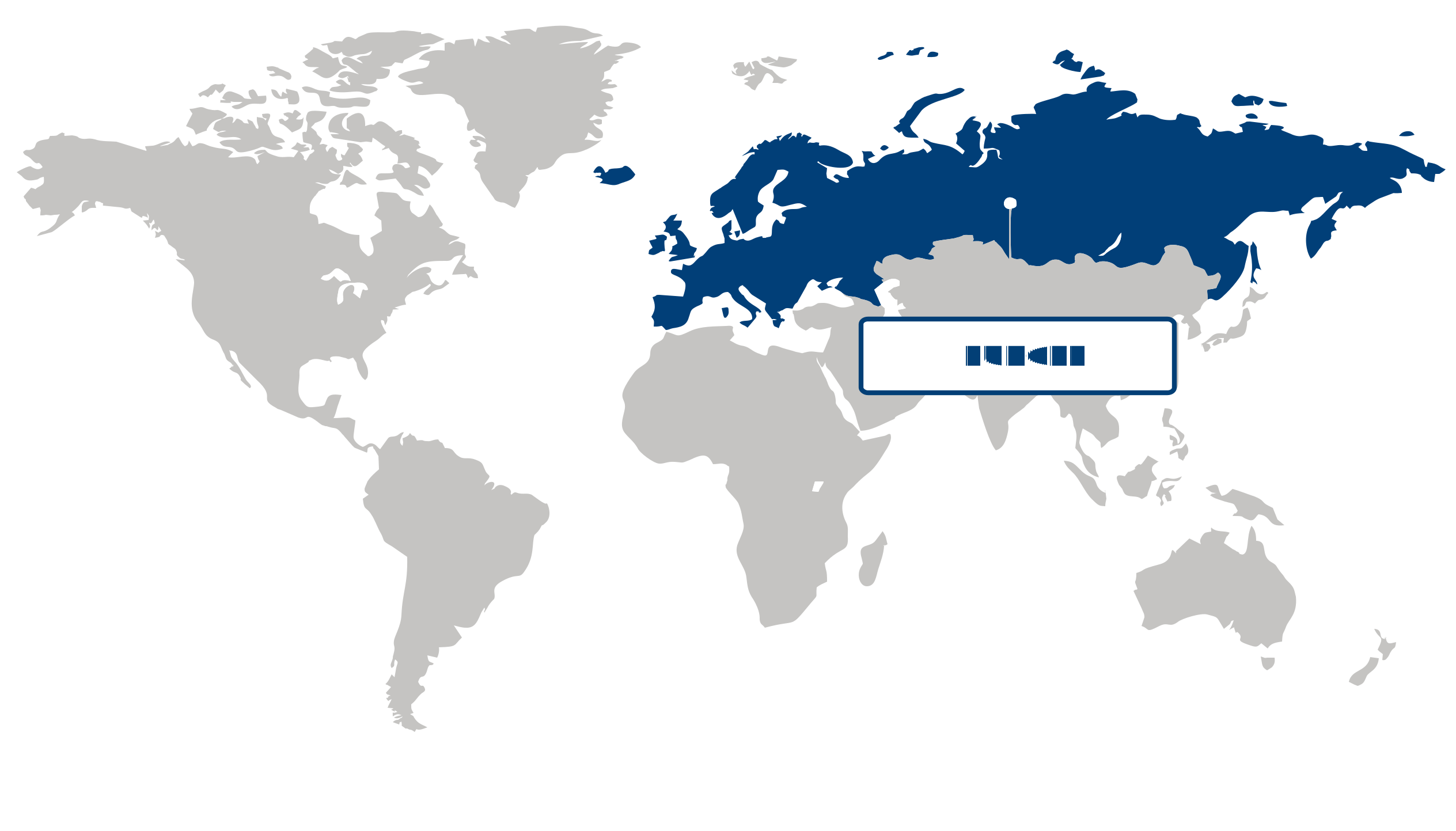
Europe (Largest Region)
Europe dominated the car breakdown recovery service market in 2026, accounting for a 32.4% share, supported by extensive road networks, high vehicle ownership, and well-established roadside assistance infrastructure. Strong consumer expectations for reliable mobility services and widespread adoption of organized vehicle assistance programs are sustaining demand across the region. In addition, stringent vehicle safety requirements, mature automotive service ecosystems, and the increasing integration of digital dispatch and location technologies are improving the efficiency and accessibility of breakdown recovery services.
Asia Pacific (Fastest-Growing Region)
Asia Pacific is expected to register the fastest growth, driven by expanding vehicle ownership, rapid urbanization, and continued development of road and transportation infrastructure. Rising demand for dependable roadside assistance is encouraging service providers to expand coverage and adopt technology-enabled response systems. Growing digital connectivity and increasing consumer preference for convenient on-demand automotive services are also supporting the transition from informal roadside assistance toward more structured and professionally managed recovery solutions.
| Parameter | North America | Asia Pacific | Europe | Latin America | MEA |
|---|---|---|---|---|---|
| Innovation HubiScaleNascentDeveloping Advanced | |||||
| Cost-Sensitive RegioniScaleLowMedium High | |||||
| Regulatory EnvironmentiScaleRestrictiveNeutral Supportive | |||||
| Demand DriversiScaleWeakModerate Strong | |||||
| Development StageiScaleEmergingDeveloping Developed | |||||
| Adoption RateiScaleLowMedium High | |||||
| New Entrants / StartupsiScaleSparseModerate Dense | |||||
| Macro IndicatorsiScaleWeakStable Strong |
Key Country Insights
United States 🇺🇸
Nationwide Assistance NetworksThe U.S. car breakdown recovery service market relies on extensive roadside assistance networks covering diverse vehicle types and travel distances. Service providers invest in digital dispatch systems, rapid response capabilities, and membership-based support programs.
Germany 🇩🇪
Mobility Reliability ServicesGermany emphasizes efficient car breakdown recovery services that minimize vehicle downtime and support dependable mobility. Providers integrate diagnostics, towing coordination, and manufacturer partnerships to enhance customer experience.
Japan 🇯🇵
Urban Response EfficiencyJapan focuses on highly responsive car breakdown recovery services suited to dense urban environments and strict operational standards. Service providers prioritize rapid dispatch, preventive diagnostics, and seamless coordination with repair facilities.
South Korea 🇰🇷
Connected Assistance PlatformsSouth Korea integrates connected vehicle technologies into car breakdown recovery services for faster incident reporting and dispatch. Digital platforms enable efficient roadside support while improving customer communication throughout the recovery process.
France 🇫🇷
Insurance Service IntegrationFrance increasingly links car breakdown recovery services with insurance offerings to simplify roadside assistance for motorists. Providers enhance value through digital claims support, nationwide towing coverage, and coordinated repair networks.
Italy 🇮🇹
Regional Coverage ExpansionItaly strengthens car breakdown recovery services by expanding coverage across urban centers and regional travel corridors. Providers focus on dependable roadside assistance, flexible towing capabilities, and improved response coordination for domestic motorists.
Car Breakdown Recovery Service Market Share (%), by Service, 2026
Go beyond the chart, access full insights & data tables
Request Free Sample ReportService Segment Analysis: Towing Services (Largest & Fastest-Growing Segment)
The towing services segment dominated the car breakdown recovery service market with a 31.54% share in 2026 and is also expected to remain the fastest-growing segment during the forecast period. Towing represents one of the most essential recovery solutions because it provides immediate assistance when vehicles cannot be repaired at the roadside due to mechanical failures, accidents, or electrical malfunctions. The increasing complexity of modern vehicles, combined with rising vehicle ownership and greater expectations for rapid roadside assistance, continues to strengthen demand for professional towing services. Expanding service coverage, integration of GPS-enabled dispatch systems, and improved response capabilities are further supporting the segment's continued leadership.
Service Provider Segment Analysis: Auto Manufacturer (Largest & Fastest-Growing Segment)
The auto manufacturer segment held the largest position in the car breakdown recovery service market in 2026 and is also projected to experience the fastest growth during the forecast period. Vehicle manufacturers are increasingly incorporating roadside assistance programs into warranty packages and after-sales service offerings to strengthen customer satisfaction and long-term brand loyalty. Their extensive dealer and service center networks enable efficient response times and standardized service quality, making manufacturer-backed recovery services highly attractive to vehicle owners. The continued expansion of connected vehicle technologies and predictive maintenance capabilities is further enhancing the value of manufacturer-operated recovery programs.
End Use Segment Analysis: Private Car Owners (Largest Segment) vs Corporate Fleets (Fastest-Growing Segment)
Private car owners represented the largest end-use segment in the car breakdown recovery service market in 2026. The dominance of this segment is driven by the large global population of personal vehicle owners who rely on roadside assistance for unexpected mechanical failures, flat tires, battery issues, and other emergencies. Growing awareness of vehicle protection plans and increasing consumer preference for dependable mobility solutions continue to support strong demand from individual motorists.
Corporate fleets are expected to witness the fastest growth during the forecast period. Businesses operating commercial vehicle fleets are placing greater emphasis on minimizing vehicle downtime to maintain operational efficiency and service reliability. As fleet management becomes increasingly data-driven, organizations are adopting comprehensive recovery services that offer rapid response, centralized support, and preventive maintenance coordination, contributing to accelerated growth within this segment.
| Segment | Sub-Segment | Largest Segment | Fastest Growing |
|---|---|---|---|
| Service | Towing Services, Roadside Repair, Fuel Delivery Services, Lock-out Assistance, Others | Towing Services | Towing Services |
| Service Provider | Motor Insurance, Auto Manufacturer, Automotive Clubs, Independent Warranty Providers | Auto Manufacturer | Auto Manufacturer |
| End Use | Private Car Owners, Corporate Fleets | Private Car Owners | Corporate Fleets |
Competitive Landscape and Market Positioning
Major players in the car breakdown recovery service market:
- Agero, Inc. (United States)
- Allianz Partners (Germany)
- RAC Motoring Services (United Kingdom)
- The Automobile Association (AA plc) (United Kingdom)
- Falck A/S (Denmark)
- SOS International A/S (Denmark)
- ARC Europe Group (Belgium)
- GEICO (United States)
- Liberty Mutual Insurance Company (United States)
- Green Flag Limited (United Kingdom)
The car breakdown recovery service market is evolving beyond basic roadside assistance as providers compete to deliver faster response times through digitally coordinated dispatch, predictive service management, and broader mobility support. Competitive advantage increasingly depends on integrating telematics, real-time vehicle diagnostics, and location intelligence to improve service efficiency while minimizing customer downtime. As vehicle technologies become more sophisticated, providers with stronger technical capabilities and access to specialized repair networks are gaining an edge over operators focused solely on conventional towing services. This transition is also raising expectations for seamless customer communication and end-to-end assistance, making service quality a more durable differentiator than fleet size alone.
| Company | Market Share | Company Revenue | Revenue CAGR (%) | Product Portfolio | Geographic Presence | Innovation / R&D Focus | Strategic Developments |
|---|---|---|---|---|---|---|---|
| Agero Inc. (United States) | |||||||
| Allianz Partners (Germany) | |||||||
| RAC Motoring Services (United Kingdom) | |||||||
| The Automobile Association (AA plc) (United Kingdom) | |||||||
| Falck A/S (Denmark) | |||||||
| SOS International A/S (Denmark) | |||||||
| ARC Europe Group (Belgium) | |||||||
| GEICO (United States) | |||||||
| Liberty Mutual Insurance Company (United States) | |||||||
| Green Flag Limited (United Kingdom) |
Industry Development / News
| Company Name | Date | Key Development |
|---|---|---|
| Renault Group | Oct-24 | Renault Group and SUEZ strengthened their strategic partnership to advance ecological transition initiatives within the automotive sector, focusing specifically on enhancing vehicle recovery and recycling services to adapt to evolving environmental regulations. |
| The Automobile Association | May-24 | The Automobile Association introduced fully electric recovery vehicles to upgrade roadside assistance capabilities, aiming to lower carbon emissions within the recovery sector and align operational footprints with net-zero objectives. |
Customize Your Report
Explore examples of how this report can be tailored to different research needs, including custom segments, additional topics or chapters, and related reports. Click a section of the wheel or its numbered marker to explore the available options.
Car Breakdown Recovery Service Market — Custom Segments
| Segment | Sub-Segment |
|---|---|
| Breakdown Cause | Mechanical Failure, Electrical Failure, Tire-Related Breakdown, Fuel-Related Breakdown, Accident-Related Breakdown, Lockout |
| Vehicle Age | Less Than 5 Years, 5–10 Years, More Than 10 Years |
| Coverage Model | Pay-Per-Use, Membership-Based, Insurance-Bundled, Manufacturer-Bundled |
Car Breakdown Recovery Service Market — Custom TOC
| Custom Chapter | Chapter Details |
|---|---|
| Fleet & Commercial Account Opportunities |
|
| Insurer Partnership Economics |
|
| EV Breakdown Service Readiness |
|
Need a different cut of the data?
Request Custom ResearchFrequently Asked Questions
How big is the car breakdown recovery service market?
What is the anticipated CAGR of the car breakdown recovery service industry?
How are connected vehicle technologies transforming breakdown recovery operations?
Why is the expanding and aging vehicle fleet strengthening demand for recovery services?
Why do towing services lead the car breakdown recovery service market?
How are corporate fleets driving growth in the car breakdown recovery service market?
Why does Europe lead the car breakdown recovery service market?
How is Asia Pacific shaping future market growth?
Who are the major participants shaping the car breakdown recovery service landscape?
Our Clients
"The team surpassed our expectations with the report depth. The actionable insights provided proved crucial in navigating market challenges."
Tata Motors
"We found the report to be very informative. The expertise and attention to market nuances significantly influenced our business direction."
DENSO Corporation
"The consumer survey findings were quite good. We now have a clearer picture of the customer churning and retention strategy."
HL Mando
Our Research Team & Methodology
Every Fundamental Business Insights report is built by a dedicated vertical research team, validated through a structured primary-and-secondary methodology, and reviewed for accuracy before it reaches you.
Delivery
Published
Available
Support
- Market Size & Forecast
- Market Segmentation
- Regional Analysis
- Growth Drivers & Challenges
- Market Dynamics
- Competitive Landscape
- Company Profiles
- Competitive Benchmarking
- Mergers & Acquisitions
- Market Share Analysis or Key Company Strategies
- Value Chain Analysis
- Porter's Five Forces
- PESTLE Analysis
- Pricing Trends
- Supply-Demand Analysis
- Technology Landscape
- Regulatory Landscape
- Investment & Funding Landscape
- Emerging Opportunities
- Future Market Outlook