Carbon Credit Market Size & Growth Forecast 2027–2036, By Segments (Type, Project Type, End-use), Regional Demand Trends (North America, Asia Pacific, Europe), Key Country Insights (U.S., Japan, South Korea, Germany, France, Italy), and Competitive Landscape
Market Size and Growth Outlook
Carbon Credit Market size was valued at USD 1.22 trillion in 2026 and is projected to grow at a 24.61% CAGR from 2027 to 2036, crossing USD 11.01 trillion by 2036. The industry revenue for 2027 is estimated at USD 1.47 trillion.
Get more details on this report
Request Free Sample ReportCarbon Credit Market Intelligence Snapshot
Regional Market Dynamics
- Europe leads because of its mature emissions trading structure, established compliance mechanisms, and broad participation from regulated industries, creating consistent carbon credit procurement and sustained transaction activity.
- North America is projected to grow at a 41.58% CAGR, driven by accelerating corporate decarbonization, expanding voluntary and regulated trading, and wider integration of carbon credits into procurement and risk strategies.
Segment Momentum
- Compliance credits held a 93.1% share in 2026 because regulated industries must purchase credits to meet legal emissions obligations, creating more stable and recurring demand than discretionary voluntary buying.
- Removal and sequestration projects are the fastest-growing segment as buyers increasingly prioritize credits tied to direct carbon removal and stronger long-term decarbonization outcomes.
Market Expansion Drivers
- Expanding carbon pricing regulations and corporate net-zero commitments driving carbon credit demand.
- Rising investment in nature-based and carbon removal projects strengthening voluntary carbon markets.
- Advancements in blockchain-enabled emissions tracking improving carbon credit transparency and traceability.
Leading Market Participants
- Prominent players in the carbon credit market include South Pole Holding AG (Switzerland), 3Degrees Group, Inc. (United States), EKI Energy Services Ltd. (India), Finite Carbon Corporation (United States), NativeEnergy LLC (United States), CarbonBetter, Inc. (United States), Carbon Care Asia Limited (Hong Kong), ClearSky Climate Solutions (Canada), WGL Holdings, Inc. (United States), Climate Impact Partners Limited (United Kingdom).
Global Market Forecast Snapshot
Market Outlook
- 2026 Market Size: USD 1.22 trillion
- 2027 Estimated Market Size: USD 1.47 trillion.
- Projected Market Size: USD 11.01 trillion by 2036
- Growth Forecast: 24.61% CAGR (2027-2036)
Regional and Segment Outlook
- Leading Regional Market: Europe
- High-Growth Regional Hub: North America
- Core Revenue Segment: Compliance (Type) | Avoidance/Reduction Projects (Project Type) | Power (End-use)
- Emerging Opportunity Segment: Voluntary (Type) | Removal/Sequestration Projects (Project Type) | Energy (End-use)
Market Growth Drivers and Industry Trends
Expanding carbon pricing regulations and corporate net-zero commitments driving carbon credit demand
The carbon credit market growth is being strengthened by the expansion of carbon pricing mechanisms and the increasing adoption of corporate net-zero strategies, which are creating greater demand for mechanisms that assign economic value to emissions reductions. Governments and regulatory authorities are developing carbon-related frameworks that encourage businesses to account for greenhouse gas emissions and incorporate decarbonization into operational planning. At the corporate level, organizations across emissions-intensive industries are setting climate targets and evaluating carbon credits as one component of broader emissions-management strategies. These developments are increasing attention toward verified emissions reductions and strengthening demand for credits that can support climate-related commitments while organizations work to reduce emissions within their own operations.
Rising investment in nature-based and carbon removal projects strengthening voluntary carbon markets
Investment in reforestation, ecosystem restoration, improved land management, and engineered carbon removal solutions will propel the carbon credit market growth by expanding the range of projects capable of generating tradable emissions-reduction or removal units. Nature-based projects can combine carbon sequestration with benefits such as biodiversity conservation and ecosystem restoration, making them attractive to organizations seeking broader environmental outcomes. At the same time, growing interest in carbon removal technologies is supporting project development aimed at extracting carbon dioxide from the atmosphere or preventing its return to the atmosphere through durable storage. Greater capital availability for these initiatives is helping project developers expand activities, improve verification practices, and develop credits that meet the evolving expectations of buyers in voluntary markets.
Advancements in blockchain-enabled emissions tracking improving carbon credit transparency and traceability
Technological advances in digital ledgers are supporting greater transparency, and blockchain-enabled tracking can enhance the carbon credit market growth by improving the ability to record, verify, and trace transactions throughout the credit lifecycle. Concerns surrounding double counting, inconsistent project information, and limited visibility into credit ownership have increased demand for systems that provide more reliable records of issuance and transfer. Blockchain-based platforms can create auditable transaction histories while enabling participants to track credits from project generation through retirement, subject to the design and verification standards of the underlying system. Greater digital traceability can also improve confidence among buyers, project developers, and other market participants when evaluating the provenance and movement of environmental assets.
| Growth Driver | Impact on CAGR | Regulatory Influence | Geographic Relevance | Adoption Rate | Impact Timeline |
|---|---|---|---|---|---|
| Expanding carbon pricing regulations and corporate net-zero commitments driving carbon credit demand | 2.50% | High | Europe, North America, Asia Pacific | High | Near Term |
| Rising investment in nature-based and carbon removal projects strengthening voluntary carbon markets | 2.10% | High | Latin America, Asia Pacific, Africa | Medium | Mid Term |
| Advancements in blockchain-enabled emissions tracking improving carbon credit transparency and traceability | 1.60% | Moderate | North America, Europe | Emerging | Mid Term |
Unlock insights tailored to your business with our bespoke market research solutions.
Click to get your customized report now.
Regional Demand Dynamics
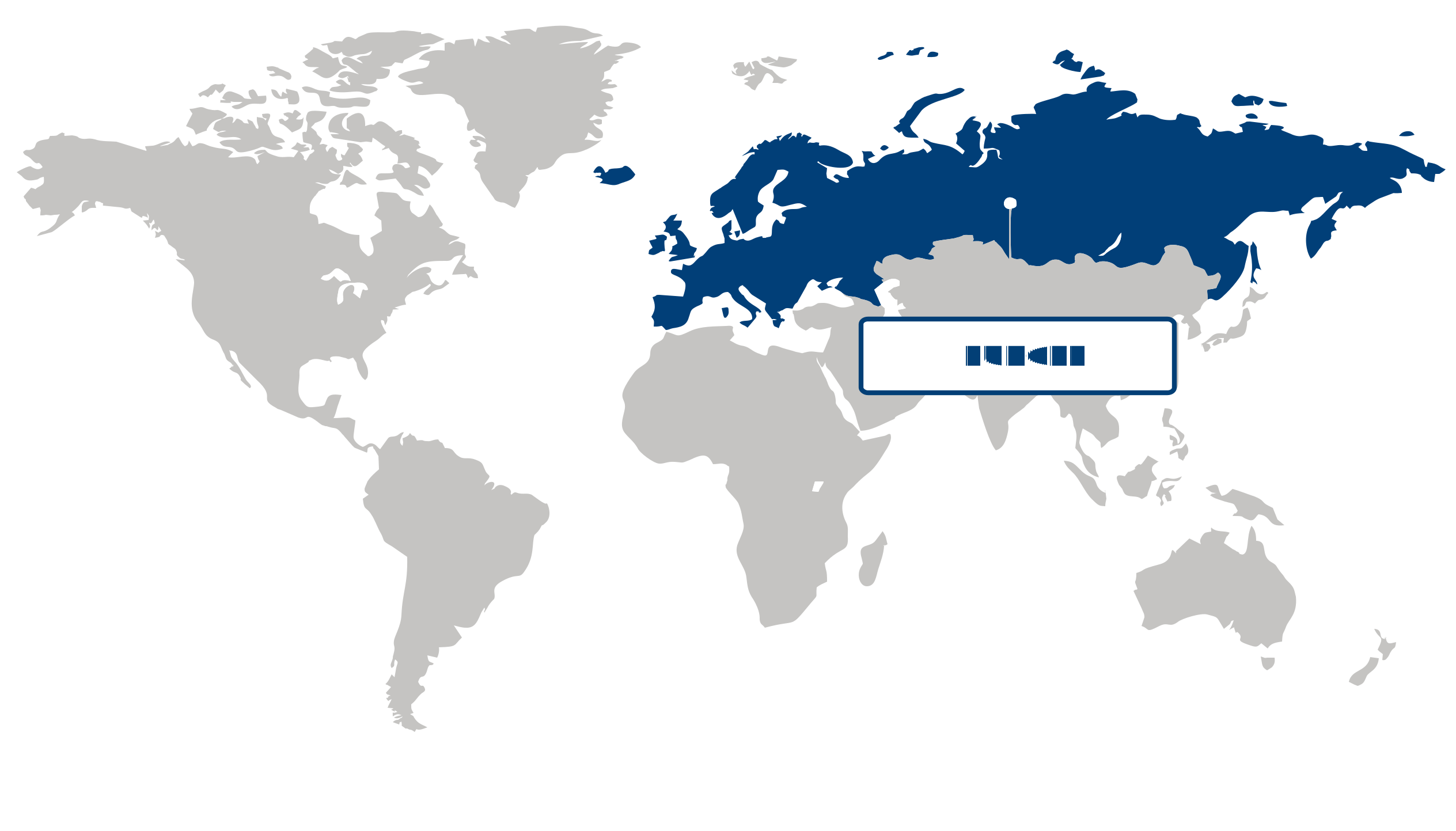
Europe (Largest Region)
In the carbon credit market, Europe held the largest share in 2026, reflecting the region’s mature carbon pricing framework, strong climate-policy orientation, and established mechanisms for emissions trading and environmental compliance. Decarbonization initiatives across energy, transportation, manufacturing, and other emissions-intensive industries are increasing demand for credible carbon market instruments. Greater corporate focus on climate-risk management and sustainability reporting is also encouraging organizations to incorporate carbon credits into broader emissions-reduction strategies. Continued development of market infrastructure, verification practices, and regulatory frameworks further strengthens Europe’s position as a leading center for carbon market activity.
North America (Fastest-Growing Region)
North America represents the fastest-growing region for the carbon credit market, supported by expanding corporate climate commitments, increasing interest in emissions reduction strategies, and growing participation in voluntary carbon markets. Businesses across multiple industries are seeking flexible mechanisms to address residual emissions while investing in broader sustainability programs. Rising awareness of carbon accounting, improvements in project verification, and greater availability of nature-based and technology-oriented carbon initiatives are helping strengthen market participation. The combination of corporate demand, evolving environmental policies, and increasing investor attention to climate-related risks is creating favorable conditions for continued regional expansion.
| Parameter | North America | Asia Pacific | Europe | Latin America | MEA |
|---|---|---|---|---|---|
| Innovation Hub i Scale Nascent Developing Advanced | |||||
| Cost-Sensitive Region i Scale Low Medium High | |||||
| Regulatory Environment i Scale Restrictive Neutral Supportive | |||||
| Demand Drivers i Scale Weak Moderate Strong | |||||
| Development Stage i Scale Emerging Developing Developed | |||||
| Adoption Rate i Scale Low Medium High | |||||
| New Entrants / Startups i Scale Sparse Moderate Dense | |||||
| Macro Indicators i Scale Weak Stable Strong |
Key Country Insights
Germany 🇩🇪
Industrial Decarbonization FocusGermany uses carbon credits as a complementary tool for hard-to-abate industrial sectors seeking additional decarbonization pathways. Demand in Germany increasingly favors certified projects with measurable environmental integrity and alignment with European sustainability standards.
France 🇫🇷
Climate Policy AlignmentFrance emphasizes carbon credits that align with national climate objectives and corporate environmental commitments. Organizations in France increasingly seek projects with strong biodiversity and social co-benefits, supporting demand for premium, high-integrity credits.
Italy 🇮🇹
Corporate Offset AdoptionItaly's carbon credit market is increasingly influenced by mid-sized companies incorporating offsets into sustainability programs. Buyers in Italy are showing greater preference for regional and nature-based projects that support environmental stewardship and reputational objectives.
Japan 🇯🇵
Transition Finance IntegrationJapan is integrating carbon credits into broader transition finance initiatives, encouraging manufacturers and energy companies to offset residual emissions. The market in Japan places growing emphasis on domestic credit generation and cross-border partnerships for verified projects.
South Korea 🇰🇷
Compliance Trading ExpansionSouth Korea continues to strengthen its emissions trading framework, supporting greater participation in carbon credit transactions by industrial firms. Interest in South Korea is expanding toward credits that complement corporate sustainability strategies and improve emissions management flexibility.
United States 🇺🇸
Voluntary Market InnovationThe U.S. carbon credit market is shaped by corporate net-zero commitments and active voluntary trading platforms that support demand for high-quality offsets. Companies are increasingly prioritizing credits linked to nature-based solutions and transparent verification mechanisms.
Segment Leadership and Growth Trends
Carbon Credit Market Share (%), by Type, 2026
Go beyond the chart, access full insights & data tables
Request Free Sample ReportType Segment Analysis: Compliance (Largest Segment) vs Voluntary (Fastest-Growing Segment)
Compliance carbon credits accounted for a dominant 93.1% share of the carbon credit market in 2026, reflecting their direct connection with mandatory emissions-reduction frameworks and regulated environmental obligations. Organizations operating under carbon regulations require eligible credits to address emissions requirements, creating structural demand tied to regulatory compliance rather than discretionary sustainability commitments. The growing focus on emissions management, carbon accounting, and adherence to environmental policies further strengthens the role of compliance markets, making this segment the primary source of carbon credit demand.
The voluntary segment is expanding more rapidly as businesses increasingly pursue emissions-reduction initiatives beyond mandatory regulatory requirements. Voluntary credits enable organizations to support climate-related projects and incorporate carbon considerations into broader sustainability strategies, including corporate environmental commitments and supply-chain initiatives. Greater attention to corporate climate responsibility, stakeholder expectations, and transparent emissions management is encouraging participation in voluntary carbon markets, supporting their faster development.
Project Type Segment Analysis: Avoidance/Reduction Projects (Largest Segment) vs Removal/Sequestration Projects (Fastest-Growing Segment)
Avoidance/Reduction projects held the largest share of the carbon credit market at 63.76% in 2026, supported by their established role in preventing or reducing greenhouse gas emissions through changes in energy use, resource management, and operational practices. These projects can address emissions at their source while supporting broader efforts to improve energy efficiency and transition toward lower-carbon activities. Their established project structures and relevance to organizations seeking measurable emissions reductions continue to underpin their leading market position.
Removal/Sequestration projects are gaining momentum as climate strategies increasingly emphasize the direct removal of carbon dioxide from the atmosphere in addition to preventing new emissions. These projects can involve approaches that capture, store, or otherwise sequester atmospheric carbon, providing a complementary pathway for addressing residual emissions that are difficult to eliminate through conventional reduction measures. Growing interest in long-term carbon management, higher-quality climate projects, and more comprehensive decarbonization strategies is strengthening demand for removal and sequestration credits.
| Segment | Sub-Segment | Largest Segment | Fastest Growing |
|---|---|---|---|
| Type | Compliance, Voluntary | Compliance | Voluntary |
| Project Type | Avoidance/Reduction Projects, Removal/Sequestration Projects | Avoidance/Reduction Projects | Removal/Sequestration Projects |
| End-use | Power, Energy, Aviation, Transportation, Buildings, Industrial, Others | Power | Energy |
Competitive Landscape and Market Positioning
Leading companies in the carbon credit market:
1. South Pole Holding AG (Switzerland)
2. 3Degrees Group Inc. (United States)
3. EKI Energy Services Ltd. (India)
4. Finite Carbon Corporation (United States)
5. NativeEnergy LLC (United States)
6. CarbonBetter Inc. (United States)
7. Carbon Care Asia Limited (Hong Kong)
8. ClearSky Climate Solutions (Canada)
9. WGL Holdings Inc. (United States)
10. Climate Impact Partners Limited (United Kingdom)
Expanding global climate initiatives are strengthening structured carbon trading mechanisms. The carbon credit market is evolving through improved verification systems that enhance transparency and traceability of emissions reductions. Digital platforms are improving trading efficiency and market accessibility. Increasing integration of sustainability frameworks is also reinforcing corporate participation in carbon offset programs.
| Company | Market Share | Company Revenue | Revenue CAGR (%) | Product Portfolio | Geographic Presence | Innovation / R&D Focus | Strategic Developments |
|---|---|---|---|---|---|---|---|
| South Pole Holding AG (Switzerland) | |||||||
| 3Degrees Group Inc. (United States) | |||||||
| EKI Energy Services Ltd. (India) | |||||||
| Finite Carbon Corporation (United States) | |||||||
| NativeEnergy LLC (United States) | |||||||
| CarbonBetter Inc. (United States) | |||||||
| Carbon Care Asia Limited (Hong Kong) | |||||||
| ClearSky Climate Solutions (Canada) | |||||||
| WGL Holdings Inc. (United States) | |||||||
| Climate Impact Partners Limited (United Kingdom). |
Industry Development/News
| Company Name | Date | Key Development |
|---|---|---|
| World Bank | May-26 | The World Bank and the Government of Singapore established a Carbon Markets Programme to scale high-integrity carbon trading. This initiative strengthens international market infrastructure and supports the growth of global climate finance by fostering standardized, transparent, and scalable mechanisms for carbon credit transactions between public and private sector participants. |
| Microsoft | May-26 | Microsoft entered a long-term procurement agreement to purchase 650,000 metric tons of carbon removals from BioCirc over a seven-year period. This significant offtake commitment reinforces corporate demand for high-quality, verified carbon removal credits and provides the financial stability required for large-scale investment in carbon sequestration projects. |
| Gold Standard | May-26 | Gold Standard partnered with Trovio to transition to a next-generation registry platform. The upgrade is designed to improve interoperability across diverse carbon credit registries and marketplaces while enhancing the traceability of credits. This technological integration addresses critical fragmentation issues in the voluntary carbon market, supporting increased efficiency and market integrity. |
| HSBC | May-26 | HSBC launched a USD 4 billion credit facility dedicated to supporting the international expansion of sustainable and transition-technology companies. By providing targeted capital to businesses in clean energy and low-carbon sectors, the initiative facilitates the development of project pipelines that serve as the foundation for future carbon credit generation and broader environmental market growth. |
| Varaha | Feb-26 | Carbon removal developer Varaha secured USD 20 million in funding and initiated a biochar production partnership with industrial facilities. This investment enables the scale-up of verifiable carbon removal operations, linking industrial waste processing to carbon credit generation, which helps fulfill the rising demand for high-permanence, technology-based carbon sequestration solutions. |
| Ecora | Nov-25 | Ecora was established as Brazil’s national carbon credit certifier through a collaborative investment by BNDES, Bradesco, and the Ecogreen Fund. The launch aims to standardize market certification processes, enhance the institutional credibility of Brazilian carbon assets, and accelerate capital inflows into domestic nature-based and technological carbon projects. |
| Chestnut Carbon | Aug-25 | Chestnut Carbon secured a USD 210 million project finance facility to scale its afforestation activities. This robust financing mechanism validates the commercial viability of nature-based carbon projects and demonstrates how structured credit facilities can be effectively utilized to support the long-term origination and delivery of high-quality carbon removal credits. |
| Bloomberg L.P. | Jan-25 | Bloomberg acquired Viridios AI to integrate specialized carbon market intelligence and analytics into its data services. This acquisition significantly enhances market transparency, enabling investors and corporate participants to better navigate carbon pricing, project risk, and valuation dynamics, thereby professionalizing data-driven decision-making within the global carbon credit ecosystem. |
| Marsh | Nov-24 | Marsh partnered with We2Sure to offer insurance products specifically designed to mitigate the risk of carbon credit fraud. This expansion of risk management infrastructure is essential for protecting investment in carbon markets, lowering the barrier to entry for institutional participants, and improving the overall bankability of carbon project assets. |
| Silva Capital | Aug-24 | Silva Capital launched the Silva Carbon Origination Fund, backed by Rio Tinto, BHP, and Qantas. The fund provides direct financing for large-scale nature-based carbon projects in Australia. This development signifies a strategic shift toward corporate-backed, dedicated funds for carbon credit origination to meet net-zero targets and secure reliable credit supply chains. |
Customize Your Report
Explore examples of how this report can be tailored to different research needs, including custom segments, additional topics or chapters, and related reports. Click a section of the wheel or its numbered marker to explore the available options.
Carbon Credit Market — Custom Segments
| Segment | Sub-Segment |
|---|---|
| Buyer Type | Corporations, Financial Institutions, Governments & Public Sector, Individuals & Nonprofits |
| Credit Standard | Verra VCS, Gold Standard, American Carbon Registry, Climate Action Reserve, Other Standards |
| Transaction Channel | Direct Project Transactions, Brokers & Intermediaries, Exchanges & Trading Platforms, Retail & Aggregator Platforms |
Carbon Credit Market — Custom TOC
| Custom Chapter | Custom Details |
|---|---|
| Corporate Net-Zero Strategy Analysis |
|
| Voluntary Carbon Market Integrity Assessment |
|
| Carbon Project Investment Opportunity Analysis |
|
Need a different cut of the data?
Request Custom ResearchWhat is the current revenue of the carbon credit market?
How is the carbon credit industry size expected to evolve during the forecast period?
How are expanding carbon pricing regulations shaping procurement strategies in the carbon credit market?
Why is transparency becoming increasingly important in the carbon credit market?
Why does the compliance segment lead the carbon credit market?
Which project type is expanding fastest in the carbon credit market?
Why does Europe lead the carbon credit market?
What is driving rapid growth in the North American carbon credit market?
Which companies are driving growth in the carbon credit landscape?
Our Clients
"The information presented in the report was genuinely insightful. The data was clear and easy to understand, which made it much easier to interpret the findings."
Amara Raja Group
"The responsiveness and professionalism exhibited by the team were exemplary. They were readily available to address queries, provide clarifications, and offer additional insights."
ONGC
"The reports offered a comprehensive analysis of various segments within the market. The detailed insights into market trends, and regulatory landscapes were excellent."
TotalEnergies
Our Research Team & Methodology
Every Fundamental Business Insights report is built by a dedicated vertical research team, validated through a structured primary-and-secondary methodology, and reviewed for accuracy before it reaches you.
Research Team Overview
Prepared by the Energy & Power Research Team
Delivery
Published
Demand
Available
Support
Trust & Compliance
Research Intelligence
Research Workflow & Quality Assurance
Data Collection
Verified information gathered through primary and secondary research.
Data Triangulation
Cross-validation using multiple independent data sources.
Forecast Modelling
Market estimates developed using historical trends and analytical models.
Analyst Validation
Findings reviewed by domain experts for accuracy and consistency.
Editorial & Quality Review
Final editorial, quality, and compliance checks before publication.
Final Publication
Released after successful completion of the internal review process.
Report Coverage
📊 Market Assessment
- Market Size & Forecast
- Market Segmentation
- Regional Analysis
- Growth Drivers & Challenges
- Market Dynamics
🏢 Competitive Intelligence
- Competitive Landscape
- Company Profiles
- Competitive Benchmarking
- Mergers & Acquisitions
- Market Share Analysis or Key Company Strategies
🔍 Strategic Analysis
- Value Chain Analysis
- Porter's Five Forces
- PESTLE Analysis
- Pricing Trends
- Supply-Demand Analysis
🚀 Future Outlook
- Technology Landscape
- Regulatory Landscape
- Investment & Funding Landscape
- Emerging Opportunities
- Future Market Outlook
Have a question about this report or need a custom scope?
Request Customization