



Cargo Bicycles Market Size & Growth Forecast 2027–2036, By Segments (Type, Product, Wheel Size, Application), Regional Demand Trends (North America, Asia Pacific, Europe), Key Country Insights (U.S., Japan, South Korea, Germany, France, Italy), and Competitive Landscape
Market Size and Growth Outlook
Cargo Bicycles Market size stood at USD 4.83 billion in 2026 and is predicted to grow at a 21.19% CAGR from 2027 to 2036, surpassing USD 33.01 billion by 2036. The industry revenue for 2027 is assessed at USD 5.69 billion.
Base Year Value (2026)
USD 4.83 billion
CAGR (2027-2036)
21.19%
Forecast Year Value (2036)
USD 33.01 billion

Historical Data Period
2022-2026

Largest Region
Europe

Forecast Period
2027-2036
Cargo Bicycles Market Intelligence Snapshot:
-
Regional Market Dynamics:
- Europe held a 49.29% market share in 2026, supported by extensive cycling infrastructure, mature urban delivery networks, and widespread commercial use for last-mile logistics.
- Asia Pacific is expected to expand at a 23.87% CAGR as urban delivery demand rises, e-commerce grows, and businesses adopt cost-efficient transport solutions for dense city environments.
-
Segment Momentum:
- Electric cargo bikes hold a 57.75% share due to reduced rider effort, higher payload capacity, and efficiency benefits in stop-and-go urban delivery operations across commercial and personal use.
- Three-wheeled models are growing fastest as they offer better load stability and handling confidence for heavier or bulkier cargo, especially in low-speed delivery and loading operations.
-
Market Expansion Drivers:
- Expanding last-mile freight delivery demand driving urban cargo bicycle fleet deployment.
- Urban sustainability mandates and congestion reduction policies accelerating eco-transport adoption.
- Rising electric cargo bike usage in courier and food delivery logistics platforms.
-
Leading Market Participants:
Top players in the cargo bicycles market include Rad Power Bikes Inc. (United States), Tern Bicycles (Taiwan), Xtracycle Inc. (United States), Yuba Bicycles LLC (United States), Smart Urban Mobility B.V. (Netherlands), Triobike A/S (Denmark), Surly Bikes (United States), Worksman Cycles (United States), Cycles Maximus Ltd. (United Kingdom), Urban Arrow B.V. (Netherlands).
Global Market Forecast Snapshot:
-
Market Outlook:
- 2026 Market Size: USD 4.83 billion
- 2027 Estimated Market Size: USD 5.69 billion.
- Projected Market Size: USD 33.01 billion by 2036
- Growth Forecasts: 21.19% CAGR (2027-2036)
-
Regional and Segment Outlook:
- Leading Regional Market: Europe
- High-Growth Regional Hub: Asia Pacific
- Core Revenue Segment: Electric (Type) | Two-Wheeled (Product) | 20"-24" (Wheel Size) | Commercial (Application)
- Emerging Opportunity Segment: Electric (Type) | Three-Wheeled (Product) | Below 20" (Wheel Size) | Personal (Application)
Market Growth Drivers and Industry Trends
Expanding last-mile freight delivery demand driving urban cargo bicycle fleet deployment
The rapid expansion of urban last-mile delivery activity is increasing the need for flexible freight solutions, supporting cargo bicycles market growth in densely populated areas. E-commerce, local retail fulfillment, grocery distribution, and on-demand deliveries require vehicles capable of navigating congested streets while reaching customers over short distances. Cargo bicycles can operate through narrow urban routes and access locations where conventional delivery vehicles face parking or traffic constraints, making them suitable for frequent neighborhood-level deliveries. Logistics operators are therefore incorporating cargo bicycles into delivery fleets to improve route flexibility, support efficient parcel movement, and address the operational challenges associated with increasingly fragmented urban delivery networks.
Urban sustainability mandates and congestion reduction policies accelerating eco-transport adoption
Municipal efforts to reduce traffic congestion, vehicle emissions, and dependence on conventional urban transport are creating favorable conditions for cargo bicycles market adoption. Cities introducing low-emission zones, restricted vehicle access areas, cycling infrastructure, and sustainable mobility programs are encouraging businesses to consider alternative modes for short-distance freight movement. Cargo bicycles provide a practical option for transporting goods without occupying as much road and parking space as larger commercial vehicles, while their integration with dedicated cycling infrastructure can improve access to busy commercial districts. Public policies that prioritize cleaner urban logistics are also encouraging businesses to redesign delivery operations around smaller, more adaptable vehicles.
Rising electric cargo bike usage in courier and food delivery logistics platforms
Growing use of electric-assisted cargo bicycles is expanding their suitability for commercial delivery operations and strengthening cargo bicycles market demand. Electric propulsion enables riders to transport heavier loads and cover longer delivery routes with less physical effort, making cargo bikes more practical for intensive courier, grocery, and food delivery schedules. Logistics platforms can deploy these vehicles across dense service areas where frequent stops and short delivery windows make maneuverability particularly important. Improvements in battery-powered assistance and cargo-carrying configurations are also allowing operators to match vehicle specifications with different delivery requirements, including parcel transportation, food containers, and other urban freight loads.
| Growth Driver Assessment Framework | |||||
| Growth Driver | Impact On CAGR | Regulatory Influence | Geographic Relevance | Adoption Rate | Impact Timeline |
|---|---|---|---|---|---|
| Expanding last-mile freight delivery demand driving urban cargo bicycle fleet deployment | 2.10% | Moderate | Europe, Asia Pacific | High | Near Term |
| Urban sustainability mandates and congestion reduction policies accelerating eco-transport adoption | 1.70% | High | Europe, North America | High | Near Term |
| Rising electric cargo bike usage in courier and food delivery logistics platforms | 1.50% | Moderate | Asia Pacific, Europe | High | Mid Term |
Unlock insights tailored to your business with our bespoke market research solutions - Click to get your customized report now!
Regional Demand Dynamics
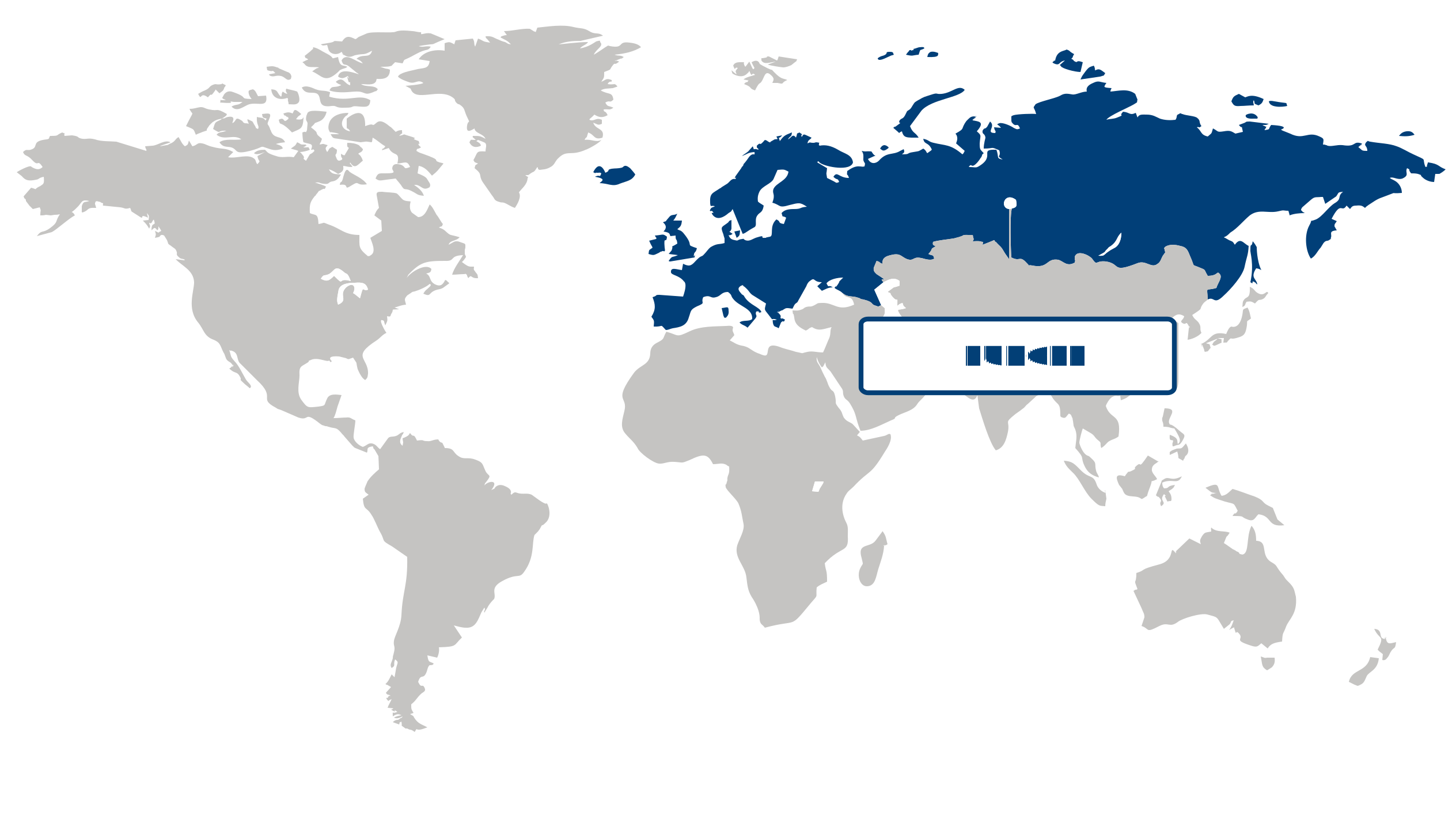
Largest Region
Europe
49.29% Market Share in 2026
Europe (Largest Region) vs Asia Pacific (Fastest-Growing Region)
Europe dominated the cargo bicycles market with a 49.29% share in 2026, supported by established cycling infrastructure, growing adoption of sustainable urban transportation, and increasing demand for efficient last-mile mobility. Cargo bicycles are increasingly suited to urban delivery and local logistics applications where congestion, emissions, and limited parking create challenges for conventional vehicles. Supportive urban mobility policies, established cycling cultures, and expanding interest in low-emission transportation solutions reinforce the region's strong market position.
Asia Pacific is experiencing the fastest growth as rapid urbanization and increasing delivery activity create demand for flexible and efficient short-distance transportation. The expansion of e-commerce and urban logistics is encouraging businesses to consider compact delivery solutions capable of navigating congested city environments. Growing investment in sustainable mobility infrastructure and increasing awareness of low-emission transportation are further supporting the adoption of cargo bicycles across the region.
Key Country Insights
The U.S. cargo bicycles market is expanding through growing adoption for urban logistics, food delivery, and commercial fleet operations. Manufacturers are introducing electric cargo bicycle models that improve operational efficiency while addressing congestion and sustainability objectives.
Japan is adopting cargo bicycles for efficient goods transport in densely populated urban areas where compact mobility solutions are essential. Manufacturers are focusing on maneuverability, electric assistance, and practical designs suited to commercial and family use.
South Korea is incorporating cargo bicycles into smart urban logistics and short-distance delivery services. Fleet operators are emphasizing connected mobility features, electric powertrains, and efficient route planning to improve last-mile transportation performance.
Germany is promoting cargo bicycles as an alternative for urban freight transport and municipal mobility. Businesses are integrating electric cargo bicycles into delivery fleets while benefiting from supportive cycling infrastructure and sustainable transport initiatives.
France is encouraging cargo bicycle adoption through policies supporting low-emission urban mobility and commercial deliveries. Companies are expanding electric cargo bicycle fleets to improve operational flexibility while reducing reliance on conventional delivery vehicles.
Italy is increasing the use of cargo bicycles across city logistics, local retail distribution, and small business transportation. Manufacturers are developing versatile electric models that accommodate varying cargo needs while supporting sustainable urban mobility initiatives.
Segment Leadership and Growth Trends
Type Segment Analysis: Electric (Largest & Fastest-Growing Segment)
Electric cargo bicycles accounted for the largest share of the cargo bicycles market at 57.75% in 2026 and are also the fastest-growing type. Electric assistance enables riders to transport heavier loads with less physical effort, making these bicycles increasingly practical for urban deliveries, commercial transportation, and everyday cargo movement. Their suitability for congested city environments, combined with growing interest in efficient and lower-emission mobility solutions, is strengthening adoption among both commercial and individual users.
Product Segment Analysis: Two-Wheeled (Largest Segment) vs Three-Wheeled (Fastest-Growing Segment)
The two-wheeled segment led the cargo bicycles market with a 52.26% share in 2026, supported by its maneuverability, relatively compact footprint, and suitability for navigating dense urban streets. Two-wheeled cargo bicycles can provide an effective balance between carrying capability and ease of handling, making them attractive for delivery services, commuting, and light commercial transport. Their ability to operate efficiently in areas where conventional vehicles face congestion or parking constraints further supports their established market position.
Three-wheeled cargo bicycles are experiencing the fastest growth as businesses and users seek greater stability and higher load-handling capability. The additional wheel provides improved balance, making these bicycles particularly suitable for commercial deliveries, mobile vending, and applications where cargo stability is important. Increasing demand for practical urban logistics solutions is encouraging broader adoption of three-wheeled designs across commercial and community transportation uses.
| Report Segmentation | |||
| Segment | Sub-Segment | Largest Segment | Fastest Growing Segment |
|---|---|---|---|
| Type | Electric, Non-electric | Electric | Electric |
| Product | Two-Wheeled, Three-Wheeled, Four-Wheeled | Two-Wheeled | Three-Wheeled |
| Wheel Size | Below 20", 20"-24", 25"-28", Above 28" | 20"-24" | Below 20" |
| Application | Personal, Commercial | Commercial | Personal |
 Read our Research Approach
Competitive Landscape and Market Positioning
Major players in the cargo bicycles market:
1. Rad Power Bikes Inc. (United States)
2. Tern Bicycles (Taiwan)
3. Xtracycle Inc. (United States)
4. Yuba Bicycles LLC (United States)
5. Smart Urban Mobility B.V. (Netherlands)
6. Triobike A/S (Denmark)
7. Surly Bikes (United States)
8. Worksman Cycles (United States)
9. Cycles Maximus Ltd. (United Kingdom)
10. Urban Arrow B.V. (Netherlands)
Urban logistics and environmentally friendly transportation trends are accelerating innovation in the cargo bicycles market. Manufacturers are introducing electric-assist models, modular cargo systems, and lightweight designs that improve carrying capacity while supporting sustainable last-mile delivery.
Industry Development/News
| Company Name | Date | Key Development |
|---|---|---|
| Amazon | Jun-26 | Amazon has deployed electric cargo bikes for last-mile deliveries in Washington, signaling a strategic shift toward micro-distribution models. This initiative aims to optimize urban logistics efficiency, reduce traffic congestion, and lower operational emissions, marking a significant commitment to integrating micromobility into large-scale commercial delivery networks. |
| KeyGreen | Apr-26 | KeyGreen has integrated cargo bicycles into its waste collection operations in Dublin City Centre to navigate strict urban access regulations. This adoption demonstrates the operational utility of cargo bikes in dense urban environments, providing a maneuverable, low-emission alternative to traditional vehicles for essential municipal service delivery. |
| The Bike Hub | Mar-26 | The Bike Hub is piloting a shared cargo bicycle system within residential buildings in Dublin, targeting the last-mile transport segment. By embedding cargo mobility directly into housing infrastructure, the initiative promotes shared usage models designed to reduce dependence on private vehicles for personal logistics and short-distance freight. |
| The Bike Hub | Dec-25 | The Bike Hub has expanded its shared cargo bicycle footprint across the South Dublin suburbs of Dun Laoghaire and Sandyford. This community-based sharing model increases local accessibility to cargo transport, providing a flexible, sustainable alternative to private vehicle use for errands and short-distance deliveries. |
| Moby | Aug-25 | Following the acquisition of a bankrupt cargo bike firm, Moby is evaluating the integration of Cargoroo-style sharing services into its existing operations. This move reflects potential consolidation and renewed focus on shared cargo bike infrastructure, contingent upon successfully scaling operations and securing necessary external support. |
| Government of Ireland | Mar-25 | The Irish government is deploying eMobility eHubs across major cities, including Dublin and Galway, to facilitate shared electric and cargo bicycle adoption. By incorporating integrated in-ground charging infrastructure, this state-led initiative aims to standardize and scale sustainable urban transport networks across the country. |
| Fin | Nov-24 | Logistics provider Fin is entering the New York market, utilizing a fleet of cargo e-bikes for last-mile delivery services. The expansion demonstrates the growing viability of cargo bikes as a primary tool for high-density urban logistics, focused on improving delivery efficiency and minimizing the environmental impact of city-based supply chains. |
Why Choose Us
Specialized Expertise: Our team comprises industry experts with a deep understanding of your market segment. We bring specialized knowledge and experience that ensures our research and consulting services are tailored to your unique needs.
Customized Solutions: We understand that every client is different. That's why we offer customized research and consulting solutions designed specifically to address your challenges and capitalize on opportunities within your industry.
Proven Results: With a track record of successful projects and satisfied clients, we have demonstrated our ability to deliver tangible results. Our case studies and testimonials speak to our effectiveness in helping clients achieve their goals.
Cutting-Edge Methodologies: We leverage the latest methodologies and technologies to gather insights and drive informed decision-making. Our innovative approach ensures that you stay ahead of the curve and gain a competitive edge in your market.
Client-Centric Approach: Your satisfaction is our top priority. We prioritize open communication, responsiveness, and transparency to ensure that we not only meet but exceed your expectations at every stage of the engagement.
Continuous Innovation: We are committed to continuous improvement and staying at the forefront of our industry. Through ongoing learning, professional development, and investment in new technologies, we ensure that our services are always evolving to meet your evolving needs.
Value for Money: Our competitive pricing and flexible engagement models ensure that you get maximum value for your investment. We are committed to delivering high-quality results that help you achieve a strong return on your investment.
Select Licence Type

