



Cellular IoT Market Size & Growth Forecast 2027–2036, By Segments (Component, Technology, End Use), Regional Demand Trends (North America, Asia Pacific, Europe), Key Country Insights (U.S., Japan, South Korea, Germany, France, Italy), and Competitive Landscape
Market Size and Growth Outlook
Cellular IoT Market size stood at USD 11.4 billion in 2026 and is predicted to grow at a 25.75% CAGR from 2027 to 2036, surpassing USD 112.72 billion by 2036. The industry revenue for 2027 is assessed at USD 13.87 billion.
Base Year Value (2026)
USD 11.4 billion
CAGR (2027-2036)
25.75%
Forecast Year Value (2036)
USD 112.72 billion

Historical Data Period
2022-2026

Largest Region
Europe

Forecast Period
2027-2036
Cellular IoT Market Intelligence Snapshot:
-
Regional Market Dynamics:
- Europe accounted for 34.24% of the market in 2026, supported by mature telecom infrastructure and widespread deployment of connected applications across utilities, automotive, and industrial sectors.
- Asia Pacific is projected to grow at a 29.15% CAGR due to rapid network expansion, large-scale device deployments, and increasing adoption of connected solutions across industries and infrastructure.
-
Segment Momentum:
- Hardware captured 61.74% of the market in 2026 because modules, chipsets, sensors, and connectivity devices form the essential infrastructure required for every cellular IoT deployment.
- 5G is the fastest-growing technology segment as businesses increasingly require higher data speeds, lower latency, and stronger support for dense connected-device environments and advanced IoT applications.
-
Market Expansion Drivers:
- 5G network expansion enabling high-speed low-latency large-scale IoT connectivity.
- Rising cross-sector demand for secure connectivity enabling remote monitoring and predictive maintenance.
- Edge computing and AI-driven analytics enhancing real-time IoT decision-making efficiency.
-
Leading Market Participants:
Top players in the cellular IoT market include Cisco Systems, Inc. (United States), Telefonaktiebolaget LM Ericsson (Sweden), Huawei Technologies Co., Ltd. (China), Verizon Communications Inc. (United States), Microsoft Corporation (United States), AT&T Inc. (United States), Tata Communications Limited (India), Semtech Corporation (United States), Quectel Wireless Solutions Co., Ltd. (China), Fibocom Wireless Inc. (China).
Global Market Forecast Snapshot:
-
Market Outlook:
- 2026 Market Size: USD 11.4 billion
- 2027 Estimated Market Size: USD 13.87 billion.
- Projected Market Size: USD 112.72 billion by 2036
- Growth Forecasts: 25.75% CAGR (2027-2036)
-
Regional and Segment Outlook:
- Leading Regional Market: Europe
- High-Growth Regional Hub: Asia Pacific
- Core Revenue Segment: Hardware (Component) | 4G (Technology) | Automotive & Transportation (End Use)
- Emerging Opportunity Segment: Software (Component) | 5G (Technology) | Automotive & Transportation (End Use)
Market Growth Drivers and Industry Trends
5G network expansion enabling high-speed low-latency large-scale IoT connectivity
The expansion of 5G networks is creating a stronger foundation for connected devices that require high-speed communication and low-latency data transmission. The cellular IoT market is benefiting from 5G capabilities that support the deployment of large numbers of connected devices across industrial, commercial, transportation, and other environments. Enhanced network performance enables applications requiring frequent data exchange and responsive connectivity, while broader 5G availability supports the integration of connected devices into increasingly sophisticated digital infrastructure.
Rising cross-sector demand for secure connectivity enabling remote monitoring and predictive maintenance
Demand for secure connectivity is increasing across industries as organizations deploy connected devices for remote monitoring, equipment management, and predictive maintenance. Within the cellular IoT market, cellular networks provide a scalable connectivity layer for devices operating across geographically distributed locations where continuous communication is essential. Reliable data transmission enables organizations to monitor asset conditions remotely, identify potential equipment issues, and coordinate maintenance activities based on operational information rather than relying exclusively on scheduled inspections.
Edge computing and AI-driven analytics enhancing real-time IoT decision-making efficiency
The combination of edge computing and AI-driven analytics is improving the ability of connected systems to process and interpret data closer to where it is generated. For the cellular IoT market, this integration enables faster analysis of device information while reducing reliance on centralized processing for time-sensitive applications. Edge-based analytics can support immediate identification of operational changes, while AI models help extract actionable insights from large volumes of sensor data used in monitoring, automation, and asset management.
| Growth Driver Assessment Framework | |||||
| Growth Driver | Impact On CAGR | Regulatory Influence | Geographic Relevance | Adoption Rate | Impact Timeline |
|---|---|---|---|---|---|
| 5G network expansion enabling high-speed low-latency large-scale IoT connectivity | 2.60% | Moderate | Europe, Asia Pacific | High | Near Term |
| Rising cross-sector demand for secure connectivity enabling remote monitoring and predictive maintenance | 2.30% | Moderate | Europe, North America, Asia Pacific | High | Near Term |
| Edge computing and AI-driven analytics enhancing real-time IoT decision-making efficiency | 2.00% | Moderate | Asia Pacific, North America, Europe | Medium | Mid Term |
Unlock insights tailored to your business with our bespoke market research solutions - Click to get your customized report now!
Regional Demand Dynamics
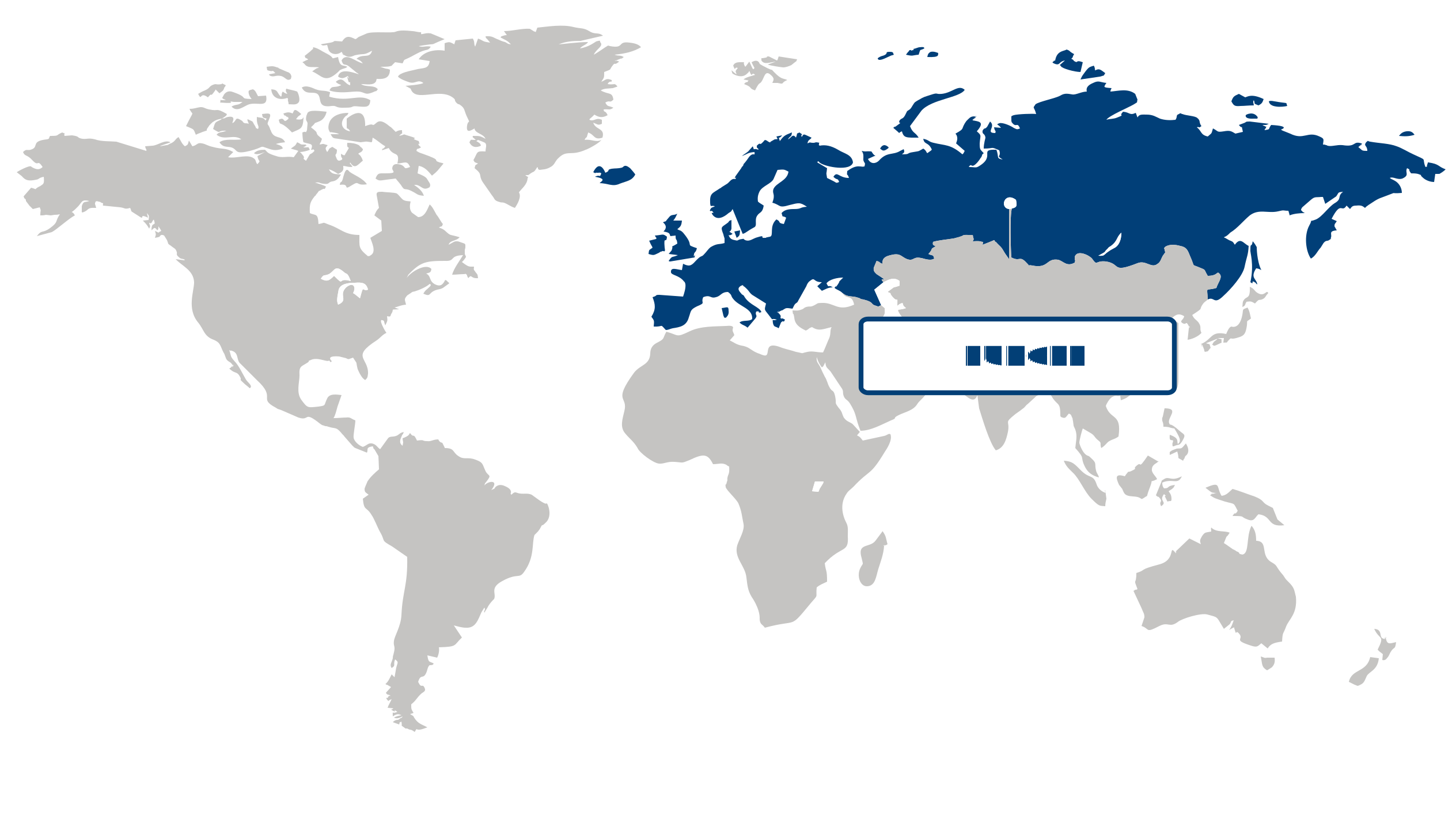
Largest Region
Europe
34.24% Market Share in 2026
Europe (Largest Region) vs Asia Pacific (Fastest-Growing Region)
Europe accounted for a 34.24% share of the cellular IoT market in 2026, reflecting strong deployment of connected technologies across industrial, automotive, energy, transportation, and smart infrastructure applications. The region’s emphasis on digital transformation, connected infrastructure, and regulatory frameworks supporting secure and efficient communications is encouraging organizations to expand cellular IoT deployments. Industrial modernization and demand for reliable wide-area connectivity are also reinforcing adoption across enterprise applications. Asia Pacific is registering the fastest growth, supported by rapid urbanization, expanding manufacturing activity, and the increasing integration of connected devices across logistics, automotive, utilities, and industrial operations. Rising investments in smart infrastructure and digital connectivity, together with the region’s large technology ecosystem, are creating favorable conditions for broader cellular IoT adoption.
Key Country Insights
The U.S. cellular IoT market is driven by expanding enterprise deployments across logistics, utilities, healthcare, and industrial operations. Organizations in the U.S. prioritize secure, scalable connectivity solutions that support real-time data exchange and efficient device lifecycle management.
Japan emphasizes cellular IoT adoption across smart infrastructure, transportation, and connected utility networks. Companies in Japan focus on dependable connectivity, energy-efficient communication technologies, and long-term device reliability for large-scale deployments.
South Korea accelerates cellular IoT implementation through widespread adoption of advanced mobile networks and connected digital services. Enterprises in South Korea prioritize high-performance connectivity for smart factories, intelligent mobility, and real-time industrial monitoring applications.
Germany advances the cellular IoT market by integrating connected devices into manufacturing, industrial automation, and asset monitoring applications. Businesses in Germany emphasize reliable network performance, secure communications, and interoperability with existing industrial systems.
France expands the cellular IoT market through connected utility infrastructure, environmental monitoring, and smart city initiatives. Organizations in France increasingly deploy secure IoT communication platforms that improve operational visibility and resource management across distributed assets.
Italy supports the cellular IoT market by increasing connectivity across transportation, agriculture, and industrial asset management. Businesses in Italy invest in cellular-enabled monitoring solutions that improve equipment visibility, maintenance planning, and operational efficiency.
Segment Leadership and Growth Trends
Component Segment Analysis: Hardware (Largest Segment) vs Software (Fastest-Growing Segment)
Hardware segment dominated the cellular IoT market, accounting for a 61.74% share in 2026. Its strong position is supported by the widespread deployment of cellular-connected devices, modules, gateways, and networking equipment required to establish reliable IoT connectivity across industrial, automotive, logistics, utilities, and smart infrastructure applications. Hardware remains essential for enabling device-level connectivity and supporting the expansion of connected assets, while continued deployment of cellular networks reinforces demand for compatible equipment. The segment also benefits from increasing integration of connected devices into operational environments where dependable wireless communication and scalable network access are critical.
The software segment is expected to register the fastest growth as cellular IoT deployments increasingly require platforms capable of managing connected devices, processing data, monitoring network performance, and supporting application-level intelligence. Growing adoption of centralized device management and analytics is encouraging organizations to complement connectivity hardware with software capabilities that improve visibility and operational efficiency. The shift toward more sophisticated IoT ecosystems, combined with demand for automation and real-time data utilization, is strengthening the role of software in future cellular IoT deployments.
Technology Segment Analysis: 4G (Largest Segment) vs 5G (Fastest-Growing Segment)
4G technology held the largest share of the market in 2026, reflecting its established infrastructure, broad network availability, and suitability for a wide range of cellular IoT applications. Its mature ecosystem provides reliable connectivity for connected vehicles, industrial equipment, tracking systems, utilities, and other distributed devices, making 4G a practical choice for large-scale deployments. Existing network coverage and compatibility with a broad installed base further support continued utilization, particularly where organizations prioritize dependable connectivity and cost-effective deployment.
In the cellular IoT market, 5G technology is positioned as the fastest-growing segment as enterprises increasingly seek higher-performance connectivity for applications requiring greater responsiveness, network capacity, and support for increasingly connected environments. The technology is particularly relevant to advanced industrial automation, connected transportation, smart infrastructure, and data-intensive IoT applications. As organizations move toward more sophisticated connected operations, the capabilities of 5G are expected to accelerate its adoption and expand the range of use cases supported by cellular IoT networks.
| Report Segmentation | |||
| Segment | Sub-Segment | Largest Segment | Fastest Growing Segment |
|---|---|---|---|
| Component | Hardware, Software | Hardware | Software |
| Technology | 2G, 3G, 4G, 5G | 4G | 5G |
| End Use | Agriculture, Automotive & Transportation, Consumer Electronics, Energy, Environment Monitoring, Healthcare, Retail, Smart Cities, Others | Automotive & Transportation | Automotive & Transportation |
 Read our Research Approach
Competitive Landscape and Market Positioning
Major players in the cellular IoT market:
1. Cisco Systems Inc. (United States)
2. Telefonaktiebolaget LM Ericsson (Sweden)
3. Huawei Technologies Co. Ltd. (China)
4. Verizon Communications Inc. (United States)
5. Microsoft Corporation (United States)
6. AT&T Inc. (United States)
7. Tata Communications Limited (India)
8. Semtech Corporation (United States)
9. Quectel Wireless Solutions Co. Ltd. (China)
10. Fibocom Wireless Inc. (China)
The cellular IoT market continues to evolve through ecosystem expansion initiatives focused on connectivity optimization, low-power communication technologies, and industrial automation support. Strategic consolidation activities and technology-sharing arrangements are enabling broader deployment capabilities across smart infrastructure and connected device applications. At the same time, sustained R&D efforts in edge intelligence and network efficiency are helping industry participants strengthen scalability and address the rising demand for reliable machine-to-machine communication solutions.
Industry Development/News
| Company Name | Date | Key Development |
|---|---|---|
| Telenor IoT; Sateliot | May-26 | Telenor IoT partnered with Sateliot to integrate low-earth-orbit satellite coverage for NB-IoT devices. By leveraging 3GPP Release 17 standards, the collaboration extends cellular IoT connectivity beyond the limitations of terrestrial networks, supporting wider geographic deployment for remote asset tracking and sensor monitoring. |
| IXT; Zscaler | Apr-26 | IXT integrated Zscaler’s Zero Trust Network Access directly into its cellular IoT platform. This strategic shift replaces traditional VPN architectures, providing robust security for operational technology and enhancing the protection of connected devices against evolving cyber threats in industrial IoT environments. |
| Nordic Semiconductor | Mar-26 | Nordic Semiconductor expanded its cellular IoT product portfolio with ultra-low-power technologies supporting LTE-M, NB-IoT, Cat 1 bis, satellite NTN, and 5G eRedCap. This expansion strengthens the company's competitive position in the global market by addressing diverse connectivity requirements for secure, power-efficient IoT deployments. |
| L&T Semiconductor Technologies | Dec-25 | L&T Semiconductor Technologies announced plans for a partner-led expansion into the cellular IoT module market. The initiative aims to capitalize on emerging demand by establishing a localized manufacturing and sourcing base in India, contributing to the diversification of the global cellular IoT supply chain. |
| Aeris; Bridge Alliance | Jul-25 | Aeris and Bridge Alliance launched an integrated cellular IoT security solution for the APAC market. By combining connectivity management with advanced enterprise network protection, the partnership aims to standardize security protocols and address the increasing demand for secure, scalable IoT connectivity across international borders. |
| Trasna; Trident; u-blox | May-25 | Trasna and Trident acquired key segments of u-blox’s business, specifically focusing on its cellular IoT modules and dual-mode cellular-satellite operations. This significant restructuring of assets reshapes the competitive landscape for IoT connectivity providers by consolidating specialized module manufacturing and hybrid satellite-cellular technologies under new ownership. |
| Wireless Logic | Apr-25 | Wireless Logic acquired Brazilian IoT MVNO Arqia to scale its connectivity and airtime operations in Latin America. The acquisition provides Wireless Logic with an established regional infrastructure, strengthening its competitive positioning and market reach in the expanding Latin American cellular IoT sector. |
| Quectel | Apr-24 | Quectel introduced the BG95-S5 multi-mode IoT module, facilitating seamless interoperability between 5G non-terrestrial satellite networks and terrestrial LTE cellular networks. This technological development is designed to ensure reliable communication in remote and underserved regions, supporting advanced global tracking and monitoring capabilities. |
| Deutsche Telekom IoT; Tele2 IoT | Feb-24 | Deutsche Telekom IoT and Tele2 IoT collaborated to launch a resilient SIM solution aimed at enhancing network availability for mission-critical IoT devices. The initiative focuses on improving connectivity reliability and redundancy for mobile internet applications, addressing key challenges in long-term enterprise IoT operational stability. |
Why Choose Us
Specialized Expertise: Our team comprises industry experts with a deep understanding of your market segment. We bring specialized knowledge and experience that ensures our research and consulting services are tailored to your unique needs.
Customized Solutions: We understand that every client is different. That's why we offer customized research and consulting solutions designed specifically to address your challenges and capitalize on opportunities within your industry.
Proven Results: With a track record of successful projects and satisfied clients, we have demonstrated our ability to deliver tangible results. Our case studies and testimonials speak to our effectiveness in helping clients achieve their goals.
Cutting-Edge Methodologies: We leverage the latest methodologies and technologies to gather insights and drive informed decision-making. Our innovative approach ensures that you stay ahead of the curve and gain a competitive edge in your market.
Client-Centric Approach: Your satisfaction is our top priority. We prioritize open communication, responsiveness, and transparency to ensure that we not only meet but exceed your expectations at every stage of the engagement.
Continuous Innovation: We are committed to continuous improvement and staying at the forefront of our industry. Through ongoing learning, professional development, and investment in new technologies, we ensure that our services are always evolving to meet your evolving needs.
Value for Money: Our competitive pricing and flexible engagement models ensure that you get maximum value for your investment. We are committed to delivering high-quality results that help you achieve a strong return on your investment.
Select Licence Type

