Cold Flow Improvers Market Size & Growth Forecast 2027–2036, By Segments (End Use, Product, Application), Regional Demand Trends (North America, Asia Pacific, Europe), Key Country Insights (U.S., Japan, South Korea, Germany, France, Italy), and Competitive Landscape
Market Size and Growth Outlook
Cold Flow Improvers Market size was worth USD 948.7 million in 2026 and is poised to grow at a 5.32% CAGR between 2027 and 2036, crossing USD 1.59 billion by 2036. The industry revenue for 2027 is assessed at USD 991.2 million.
Get more details on this report
Request Free Sample ReportCold Flow Improvers Market Intelligence Snapshot
Regional Market Dynamics
- Europe leads due to mature fuel supply chain widespread diesel usage across transport and industry cold climate requirements and routine use of additives to ensure fuel performance in winter conditions.
- Asia Pacific growth is driven by rising diesel consumption in transport and industry expanding refining and distribution increasing adoption of additives to improve fuel handling and reduce flow disruptions.
Segment Momentum
- Ethylene Vinyl Acetate held a 63.54% share in 2026 because of its broad applicability in improving low-temperature fuel flow behavior and its strong fit with routine fuel treatment requirements.
- Polyalkyl Methacrylate is the fastest-growing segment as users increasingly seek solutions that address evolving fuel compositions and more targeted low-temperature performance requirements.
Market Expansion Drivers
- Stringent fuel quality regulations mandating low-temperature diesel operability standards.
- Frequent extreme winter conditions increasing diesel fuel gelling prevention demand.
- Rising ultra-low sulfur diesel and biofuel blends increasing wax crystallization challenges.
Leading Market Participants
- Top companies in the cold flow improvers market include Afton Chemical Corporation (United States), Baker Hughes Company (United States), BASF SE (Germany), Chevron Corporation (United States), Clariant AG (Switzerland), Dorf Ketal Chemicals (India), Evonik Industries AG (Germany), Infineum International Limited (United Kingdom), Innospec Inc. (United States), The Lubrizol Corporation (United States).
Global Market Forecast Snapshot
Market Outlook
- 2026 Market Size: USD 948.7 million
- 2027 Estimated Market Size: USD 991.2 million.
- Projected Market Size: USD 1.59 billion by 2036
- Growth Forecast: 5.32% CAGR (2027-2036)
Regional and Segment Outlook
- Leading Regional Market: Europe
- High-Growth Regional Hub: Asia Pacific
- Core Revenue Segment: Automotive (End Use) | Ethylene Vinyl Acetate (Product) | Diesel Fuel (Application)
- Emerging Opportunity Segment: Automotive (End Use) | Polyalkyl Methacrylate (Product) | Lubricating Oil (Application)
Market Growth Drivers and Industry Trends
Stringent fuel quality regulations mandating low-temperature diesel operability standards
Stringent fuel quality regulations will propel the cold flow improvers market growth as fuel suppliers and distributors must maintain diesel performance under low-temperature operating conditions. Regulatory requirements concerning fuel quality and operability encourage the use of additives that modify wax behavior and help preserve fuel flow through storage and distribution systems during colder conditions. This is particularly important for transportation and commercial diesel applications where fuel performance directly affects vehicle reliability, while compliance requirements encourage consistent incorporation of suitable cold-flow additive technologies into fuel formulations.
Frequent extreme winter conditions increasing diesel fuel gelling prevention demand
More frequent periods of severe winter weather are increasing the need for diesel fuel formulations that can remain usable under challenging low-temperature conditions, supporting the cold flow improvers market. Low temperatures can cause wax crystals to form within diesel, restricting fuel movement through filters and fuel systems and potentially disrupting vehicle operation. Cold-flow additives help control crystal formation and improve low-temperature handling characteristics, making them valuable for logistics fleets, commercial transportation, construction equipment, and other diesel-dependent operations exposed to seasonal or extreme cold.
Rising ultra-low sulfur diesel and biofuel blends increasing wax crystallization challenges
Growing use of ultra-low sulfur diesel and biofuel blends is creating formulation challenges that will support demand for the cold flow improvers market. Changes in fuel composition can influence wax crystallization behavior and low-temperature performance, requiring refiners and fuel formulators to carefully manage operability across different climatic conditions. Biofuel incorporation can further alter the physical characteristics of finished fuels, increasing the importance of additive solutions that maintain flow properties, reduce filter-plugging risks, and support reliable diesel distribution and use during colder operating periods.
| Growth Driver | Impact on CAGR | Regulatory Influence | Geographic Relevance | Adoption Rate | Impact Timeline |
|---|---|---|---|---|---|
| Stringent fuel quality regulations mandating low-temperature diesel operability standards | 2.00% | High | North America, Europe | High | Near Term |
| Frequent extreme winter conditions increasing diesel fuel gelling prevention demand | 1.80% | Moderate | North America, Europe, Asia Pacific | High | Near Term |
| Rising ultra-low sulfur diesel and biofuel blends increasing wax crystallization challenges | 1.50% | Moderate | Asia Pacific, Europe, North America | Medium | Mid Term |
Explore Growth Opportunities
Request Free Sample ReportRegional Demand Dynamics
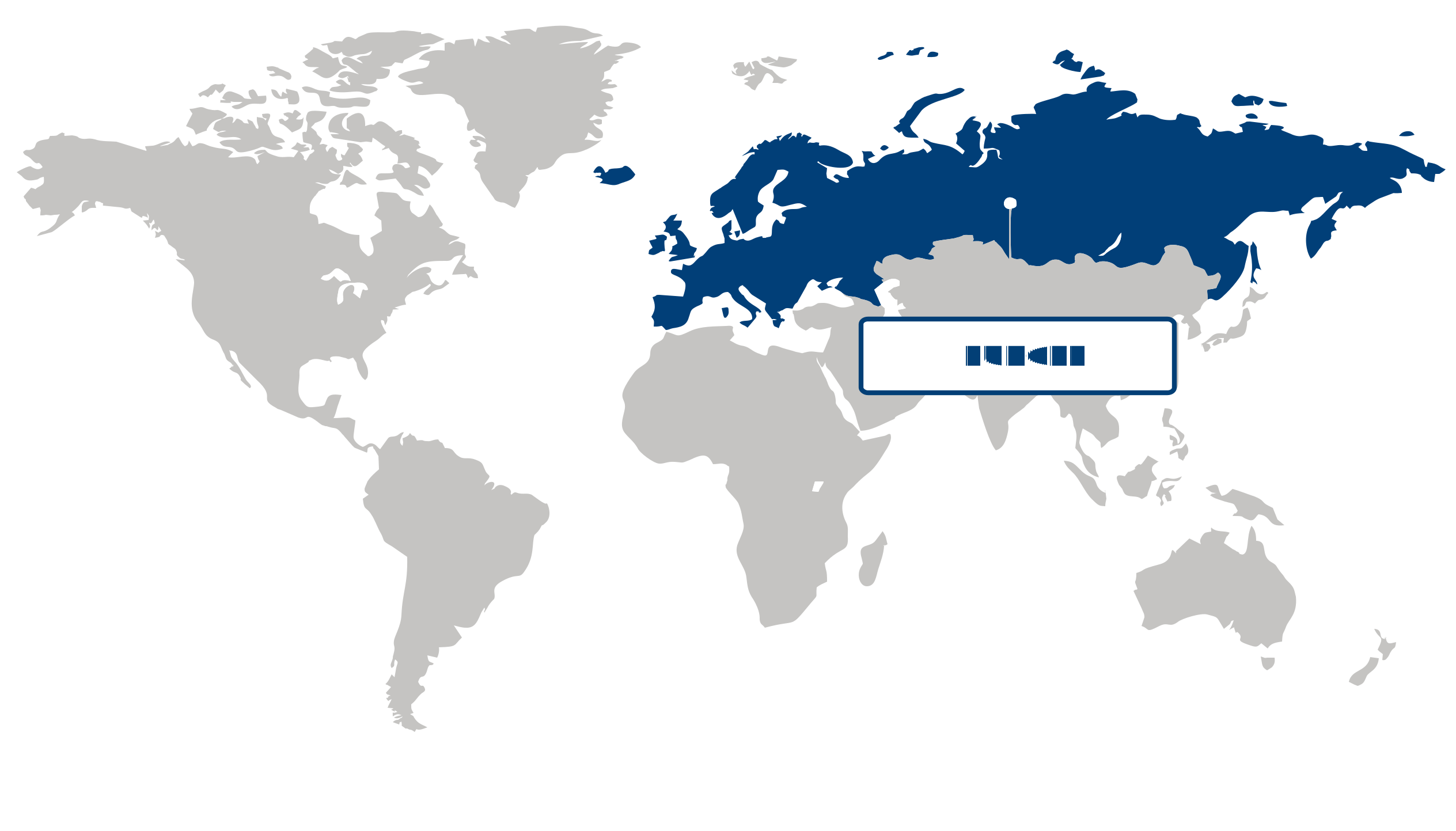
Europe (Largest Region)
In the cold flow improvers market, Europe held the largest share in 2026, reflecting its established automotive and transportation sectors, extensive fuel distribution infrastructure, and strong focus on fuel performance under demanding operating conditions. Cold flow improvers help maintain the handling and flow characteristics of fuels exposed to low temperatures, making them relevant across diesel and other middle-distillate applications. Regulatory attention to fuel quality and the region’s sophisticated refining and fuel distribution networks further support demand for performance-enhancing additives.
Asia Pacific (Fastest-Growing Region)
Asia Pacific is experiencing the fastest growth as transportation activity, industrialization, and fuel consumption expand across major economies. Growing vehicle ownership and development of commercial transportation infrastructure are increasing the need for fuel additives that support reliable performance across varying climatic conditions. Expansion of refining capacity, modernization of fuel formulations, and rising attention to fuel efficiency are also creating favorable conditions for broader adoption of cold flow improvers.
| Parameter | North America | Asia Pacific | Europe | Latin America | MEA |
|---|---|---|---|---|---|
| Innovation Hub i Scale Nascent Developing Advanced | |||||
| Cost-Sensitive Region i Scale Low Medium High | |||||
| Regulatory Environment i Scale Restrictive Neutral Supportive | |||||
| Demand Drivers i Scale Weak Moderate Strong | |||||
| Development Stage i Scale Emerging Developing Developed | |||||
| Adoption Rate i Scale Low Medium High | |||||
| New Entrants / Startups i Scale Sparse Moderate Dense | |||||
| Macro Indicators i Scale Weak Stable Strong |
Key Country Insights
Germany 🇩🇪
Fuel Quality EnhancementGermany prioritizes cold flow improvers that help refiners and fuel distributors maintain consistent diesel performance under challenging climatic conditions. The market benefits from strong attention to fuel specifications, operational efficiency, and environmental compliance.
France 🇫🇷
Climate-Responsive Fuel SolutionsFrance applies cold flow improvers to maintain dependable diesel performance across seasonal operating conditions. French fuel suppliers increasingly adopt additive technologies that improve fuel handling characteristics while supporting evolving regulatory requirements.
Italy 🇮🇹
Distribution Efficiency FocusItaly utilizes cold flow improvers to improve diesel transport, storage, and operational reliability during colder periods. The Italian market places importance on additive performance that minimizes fuel-related operational disruptions throughout the supply chain.
Japan 🇯🇵
Advanced Additive FormulationJapan emphasizes technically advanced cold flow improvers that support premium fuel formulations and reliable engine performance. Japanese refiners focus on additive compatibility and product consistency to meet demanding quality expectations across transportation sectors.
South Korea 🇰🇷
Refinery Performance SupportSouth Korea integrates cold flow improvers into refinery operations to improve diesel fuel performance for domestic use and export markets. The country's producers value additive solutions that enhance product quality while supporting efficient fuel logistics.
United States 🇺🇸
Winter Fuel PerformanceThe U.S. cold flow improvers market is supported by seasonal fuel quality requirements across regions exposed to low temperatures. Fuel suppliers in the U.S. continue adopting additive technologies that enhance diesel operability, storage stability, and distribution efficiency during colder months.
Segment Leadership and Growth Trends
Cold Flow Improvers Market Share (%), by End Use, 2026
Go beyond the chart, access full insights & data tables
Request Free Sample ReportEnd Use Segment Analysis: Automotive (Largest & Fastest-Growing Segment)
The cold flow improvers market was led by the automotive segment, which held the largest share in 2026 and is also the fastest-growing end-use segment. Cold flow improvers are widely incorporated into fuels and lubricants to maintain fluidity and improve low-temperature performance, helping vehicles operate reliably under colder conditions. Rising vehicle utilization, demand for efficient fuel and lubricant formulations, and the need to maintain engine performance across varying operating environments are supporting sustained adoption. Increasing emphasis on fuel quality and performance-enhancing additives is further reinforcing the automotive sector's position.
Product Segment Analysis: Ethylene Vinyl Acetate (Largest Segment) vs Polyalkyl Methacrylate (Fastest-Growing Segment)
Ethylene vinyl acetate accounted for the largest share of the cold flow improvers market, reaching 63.54% in 2026. Its effectiveness in modifying wax crystallization and improving the low-temperature flow characteristics of petroleum-based fuels makes it an established choice for cold-weather fuel applications. Strong compatibility with commonly used fuel formulations, established processing practices, and demand for reliable fuel performance continue to support widespread use of ethylene vinyl acetate-based cold flow improvers.
Polyalkyl methacrylate is expected to register the fastest growth among product types as formulators seek additives capable of delivering improved low-temperature performance across increasingly demanding fuel and lubricant applications. These polymers can be tailored to influence wax formation and enhance fluidity, providing formulation flexibility across different operating conditions. Ongoing development of advanced additive formulations and growing attention to fuel efficiency and dependable performance are creating favorable conditions for greater adoption of polyalkyl methacrylate.
| Segment | Sub-Segment | Largest Segment | Fastest Growing |
|---|---|---|---|
| End Use | Automotive, Aerospace & Defense, Others | Automotive | Automotive |
| Product | Ethylene Vinyl Acetate, Polyalkyl Methacrylate, Polyalpha Olefin, Others | Ethylene Vinyl Acetate | Polyalkyl Methacrylate |
| Application | Diesel Fuel, Lubricating Oil, Aviation Fuel, Others | Diesel Fuel | Lubricating Oil |
Unlock insights tailored to your business with our bespoke market research solutions.
Click to get your customized report now.
Competitive Landscape and Market Positioning
Leading companies in the cold flow improvers market:
1. Afton Chemical Corporation (United States)
2. Baker Hughes Company (United States)
3. BASF SE (Germany)
4. Chevron Corporation (United States)
5. Clariant AG (Switzerland)
6. Dorf Ketal Chemicals (India)
7. Evonik Industries AG (Germany)
8. Infineum International Limited (United Kingdom)
9. Innospec Inc. (United States)
10. The Lubrizol Corporation (United States)
The cold flow improvers market is advancing through continuous innovation in additive formulations that enhance fuel performance under low-temperature conditions. Manufacturers are prioritizing environmentally compliant solutions and investing in research to improve efficiency across diverse fuel applications. Demand for cleaner and more reliable fuel technologies is further accelerating product development activities within the market.
| Company | Market Share | Company Revenue | Revenue CAGR (%) | Product Portfolio | Geographic Presence | Innovation / R&D Focus | Strategic Developments |
|---|---|---|---|---|---|---|---|
| Afton Chemical Corporation (United States) | |||||||
| Baker Hughes Company (United States) | |||||||
| BASF SE (Germany) | |||||||
| Chevron Corporation (United States) | |||||||
| Clariant AG (Switzerland) | |||||||
| Dorf Ketal Chemicals (India) | |||||||
| Evonik Industries AG (Germany) | |||||||
| Infineum International Limited (United Kingdom) | |||||||
| Innospec Inc. (United States) | |||||||
| The Lubrizol Corporation (United States). |
Customize Your Report
Explore examples of how this report can be tailored to different research needs, including custom segments, additional topics or chapters, and related reports. Click a section of the wheel or its numbered marker to explore the available options.
Cold Flow Improvers Market — Custom Segments
| Segment | Sub-Segment |
|---|---|
| Customer Type | Fuel Producers & Refiners, Lubricant Manufacturers, Additive Blenders, Industrial End Users |
| Performance Requirement | Pour Point Depression, Cold Filter Plugging Point Improvement, Wax Crystal Modification |
| Supply Form | Liquid Concentrates, Solid Forms, Ready-to-Use Blends |
Cold Flow Improvers Market — Custom TOC
| Custom Chapter | Chapter Details |
|---|---|
| Biofuel Compatibility and Low-Carbon Fuel Opportunities |
|
| Fuel Quality Compliance Impact Assessment |
|
| Winter Fuel Demand and Seasonal Consumption Assessment |
|
Need a different cut of the data?
Request Custom ResearchWhat is the market size of cold flow improvers?
How will the cold flow improvers industry grow in terms of size and CAGR by 2036?
How are evolving fuel quality requirements influencing demand for cold flow improvers?
What operational trends are increasing adoption of specialized cold flow improver formulations?
Why is Ethylene Vinyl Acetate the leading product segment in the cold flow improvers market?
Which product segment is growing fastest in the cold flow improvers market?
Why does Europe lead the cold flow improvers market?
What is driving growth in the Asia Pacific cold flow improvers market?
Which organizations are considered leaders in the cold flow improvers landscape?
Our Clients
"The report helped us understand emerging consumer trends in our product category. It clarified where to focus innovation for the next product launch."
LyondellBasell
"The regional forecast section was incredibly useful. We were able to identify two new potential partners in Europe thanks to the vendor mapping you included."
SABIC
"We appreciated how actionable the recommendations were. It guided us to improve supply chain resilience."
Olin Corporation
Our Research Team & Methodology
Every Fundamental Business Insights report is built by a dedicated vertical research team, validated through a structured primary-and-secondary methodology, and reviewed for accuracy before it reaches you.
Research Team Overview
Prepared by the Chemicals & Materials Research Team
Delivery
Published
Demand
Available
Support
Trust & Compliance
Research Intelligence
| Source | Reference |
|---|---|
| American Chemistry Council (ACC) | www.americanchemistry.com |
| European Chemical Industry Council (Cefic) | cefic.org |
| International Council of Chemical Associations (ICCA) | icca-chem.org |
| European Chemicals Agency (ECHA) | echa.europa.eu |
| U.S. Environmental Protection Agency (EPA) | www.epa.gov |
| ASTM International | www.astm.org |
| International Organization for Standardization (ISO) | www.iso.org |
| National Institute of Standards and Technology (NIST) | www.nist.gov |
| Plastics Industry Association (PLASTICS) | www.plasticsindustry.org |
| European Biplastics | www.european-bioplastics.org |
| The Adhesive and Sealant Council (ASC) | www.ascouncil.org |
| National Association of Corrosion Engineers (AMPP) | www.ampp.org |
| Society of Plastics Engineers (SPE) | www.4spe.org |
| International Fertilizer Association (IFA) | www.fertilizer.org |
| CropLife International | croplife.org |
| Packaging Europe | packagingeurope.com |
| Flexible Packaging Association (FPA) | www.flexpack.org |
| Battery Council International (BCI) | batterycouncil.org |
| International Copper Association (ICA) | internationalcopper.org |
| World Steel Association | worldsteel.org |
Research Workflow & Quality Assurance
Data Collection
Verified information gathered through primary and secondary research.
Data Triangulation
Cross-validation using multiple independent data sources.
Forecast Modelling
Market estimates developed using historical trends and analytical models.
Analyst Validation
Findings reviewed by domain experts for accuracy and consistency.
Editorial & Quality Review
Final editorial, quality, and compliance checks before publication.
Final Publication
Released after successful completion of the internal review process.
Report Coverage
📊 Market Assessment
- Market Size & Forecast
- Market Segmentation
- Regional Analysis
- Growth Drivers & Challenges
- Market Dynamics
🏢 Competitive Intelligence
- Competitive Landscape
- Company Profiles
- Competitive Benchmarking
- Mergers & Acquisitions
- Market Share Analysis or Key Company Strategies
🔍 Strategic Analysis
- Value Chain Analysis
- Porter's Five Forces
- PESTLE Analysis
- Pricing Trends
- Supply-Demand Analysis
🚀 Future Outlook
- Technology Landscape
- Regulatory Landscape
- Investment & Funding Landscape
- Emerging Opportunities
- Future Market Outlook
Have a question about this report or need a custom scope?
Request Customization