Collision Avoidance System Market Size & Growth Forecast 2027–2036, By Segments (Technology, Application), Regional Demand Trends (North America, Asia Pacific, Europe), Key Country Insights (U.S., Japan, South Korea, Germany, France, Italy), and Competitive Landscape
Jump to Content
Market Size and Growth Outlook
Collision Avoidance System Market size was worth USD 97.51 billion in 2026 and is expected to grow at a 10.83% CAGR between 2027 and 2036, reaching USD 272.66 billion by 2036. The industry revenue for 2027 is calculated at USD 106.4 billion.
Get more details on this report
Request Free Sample ReportCollision Avoidance System Market Intelligence Snapshot
Regional Market Dynamics
- Europe captured 34.98% of the market in 2026, supported by stringent vehicle safety regulations, established automotive manufacturing, and widespread adoption of advanced driver assistance technologies.
- Asia Pacific is projected to grow at a 12.66% CAGR, driven by expanding vehicle production, greater demand for safety-equipped vehicles, and increasing adoption of intelligent automotive technologies.
Segment Momentum
- Radar led the market with a 45.9% share in 2026, supported by dependable object detection across varying weather and lighting conditions and broad integration into vehicle safety systems.
- Blind Spot Detection (BSD) is the fastest-growing application as automakers increasingly integrate lane-change safety features to improve driver awareness and reduce side-impact risks.
Market Expansion Drivers
- Growing integration of LiDAR, radar, and camera-based ADAS safety technologies in vehicles.
- Increasing vehicle safety regulations and consumer demand for advanced driver assistance systems.
- Advancements in autonomous driving and connected vehicle ecosystems enhancing collision prevention systems.
Leading Market Participants
- Major companies in the collision avoidance system market include Robert Bosch GmbH (Germany), Continental AG (Germany), Denso Corporation (Japan), Aptiv PLC (Ireland), Infineon Technologies AG (Germany), ZF Friedrichshafen AG (Germany), Mobileye Global Inc. (Israel), Valeo SA (France), Murata Manufacturing Co., Ltd. (Japan), NXP Semiconductors N.V. (Netherlands).
Global Market Forecast Snapshot
Market Outlook
- 2026 Market Size: USD 97.51 billion
- 2027 Estimated Market Size: USD 106.4 billion.
- Projected Market Size: USD 272.66 billion by 2036
- Growth Forecast: 10.83% CAGR (2027-2036)
Regional and Segment Outlook
- Leading Regional Market: Europe
- High-Growth Regional Hub: Asia Pacific
- Core Revenue Segment: Radar (Technology) | Adaptive Cruise Control (ACC) (Application)
- Emerging Opportunity Segment: LiDAR (Technology) | Blind Spot Detection (BSD) (Application)
Market Growth Drivers and Industry Trends
Growing integration of LiDAR, radar, and camera-based ADAS safety technologies in vehicles
The growing integration of LiDAR, radar, and camera-based advanced driver assistance systems is strengthening the collision avoidance system market by improving the ability of vehicles to detect surrounding objects and identify potential hazards. These sensing technologies provide complementary capabilities, with cameras supporting visual recognition, radar enabling distance and motion detection, and LiDAR generating detailed environmental information for more precise object identification. Combining multiple sensing technologies allows vehicle safety systems to operate more reliably across different driving conditions and supports functions such as forward collision warning, automatic emergency braking, blind-spot monitoring, and lane-related safety features. Automakers are increasingly incorporating sensor-based ADAS architectures into vehicle platforms as safety expectations rise and electronic systems become more sophisticated.
Increasing vehicle safety regulations and consumer demand for advanced driver assistance systems
Stricter vehicle safety requirements and growing consumer awareness of active safety features are creating favorable conditions for the collision avoidance system market. Regulatory authorities are increasingly emphasizing technologies that can reduce the likelihood or severity of road accidents, encouraging vehicle manufacturers to incorporate automated warning and intervention functions into new models. At the same time, consumers are placing greater value on vehicles equipped with systems that can identify hazards, alert drivers, and intervene when a collision becomes imminent. The combination of regulatory pressure and purchasing preferences is encouraging automakers to expand the availability of advanced driver assistance features across different vehicle categories, including systems designed for emergency braking, pedestrian detection, lane monitoring, and surrounding-object awareness.
Advancements in autonomous driving and connected vehicle ecosystems enhancing collision prevention systems
Progress in autonomous driving is increasing the sophistication of technologies used to perceive and respond to potential road hazards. Within the collision avoidance system market, integration with connected vehicle ecosystems enables safety systems to use information from onboard sensors together with vehicle-to-vehicle, vehicle-to-infrastructure, and other connected sources. Greater access to real-time environmental and vehicle information can improve situational awareness and support earlier identification of potential collision scenarios. Autonomous driving development is also driving improvements in sensor fusion, decision-making software, and automated braking or steering responses, while connected platforms provide additional data that can complement the vehicle's direct perception capabilities.
| Growth Driver | Impact on CAGR | Regulatory Influence | Geographic Relevance | Adoption Rate | Impact Timeline |
|---|---|---|---|---|---|
| Adoption of Collision Avoidance Systems in Vehicles | 5.00% | Short term (≤ 2 yrs) | North America, Europe (spillover: Asia Pacific) | Medium | Fast |
| Integration with ADAS & Autonomous Driving Technologies | 4.00% | Medium term (2–5 yrs) | Europe, Asia Pacific (spillover: North America) | Low | Moderate |
| Regulatory Mandates for Vehicle Safety Systems | 2.30% | Long term (5+ yrs) | North America, Europe (spillover: MEA) | High | Moderate |
| Growing integration of LiDAR, radar, and camera-based ADAS safety technologies in vehicles | 2.50% | High | North America, Europe | High | Near Term |
| Increasing vehicle safety regulations and consumer demand for advanced driver assistance systems | 2.00% | High | Global | High | Mid Term |
| Advancements in autonomous driving and connected vehicle ecosystems enhancing collision prevention systems | 1.70% | Moderate | North America, Asia Pacific | Medium | Mid Term |
Explore Growth Opportunities
Request Free Sample ReportRegional Demand Dynamics
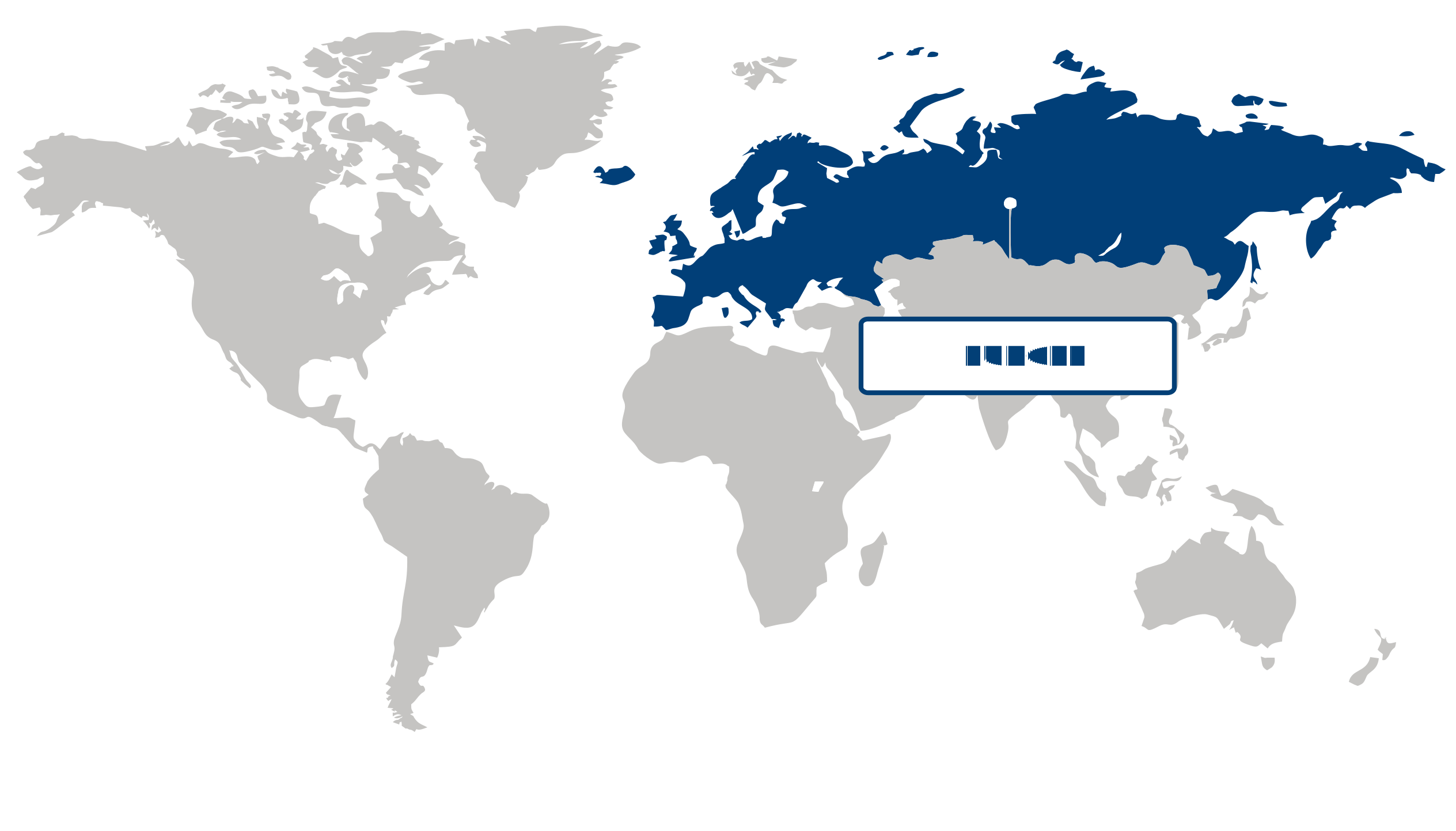
Europe (Largest Region)
Europe held the largest share of the collision avoidance system market at 34.98% in 2026, supported by strong automotive safety standards, advanced vehicle engineering capabilities, and increasing emphasis on reducing road accidents. The region's regulatory environment encourages the integration of active safety technologies that can detect potential hazards and assist drivers in avoiding or mitigating collisions. Growing adoption of advanced driver assistance systems is strengthening demand for technologies such as radar, cameras, sensors, and automated warning mechanisms. Automotive manufacturers are also placing greater emphasis on vehicle safety, intelligent mobility, and the development of increasingly automated driving functions, creating a favorable environment for collision avoidance technologies. In addition, the expansion of connected vehicle infrastructure and growing consumer awareness of safety features are supporting wider adoption across passenger and commercial vehicles. Continued investment in automotive electronics and vehicle intelligence is therefore reinforcing Europe's established position in this market.
Asia Pacific (Fastest-Growing Region)
Asia Pacific is emerging as the fastest-growing region for the collision avoidance system market, driven by expanding vehicle production, increasing road safety awareness, and rapid adoption of advanced automotive technologies. Growing urbanization and traffic congestion are encouraging governments and automotive stakeholders to prioritize technologies that can improve vehicle safety and reduce the risk of accidents. Rising consumer interest in vehicles equipped with driver assistance features is also encouraging manufacturers to incorporate collision detection and avoidance capabilities across broader vehicle categories. The region's expanding automotive manufacturing ecosystem and growing investment in intelligent mobility technologies are creating additional opportunities for sensor-based safety systems. Furthermore, improvements in electronics manufacturing and increasing development of connected and semi-autonomous vehicles are supporting the integration of sophisticated safety functions, strengthening the region's growth potential.
| Parameter | North America | Asia Pacific | Europe | Latin America | MEA |
|---|---|---|---|---|---|
| Innovation HubiScaleNascentDeveloping Advanced | |||||
| Cost-Sensitive RegioniScaleLowMedium High | |||||
| Regulatory EnvironmentiScaleRestrictiveNeutral Supportive | |||||
| Demand DriversiScaleWeakModerate Strong | |||||
| Development StageiScaleEmergingDeveloping Developed | |||||
| Adoption RateiScaleLowMedium High | |||||
| New Entrants / StartupsiScaleSparseModerate Dense | |||||
| Macro IndicatorsiScaleWeakStable Strong |
Key Country Insights
Germany 🇩🇪
Automotive safety engineering focusIn Germany, the collision avoidance system market is closely linked to automotive safety engineering leadership and high-end vehicle manufacturing. The country emphasizes sensor fusion and precision systems, with widespread integration across luxury and performance vehicles produced by established OEMs.
France 🇫🇷
Regulatory safety alignmentIn France, the collision avoidance system market is influenced by stringent vehicle safety regulations and increasing deployment of ADAS features across passenger vehicles. Manufacturers emphasize compliance-driven adoption, with growing integration into mainstream vehicle segments beyond premium offerings.
Italy 🇮🇹
Automotive aftermarket upgradesIn Italy, the collision avoidance system market is shaped by gradual integration into both OEM and aftermarket vehicle safety upgrades. Demand is driven by urban driving conditions where improved safety systems are increasingly valued in compact cars and mid-range vehicles.
Japan 🇯🇵
Sensor-driven safety innovationIn Japan, the collision avoidance system market is shaped by strong expertise in sensor technology and proactive safety systems. Automakers prioritize advanced driver assistance features that reduce accident risk, particularly in compact vehicles designed for dense urban driving environments.
South Korea 🇰🇷
Connected vehicle adoptionIn South Korea, the collision avoidance system market is supported by rapid adoption of connected vehicle technologies and smart mobility platforms. Domestic automakers integrate advanced safety features into new models, particularly in urban-focused vehicles with high digital system integration.
United States 🇺🇸
ADAS integration leadershipIn the United States, the collision avoidance system market is driven by advanced driver assistance system integration across passenger and commercial vehicles. Automakers and technology providers prioritize safety innovation, with strong adoption in premium vehicles and increasing penetration in mid-range models.
Collision Avoidance System Market Share (%), by Technology, 2026
Go beyond the chart, access full insights & data tables
Request Free Sample ReportTechnology Segment Analysis: Radar (Largest Segment) vs LiDAR (Fastest-Growing Segment)
Radar technology accounted for the largest share of the collision avoidance system market in 2026, with a 45.9% share, reflecting its established role in detecting surrounding objects and supporting vehicle safety functions under varied driving conditions. Radar systems can provide reliable distance and object detection while maintaining effectiveness in challenging visibility conditions, making them well suited to advanced driver-assistance applications. Their integration into functions such as adaptive cruise control and other safety systems has strengthened deployment across vehicles. Continued emphasis on vehicle safety and automated driving capabilities is supporting sustained demand for radar-based collision avoidance.
LiDAR represents the fastest-growing technology segment, supported by its ability to generate detailed spatial information and improve the precision of environmental perception. The technology can complement other sensing systems by providing accurate information about object location, distance, and surrounding vehicle conditions. As automotive manufacturers advance toward more sophisticated driver-assistance and automated driving functions, the need for high-resolution sensing is increasing. Continued development of sensor integration and perception capabilities is therefore creating stronger opportunities for LiDAR within collision avoidance systems.
Application Segment Analysis: Adaptive Cruise Control (ACC) (Largest Segment) vs Blind Spot Detection (BSD) (Fastest-Growing Segment)
Adaptive cruise control (ACC) led the collision avoidance system market in 2026, accounting for a 29.16% share, driven by growing demand for technologies that improve driving comfort while maintaining safer vehicle spacing. ACC continuously monitors surrounding traffic and adjusts vehicle speed according to road conditions, making it an important component of modern driver-assistance systems. Its ability to reduce driver workload during highway and congested driving situations supports broad consumer appeal. Increasing integration of advanced safety functions into vehicles is further strengthening the role of ACC within collision avoidance applications.
Blind spot detection (BSD) is experiencing the fastest growth as drivers and vehicle manufacturers place greater emphasis on preventing collisions during lane changes and maneuvering. BSD systems provide additional awareness of vehicles or objects positioned outside the driver's direct field of view, addressing a common limitation of conventional visual monitoring. Growing adoption of comprehensive safety packages and increasing integration of multiple sensing technologies are supporting wider deployment. The emphasis on improving situational awareness and reducing avoidable side-impact risks is further accelerating demand for BSD applications.
| Segment | Sub-Segment | Largest Segment | Fastest Growing |
|---|---|---|---|
| Technology | Radar, Camera, Ultrasound, LiDAR | Radar | LiDAR |
| Application | Adaptive Cruise Control (ACC), Blind Spot Detection (BSD), Forward Collision Warning System (FCWS), Lane Departure Warning System (LDWS), Parking Assistance, Others | Adaptive Cruise Control (ACC) | Blind Spot Detection (BSD) |
Unlock insights tailored to your business with our bespoke market research solutions.
Click to get your customized report now.
Competitive Landscape and Market Positioning
Top players in the collision avoidance system market:
1. Robert Bosch GmbH (Germany)
2. Continental AG (Germany)
3. Denso Corporation (Japan)
4. Aptiv PLC (Ireland)
5. Infineon Technologies AG (Germany)
6. ZF Friedrichshafen AG (Germany)
7. Mobileye Global Inc. (Israel)
8. Valeo SA (France)
9. Murata Manufacturing Co. Ltd. (Japan)
10. NXP Semiconductors N.V. (Netherlands)
The collision avoidance system market is evolving rapidly with enhanced integration of sensor fusion and intelligent detection technologies. Continuous advancements in automation and AI-based safety systems are improving real-time hazard response accuracy. Collaborative engineering efforts are supporting system refinement, while new solution introductions are strengthening safety performance across the collision avoidance system market.
| Company | Market Share | Company Revenue | Revenue CAGR (%) | Product Portfolio | Geographic Presence | Innovation / R&D Focus | Strategic Developments |
|---|---|---|---|---|---|---|---|
| Robert Bosch GmbH (Germany) | |||||||
| Continental AG (Germany) | |||||||
| Denso Corporation (Japan) | |||||||
| Aptiv PLC (Ireland) | |||||||
| Infineon Technologies AG (Germany) | |||||||
| ZF Friedrichshafen AG (Germany) | |||||||
| Mobileye Global Inc. (Israel) | |||||||
| Valeo SA (France) | |||||||
| Murata Manufacturing Co. Ltd. (Japan) | |||||||
| NXP Semiconductors N.V. (Netherlands). |
Industry Development/News
| Company Name | Date | Key Development |
|---|---|---|
| Hyundai | May-26 | Hyundai initiated a large-scale recall of 421,078 vehicles due to incorrect front collision avoidance system calibration. The company implemented revised front camera software as a production running change across its Pesqueria, Montgomery, and Ulsan plants between March and April 2026 to resolve system accuracy and safety performance concerns. |
| Reliable Robotics | Apr-26 | Reliable Robotics successfully completed flight tests validating its detect-and-avoid system for uncrewed aircraft operations. This test campaign generated critical operational data to support regulatory certification for autonomous collision avoidance in airport environments, marking a strategic advancement in safety systems integration for pilotless aviation platforms. |
| ACSS | Apr-26 | ACSS, in partnership with Airborne Maintenance & Engineering Services and Innovative Aerosystems, launched development of an ADS-B In retrofit package for Boeing 757 and 767 aircraft. The initiative aims to enhance airborne situational awareness and collision avoidance through upgraded surveillance and data integration, targeting improvements in commercial aviation safety infrastructure. |
| BIA Group | Feb-26 | BIA Group’s SmartFleetDX entered a strategic partnership with Wabtec Digital Mine to integrate the Gen3 Collision Avoidance System and AI-enabled smart camera solutions into its digital safety portfolio. This collaboration enhances fleet safety in mining environments by deploying advanced hazard detection and real-time operational intelligence across heavy vehicle fleets. |
| Hexagon | Jul-25 | Hexagon launched its Operator Alertness System 7.5, which integrates operator fatigue monitoring with the Collision Avoidance System 10. By combining driver state analysis with vehicle interaction visibility, the solution enables more proactive safety interventions, strengthening Hexagon’s competitive positioning in industrial and mining environment safety technologies. |
| Volvo Trucks | Nov-24 | Volvo Trucks introduced an active side collision avoidance system featuring autonomous braking functionality for commercial trucking. The technology detects lateral hazards and automatically initiates braking to mitigate collision risk, representing a significant enhancement to driver assistance capabilities and commercial vehicle safety standards. |
| Merlin Labs | Sep-24 | Merlin Labs partnered with MIT Lincoln Laboratory to integrate an autonomous pilot system with ACAS Xu collision avoidance technology. This collaboration focuses on enabling detect-and-avoid capabilities for unmanned aircraft, facilitating safer integration of autonomous platforms within shared, regulated airspace alongside conventional piloted aviation systems. |
| Epiroc | May-24 | Epiroc released the fourth-generation Titan Collision Avoidance System, delivering enhanced safety and operational efficiency for mining environments. The upgraded system leverages improved detection and prevention capabilities to reduce collision risks, reinforcing the company's commitment to industrial safety through advanced sensor integration and heavy machinery automation. |
| Nissan | Jun-23 | Nissan integrated intersection collision avoidance technology into its driver-assistance suite, utilizing advanced LiDAR for ground-truth perception. The system accurately assesses object speed, position, and collision probability from lateral directions, executing emergency braking or releasing brakes as necessary to manage dynamic intersection risks with high-speed responsiveness. |
| TORSA | Nov-22 | TORSA launched a next-generation Collision Avoidance System for mining vehicles, including shovels and haul trucks. The update features a refined user interface to streamline critical information for operators and control room personnel, reducing information noise while ensuring a less intrusive safety monitoring experience in complex mining operations. |
Customize Your Report
Explore examples of how this report can be tailored to different research needs, including custom segments, additional topics or chapters, and related reports. Click a section of the wheel or its numbered marker to explore the available options.
Collision Avoidance System Market — Custom Segments
| Segment | Sub-Segment |
|---|---|
| Vehicle Type | Passenger Cars, Light Commercial Vehicles, Heavy Commercial Vehicles, Buses & Coaches, Two-Wheelers |
| Automation Level | Driver Assistance, Partial Automation, Conditional Automation, High Automation |
| Integration Mode | Factory-Fitted Systems, Retrofit Systems |
Collision Avoidance System Market — Custom TOC
| Custom Chapter | Chapter Details |
|---|---|
| Autonomous Safety Adoption Roadmap |
|
| Vehicle Safety Regulation Impact Assessment |
|
| Fleet Safety Technology Investment Analysis |
|
Need a different cut of the data?
Request Custom ResearchFrequently Asked Questions
What is the market valuation of collision avoidance system?
What is the projected value of the collision avoidance system industry by 2036?
How is multi-sensor integration changing adoption dynamics in collision avoidance systems?
Why is regulatory and consumer pressure accelerating the deployment of advanced driver assistance features like collision avoidance systems?
Which technology segment held the largest share of the collision avoidance system market?
Which application segment is expanding the fastest in the collision avoidance system market?
Why is Europe the leading region in the collision avoidance system market?
Why is Asia Pacific the fastest-growing collision avoidance system market?
Which companies dominate the collision avoidance system landscape?
Our Clients
"The team surpassed our expectations with the report depth. The actionable insights provided proved crucial in navigating market challenges."
Tata Motors
"We found the report to be very informative. The expertise and attention to market nuances significantly influenced our business direction."
DENSO Corporation
"The consumer survey findings were quite good. We now have a clearer picture of the customer churning and retention strategy."
HL Mando
Our Research Team & Methodology
Every Fundamental Business Insights report is built by a dedicated vertical research team, validated through a structured primary-and-secondary methodology, and reviewed for accuracy before it reaches you.
This report was prepared by the Automotive & Transportation Research Team at Fundamental Business Insights, a dedicated research group specializing in the global automotive, mobility, and transportation industries. Our analysts continuously monitor vehicle technology advancements, electrification trends, autonomous and connected mobility, manufacturing developments, supply chain dynamics, regulatory standards, emissions policies, aftermarket activities, and evolving consumer and commercial transportation requirements to deliver timely and reliable market intelligence. The research is developed using a structured methodology that combines primary discussions with vehicle manufacturers, component suppliers, technology providers, distributors, logistics stakeholders, and industry experts, along with company annual reports, regulatory publications, government transportation statistics, industry associations, technical standards, and other authoritative secondary sources. Market estimates are validated through multiple research techniques, including top-down and bottom-up analysis, before undergoing an internal quality review to ensure accuracy, consistency, and methodological integrity prior to publication.
Delivery
Published
Available
Support
- Market Size & Forecast
- Market Segmentation
- Regional Analysis
- Growth Drivers & Challenges
- Market Dynamics
- Competitive Landscape
- Company Profiles
- Competitive Benchmarking
- Mergers & Acquisitions
- Market Share Analysis or Key Company Strategies
- Value Chain Analysis
- Porter's Five Forces
- PESTLE Analysis
- Pricing Trends
- Supply-Demand Analysis
- Technology Landscape
- Regulatory Landscape
- Investment & Funding Landscape
- Emerging Opportunities
- Future Market Outlook