Commercial Single Phase Micro Inverter Market Size & Growth Forecast 2027–2036, By Segments (Connectivity), Regional Demand Trends (North America, Asia Pacific, Europe), Key Country Insights (U.S., Japan, South Korea, Germany, France, Italy), and Competitive Landscape
Market Size and Growth Outlook
Commercial Single Phase Micro Inverter Market size stood at USD 19.82 Million in 2026 and is predicted to grow at 15.7% CAGR from 2027 to 2036, exceeding USD 85.2 Million by 2036. The industry revenue for 2027 is estimated at USD 22.51 Million.
Get more details on this report
Request Free Sample ReportCommercial Single Phase Micro Inverter Market Intelligence Snapshot
Regional Market Dynamics
- Europe accounted for 46.11% in 2026, supported by distributed solar expansion, clean-energy policies, and investment in decentralized commercial photovoltaic infrastructure.
- Asia Pacific is expanding rapidly through rising solar installations, electricity demand, photovoltaic investment, and greater adoption of decentralized renewable energy systems.
Segment Momentum
- The on-grid segment held a 62.12% share in 2026 because it enables seamless utility integration, supports exporting excess electricity, improves energy management, and simplifies expansion of commercial solar installations.
- On-grid connectivity is the fastest-growing segment as rising investment in grid-connected commercial solar projects and the need for lower electricity costs, better monitoring, and improved energy reliability continue to drive adoption.
Market Expansion Drivers
- Distributed solar adoption driving demand for residential and commercial micro inverters
- Regulatory incentives boosting adoption of rooftop solar inverter systems
- Safety and reliability improvements accelerating preference for micro inverter architectures
Leading Market Participants
- Top companies in the commercial single phase micro inverter market include Enphase Energy Inc. (United States), Hoymiles Power Electronics Inc. (China), APsystems (China), Growatt New Energy Co., Ltd. (China), Sungrow Power Supply Co., Ltd. (China), SolarEdge Technologies Inc. (Israel), Renogy (United States), Yotta Energy Inc. (United States), Tigo Energy Inc. (United States), GoodWe Technologies Co., Ltd. (China)
Global Market Forecast Snapshot
Market Outlook
- 2026 Market Size: USD 19.82 Million
- 2027 Estimated Market Size: USD 22.51 Million
- Projected Market Size: USD 85.2 Million by 2036
- Growth Forecast: 15.7% CAGR (2027-2036)
Regional and Segment Outlook
- Leading Regional Market: Europe
- High-Growth Regional Hub: Asia Pacific
- Core Revenue Segment: On Grid (Connectivity)
- Emerging Opportunity Segment: On Grid (Connectivity)
Market Growth Drivers and Industry Trends
Distributed solar adoption driving demand for residential and commercial micro inverters
The expanding deployment of distributed solar installations across homes, commercial buildings, and small businesses is creating sustained demand for advanced inverter technologies that maximize energy production at the module level. This trend will propel the commercial single phase micro inverter market growth by increasing the need for systems capable of optimizing individual panel performance under varying environmental conditions. Micro inverters help improve energy harvest by minimizing the impact of shading, panel mismatch, and orientation differences while enabling easier system expansion and performance monitoring. Their compatibility with decentralized solar installations also supports greater flexibility for installers and building owners seeking efficient and scalable photovoltaic solutions.
Regulatory incentives boosting adoption of rooftop solar inverter systems
Supportive government policies encouraging rooftop solar deployment are accelerating investments in distributed photovoltaic systems across residential and commercial applications. The commercial single phase micro inverter market benefits from these initiatives because financial incentives, favorable net-metering frameworks, and renewable energy programs improve the economic viability of solar installations that rely on efficient power conversion technologies. Regulatory support also encourages property owners to modernize energy infrastructure with equipment that meets evolving performance and grid compliance requirements. As installation activity expands, demand grows for inverter solutions that simplify integration while maintaining consistent operational efficiency.
Safety and reliability improvements accelerating preference for micro inverter architectures
Continuous improvements in product design, monitoring capabilities, and electrical protection features are strengthening confidence in micro inverter-based solar systems. These technological advancements will drive the commercial single phase micro inverter market growth as installers and end users increasingly prioritize solutions that reduce system vulnerabilities and enhance long-term operational performance. Module-level power conversion supports improved fault isolation, simplifies maintenance activities, and allows individual panel diagnostics without affecting the performance of the entire array. Enhanced durability and advanced communication features further contribute to dependable operation across diverse installation environments where consistent system availability is essential.
| Growth Driver | Impact on CAGR | Regulatory Influence | Geographic Relevance | Adoption Rate | Impact Timeline |
|---|---|---|---|---|---|
| Distributed solar adoption driving demand for residential and commercial micro inverters | 2% | High | North America, Europe | High | Near Term |
| Regulatory incentives boosting adoption of rooftop solar inverter systems | 1.8% | High | Europe, Asia Pacific | High | Near Term |
| Safety and reliability improvements accelerating preference for micro inverter architectures | 1.5% | Moderate | North America, Asia Pacific | High | Mid Term |
Explore Growth Opportunities
Request Free Sample ReportRegional Demand Dynamics
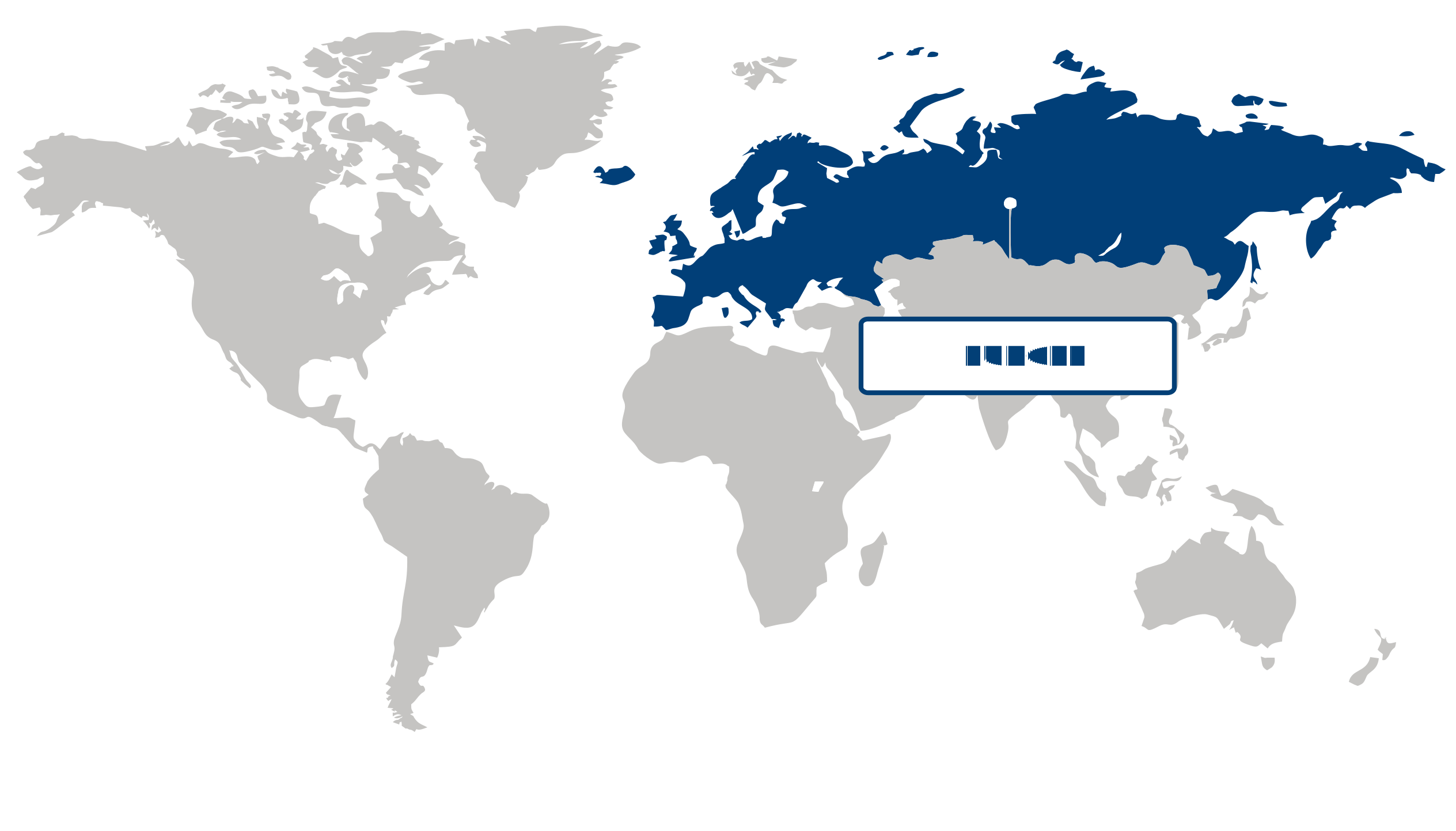
Europe (Largest Region)
Europe held the largest share of the commercial single phase micro inverter market in 2026, accounting for 46.11%. The region's strong position is closely associated with the expansion of distributed solar power and increasing adoption of technologies that improve the efficiency and reliability of commercial photovoltaic systems. Growing emphasis on renewable energy deployment, decentralized electricity generation, and improved solar system performance is encouraging the use of micro inverters. Supportive clean-energy policies and continued investment in distributed energy infrastructure are also contributing to regional demand, particularly among commercial users seeking greater control over solar power generation.
Asia Pacific (Fastest-Growing Region)
Asia Pacific is projected to achieve the fastest growth in the commercial single phase micro inverter market, supported by expanding solar installations, rising electricity demand, and accelerating adoption of distributed renewable energy systems. Increasing investment in photovoltaic infrastructure across commercial and urban applications is creating greater demand for efficient power conversion technologies. The region's growing focus on clean energy, energy security, and decentralized electricity generation is encouraging businesses to adopt advanced solar solutions. Continued development of renewable energy infrastructure and increasing deployment of commercial solar systems are expected to further strengthen the market's growth trajectory.
| Parameter | North America | Asia Pacific | Europe | Latin America | MEA |
|---|---|---|---|---|---|
| Innovation Hub i Scale Nascent Developing Advanced | |||||
| Cost-Sensitive Region i Scale Low Medium High | |||||
| Regulatory Environment i Scale Restrictive Neutral Supportive | |||||
| Demand Drivers i Scale Weak Moderate Strong | |||||
| Development Stage i Scale Emerging Developing Developed | |||||
| Adoption Rate i Scale Low Medium High | |||||
| New Entrants / Startups i Scale Sparse Moderate Dense | |||||
| Macro Indicators i Scale Weak Stable Strong |
Key Country Insights
United States 🇺🇸
Distributed Solar ExpansionThe U.S. commercial single phase micro inverter market benefits from growing rooftop solar installations across small commercial facilities. Buyers prioritize module-level optimization, simplified maintenance, and monitoring capabilities that maximize system performance under varying operating conditions.
Germany 🇩🇪
High-Efficiency InstallationsGermany focuses on commercial single phase micro inverters that improve solar energy conversion efficiency and long-term system reliability. Installers increasingly select advanced monitoring features and flexible system architectures to support distributed photovoltaic deployments.
Japan 🇯🇵
Space-Efficient Solar SystemsJapan emphasizes commercial single phase micro inverters for rooftop solar projects where installation space is limited. Businesses value compact, high-performance systems that optimize electricity generation across complex roof layouts and diverse shading conditions.
South Korea 🇰🇷
Intelligent PV IntegrationSouth Korea integrates commercial single phase micro inverters with smart photovoltaic systems and digital energy management platforms. Market demand centers on reliable module-level control, performance visibility, and compatibility with evolving commercial solar installations.
France 🇫🇷
Rooftop Performance EnhancementFrance encourages commercial single phase micro inverter adoption to improve rooftop solar productivity across commercial buildings. System developers emphasize operational flexibility, simplified expansion, and enhanced energy yield from distributed photovoltaic installations.
Italy 🇮🇹
Flexible Solar DeploymentItaly supports commercial single phase micro inverter adoption through increasing distributed solar installations in commercial facilities. Businesses favor scalable inverter solutions that improve energy harvest, simplify maintenance, and accommodate varied rooftop configurations.
Segment Leadership and Growth Trends
Commercial Single Phase Micro Inverter Market Share (%), by Connectivity, 2026
Go beyond the chart, access full insights & data tables
Request Free Sample ReportConnectivity Segment Analysis: On Grid (Largest & Fastest-Growing Segment)
The commercial single phase micro inverter market was led by the on-grid connectivity segment, which accounted for 62.12% of the market share in 2026 while also emerging as the fastest-growing segment. On-grid micro inverter systems are widely adopted in commercial solar installations because they enable efficient integration with utility networks, allowing excess electricity generation to be supplied back to the grid while improving overall energy utilization. Their ability to support real-time energy management, enhance system monitoring, and simplify expansion of distributed solar installations has strengthened market adoption. Increasing commercial investment in grid-connected renewable energy projects, combined with the growing emphasis on reducing electricity costs and improving energy reliability, is expected to reinforce the segment’s dominant position.
| Segment | Sub-Segment | Largest Segment | Fastest Growing |
|---|---|---|---|
| Connectivity | Standalone, On Grid | On Grid | On Grid |
Unlock insights tailored to your business with our bespoke market research solutions.
Click to get your customized report now.
Competitive Landscape and Market Positioning
Major players in the commercial single phase micro inverter market:
- Enphase Energy, Inc. (United States)
- Hoymiles Power Electronics, Inc. (China)
- APsystems (China)
- Growatt New Energy Co., Ltd. (China)
- Sungrow Power Supply Co., Ltd. (China)
- SolarEdge Technologies, Inc. (Israel)
- Renogy (United States)
- Yotta Energy, Inc. (United States)
- Tigo Energy, Inc. (United States)
- GoodWe Technologies Co., Ltd. (China)
Manufacturers are steadily shifting their focus from basic power conversion performance toward intelligent system functionality that enhances energy yield, monitoring, and installation efficiency. Competition is being shaped by innovations that improve conversion reliability under varying operating conditions while simplifying integration with rooftop solar installations and digital energy management platforms. Suppliers are also refining compact designs and expanding compatibility across diverse photovoltaic configurations, allowing installers greater flexibility without increasing system complexity. Product reliability, remote diagnostics, and long-term operational stability are emerging as increasingly influential factors in purchasing decisions.
| Company | Market Share | Company Revenue | Revenue CAGR (%) | Product Portfolio | Geographic Presence | Innovation / R&D Focus | Strategic Developments |
|---|---|---|---|---|---|---|---|
| Enphase Energy Inc. (United States) | |||||||
| Hoymiles Power Electronics Inc. (China) | |||||||
| APsystems (China) | |||||||
| Growatt New Energy Co. Ltd. (China) | |||||||
| Sungrow Power Supply Co. Ltd. (China) | |||||||
| SolarEdge Technologies Inc. (Israel) | |||||||
| Renogy (United States) | |||||||
| Yotta Energy Inc. (United States) | |||||||
| Tigo Energy Inc. (United States) | |||||||
| GoodWe Technologies Co. Ltd. (China) |
Customize Your Report
Explore examples of how this report can be tailored to different research needs, including custom segments, additional topics or chapters, and related reports. Click a section of the wheel or its numbered marker to explore the available options.
Commercial Single Phase Micro Inverter Market — Custom Segments
| Segment | Sub-Segment |
|---|---|
| Power Rating | Up to 500 W, 500 W to 1 kW, Above 1 kW |
| Monitoring and Control Capability | Basic Monitoring, Module-Level Monitoring, Advanced Monitoring and Remote Control |
| Installation Type | Rooftop Systems, Ground-Mounted Systems, Commercial Building-Integrated Systems |
Commercial Single Phase Micro Inverter Market — Custom TOC
| Custom Chapter | Chapter Details |
|---|---|
| Commercial Solar System Economics |
|
| Commercial Rooftop Solar Adoption Roadmap |
|
| Retrofit & Repowering Opportunity Analysis |
|
Need a different cut of the data?
Request Custom ResearchHow much is the commercial single phase micro inverter market worth?
How will the commercial single phase micro inverter industry grow in terms of size and CAGR by 2036?
How is distributed solar deployment shaping demand in the Commercial Single Phase Micro Inverter market?
Why are micro inverter architectures gaining preference in rooftop solar installations?
Why does the on-grid connectivity segment dominate the commercial single phase micro inverter market?
How is on-grid connectivity supporting growth in the commercial single phase micro inverter market?
Why does Europe hold the largest share of the commercial single phase micro inverter market?
How is Asia Pacific driving future growth in commercial single phase micro inverters?
What are the key competitors in the commercial single phase micro inverter landscape?
Our Clients
"The information presented in the report was genuinely insightful. The data was clear and easy to understand, which made it much easier to interpret the findings."
Amara Raja Group
"The responsiveness and professionalism exhibited by the team were exemplary. They were readily available to address queries, provide clarifications, and offer additional insights."
ONGC
"The reports offered a comprehensive analysis of various segments within the market. The detailed insights into market trends, and regulatory landscapes were excellent."
TotalEnergies
Our Research Team & Methodology
Every Fundamental Business Insights report is built by a dedicated vertical research team, validated through a structured primary-and-secondary methodology, and reviewed for accuracy before it reaches you.
Research Team Overview
Prepared by the Energy & Power Research Team
Delivery
Published
Demand
Available
Support
Trust & Compliance
Research Intelligence
| Source | Reference |
|---|---|
| International Energy Agency (IEA) | www.iea.org |
| U.S. Energy Information Administration (EIA) | www.eia.gov |
| International Renewable Energy Agency (IRENA) | www.irena.org |
| International Electrotechnical Commission (IEC) | www.iec.ch |
| International Organization for Standardization (ISO) | www.iso.org |
| IEEE | www.ieee.org |
| CIGRE (International Council on Large Electric Systems) | www.cigre.org |
| World Energy Council (WEC) | www.worldenergy.org |
| U.S. Department of Energy (DOE) | www.energy.gov |
| International Atomic Energy Agency (IAEA) | www.iaea.org |
| American Petroleum Institute (API) | www.api.org |
| Society of Petroleum Engineers (SPE) | www.spe.org |
| Hydrogen Council | hydrogencouncil.com |
| Battery Council International (BCI) | batterycouncil.org |
| Global Wind Energy Council (GWEC) | gwec.net |
| SolarPower Europe | www.solarpowereurope.org |
| World Bioenergy Association (WBA) | worldbioenergy.org |
| International Hydropower Association (IHA) | www.hydropower.org |
| Edison Electric Institute (EEI) | www.eei.org |
| National Renewable Energy Laboratory (NREL) | www.nrel.gov |
Research Workflow & Quality Assurance
Data Collection
Verified information gathered through primary and secondary research.
Data Triangulation
Cross-validation using multiple independent data sources.
Forecast Modelling
Market estimates developed using historical trends and analytical models.
Analyst Validation
Findings reviewed by domain experts for accuracy and consistency.
Editorial & Quality Review
Final editorial, quality, and compliance checks before publication.
Final Publication
Released after successful completion of the internal review process.
Report Coverage
📊 Market Assessment
- Market Size & Forecast
- Market Segmentation
- Regional Analysis
- Growth Drivers & Challenges
- Market Dynamics
🏢 Competitive Intelligence
- Competitive Landscape
- Company Profiles
- Competitive Benchmarking
- Mergers & Acquisitions
- Market Share Analysis or Key Company Strategies
🔍 Strategic Analysis
- Value Chain Analysis
- Porter's Five Forces
- PESTLE Analysis
- Pricing Trends
- Supply-Demand Analysis
🚀 Future Outlook
- Technology Landscape
- Regulatory Landscape
- Investment & Funding Landscape
- Emerging Opportunities
- Future Market Outlook
Have a question about this report or need a custom scope?
Request Customization