Compact Electric Construction Equipment Market Size & Growth Forecast 2027–2036, By Segments (Ton, Product), Regional Demand Trends (North America, Asia Pacific, Europe), Key Country Insights (U.S., Japan, South Korea, Germany, France, Italy), and Competitive Landscape
Jump to Content
Market Size and Growth Outlook
Compact Electric Construction Equipment Market size was over USD 77.8 billion in 2026 and is likely to grow at a 13.21% CAGR between 2027 and 2036, attaining USD 269.05 billion by 2036. The industry revenue for 2027 is estimated at USD 86.45 billion.
Get more details on this report
Request Free Sample ReportCompact Electric Construction Equipment Market Intelligence Snapshot
Regional Market Dynamics
- Europe held a 42.40% share in 2026, supported by stronger adoption of low-emission equipment, strict noise and emissions requirements, and well-established rental channels for battery-powered machinery.
- Asia Pacific is expected to grow at a 15.34% CAGR as urban construction expands, contractors adopt electric equipment for confined worksites, and regional fleets increasingly integrate compact battery-powered machines.
Segment Momentum
- The Below 5 Ton segment held a 40.28% share in 2026 because its maneuverability, ease of transport, and suitability for compact urban jobsites make electrification more practical for everyday operations.
- Electric loaders are growing fastest as contractors increasingly value low-noise, zero-emission machines for versatile loading tasks in confined urban worksites where maneuverability offers clear operational advantages.
Market Expansion Drivers
- Rapid urban infrastructure expansion driving demand for compact and low-emission construction machinery.
- Rising equipment rental penetration improving access to cost-efficient electric construction fleets.
- Strict emission regulations accelerating electrification of construction and material handling equipment.
Leading Market Participants
- Prominent companies in the compact electric construction equipment market include Caterpillar Inc. (United States), Volvo Construction Equipment AB (Sweden), Deere & Company (United States), Hitachi Construction Machinery Co., Ltd. (Japan), SANY Group Co., Ltd. (China), Komatsu Ltd. (Japan), Bobcat Company (United States), J C Bamford Excavators Ltd. (United Kingdom), LiuGong Machinery Co., Ltd. (China), Zoomlion Heavy Industry Science & Technology Co., Ltd. (China).
Global Market Forecast Snapshot
Market Outlook
- 2026 Market Size: USD 77.8 billion
- 2027 Estimated Market Size: USD 86.45 billion.
- Projected Market Size: USD 269.05 billion by 2036
- Growth Forecast: 13.21% CAGR (2027-2036)
Regional and Segment Outlook
- Leading Regional Market: Europe
- High-Growth Regional Hub: Asia Pacific
- Core Revenue Segment: Below 5 Ton (Ton) | Forklift (Product)
- Emerging Opportunity Segment: Below 5 Ton (Ton) | Loader (Product)
Market Growth Drivers and Industry Trends
Rapid urban infrastructure expansion driving demand for compact and low-emission construction machinery
Rapid development of urban infrastructure is creating greater demand for maneuverable machinery that can operate efficiently in confined construction environments, which will propel the compact electric construction equipment market growth. Urban projects often involve road maintenance, utility installation, building renovation, landscaping, and other applications where smaller equipment can provide greater accessibility than conventional heavy machinery. Electric powertrains further support operations in densely populated areas by reducing direct exhaust emissions and enabling quieter equipment operation, making compact electric machinery suitable for construction activities near residential, commercial, and public spaces.
Rising equipment rental penetration improving access to cost-efficient electric construction fleets
The increasing penetration of equipment rental services is making electric construction machinery more accessible to contractors that may be reluctant to make large upfront investments, thereby supporting the compact electric construction equipment market. Rental providers can offer compact electric excavators, loaders, and other machines across varied project requirements, allowing contractors to select equipment according to job duration, site conditions, and operating needs. Electric equipment can also provide advantages in applications where lower routine maintenance requirements and reduced fuel dependence are important considerations, while rental models allow businesses to evaluate electric technologies without committing substantial capital to fleet ownership.
Strict emission regulations accelerating electrification of construction and material handling equipment
Stricter emissions requirements are encouraging construction companies and equipment operators to transition away from conventional combustion-powered machinery, strengthening demand in the compact electric construction equipment market. Regulatory pressure is particularly relevant in urban areas and environmentally sensitive projects where exhaust emissions and noise can affect surrounding communities. Electric equipment eliminates direct tailpipe emissions during operation and can provide quieter performance, making it increasingly suitable for indoor construction, municipal projects, and work conducted in emission-controlled environments. Manufacturers and fleet operators are consequently placing greater emphasis on electrified compact equipment that can meet evolving environmental requirements while maintaining practical site performance.
| Growth Driver | Impact on CAGR | Regulatory Influence | Geographic Relevance | Adoption Rate | Impact Timeline |
|---|---|---|---|---|---|
| Rapid urban infrastructure expansion driving demand for compact and low-emission construction machinery | 2.30% | High | Asia Pacific | High | Near Term |
| Rising equipment rental penetration improving access to cost-efficient electric construction fleets | 1.60% | Moderate | North America, Europe | High | Mid Term |
| Strict emission regulations accelerating electrification of construction and material handling equipment | 1.20% | High | Europe, North America | Medium | Mid Term |
Go beyond the chart, access full insights & data tables
Request Free Sample ReportRegional Demand Dynamics
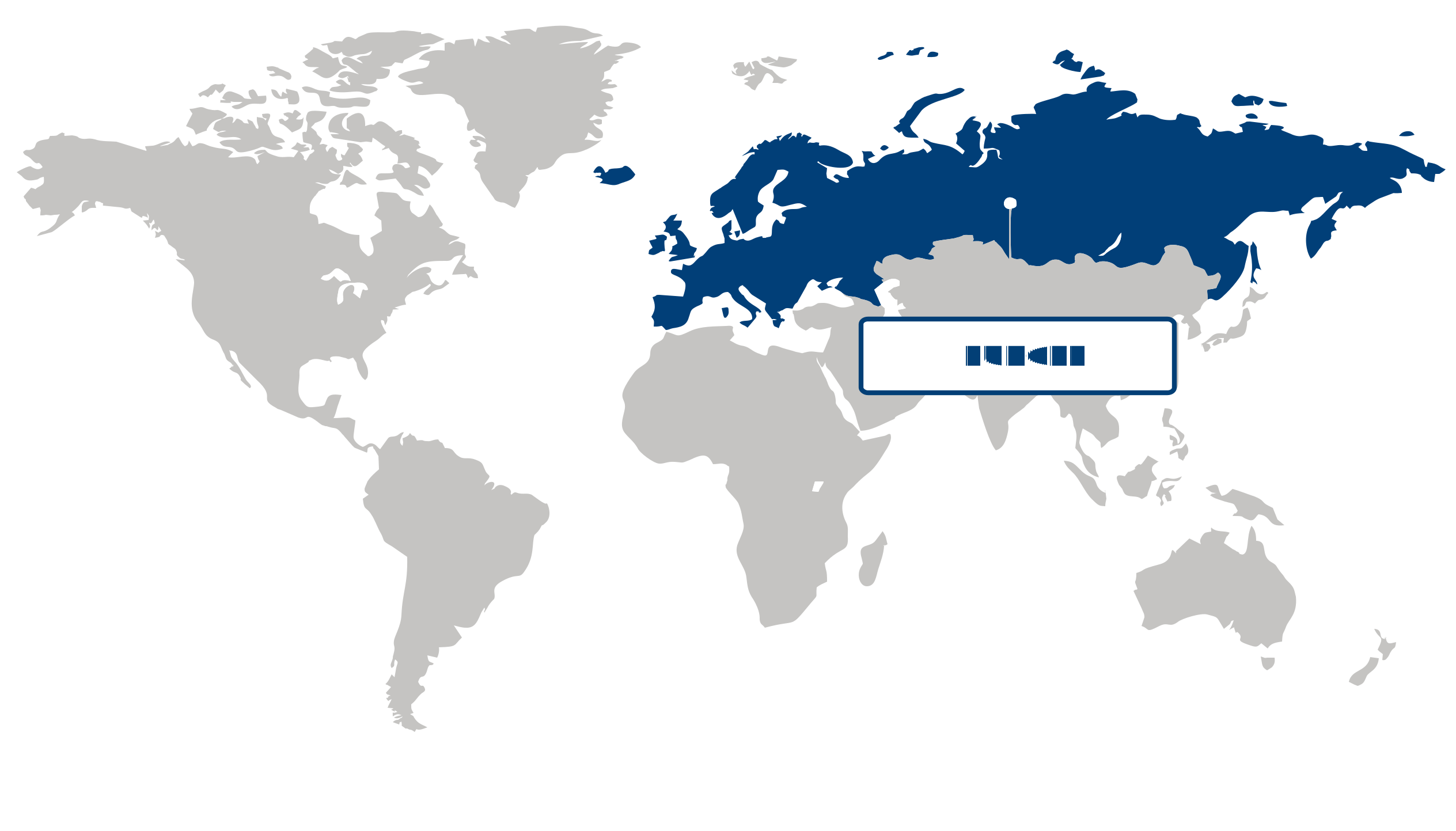
Europe (Largest Region)
Europe held the largest share of the compact electric construction equipment market, accounting for 42.40% in 2026. Strong emphasis on reducing construction-related emissions, increasingly stringent environmental expectations, and established adoption of electric technologies are supporting demand for compact electric machinery. Urban construction environments also favor equipment with lower noise and reduced local emissions, while continued investment in sustainable construction practices is encouraging contractors and fleet operators to transition toward cleaner equipment solutions.
Asia Pacific (Fastest-Growing Region)
Asia Pacific is the fastest-growing region, driven by rapid urbanization, expanding construction activity, and increasing investment in infrastructure development. Growing demand for compact machinery in densely populated urban environments is creating opportunities for electric equipment, particularly where lower noise and localized emissions provide operational advantages. Improvements in charging infrastructure, increasing awareness of cleaner construction technologies, and the modernization of construction fleets are further supporting the transition toward compact electric equipment.
| Parameter | North America | Asia Pacific | Europe | Latin America | MEA |
|---|---|---|---|---|---|
| Innovation HubiScaleNascentDeveloping Advanced | |||||
| Cost-Sensitive RegioniScaleLowMedium High | |||||
| Regulatory EnvironmentiScaleRestrictiveNeutral Supportive | |||||
| Demand DriversiScaleWeakModerate Strong | |||||
| Development StageiScaleEmergingDeveloping Developed | |||||
| Adoption RateiScaleLowMedium High | |||||
| New Entrants / StartupsiScaleSparseModerate Dense | |||||
| Macro IndicatorsiScaleWeakStable Strong |
Key Country Insights
Germany 🇩🇪
Precision Engineering FocusGermany emphasizes compact electric construction equipment with advanced engineering and compliance with stringent environmental standards. Demand centers on efficient battery-powered machines that integrate with modern construction practices and support sustainable infrastructure development.
France 🇫🇷
Urban Project AdoptionFrance is encouraging compact electric construction equipment for municipal works where noise reduction and emission control are important procurement considerations. Equipment suppliers are strengthening electric product portfolios to meet contractor expectations for sustainable operations.
Italy 🇮🇹
Compact Fleet ModernizationItaly is modernizing compact construction fleets with electric equipment suited for infrastructure upgrades and renovation projects. Purchasers are evaluating lifecycle costs, charging convenience, and machine versatility when replacing conventional diesel-powered equipment.
Japan 🇯🇵
Space-Efficient EquipmentJapan prioritizes compact electric construction equipment suited to confined construction sites and urban redevelopment projects. Manufacturers in Japan focus on maneuverability, low-noise operation, and dependable battery performance for contractors working in densely populated environments.
South Korea 🇰🇷
Smart Equipment IntegrationSouth Korea is expanding the use of compact electric construction equipment through digitally connected construction projects. Buyers increasingly value telematics, battery management, and automation features that improve equipment utilization and operational efficiency.
United States 🇺🇸
Jobsite ElectrificationThe U.S. is accelerating adoption of compact electric construction equipment as contractors seek lower emissions and quieter operation for urban projects. Fleet operators are prioritizing battery reliability, charging infrastructure, and equipment productivity to support daily construction activities.
Compact Electric Construction Equipment Market Share (%), by Ton, 2026
Unlock insights tailored to your business with our bespoke market research solutions.
Click to get your customized report now.
Go beyond the chart, access full insights & data tables
Request Free Sample ReportTon Segment Analysis: Below 5 Ton (Largest & Fastest-Growing Segment)
The below 5 ton segment led the compact electric construction equipment market in 2026 with a 40.28% share and is also the fastest-growing segment. Compact equipment in this weight category is particularly suited to urban construction, renovation, landscaping, utility work, and projects where maneuverability and low operating disruption are important. Electric powertrains enhance the suitability of these machines for enclosed or densely populated environments by reducing direct emissions and noise compared with conventional equipment. Growing urbanization, tighter environmental requirements, and increasing demand for compact machinery that can operate efficiently in confined work areas are strengthening adoption.
Product Segment Analysis: Forklift (Largest Segment) vs Loader (Fastest-Growing Segment)
Forklifts held the largest share of the compact electric construction equipment market in 2026 at 76.8%, reflecting their broad use for material handling across construction sites, warehouses, manufacturing facilities, and logistics operations. Electric forklifts offer advantages such as reduced local emissions, lower noise, and suitability for indoor applications, making them increasingly attractive as businesses modernize material-handling fleets. The need for efficient movement of construction materials and goods, combined with growing interest in cleaner equipment, supports the segment's substantial market presence.
The loader segment is advancing at the fastest pace as construction operators increasingly seek compact machines capable of handling earthmoving and material-loading tasks while meeting environmental and operational requirements. Electric loaders can provide quieter operation and reduced direct emissions, which is particularly beneficial for urban projects and worksites located near residential or commercial areas. Growing investment in sustainable construction equipment, demand for versatile machinery, and the shift toward electrification are supporting stronger adoption of electric loaders.
| Segment | Sub-Segment | Largest Segment | Fastest Growing |
|---|---|---|---|
| Ton | Below 5 Ton, 6 to 8 Ton, 8 to 10 Ton | Below 5 Ton | Below 5 Ton |
| Product | Forklift, Loader, Excavator, AWP | Forklift | Loader |
Competitive Landscape and Market Positioning
Prominent players in the compact electric construction equipment market:
1. Caterpillar Inc. (United States)
2. Volvo Construction Equipment AB (Sweden)
3. Deere & Company (United States)
4. Hitachi Construction Machinery Co. Ltd. (Japan)
5. SANY Group Co. Ltd. (China)
6. Komatsu Ltd. (Japan)
7. Bobcat Company (United States)
8. J C Bamford Excavators Ltd. (United Kingdom)
9. LiuGong Machinery Co. Ltd. (China)
10. Zoomlion Heavy Industry Science & Technology Co. Ltd. (China)
The compact electric construction equipment market is gaining momentum through electrification and low-emission machinery adoption. Urban infrastructure growth is driving demand for quieter and more efficient equipment solutions. Innovation is focused on enhancing performance while reducing operational environmental impact.
| Company | Market Share | Company Revenue | Revenue CAGR (%) | Product Portfolio | Geographic Presence | Innovation / R&D Focus | Strategic Developments |
|---|---|---|---|---|---|---|---|
| Caterpillar Inc. (United States) | |||||||
| Volvo Construction Equipment AB (Sweden) | |||||||
| Deere & Company (United States) | |||||||
| Hitachi Construction Machinery Co. Ltd. (Japan) | |||||||
| SANY Group Co. Ltd. (China) | |||||||
| Komatsu Ltd. (Japan) | |||||||
| Bobcat Company (United States) | |||||||
| J C Bamford Excavators Ltd. (United Kingdom) | |||||||
| LiuGong Machinery Co. Ltd. (China) | |||||||
| Zoomlion Heavy Industry Science & Technology Co. Ltd. (China). |
Industry Development/News
| Company Name | Date | Key Development |
|---|---|---|
| HD Construction Equipment | Mar-26 | HD Construction Equipment is hosting an Operator Challenge at CONEXPO-CON/AGG 2026, designed to demonstrate equipment performance and operator capability in a live competitive environment. The initiative supports broader commercial engagement with contractors and industry stakeholders, reinforcing product visibility and strengthening market positioning within the compact electric construction equipment segment through experiential demonstration strategies. |
| Fayat Group | Mar-25 | Fayat Group agreed to acquire Mecalac, strengthening its presence in multifunctional urban and compact machinery segments. The acquisition expands its portfolio of compact and electric-ready equipment and enhances cross-selling opportunities through BOMAG and Dynapac channels, supporting broader consolidation and competitive positioning within the evolving compact construction equipment market. |
| Caterpillar | Mar-25 | Caterpillar partnered with Luminar to integrate Iris lidar technology into autonomous quarry equipment under its Cat Command platform. The collaboration accelerates development of autonomous and semi-autonomous job-site systems, reinforcing Caterpillar’s strategic positioning in advanced construction automation and supporting broader integration of AI-enabled sensing technologies in heavy equipment operations. |
| Volvo Group | Jan-25 | Volvo Group reported 766 fully electric compact unit bookings in Q4 2024, reflecting strong demand validation for its modular electrification strategy. The development strengthens backlog visibility into 2025 deliveries and reinforces Volvo’s positioning in electric compact construction equipment through scaling adoption of battery-electric machinery across commercial applications. |
Customize Your Report
Explore examples of how this report can be tailored to different research needs, including custom segments, additional topics or chapters, and related reports. Click a section of the wheel or its numbered marker to explore the available options.
Compact Electric Construction Equipment Market — Custom Segments
| Segment | Sub-Segment |
|---|---|
| Ownership Model | Equipment Rental, Equipment Leasing, Direct Ownership |
| Operating Environment | Indoor Operations, Urban Construction, Infrastructure & Outdoor Construction, Confined-Space Operations |
| Application Sector | Building Construction, Infrastructure Construction, Landscaping & Grounds Maintenance, Material Handling & Warehousing |
Compact Electric Construction Equipment Market — Custom TOC
| Custom Chapter | Chapter Details |
|---|---|
| Fleet Electrification Adoption Roadmap |
|
| Total Cost of Ownership Benchmarking |
|
| Charging Infrastructure Readiness Assessment |
|
Need a different cut of the data?
Request Custom ResearchFrequently Asked Questions
What is the market valuation of compact electric construction equipment?
What is the projected value of the compact electric construction equipment industry by 2036?
How are urban construction trends influencing adoption of compact electric machinery across job sites?
What role is equipment rental expansion playing in accelerating electrification of compact construction fleets?
Why is the Below 5 Ton segment leading the compact electric construction equipment market?
Why are Loaders the fastest-growing product segment in the compact electric construction equipment market?
Why does Europe lead the compact electric construction equipment market?
What is driving the rapid growth of the compact electric construction equipment market in Asia Pacific?
Which companies dominate the compact electric construction equipment landscape?
Our Clients
"Your insights on workforce structures were spot-on. The analysis on mid-to-senior level roles validated some of our hiring decisions and highlighted gaps."
Ateliers De France
"The report gave us insights on competitors in the market. It helped our team refine our bidding strategy for upcoming contracts."
Clark Construction
"The reports provided a deep dive into market trends, and competitive landscape. The strategic insights and recommendations have been very helpful."
Rudolph and Sletten
Our Research Team & Methodology
Every Fundamental Business Insights report is built by a dedicated vertical research team, validated through a structured primary-and-secondary methodology, and reviewed for accuracy before it reaches you.
Delivery
Published
Available
Support
- Market Size & Forecast
- Market Segmentation
- Regional Analysis
- Growth Drivers & Challenges
- Market Dynamics
- Competitive Landscape
- Company Profiles
- Competitive Benchmarking
- Mergers & Acquisitions
- Market Share Analysis or Key Company Strategies
- Value Chain Analysis
- Porter's Five Forces
- PESTLE Analysis
- Pricing Trends
- Supply-Demand Analysis
- Technology Landscape
- Regulatory Landscape
- Investment & Funding Landscape
- Emerging Opportunities
- Future Market Outlook