Consumer Drone Market Size & Growth Forecast 2027–2036, By Segments (Application, Product), Regional Demand Trends (North America, Asia Pacific, Europe), Key Country Insights (U.S., Japan, South Korea, Germany, France, Italy), and Competitive Landscape
Jump to content
Market Size and Growth Outlook
Consumer Drone Market size was valued at USD 13.9 billion in 2026 and is anticipated to grow at a 8.36% CAGR from 2027 to 2036, crossing USD 31.02 billion by 2036. The industry revenue for 2027 is assessed at USD 14.88 billion.
Get more details on this report
Request Free Sample ReportConsumer Drone Market Intelligence Snapshot
Regional Market Dynamics
- Europe led the market in 2026 through strong recreational drone adoption, mature retail availability, demand for advanced imaging features, and steady replacement purchases across key markets.
- Asia Pacific is expected to expand at a 14.67% CAGR, supported by rising middle-class spending, affordable regional products, growing social media content creation, and wider online retail access.
Segment Momentum
- Toy/Hobbyist accounted for 63.05% of the market in 2026, supported by affordable pricing, simple operation, broad retail availability, and strong demand from first-time recreational drone buyers.
- Nano drones are growing fastest because consumers increasingly value compact, lightweight, and easy-to-use devices that are convenient for indoor flying, casual use, and entry-level recreational experiences.
Market Expansion Drivers
- Growing consumer interest in aerial photography and videography driving recreational drone adoption.
- Advancements in AI-enabled navigation and imaging technologies improving drone functionality and usability.
- Increasing integration of drones with 3D modeling and content creation ecosystems expanding prosumer demand.
Leading Market Participants
- Prominent players in the consumer drone market include DJI (China), Parrot S.A. (France), Yuneec International Co. Ltd. (China), Autel Robotics Co., Ltd. (China), Skydio, Inc. (United States), Hubsan Technology Co., Ltd. (China), Horizon Hobby, LLC (United States), Sony Group Corporation (Japan), Intel Corporation (United States), ZeroTech (Australia).
Global Market Forecast Snapshot
Market Outlook
- 2026 Market Size: USD 13.9 billion
- 2027 Estimated Market Size: USD 14.88 billion.
- Projected Market Size: USD 31.02 billion by 2036
- Growth Forecast: 8.36% CAGR (2027-2036)
Regional and Segment Outlook
- Leading Regional Market: Europe
- High-Growth Regional Hub: Asia Pacific
- Core Revenue Segment: Toy/Hobbyist (Application) | Multi-rotor (Product)
- Emerging Opportunity Segment: Prosumer (Application) | Nano (Product)
Market Growth Drivers and Industry Trends
Growing consumer interest in aerial photography and videography driving recreational drone adoption
The consumer drone market is gaining momentum as aerial photography and videography become increasingly attractive applications for recreational users. Drones provide consumers with accessible ways to capture elevated perspectives and dynamic footage, expanding their appeal beyond conventional recreational use among individuals interested in photography, video creation, and outdoor activities.
Advancements in AI-enabled navigation and imaging technologies improving drone functionality and usability
AI-enabled navigation and imaging advancements are making drones easier to operate while improving their ability to perform key flight and image-capture functions. For the consumer drone market, these technological improvements can enhance usability and broaden the range of activities supported by consumer devices, making advanced capabilities more accessible to recreational and enthusiast users.
Increasing integration of drones with 3D modeling and content creation ecosystems expanding prosumer demand
Integration with 3D modeling and content creation ecosystems is expanding the applications available to advanced drone users. The consumer drone market can capture growing prosumer demand as users incorporate aerial imagery into digital content workflows and 3D modeling activities, creating broader utility for drones beyond recreational photography and videography.
| Growth Driver | Impact on CAGR | Regulatory Influence | Geographic Relevance | Adoption Rate | Impact Timeline |
|---|---|---|---|---|---|
| Growing consumer interest in aerial photography and videography driving recreational drone adoption | 2.10% | Moderate | North America, Asia Pacific | High | Near Term |
| Advancements in AI-enabled navigation and imaging technologies improving drone functionality and usability | 1.90% | Moderate | Europe, North America | High | Mid Term |
| Increasing integration of drones with 3D modeling and content creation ecosystems expanding prosumer demand | 1.50% | Low | Asia Pacific, Europe | Emerging | Long Term |
Unlock insights tailored to your business with our bespoke market research solutions.
Click to get your customized report now.
Regional Demand Dynamics
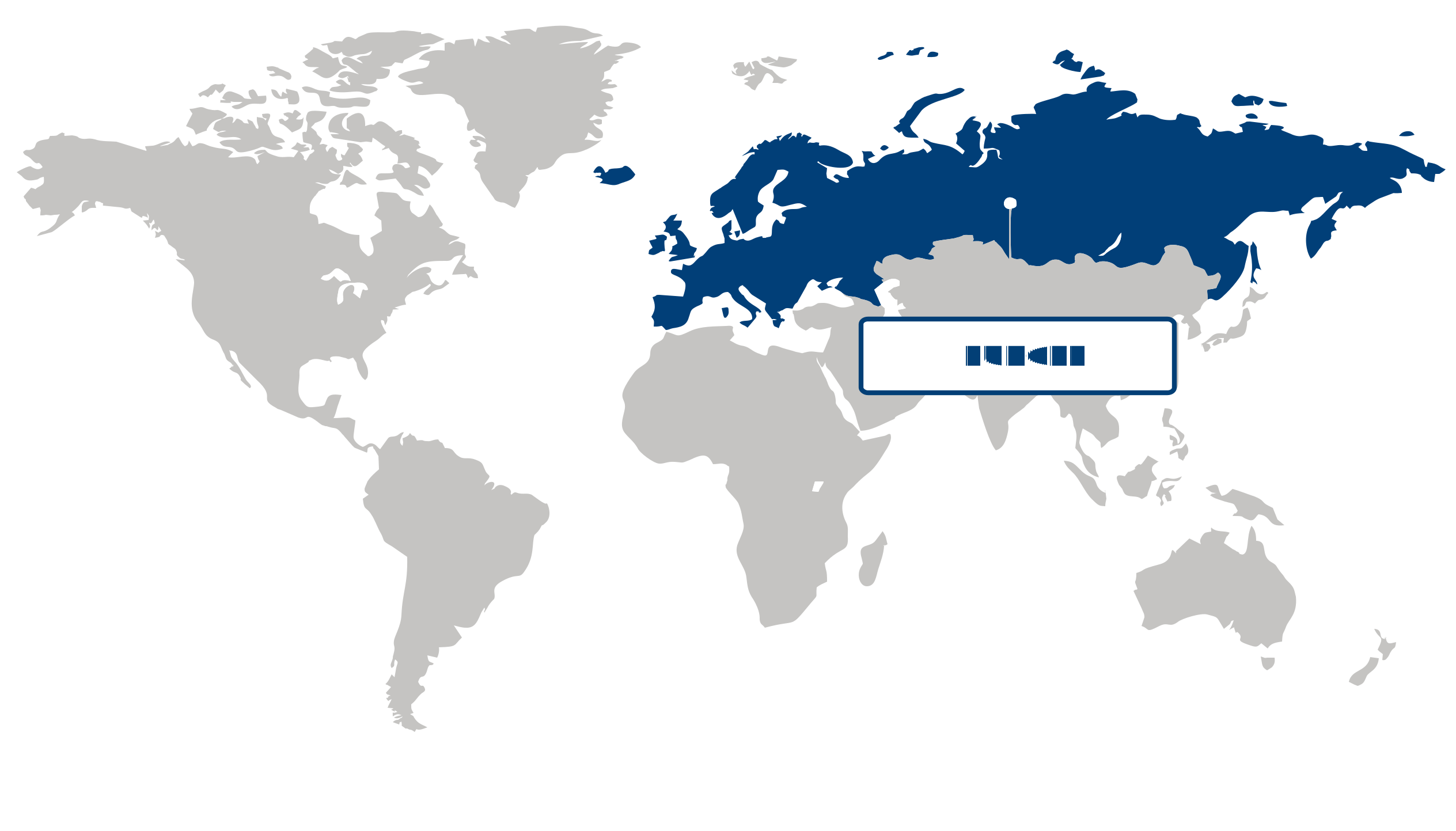
Europe (Largest Region)
Europe led the consumer drone market in 2026, supported by strong consumer interest in aerial photography, recreational technology, and advanced connected devices. The region benefits from high levels of digital adoption and a technologically sophisticated consumer base that values drones for photography, videography, travel, recreation, and personal content creation. Established retail and e-commerce channels facilitate product accessibility, while regulatory frameworks governing drone operation are encouraging greater awareness of responsible and compliant use. Improvements in camera quality, flight stability, obstacle detection, battery performance, and intelligent control features are also making consumer drones more versatile and attractive to a broader user base.
Asia Pacific (Fastest-Growing Region)
Asia Pacific is the fastest-growing regional market, fueled by expanding consumer electronics adoption, rising disposable incomes, and growing interest in technology-enabled recreational products. Increasing demand for aerial photography and content creation is encouraging consumers to explore compact drones with automated flight and imaging capabilities. Rapid development of e-commerce and electronics distribution networks is improving access to these products across urban and emerging markets. The region's strong manufacturing ecosystem also supports continuous product innovation and broader availability of competitively positioned devices. Growing interest in travel content, outdoor recreation, and digital media creation is further strengthening demand for consumer drones.
| Parameter | North America | Asia Pacific | Europe | Latin America | MEA |
|---|---|---|---|---|---|
| Innovation HubiScaleNascentDeveloping Advanced | |||||
| Cost-Sensitive RegioniScaleLowMedium High | |||||
| Regulatory EnvironmentiScaleRestrictiveNeutral Supportive | |||||
| Demand DriversiScaleWeakModerate Strong | |||||
| Development StageiScaleEmergingDeveloping Developed | |||||
| Adoption RateiScaleLowMedium High | |||||
| New Entrants / StartupsiScaleSparseModerate Dense | |||||
| Macro IndicatorsiScaleWeakStable Strong |
Key Country Insights
Germany 🇩🇪
Precision Imaging PreferenceGermany emphasizes consumer drones offering high-quality imaging, reliable flight performance, and durable engineering. German buyers increasingly value advanced safety features and software capabilities that support both recreational and semi-professional applications.
France 🇫🇷
Creative Aerial ApplicationsFrance maintains steady demand for consumer drones used in photography, outdoor recreation, and creative media production. French consumers increasingly prefer models that combine intuitive controls, reliable imaging performance, and regulatory compliance features.
Italy 🇮🇹
Lifestyle Content IntegrationItaly utilizes consumer drones extensively for travel content, recreational activities, and visual storytelling. Italian consumers increasingly choose versatile drone platforms that balance image quality, portability, and ease of operation across diverse environments.
Japan 🇯🇵
Compact Innovation DemandJapan favors lightweight consumer drones designed for portability, intelligent automation, and urban usability. Japanese manufacturers continue refining compact drone technologies that improve flight stability while simplifying operation for everyday users.
South Korea 🇰🇷
Creator Economy SupportSouth Korea is witnessing growing consumer drone adoption among digital content creators and technology enthusiasts. Local demand increasingly centers on drones with enhanced camera performance, AI-assisted flight modes, and seamless mobile connectivity.
United States 🇺🇸
Recreational Technology AdoptionThe U.S. consumer drone market benefits from strong demand for aerial photography, content creation, and recreational flying. Consumers increasingly seek drones with advanced imaging, obstacle avoidance, and intelligent flight capabilities that enhance user experience.
Consumer Drone Market Share (%), by Application, 2026
Go beyond the chart, access full insights & data tables
Request Free Sample ReportApplication Segment Analysis: Toy/Hobbyist (Largest Segment) vs Prosumer (Fastest-Growing Segment)
The Toy/Hobbyist segment led the consumer drone market with a 63.05% share in 2026, supported by strong consumer interest in recreational flying, aerial photography, and accessible drone-based entertainment. Drones designed for hobby use appeal to a broad user base because they provide an accessible entry point into aerial technology while supporting activities such as outdoor recreation, photography, and skill development. Continued improvements in ease of operation, camera capabilities, safety features, and compact designs are further strengthening consumer adoption in this segment.
The prosumer segment is advancing at the fastest pace as consumers increasingly seek drones that combine recreational usability with more sophisticated imaging and flight capabilities. Prosumer users often require enhanced cameras, greater stability, intelligent flight functions, and improved control for content creation and specialized personal applications. The expanding creator economy, growing interest in high-quality aerial content, and increasing accessibility of advanced drone features are supporting greater demand for prosumer-oriented models.
Product Segment Analysis: Multi-rotor (Largest Segment) vs Nano (Fastest-Growing Segment)
Multi-rotor drones accounted for the largest share of the consumer drone market at 66.93% in 2026, owing to their versatility, maneuverability, and suitability for a wide range of recreational and personal applications. Their ability to hover, take off vertically, and maintain stable flight makes them well suited to aerial photography, videography, racing, and general hobbyist use. Improvements in stabilization, autonomous flight functions, and camera integration continue to reinforce the popularity of multi-rotor designs among consumers.
Nano drones are experiencing the fastest growth as consumers show increasing interest in highly portable and convenient aerial devices. Their compact form factor makes them suitable for indoor flying, casual recreation, beginner use, and situations where portability is important. Advances in miniaturized flight components, improved control systems, and more accessible drone technology are helping expand the appeal of nano drones among new and experienced users.
| Segment | Sub-Segment | Largest Segment | Fastest Growing |
|---|---|---|---|
| Application | Prosumer, Toy/Hobbyist, Photogrammetry | Toy/Hobbyist | Prosumer |
| Product | Multi-rotor, Nano, Others | Multi-rotor | Nano |
Competitive Landscape and Market Positioning
Leading companies in the consumer drone market:
1. DJI (China)
2. Parrot S.A. (France)
3. Yuneec International Co. Ltd. (China)
4. Autel Robotics Co. Ltd. (China)
5. Skydio Inc. (United States)
6. Hubsan Technology Co. Ltd. (China)
7. Horizon Hobby LLC (United States)
8. Sony Group Corporation (Japan)
9. Intel Corporation (United States)
10. ZeroTech (Australia)
The transcatheter pulmonary valve market is experiencing steady advancement driven by continuous innovation in device design and procedural refinement. A strong emphasis on the transcatheter pulmonary valve market has encouraged faster development cycles, particularly through collaborative clinical research and shared technological expertise. New-generation solutions are increasingly focused on improving durability, precision, and patient outcomes, while iterative upgrades are expanding procedural applicability across complex cases.
| Company | Market Share | Company Revenue | Revenue CAGR (%) | Product Portfolio | Geographic Presence | Innovation / R&D Focus | Strategic Developments |
|---|---|---|---|---|---|---|---|
| DJI (China) | |||||||
| Parrot S.A. (France) | |||||||
| Yuneec International Co. Ltd. (China) | |||||||
| Autel Robotics Co. Ltd. (China) | |||||||
| Skydio Inc. (United States) | |||||||
| Hubsan Technology Co. Ltd. (China) | |||||||
| Horizon Hobby LLC (United States) | |||||||
| Sony Group Corporation (Japan) | |||||||
| Intel Corporation (United States) | |||||||
| ZeroTech (Australia). |
Industry Development / News
| Company Name | Date | Key Development |
|---|---|---|
| DJI | May-26 | The Federal Communications Commission (FCC) has maintained and defended regulatory restrictions on Chinese drone manufacturers, directly impacting DJI's operational access to the U.S. consumer market. This ongoing regulatory pressure creates significant headwinds for the company, complicating its U.S. distribution strategy and market positioning amid increasing geopolitical scrutiny regarding drone technology sourcing. |
| Manna Air Delivery | Apr-26 | Manna Air Delivery secured $50 million in Series B funding to scale its drone delivery operations across the United States and Europe. This investment significantly bolsters the company's capital position, accelerating the commercial deployment and operational expansion of its drone-based logistics infrastructure within the competitive consumer-accessible delivery segment. |
| Skydio | Apr-26 | Amidst intensifying regulatory actions against Chinese drone manufacturers, Skydio is actively reinforcing its strategic position within the U.S. market. By emphasizing its domestic status, the company aims to capitalize on shifts in procurement preferences and regulatory environments, playing a central role in the development and security of the domestic drone ecosystem. |
| DJI | Apr-26 | The Beijing municipal government has introduced new restrictions on the sale of consumer drones, presenting additional operational challenges for DJI within its domestic home market. This development signals a tightening regulatory environment for drone technology, potentially impacting DJI's ability to maintain its domestic growth trajectory and market share. |
| Walmart & Wing | Dec-25 | Walmart and Wing have successfully expanded drone delivery operations within the Atlanta metropolitan area, with a strategic roadmap to scale services to 100 retail locations by 2026. This initiative marks a significant acceleration in the integration of drone-based logistics into mainstream retail supply chains, demonstrating the increasing commercial viability of last-mile aerial delivery. |
| Autel Robotics | Dec-25 | Autel Robotics is preparing for the launch of its Apex and EVO 3 drone models, strategically targeting market opportunities arising from potential U.S. regulatory restrictions on major competitors. By positioning its latest hardware to appeal to users shifting away from restricted brands, Autel aims to gain competitive share in the evolving North American drone landscape. |
Customize Your Report
Explore examples of how this report can be tailored to different research needs, including custom segments, additional topics or chapters, and related reports. Click a section of the wheel or its numbered marker to explore the available options.
Consumer Drone Market — Custom Segments
| Segment | Sub-Segment |
|---|---|
| Price Tier | Entry-Level, Mid-Range, Premium |
| Purchase Channel | Online Retail, Specialty Electronics Stores, Direct-to-Consumer |
| Flight Capability | Short-Range & Basic Flight, Extended-Range & Advanced Flight, Autonomous & Intelligent Flight |
Consumer Drone Market — Custom TOC
| Custom Chapter | Chapter Details |
|---|---|
| Consumer Drone Buying Behavior and Adoption Insights |
|
| Country-Level Recreational Drone Policy Attractiveness |
|
| Aftermarket Services and Accessories Opportunity Assessment |
|
Need a different cut of the data?
Request Custom ResearchFrequently Asked Questions
What is the current revenue of the consumer drone market?
What is the forecasted size of the consumer drone industry?
How is the rise of content creation influencing demand for consumer drones?
Why are AI-enabled flight and imaging features becoming critical in drone purchasing decisions?
Why is the Toy/Hobbyist segment the largest application in the consumer drone market?
Why are Nano drones the fastest-growing product segment in the consumer drone market?
What makes Europe the largest regional market for consumer drones?
Why is Asia Pacific the fastest-growing consumer drone market?
Which companies are driving growth in the consumer drone landscape?
Our Clients
"The reports offered a comprehensive view of the Food and Beverage landscape, covering market trends, consumer behavior, and competitive dynamics."
Terma A/S
"Our experience in acquiring market research reports has been outstanding — the depth of analysis and actionable insights have proven invaluable."
The Aerospace Corporation
"Fundamental Business Insights demonstrated a keen understanding of our business needs, delivering reports tailored to our specific objectives."
Kongsberg Gruppen
Our Research Team & Methodology
Every Fundamental Business Insights report is built by a dedicated vertical research team, validated through a structured primary-and-secondary methodology, and reviewed for accuracy before it reaches you.
Delivery
Published
Available
Support
- Market Size & Forecast
- Market Segmentation
- Regional Analysis
- Growth Drivers & Challenges
- Market Dynamics
- Competitive Landscape
- Company Profiles
- Competitive Benchmarking
- Mergers & Acquisitions
- Market Share Analysis or Key Company Strategies
- Value Chain Analysis
- Porter's Five Forces
- PESTLE Analysis
- Pricing Trends
- Supply-Demand Analysis
- Technology Landscape
- Regulatory Landscape
- Investment & Funding Landscape
- Emerging Opportunities
- Future Market Outlook