Contactless Payment Terminals Market Size & Forecasts 2026-2035, By Segments (Technology, Payment Method, Device, End-user Industry), Growth Opportunities, Innovation Landscape, Regulatory Shifts, Strategic Regional Insights (U.S., Japan, China, South Korea, UK, Germany, France), and Competitive Dynamics (Ingenico, Verifone, PAX Technology, Square, Clover)
Market Size and Growth Outlook
Contactless Payment Terminals Market size is likely to expand from USD 44.44 billion in 2025 to USD 192.69 billion by 2035, posting a CAGR above 15.8% across 2026-2035. The industry’s revenue potential for 2026 is USD 50.68 billion.
Get more details on this report
Request Free Sample ReportContactless Payment Terminals Market Intelligence Snapshot
Regional Market Dynamics
Segment Momentum
Market Expansion Drivers
Leading Market Participants
Global Market Forecast Snapshot
Market Outlook
Regional and Segment Outlook
Market Growth Drivers and Industry Trends
Retailers and hospitality chains are accelerating upgrades to in-store checkout and table-service flows as consumers favor speed and low-touch options, reshaping the contactless payment terminals market. National Retail Federation surveys and Mastercard consumer research document higher consumer preference for tap-and-go payments and expanded acceptance at restaurants and quick-service outlets. For incumbents this creates an opportunity to bundle loyalty, receipts, and analytics with terminals; for new entrants it opens niche plays in hospitality-tailored UX, middleware, and retrofit devices. Given ongoing merchant investments and demonstrated consumer behavior, expect continued replacement of legacy PIN/POS units with streamlined contactless-focused systems.
Expansion of NFC-enabled smartphones and devices
Widespread NFC on handsets and wearables from Apple Inc., Samsung Electronics and Google LLC is lowering the hardware barrier for in-person acceptance and enabling softPOS, influencing the contactless payment terminals market. Apple’s ecosystem (Apple Inc.) and Android vendors’ NFC APIs are enabling tap-to-pay and tokenization at scale, while wearable adoption drives alternative form factors. Established terminal vendors can partner with OEMs to certify devices and extend services; startups can capitalize on app-based softPOS and HCE solutions. Observable platform-level API releases and device rollouts point to broader software-driven acceptance paths rather than purely hardware-dependent expansion.
Integration with digital banking and fintech platforms
Deeper integration between terminals and fintech stacks—exemplified by Stripe, Inc.’s Terminal, Block, Inc. (Square) integrated POS, and PayPal Holdings, Inc.’s acquisition of iZettle—is turning payment hardware into extensible banking and commerce platforms, changing dynamics in the contactless payment terminals market. Banks and fintechs are embedding issuance, reconciliation, and loyalty into terminal flows, creating cross-sell and recurring-revenue opportunities for established vendors that enable platform partnerships, and low-code API openings for newcomers. With platform providers expanding terminal SDKs and partner programs, adoption will be shaped by ecosystem interoperability and developer-led integrations rather than standalone device sales.
Industry Restraints:
Regulatory and Data-Privacy Compliance Complexity
Divergent and tightening standards—PCI Security Standards Council requirements for payment acceptance, EMVCo contactless specifications, the European Commission’s GDPR and national data‑localization mandates such as Reserve Bank of India directives—raise certification complexity and operational overhead for terminal vendors and acquirers. Meeting PCI and EMVCo test cycles and local data residency rules obliges redesigns (secure elements, tokenization, on‑device encryption), prolonging deployment and increasing per‑unit costs. Established vendors absorb compliance with scale; smaller entrants face steep certification timelines and capital strain. Expect sustained regional fragmentation over the near to medium term, driving demand for compliance-as-a-service, consolidation around certified platform providers, and continued premium pricing for fully compliant terminal solutions.
Component Shortages and Hardware Supply-Chain Constraints
Dependence on specialized secure chips, NFC controllers and legacy manufacturing has been strained by industry supply disruptions, with semiconductor suppliers such as NXP Semiconductors and Infineon Technologies publicly noting capacity tightness and allocation pressures in their corporate communications. Delays in secure element availability and PCB assembly extend lead times and raise inventory and financing costs for terminal makers and merchants, slowing rollouts and replacement projects. Large incumbents able to secure capacity gain market advantage; startups face longer time‑to‑market and margin compression. In the near to medium term, expect migration to diversified sourcing, higher emphasis on modular hardware design and software-driven upgrades, but persistent cost and timing premium for hardware‑heavy deployments.
| Growth Driver | Impact on CAGR | Regulatory Influence | Geographic Relevance | Adoption Rate | Impact Timeline |
|---|---|---|---|---|---|
| Growth in contactless payments in retail and hospitality | 5.50% | Short term (≤ 2 yrs) | Europe, North America | Medium | Fast |
| Expansion of NFC-enabled smartphones and devices | 5.00% | Medium term (2–5 yrs) | Asia Pacific, North America | Low | Moderate |
| Integration with digital banking and fintech platforms | 3.00% | Long term (5+ yrs) | North America, Europe | Medium | Moderate |
Explore Growth Opportunities
Request Free Sample ReportRegional Demand Dynamics
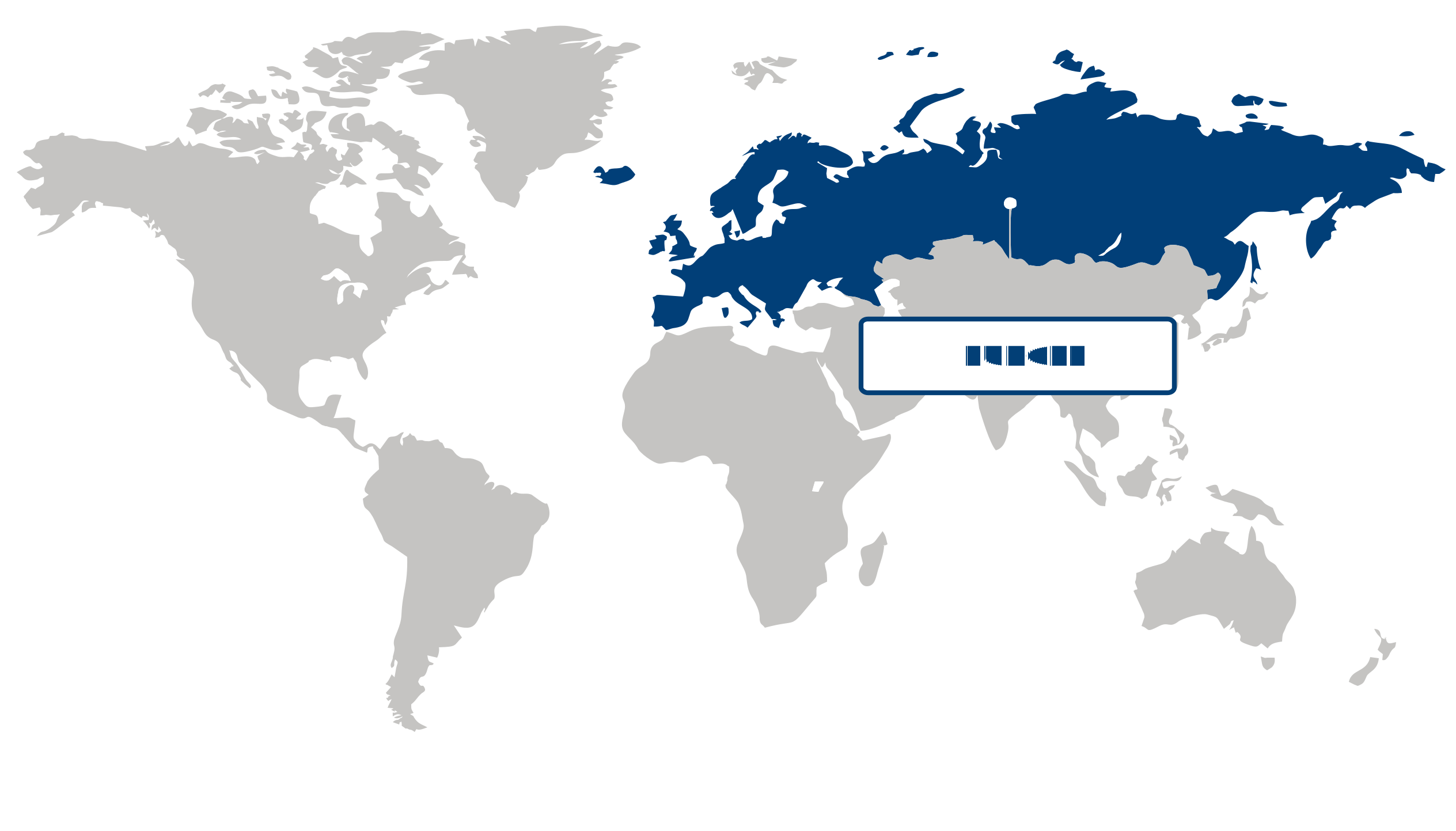
The contactless payment terminals market in Europe captured over 41% of the global market in 2025 and is the largest regional market by share. This leadership reflects strong regulatory support—notably the European Commission’s Payment Services Directive (PSD2) and broader digital finance initiatives—and rapid consumer migration to cashless transactions, as documented in European Central Bank payments statistics showing rising card and contactless volumes. Major card networks such as Visa have reported accelerated tap-and-go adoption across EU markets, while national regulators have eased limits and standards to speed acceptance. These policy and demand dynamics, combined with merchant modernization and cross-border SEPA harmonization, position Europe for continued equipment refresh cycles and integrated terminal solutions that address security, sustainability, and omnichannel commerce.
Germany anchors the European market in contactless payment terminals market adoption through a mix of regulatory nudges and aggressive POS modernization by retailers and banks. Deutsche Bundesbank data indicate a steady decline in cash use, prompting Sparkassen and major banks to upgrade terminals; meanwhile the Federal Ministry of Finance has supported digital payment frameworks that ease bank-led rollouts. Card networks and terminal vendors report large-scale projects with German retailers to replace legacy PIN pads, reflecting consumer preference shifts toward tap-to-pay. Strategically, Germany’s scale and conservative banking infrastructure make it a proving ground for durable, regulation-compliant terminal offerings that can be scaled across the region.
France plays a pivotal role in the contactless payment terminals market by combining fast consumer adoption with strong domestic terminal OEM activity. Banque de France statistics and French banking association communications show rapid uptake of contactless payments—fuelled in part by authorities raising contactless transaction limits—and companies such as Worldline have publicly announced major terminal deployments for large retail groups. French policy alignment and active merchant modernization create a dense ecosystem for terminal software innovation, tokenization, and value-added services. For investors and strategists, France’s interoperability focus and OEM presence offer high-reach pilot opportunities that reinforce Europe’s overall market momentum.
Asia Pacific Market Analysis:
Asia Pacific emerged as the fastest-growing region in the contactless payment terminals market, registering a robust CAGR of 18.96% driven by the rapid growth of digital wallets and mobile payment infrastructure. Expansion of mobile-first ecosystems—exemplified by Ant Group's Alipay and Tencent's WeChat Pay—alongside central-bank initiatives such as the People's Bank of China (PBOC) e-CNY pilots and broad network investments by China UnionPay have accelerated terminal upgrades across merchant tiers. Public policy actions like Japan’s Ministry of Economy, Trade and Industry (METI) cashless promotion and large-scale rollouts by PayPay and Rakuten Pay have increased merchant acceptance. These dynamics create sustained demand for upgraded NFC- and QR-capable terminals, positioning the region for continued investment in integrated POS hardware and software services.
Japan serves as a modernization and interoperability testbed in the contactless payment terminals market, where consumer preference for convenience meets high smartphone penetration and legacy NFC usage. PayPay (SoftBank Corp. and Z Holdings) and Rakuten Pay have driven QR-code adoption among small and mid-size merchants, while Sony's FeliCa remains key for transit and convenience payments; METI incentives have accelerated merchant terminal replacement cycles. Regulatory stability and a strong retail tech vendor base make Japan ideal for piloting multi-protocol terminals and value-added services such as loyalty integration, informing regional product road maps and go-to-market strategies.
China is the scale leader in the contactless payment terminals market, where super-app integration and ubiquitous QR/NFC acceptance create very high terminal throughput. Ant Group's Alipay and Tencent's WeChat Pay dominate consumer payment flows, China UnionPay provides merchant acquiring scale, and the PBOC's e-CNY pilot has prompted device certification and software updates at tens of thousands of outlets. Rapid urban-to-rural rollout, tight device supply chains, and advanced offline payment resiliency make China the primary source of volume-driven device innovation and cost-optimized terminals that regional suppliers can adapt for broader Asia Pacific deployment.
North America Market Trends:
North America held a commanding share in the contactless payment terminals market, supported by broad consumer acceptance of tap-to-pay, accelerated merchant POS refresh cycles, and ecosystem investments from card schemes and device manufacturers. Recent Federal Reserve analysis on post‑pandemic payment behavior and Visa press releases citing sustained contactless transaction growth reinforce demand shifts toward NFC and card‑present tokenization; EMVCo guidance and Mastercard announcements have nudged issuers and acquirers to prioritize terminal upgrades. Major suppliers such as Verifone and Ingenico have publicized product roadmaps tying hardware renewals to cloud management, while large U.S. retailers and chains have adopted contactless at scale. Together these dynamics make North America a durable commercialization hub for integrated terminal‑plus‑services opportunities.
The U.S. represents the primary growth engine in the contactless payment terminals market, where fintech distribution, merchant aggregator models and high smartphone penetration accelerate deployment. Evidence includes Block (Square) product announcements expanding contactless‑enabled terminals and Verifone press releases on enterprise deployments, alongside Federal Reserve findings showing consumer preference shifts toward contactless options. A fragmented acquiring landscape and stringent PCI Security Standards Council expectations create opportunities for vendors offering turnkey compliance, remote management and value‑added services. Strategically, vendors that align with U.S. payment facilitators and national retailers can scale regionally across North America by leveraging proven integrations and managed‑service monetization.
| Parameter | North America | Asia Pacific | Europe | Latin America | MEA |
|---|---|---|---|---|---|
| Innovation Hub i Scale Nascent Developing Advanced | |||||
| Cost-Sensitive Region i Scale Low Medium High | |||||
| Regulatory Environment i Scale Restrictive Neutral Supportive | |||||
| Demand Drivers i Scale Weak Moderate Strong | |||||
| Development Stage i Scale Emerging Developing Developed | |||||
| Adoption Rate i Scale Low Medium High | |||||
| New Entrants / Startups i Scale Sparse Moderate Dense | |||||
| Macro Indicators i Scale Weak Stable Strong |
Segment Leadership and Growth Trends
Contactless Payment Terminals Market Share (%), by Technology, 2026
Go beyond the chart, access full insights & data tables
Request Free Sample ReportInfrared dominated the contactless payment terminals market in 2025 as the largest share, driven by accelerating global adoption of contactless payments that favor secure, low-latency point-of-sale interfaces supporting infrared alongside NFC and Bluetooth. Leadership stems from merchant priorities for transaction speed and security and from standards alignment; EMVCo contactless specifications and Visa commentary on rising tap-and-go usage reinforce supplier investment in infrared-capable modules. Supply-chain availability of optical components, vendor differentiation by Ingenico and Worldline, and consumer demand for frictionless checkouts create avenues for incumbents and niche entrants offering retrofit kits and services, and these drivers point to sustained relevance through the medium term.
Analysis by Payment Method
Credit/Debit Card represented largest share of the contactless payment terminals market in 2025 owing to widespread consumer preference for tap-to-pay card transactions over cash and stored-value alternatives. This dominance is supported by issuer and network momentum—Visa and Mastercard reporting continual increases in card-based contactless transactions—and by regulatory encouragement of cashless payments in several jurisdictions. Demographic comfort with card payments, tokenization advances from payment networks, and acquirer investments in certification create strategic openings for card processors and fintechs to bundle value-added services, keeping card-centric terminals central to merchant acceptance strategies in the near to medium term.
Analysis by Device
Integrated POS held largest share of the contactless payment terminals market in 2025 as merchants continued investing in all-in-one systems that natively support contactless cards and mobile wallets. Market leadership is tied to merchant priorities for unified payments, inventory and loyalty integration; vendor roadmaps from Square (Block), Verifone, and Worldline announcing integrated contactless offerings underscore this trend. Operational efficiency demands, workforce workflows prioritizing faster checkout, and software-driven differentiators favor integrated devices, creating opportunities for established terminal manufacturers and cloud-native challengers to deliver platform services, and supporting continued adoption as retailers modernize point-of-sale infrastructure.
| Segment | Sub-Segment | Largest Segment | Fastest Growing |
|---|---|---|---|
| Technology | Bluetooth, Infrared, Carrier-based, Wi-Fi | ||
| Payment Method | Account-based, Credit/Debit Card, Stored Value, Smart Card | ||
| Device | Integrated POS, mPOS, PDA, Unattended Terminal, Contactless Reader | ||
| End-user Industry | Retail, Transportation, Banking, Government, Healthcare |
Unlock insights tailored to your business with our bespoke market research solutions.
Click to get your customized report now.
Competitive Landscape and Market Positioning
The competitive environment shows Top 10 players expanding solution breadth and deepening ecosystem ties to capture verticals such as retail, hospitality and transit. Hardware roadmaps are being aligned with cloud services and developer-friendly APIs, while device-level security and tokenization are being embedded to meet issuer and wallet requirements. These initiatives increase platform differentiation, accelerate product turnover and favor vendors that can certify rapidly and integrate multi-wallet acceptance.
Strategic / Actionable Recommendations for Regional Players
North America: Pursue tighter ties with payment processors and POS software providers to bundle terminals with value-added services for SMBs. Prioritize open APIs, subscription pricing and streamlined certification to counter software-first entrants.
Asia Pacific: Focus on cost-optimized hardware and broad wallet acceptance, including QR and local digital wallets. Leverage regional manufacturing and distribution partnerships and localized firmware to win price-sensitive and emerging-channel segments.
Europe: Emphasize certification, cross-border interoperability and strong issuer relationships to capture enterprise and transit deployments. Differentiate through secure element investments, bank partnerships and channel programs targeting regulated verticals.
| Company | Market Share | Company Revenue | Revenue CAGR (%) | Product Portfolio | Geographic Presence | Innovation / R&D Focus | Strategic Developments |
|---|---|---|---|---|---|---|---|
| No companies available. | |||||||
Customize Your Report
Explore examples of how this report can be tailored to different research needs, including custom segments, additional topics or chapters, and related reports. Click a section of the wheel or its numbered marker to explore the available options.
Contactless Payment Terminals Market — Custom Segments
| Segment | Sub-Segment |
|---|---|
| No segment data available. | |
Contactless Payment Terminals Market — Custom TOC
| Custom Chapter | Chapter Details | ||
|---|---|---|---|
| No custom TOC data available. | |||
Need a different cut of the data?
Request Custom ResearchHow big is the contactless payment terminals market?
How will the contactless payment terminals industry grow in terms of size and CAGR by 2035?
What is the leading region in terms of contactless payment terminals market share?
Which region shows the most rapid acceleration in the contactless payment terminals sector?
Where is the infrared segment seeing the strongest adoption within the contactless payment terminals industry?
When did Credit/Debit card sub-segment emerge as the largest sub-segment in the payment method segment of contactless payment terminals sector?
Why is the integrated POS segment leading in the contactless payment terminals industry?
Why does retail sub-segment dominate the end-user industry segment of contactless payment terminals sector?
Who are the major participants shaping the contactless payment terminals landscape?
Our Clients
"The team demonstrated a great understanding of our business needs, and the reports were tailored to address our specific concerns and objectives."
Infosys
"The report was up-to-date with the latest industry trends and technological advancements. The detailed competitive landscape analysis was quite helpful."
Zebra Technologies
"The data presented in the report was accurate and well-researched. I also found the market dynamics section particularly useful."
Arlo Technologies
Our Research Team & Methodology
Every Fundamental Business Insights report is built by a dedicated vertical research team, validated through a structured primary-and-secondary methodology, and reviewed for accuracy before it reaches you.
Research Team Overview
Prepared by the Smart Technologies Research Team
Delivery
Published
Demand
Available
Support
Trust & Compliance
Research Intelligence
| Source | Reference |
|---|---|
| National Institute of Standards and Technology (NIST) | www.nist.gov |
| International Organization for Standardization (ISO) | www.iso.org |
| Institute of Electrical and Electronics Engineers (IEEE) | www.ieee.org |
| Internet Engineering Task Force (IETF) | www.ietf.org |
| World Wide Web Consortium (W3C) | www.w3.org |
| Cloud Security Alliance (CSA) | cloudsecurityalliance.org |
| Open Source Initiative (OSI) | opensource.org |
| Linux Foundation | www.linuxfoundation.org |
| FinOps Foundation | www.finops.org |
| PCI Security Standards Council | www.pcisecuritystandards.org |
| SWIFT | www.swift.com |
| Financial Stability Board (FSB) | www.fsb.org |
| GSMA | www.gsma.com |
| International Telecommunication Union (ITU) | www.itu.int |
| OWASP Foundation | owasp.org |
| MITRE | www.mitre.org |
| World Economic Forum (WEF) | www.weforum.org |
| OECD Digital Economy | www.oecd.org/digital |
| World Bank Data | data.worldbank.org |
| U.S. Census Bureau | www.census.gov |
Research Workflow & Quality Assurance
Data Collection
Verified information gathered through primary and secondary research.
Data Triangulation
Cross-validation using multiple independent data sources.
Forecast Modelling
Market estimates developed using historical trends and analytical models.
Analyst Validation
Findings reviewed by domain experts for accuracy and consistency.
Editorial & Quality Review
Final editorial, quality, and compliance checks before publication.
Final Publication
Released after successful completion of the internal review process.
Report Coverage
📊 Market Assessment
- Market Size & Forecast
- Market Segmentation
- Regional Analysis
- Growth Drivers & Challenges
- Market Dynamics
🏢 Competitive Intelligence
- Competitive Landscape
- Company Profiles
- Competitive Benchmarking
- Mergers & Acquisitions
- Market Share Analysis or Key Company Strategies
🔍 Strategic Analysis
- Value Chain Analysis
- Porter's Five Forces
- PESTLE Analysis
- Pricing Trends
- Supply-Demand Analysis
🚀 Future Outlook
- Technology Landscape
- Regulatory Landscape
- Investment & Funding Landscape
- Emerging Opportunities
- Future Market Outlook
Have a question about this report or need a custom scope?
Request Customization