Cross Laminated Timber Market Size & Growth Forecast 2027–2036, By Segments (Product, Application), Regional Demand Trends (North America, Asia Pacific, Europe), Key Country Insights (U.S., Japan, South Korea, Germany, France, Italy), and Competitive Landscape
Market Size and Growth Outlook
Cross Laminated Timber Market size stood at USD 2 billion in 2026 and is predicted to grow at a 15.3% CAGR from 2027 to 2036, reaching USD 8.3 billion by 2036. The industry revenue for 2027 is assessed at USD 2.26 billion.
Get more details on this report
Request Free Sample ReportCross Laminated Timber Market Intelligence Snapshot
Regional Market Dynamics
- Europe held a 61.85% share in 2026, supported by a mature timber construction ecosystem, established manufacturing capacity, and widespread adoption of engineered wood in building projects.
- North America is projected to grow at a 16.46% CAGR as mass timber adoption expands across commercial, institutional, and multifamily construction, supported by increasing production and broader market acceptance.
Segment Momentum
- Adhesive Bonded Cross Laminated Timber held an 83.79% share in 2026 due to its established manufacturing base, dependable structural performance, and broad acceptance across commercial construction projects.
- Residential accounted for a 48.34% share and is the fastest-growing application because cross laminated timber supports efficient installation, structural performance, and repeatable deployment across housing construction projects.
Market Expansion Drivers
- Rising green building mandates and VOC regulations accelerating low-carbon construction material adoption.
- Prefabricated CLT panels enabling faster construction cycles and reduced on-site waste generation.
- Growing mid-rise mass timber projects replacing steel and concrete in urban construction developments.
Leading Market Participants
- Key players in the cross laminated timber market include Stora Enso Oyj (Finland), Mayr-Melnhof Holz Holding AG (Austria), Binderholz GmbH (Austria), KLH Massivholz GmbH (Austria), Structurlam Mass Timber Corporation (Canada), SmartLam North America Inc. (United States), XLam (New Zealand), Schilliger Holz AG (Switzerland), EGGER Group (Austria), Hasslacher Norica Timber GmbH (Austria).
Global Market Forecast Snapshot
Market Outlook
- 2026 Market Size: USD 2 billion
- 2027 Estimated Market Size: USD 2.26 billion.
- Projected Market Size: USD 8.3 billion by 2036
- Growth Forecast: 15.3% CAGR (2027-2036)
Regional and Segment Outlook
- Leading Regional Market: Europe
- High-Growth Regional Hub: North America
- Core Revenue Segment: Adhesive Bonded Cross Laminated Timber (Product) | Residential (Application)
- Emerging Opportunity Segment: Adhesive Bonded Cross Laminated Timber (Product) | Residential (Application)
Market Growth Drivers and Industry Trends
Rising green building mandates and VOC regulations accelerating low-carbon construction material adoption
The cross laminated timber market is gaining traction as green building mandates and increasingly stringent requirements concerning emissions encourage the construction sector to consider lower-carbon material alternatives. CLT is manufactured from layers of timber arranged in alternating directions, creating structural panels that can replace certain conventional building materials while incorporating renewable wood resources. Growing emphasis on sustainable building practices is encouraging architects, developers, and contractors to assess materials based on embodied carbon, resource efficiency, and indoor environmental considerations. At the same time, greater attention to VOC emissions is supporting the use of construction systems and finishes designed to contribute to healthier building environments, strengthening interest in timber-based structural solutions.
Prefabricated CLT panels enabling faster construction cycles and reduced on-site waste generation
Prefabricated CLT panels are supporting the cross laminated timber market by allowing substantial portions of building components to be manufactured and precisely prepared before arriving at the construction site. Factory-based production can improve dimensional accuracy and simplify installation, reducing the amount of cutting, adjustment, and material handling required during on-site assembly. Faster panel installation can help shorten construction schedules, while controlled manufacturing processes can improve material utilization and limit construction waste. These advantages are particularly relevant for developers seeking greater predictability in project execution and for urban construction sites where limited space and reduced disruption make efficient assembly methods valuable.
Growing mid-rise mass timber projects replacing steel and concrete in urban construction developments
Growing adoption of mid-rise mass timber construction is creating demand for the cross laminated timber market as developers increasingly evaluate timber systems as alternatives to conventional steel and concrete structures. CLT panels can provide substantial structural capacity while offering lighter-weight construction and efficient prefabrication, making them suitable for selected residential, commercial, institutional, and mixed-use projects. Urban developers are showing greater interest in mass timber where sustainability objectives, construction efficiency, and architectural flexibility are important considerations. Wider acceptance of engineered wood systems is also supporting their incorporation into multi-story building designs as project teams become more familiar with timber-based structural methods and their integration with other building systems.
| Growth Driver | Impact on CAGR | Regulatory Influence | Geographic Relevance | Adoption Rate | Impact Timeline |
|---|---|---|---|---|---|
| Rising green building mandates and VOC regulations accelerating low-carbon construction material adoption | 2.60% | High | Europe, North America | High | Near Term |
| Prefabricated CLT panels enabling faster construction cycles and reduced on-site waste generation | 2.10% | Moderate | North America, Europe | High | Near Term |
| Growing mid-rise mass timber projects replacing steel and concrete in urban construction developments | 1.80% | Moderate | Europe, North America, Asia Pacific | Medium | Mid Term |
Unlock insights tailored to your business with our bespoke market research solutions.
Click to get your customized report now.
Regional Demand Dynamics
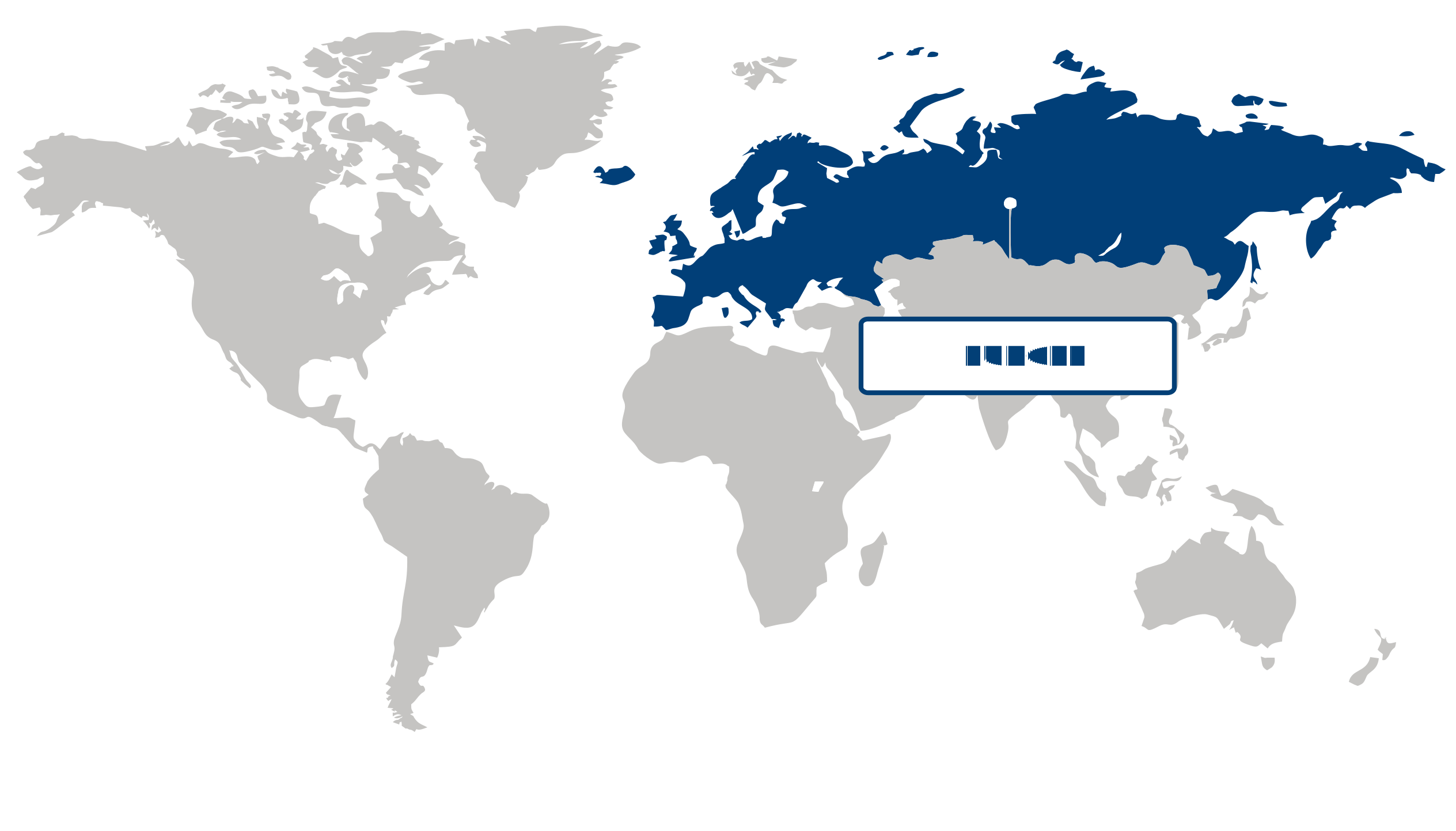
Europe (Largest Region)
Europe led the cross laminated timber market in 2026, accounting for a 61.85% share, supported by strong adoption of sustainable construction practices and established interest in engineered wood products. Cross laminated timber provides structural strength while offering opportunities to reduce reliance on conventional construction materials, making it attractive for residential, commercial, and institutional projects. The region's emphasis on lowering building-related environmental impacts is encouraging greater use of renewable and lower-carbon construction materials. Mature forestry and timber-processing industries also provide a supportive supply base, while established expertise in timber engineering facilitates wider application of mass timber systems. Increasing demand for energy-efficient buildings and construction methods that support sustainability objectives is further strengthening the role of cross laminated timber across European construction markets.
North America (Fastest-Growing Region)
North America is the fastest-growing region, driven by increasing acceptance of mass timber construction, expanding interest in sustainable building materials, and growing investment in modern construction techniques. Architects, developers, and builders are increasingly exploring engineered wood for projects where structural performance, design flexibility, and environmental considerations are important. Growing awareness of timber's potential to support lower-impact construction is encouraging broader consideration of cross laminated timber in commercial, residential, and institutional applications. The expansion of specialized manufacturing capabilities and improving familiarity with mass timber engineering are also helping overcome barriers to adoption. As sustainable construction practices gain greater traction, North America is positioned for accelerated development in the cross laminated timber market.
| Parameter | North America | Asia Pacific | Europe | Latin America | MEA |
|---|---|---|---|---|---|
| Innovation Hub i Scale Nascent Developing Advanced | |||||
| Cost-Sensitive Region i Scale Low Medium High | |||||
| Regulatory Environment i Scale Restrictive Neutral Supportive | |||||
| Demand Drivers i Scale Weak Moderate Strong | |||||
| Development Stage i Scale Emerging Developing Developed | |||||
| Adoption Rate i Scale Low Medium High | |||||
| New Entrants / Startups i Scale Sparse Moderate Dense | |||||
| Macro Indicators i Scale Weak Stable Strong |
Key Country Insights
Germany 🇩🇪
Engineered Wood InnovationGermany continues advancing cross laminated timber through engineered wood construction and sustainable building practices. Manufacturers are improving structural performance while collaborating with architects and contractors to expand applications across modern building projects.
France 🇫🇷
Low-Carbon Building MaterialsFrance encourages cross laminated timber adoption within sustainable construction initiatives and public building projects. Domestic stakeholders are strengthening local manufacturing capabilities while promoting timber-based solutions for energy-efficient building designs.
Italy 🇮🇹
Architectural Timber ApplicationsItaly is integrating cross laminated timber into residential, hospitality, and public infrastructure projects that emphasize design flexibility and sustainability. Manufacturers are expanding engineered wood offerings to support modern construction practices and architectural innovation.
Japan 🇯🇵
Seismic Design IntegrationJapan incorporates cross laminated timber into building projects designed to balance structural performance with sustainability objectives. Developers are adapting engineered wood systems to meet seismic design requirements while supporting efficient construction methods.
South Korea 🇰🇷
Urban Construction SolutionsSouth Korea is evaluating cross laminated timber for urban developments seeking faster construction and reduced environmental impact. Industry participants are promoting engineered timber systems through demonstration projects and technical collaboration across the construction sector.
United States 🇺🇸
Mass Timber AdoptionThe U.S. is increasing the use of cross laminated timber in commercial and institutional construction as developers seek efficient, lower-carbon building solutions. Investments in domestic production capacity and updated building codes are supporting broader project adoption.
Segment Leadership and Growth Trends
Cross Laminated Timber Market Share (%), by Product, 2026
Go beyond the chart, access full insights & data tables
Request Free Sample ReportProduct Segment Analysis: Adhesive Bonded Cross Laminated Timber (Largest & Fastest-Growing Segment)
Adhesive bonded cross laminated timber held the largest share of the cross laminated timber market in 2026, accounting for 83.79% share, while also representing the fastest-growing product segment. Its strong position is supported by the ability of adhesive bonding to create structurally stable timber panels with high strength, dimensional consistency, and design flexibility. These characteristics make adhesive bonded cross laminated timber well suited to modern construction applications where prefabrication, faster installation, and efficient use of engineered wood are increasingly important. Growing interest in sustainable building materials and the wider adoption of mass timber construction are further strengthening demand for this product type.
Application Segment Analysis: Residential (Largest & Fastest-Growing Segment)
The residential segment dominated the cross laminated timber market in 2026 with a 48.34% share and is also the fastest-growing application segment. Cross laminated timber is increasingly suited to residential construction because it combines structural performance with the benefits of prefabricated building systems, enabling efficient construction while supporting contemporary architectural designs. Rising interest in renewable construction materials, lower-impact building practices, and sustainable alternatives to conventional structural materials is encouraging greater use of engineered timber in homes. The growing focus on energy-efficient and environmentally responsible residential development further supports the segment's continued expansion.
| Segment | Sub-Segment | Largest Segment | Fastest Growing |
|---|---|---|---|
| Product | Adhesive Bonded Cross Laminated Timber, Mechanically Fastened Cross Laminated Timber | Adhesive Bonded Cross Laminated Timber | Adhesive Bonded Cross Laminated Timber |
| Application | Residential, Institutional, Commercial, Others | Residential | Residential |
Competitive Landscape and Market Positioning
Top players in the cross laminated timber market:
1. Stora Enso Oyj (Finland)
2. Mayr-Melnhof Holz Holding AG (Austria)
3. Binderholz GmbH (Austria)
4. KLH Massivholz GmbH (Austria)
5. Structurlam Mass Timber Corporation (Canada)
6. SmartLam North America Inc. (United States)
7. XLam (New Zealand)
8. Schilliger Holz AG (Switzerland)
9. EGGER Group (Austria)
10. Hasslacher Norica Timber GmbH (Austria)
The cross laminated timber market is gaining traction as sustainable construction materials become a priority in modern architecture. Engineered wood solutions are improving structural efficiency while reducing environmental impact. The cross laminated timber market is also expanding across residential and commercial building projects due to design flexibility.
| Company | Market Share | Company Revenue | Revenue CAGR (%) | Product Portfolio | Geographic Presence | Innovation / R&D Focus | Strategic Developments |
|---|---|---|---|---|---|---|---|
| Stora Enso Oyj (Finland) | |||||||
| Mayr-Melnhof Holz Holding AG (Austria) | |||||||
| Binderholz GmbH (Austria) | |||||||
| KLH Massivholz GmbH (Austria) | |||||||
| Structurlam Mass Timber Corporation (Canada) | |||||||
| SmartLam North America Inc. (United States) | |||||||
| XLam (New Zealand) | |||||||
| Schilliger Holz AG (Switzerland) | |||||||
| EGGER Group (Austria) | |||||||
| Hasslacher Norica Timber GmbH (Austria). |
Industry Development/News
| Company Name | Date | Key Development |
|---|---|---|
| Stora Enso Oyj | Apr-25 | Stora Enso launched a specialized range of fire-rated cross-laminated timber panels specifically engineered for high-rise residential and commercial applications. This product introduction expands the company’s technical portfolio and market reach in Europe and Asia Pacific, addressing critical safety and regulatory requirements necessary for the increased adoption of mass timber in dense urban construction projects. |
| Timberlab | Jul-24 | Timberlab acquired American Laminators, integrating glulam manufacturing assets across Oregon. This acquisition strengthens the company’s end-to-end mass timber supply chain, significantly increasing production capacity for cross-laminated timber and engineered wood products. The move enhances its strategic position to meet the growing demand for sustainable construction materials in large-scale infrastructure projects. |
| Sierra Institute’s Mosaic Timber LLC | Jul-24 | Mosaic Timber LLC established California’s first cross-laminated timber production facility following the acquisition of specialized press and planer equipment. This investment significantly increases regional manufacturing capacity for mass timber, supporting more localized supply chains and reducing dependence on out-of-state engineered wood sourcing for sustainable construction initiatives. |
| Mercer Mass Timber | Jul-24 | Mercer Mass Timber launched a new construction services division focused on the installation and execution of mass timber projects. This vertical integration addresses critical industry-wide workforce capability gaps and enhances downstream project delivery, strengthening the firm’s competitive positioning as a comprehensive provider within the growing mass timber construction ecosystem. |
| Cambium | Jul-24 | Cambium introduced Carbon Smart CLT, a cross-laminated timber product manufactured from salvaged wood, to support circular economy objectives in construction. This strategic product launch broadens the company’s engineered wood portfolio, providing sustainable material alternatives that align with increasing developer demand for low-carbon building solutions and environmentally responsible resource utilization. |
| Skanska | Jul-24 | Skanska completed the first mass timber broadcast facility in the United States, a 35,000-square-foot headquarters for Cincinnati Public Radio. This project demonstrates the firm’s commitment to integrating low-carbon building methods and validates the scalability of cross-laminated timber in commercial infrastructure, marking a strategic advancement in the adoption of sustainable materials for large-scale developments. |
Customize Your Report
Explore examples of how this report can be tailored to different research needs, including custom segments, additional topics or chapters, and related reports. Click a section of the wheel or its numbered marker to explore the available options.
Cross Laminated Timber Market — Custom Segments
| Segment | Sub-Segment |
|---|---|
| Structural Application | Floors & Roofs, Walls, Beams & Columns, Modular & Prefabricated Structures |
| Buyer Type | General Contractors, Architects & Engineers, Developers, Specialized Timber Contractors |
| Construction Method | Panelized Construction, Modular Construction, Hybrid Construction, Conventional Construction with CLT Components |
Cross Laminated Timber Market — Custom TOC
| Custom Chapter | Custom Details |
|---|---|
| Mass Timber Construction Adoption Roadmap |
|
| Building Code and Regulatory Readiness Analysis |
|
| Architect and Developer Specification Trends |
|
Need a different cut of the data?
Request Custom ResearchHow large is the cross laminated timber market?
What is the anticipated CAGR of the cross laminated timber industry?
How are green building mandates and low-carbon construction requirements driving adoption of cross laminated timber in modern building projects?
Why is the shift toward prefabricated CLT construction changing project execution and adoption patterns in the cross laminated timber market?
Why does adhesive bonded cross laminated timber dominate the market?
Why is the residential segment growing fastest in the cross laminated timber market?
Why does Europe lead the cross laminated timber market?
What is driving rapid growth in the North American cross laminated timber market?
Who holds a significant market share in the cross laminated timber landscape?
Our Clients
"Your insights on workforce structures were spot-on. The analysis on mid-to-senior level roles validated some of our hiring decisions and highlighted gaps."
Ateliers De France
"The report gave us insights on competitors in the market. It helped our team refine our bidding strategy for upcoming contracts."
Clark Construction
"The reports provided a deep dive into market trends, and competitive landscape. The strategic insights and recommendations have been very helpful."
Rudolph and Sletten
Our Research Team & Methodology
Every Fundamental Business Insights report is built by a dedicated vertical research team, validated through a structured primary-and-secondary methodology, and reviewed for accuracy before it reaches you.
Research Team Overview
Prepared by the Construction & Manufacturing Research Team
Delivery
Published
Demand
Available
Support
Trust & Compliance
Research Domains
10 coverage areasResearch Intelligence
| Source | Reference |
|---|---|
| International Organization for Standardization (ISO) | www.iso.org |
| ASTM International | www.astm.org |
| National Institute of Standards and Technology (NIST) | www.nist.gov |
| International Code Council (ICC) | www.iccsafe.org |
| American Concrete Institute (ACI) | www.concrete.org |
| American Institute of Steel Construction (AISC) | www.aisc.org |
| Construction Industry Institute (CII) | www.construction-institute.org |
| Associated General Contractors of America (AGC) | www.agc.org |
| Association of Equipment Manufacturers (AEM) | www.aem.org |
| Building Owners and Managers Association (BOMA) | www.boma.org |
| American Society of Civil Engineers (ASCE) | www.asce.org |
| National Ready Mixed Concrete Association (NRMCA) | www.nrmca.org |
| International Facility Management Association (IFMA) | www.ifma.org |
| World Green Building Council (WorldGBC) | worldgbc.org |
| International Federation of Consulting Engineers (FIDIC) | fidic.org |
| International Labour Organization (ILO) | www.ilo.org |
| American Society of Mechanical Engineers (ASME) | www.asme.org |
| Society of Manufacturing Engineers (SME) | www.sme.org |
| National Association of Home Builders (NAHB) | www.nahb.org |
| European Construction Industry Federation (FIEC) | www.fiec.eu |
Research Workflow & Quality Assurance
Data Collection
Verified information gathered through primary and secondary research.
Data Triangulation
Cross-validation using multiple independent data sources.
Forecast Modelling
Market estimates developed using historical trends and analytical models.
Analyst Validation
Findings reviewed by domain experts for accuracy and consistency.
Editorial & Quality Review
Final editorial, quality, and compliance checks before publication.
Final Publication
Released after successful completion of the internal review process.
Report Coverage
📊 Market Assessment
- Market Size & Forecast
- Market Segmentation
- Regional Analysis
- Growth Drivers & Challenges
- Market Dynamics
🏢 Competitive Intelligence
- Competitive Landscape
- Company Profiles
- Competitive Benchmarking
- Mergers & Acquisitions
- Market Share Analysis or Key Company Strategies
🔍 Strategic Analysis
- Value Chain Analysis
- Porter's Five Forces
- PESTLE Analysis
- Pricing Trends
- Supply-Demand Analysis
🚀 Future Outlook
- Technology Landscape
- Regulatory Landscape
- Investment & Funding Landscape
- Emerging Opportunities
- Future Market Outlook
Have a question about this report or need a custom scope?
Request Customization