



Datacenter Chip Market Size & Growth Forecast 2027–2036, By Segments (Chip Type, Vertical Industry, Data Center Size), Regional Demand Trends (North America, Asia Pacific, Europe), Key Country Insights (U.S., Japan, South Korea, Germany, France, Italy), and Competitive Landscape
Market Size and Growth Outlook
Datacenter Chip Market size was valued at USD 19.81 Billion in 2026 and is anticipated to grow at 16.12% CAGR from 2027 to 2036, attaining USD 88.3 Billion by 2036. The industry revenue for 2027 is assessed at USD 22.57 Billion.
Base Year Value (2026)
USD 19.81 Billion
CAGR (2027-2036)
16.12%
Forecast Year Value (2036)
USD 88.3 Billion

Historical Data Period
2022-2026

Largest Region
Asia Pacific

Forecast Period
2027-2036
Datacenter Chip Market Intelligence Snapshot:
-
Regional Market Dynamics:
- Asia Pacific accounted for 35.32% in 2026, supported by its semiconductor ecosystem, expanding data centers, and rising demand for high-performance computing technologies.
- North America is the fastest-growing region, driven by data center investment, AI and cloud computing workloads, and demand for specialized high-performance processing architectures.
-
Segment Momentum:
- CPUs accounted for 32.51% of the market in 2026 because they remain the core processing platform for enterprise applications, virtualization, databases, and general-purpose computing across modern data center environments.
- GPUs are expanding rapidly as artificial intelligence, machine learning, advanced analytics, and other computationally intensive workloads require high-performance parallel processing capabilities within modern data center architectures.
-
Market Expansion Drivers:
- Surging AI and machine learning workloads accelerating demand for high-performance data center chips
- Hyperscale cloud expansion driving adoption of specialized energy-efficient semiconductor architectures
- Rapid 5G infrastructure rollout increasing edge and distributed compute chip requirements
-
Leading Market Participants:
Major players in the datacenter chip market include NVIDIA Corporation (United States), Intel Corporation (United States), Advanced Micro Devices, Inc. (United States), Taiwan Semiconductor Manufacturing Company Limited (Taiwan), Samsung Electronics Co., Ltd. (South Korea), SK Hynix Inc. (South Korea), Broadcom Inc. (United States), Qualcomm Incorporated (United States), Micron Technology, Inc. (United States), MediaTek Inc. (Taiwan)
Global Market Forecast Snapshot:
-
Market Outlook:
- 2026 Market Size: USD 19.81 Billion
- 2027 Estimated Market Size: USD 22.57 Billion
- Projected Market Size: USD 88.3 Billion by 2036
- Growth Forecasts: 16.12% CAGR (2027-2036)
-
Regional and Segment Outlook:
- Leading Regional Market: Asia Pacific
- High-Growth Regional Hub: North America
- Core Revenue Segment: Central Processing Unit (CPU) (Chip Type) | BFSI (Vertical Industry) | Large Size (Data Center Size)
- Emerging Opportunity Segment: Graphics Processing Unit (GPU) (Chip Type) | IT and Telecom (Vertical Industry) | Large Size (Data Center Size)
Market Growth Drivers and Industry Trends
Surging AI and machine learning workloads accelerating demand for high-performance data center chips
The rapid adoption of artificial intelligence and machine learning applications is placing unprecedented computational demands on modern data centers, and this trend will drive the datacenter chip market growth through increased deployment of high-performance processing solutions. AI model training, inference, and large-scale data analytics require chips capable of delivering exceptional computing power, memory bandwidth, and parallel processing efficiency. As enterprises expand AI-enabled services across industries, operators are investing in advanced semiconductor platforms that can support increasingly complex workloads while maintaining consistent processing performance.
Hyperscale cloud expansion driving adoption of specialized energy-efficient semiconductor architectures
The continued expansion of hyperscale cloud infrastructure is encouraging data center operators to optimize processing capabilities while controlling energy consumption and operating costs. This evolution will propel the datacenter chip market growth as cloud providers adopt specialized semiconductor architectures designed to deliver higher computational efficiency across diverse workloads. Purpose-built processors enable improved workload distribution, enhanced resource utilization, and better thermal management, allowing hyperscale facilities to accommodate growing demand without compromising operational efficiency.
Rapid 5G infrastructure rollout increasing edge and distributed compute chip requirements
Widespread deployment of 5G networks is transforming data processing architectures by shifting more computing capabilities closer to end users and connected devices. The datacenter chip market benefits from this transition as edge computing environments require specialized processors capable of delivering low-latency performance for real-time applications. Distributed computing infrastructure supporting industrial automation, connected vehicles, smart cities, and internet of things ecosystems depends on efficient chip technologies that can process large volumes of data near the point of generation.
| Growth Driver Assessment Framework | |||||
| Growth Driver | Impact On CAGR | Regulatory Influence | Geographic Relevance | Adoption Rate | Impact Timeline |
|---|---|---|---|---|---|
| Surging AI and machine learning workloads accelerating demand for high-performance data center chips | 3% | Low | North America, Asia Pacific | High | Near Term |
| Hyperscale cloud expansion driving adoption of specialized energy-efficient semiconductor architectures | 2.7% | Moderate | North America, Europe | High | Near Term |
| Rapid 5G infrastructure rollout increasing edge and distributed compute chip requirements | 2.3% | Moderate | Asia Pacific, Europe | Medium | Mid Term |
Unlock insights tailored to your business with our bespoke market research solutions - Click to get your customized report now!
Regional Demand Dynamics
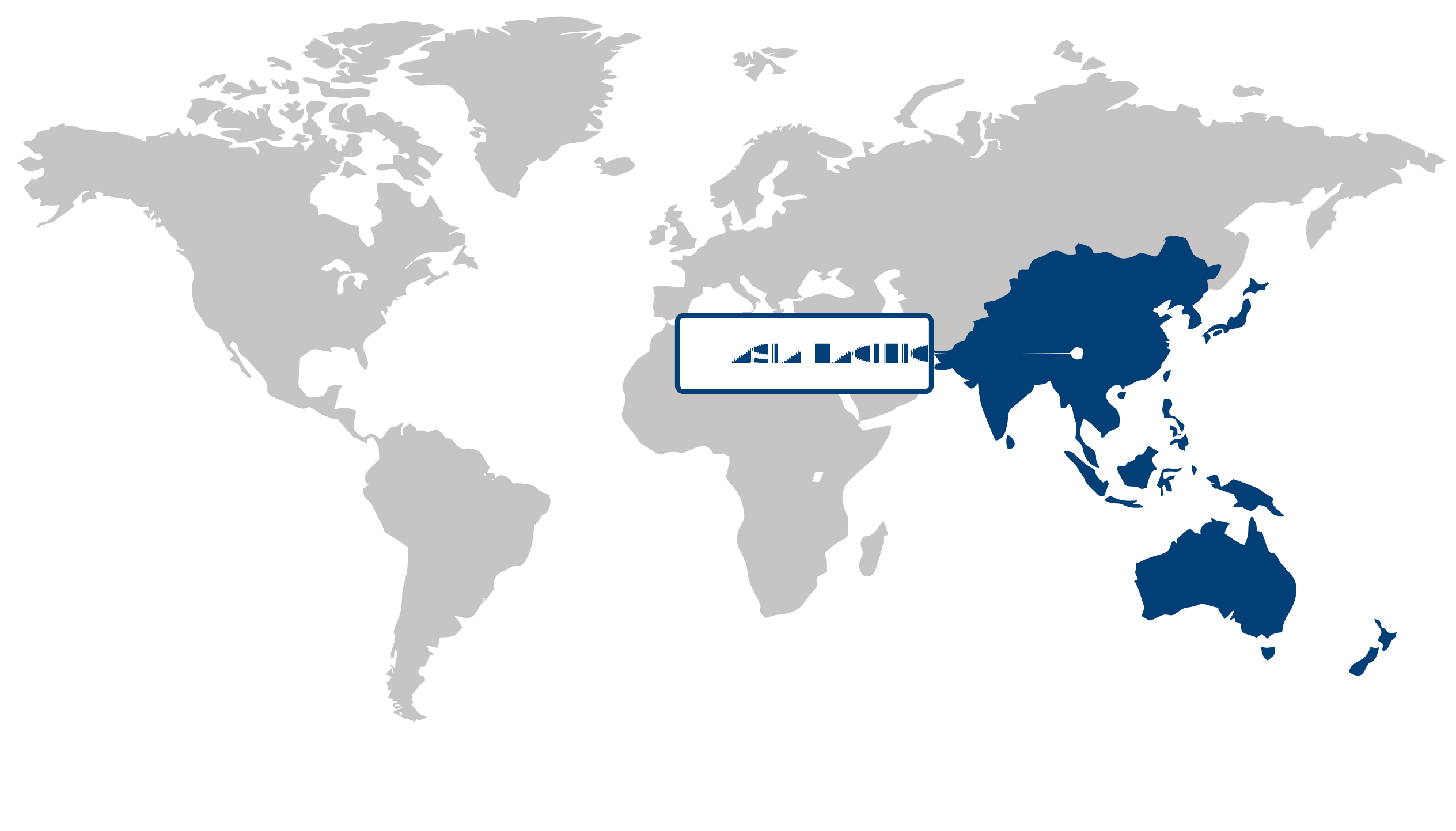
Largest Region
Asia Pacific
35.32% Market Share in 2026
Asia Pacific (Largest Region) vs North America (Fastest-Growing Region)
Asia Pacific accounted for the largest share of 35.32% in 2026, benefiting from its strong semiconductor manufacturing ecosystem, expanding data center infrastructure, and growing demand for high-performance computing. The region's established electronics and technology industries support the development and deployment of advanced datacenter chips, while increasing cloud adoption and digital services are raising demand for efficient computing infrastructure. Continued investment in artificial intelligence, accelerated computing, and data processing capabilities is further strengthening the regional market position.
North America is expected to experience the fastest growth, supported by substantial investment in data center expansion and the rising computational requirements of cloud computing and artificial intelligence workloads. The growing need for high-performance processors and specialized computing architectures is encouraging innovation in datacenter chip technologies. In parallel, the region's strong technology ecosystem, increasing deployment of advanced computing infrastructure, and focus on improving processing efficiency are creating favorable conditions for sustained market expansion.
Key Country Insights
The U.S. datacenter chip market is shaped by growing demand for processors supporting AI training, cloud computing, and high-performance workloads. U.S. technology providers prioritize advanced chip architectures that improve computing efficiency, scalability, and workload optimization.
Japan supports the datacenter chip market through demand for dependable processors across enterprise, financial, and public-sector computing environments. Japanese operators prioritize efficient chip performance, stable system operation, and compatibility with evolving digital infrastructure requirements.
South Korea advances datacenter chip adoption through investments in AI infrastructure and cloud computing capacity. South Korean operators seek processors that deliver higher computational density, efficient power utilization, and strong support for accelerated workloads.
Germany focuses on datacenter chips that enhance enterprise computing performance while maintaining energy efficiency. German organizations increasingly adopt processors optimized for virtualization, industrial data processing, and secure cloud infrastructure deployments.
France is strengthening demand for datacenter chips as cloud adoption and digital services continue expanding. French infrastructure providers emphasize processors that balance computing performance with energy efficiency across enterprise and public cloud environments.
Italy is increasing deployment of datacenter chips that support enterprise modernization and digital transformation initiatives. Italian organizations prioritize scalable processor platforms capable of handling mixed workloads while improving infrastructure efficiency and operational flexibility.
Segment Leadership and Growth Trends
Chip Type Segment Analysis: Central Processing Unit (CPU) (Largest Segment) vs Graphics Processing Unit (GPU) (Fastest-Growing Segment)
The datacenter chip market was dominated by the central processing unit (CPU) segment, accounting for 32.51% in 2026. CPUs remain the core processing component within data centers, supporting a broad range of enterprise applications, virtualization environments, database management, and general-purpose computing workloads. Their versatility, compatibility with existing infrastructure, and essential role in managing system operations continue to drive widespread deployment across data center environments. Ongoing expansion of digital services further strengthens the segment’s leading position.
The graphics processing unit (GPU) segment is projected to witness the fastest growth as demand accelerates for high-performance computing applications involving artificial intelligence, machine learning, advanced analytics, and complex data processing. GPUs provide exceptional parallel processing capabilities that enable faster execution of computationally intensive workloads, making them increasingly important in modern data center architectures. Growing adoption of AI-driven applications and data-intensive computing is expected to fuel rapid expansion of this segment.
Vertical Industry Segment Analysis: BFSI (Largest Segment) vs IT and Telecom (Fastest-Growing Segment)
The BFSI vertical industry segment held a 28.84% share in 2026, making it the largest end-use category for datacenter chips. Financial institutions increasingly depend on advanced computing infrastructure to support digital banking, transaction processing, cybersecurity, fraud detection, and regulatory compliance. The need for reliable, high-performance processing capabilities across mission-critical financial operations continues to sustain the segment’s dominant position.
The datacenter chip market is expected to experience the fastest growth in the IT and telecom vertical industry segment as cloud services, communication networks, and digital platforms continue to expand rapidly. Increasing deployment of next-generation network infrastructure, virtualization technologies, and data-intensive applications is driving demand for powerful processing solutions capable of supporting evolving digital workloads. Continued investments in advanced telecommunications infrastructure are expected to accelerate growth in this segment.
Data Center Size Segment Analysis: Large Size (Largest & Fastest-Growing Segment)
Holding the largest share of the datacenter chip market, the large size data center segment dominated in 2026 while also emerging as the fastest-growing segment. Large-scale data centers require substantial processing capacity to support cloud computing, enterprise applications, artificial intelligence, big data analytics, and high-performance computing workloads. Their continuous expansion and modernization are driving strong demand for advanced chip technologies capable of delivering greater processing efficiency, scalability, and performance. As organizations increasingly consolidate critical digital operations into large data center environments, this segment is expected to maintain its market leadership and sustained growth.
| Report Segmentation | |||
| Segment | Sub-Segment | Largest Segment | Fastest Growing Segment |
|---|---|---|---|
| Chip Type | Central Processing Unit (CPU), Graphics Processing Unit (GPU), Field-Programmable Gate Array (FPGA), Application Specific Integrated Circuit (ASIC), Others | Central Processing Unit (CPU) | Graphics Processing Unit (GPU) |
| Vertical Industry | BFSI, Government, IT and Telecom, Transportation, Energy & Utilities, Others | BFSI | IT and Telecom |
| Data Center Size | Small and Medium Size, Large Size | Large Size | Large Size |
 Read our Research Approach
Competitive Landscape and Market Positioning
Prominent players in the datacenter chip market:
- NVIDIA Corporation (United States)
- Intel Corporation (United States)
- Advanced Micro Devices, Inc. (United States)
- Taiwan Semiconductor Manufacturing Company Limited (Taiwan)
- Samsung Electronics Co., Ltd. (South Korea)
- SK Hynix, Inc. (South Korea)
- Broadcom, Inc. (United States)
- Qualcomm Incorporated (United States)
- Micron Technology, Inc. (United States)
- MediaTek, Inc. (Taiwan)
Competitive dynamics in the datacenter chip market are increasingly shaped by the ability to deliver architectures optimized for demanding computing workloads while balancing performance, energy efficiency, and deployment flexibility. Competition extends beyond processing capability as suppliers strengthen software ecosystems, development tools, and platform compatibility to encourage long-term customer adoption. The growing importance of workload-specific acceleration is also prompting greater emphasis on specialized chip designs, making integration across hardware and software environments an increasingly influential factor in purchasing decisions and raising barriers for participants with narrower technology portfolios.
Industry Development/News
| Company Name | Date | Key Development |
|---|---|---|
| AMD | Jul-26 | AMD launched its next-generation MI400-series AI accelerators and Helios rack-scale platform to expand its footprint in the datacenter GPU market. The architecture is engineered for large-scale AI training and inference, providing higher memory bandwidth to compete directly in hyperscale cloud computing and enterprise environments. |
| OpenAI | Jun-26 | OpenAI collaborated with Broadcom to introduce its first custom AI inference chip, Jalapeño. Optimized for large language model workloads, the application-specific processor aims to enhance computational efficiency and reduce operational costs across hyperscale data centers, positioning the company to reduce its dependence on third-party GPU suppliers. |
| Qualcomm | Jun-26 | Qualcomm entered the datacenter accelerator market by introducing a portfolio of AI accelerators, custom hyperscaler chips, and CPU solutions optimized for agentic AI workloads. This expansion provides cloud service providers with alternative architectures, targeting the increasing market demand for performance and energy efficiency in generative AI infrastructure. |
| Intel | Oct-25 | Intel announced that customer sampling for its Crescent Island AI datacenter GPU will begin in the second half of 2026. The new processor line is designed to complement the company's server CPU portfolio and establish a stronger competitive foothold against NVIDIA and AMD in high-performance computing infrastructure. |
| Intel | Jan-25 | Intel revised its datacenter processor roadmap, delaying the Xeon 7 "Clearwater Forest" launch and discontinuing the "Falcon Shores" accelerator. The restructured strategy shifts focus toward introducing high-core-count processors, specifically 144 E-core, 128 P-core, and 288 E-core Xeon models, altering its competitive positioning against architecture rivals. |
Why Choose Us
Specialized Expertise: Our team comprises industry experts with a deep understanding of your market segment. We bring specialized knowledge and experience that ensures our research and consulting services are tailored to your unique needs.
Customized Solutions: We understand that every client is different. That's why we offer customized research and consulting solutions designed specifically to address your challenges and capitalize on opportunities within your industry.
Proven Results: With a track record of successful projects and satisfied clients, we have demonstrated our ability to deliver tangible results. Our case studies and testimonials speak to our effectiveness in helping clients achieve their goals.
Cutting-Edge Methodologies: We leverage the latest methodologies and technologies to gather insights and drive informed decision-making. Our innovative approach ensures that you stay ahead of the curve and gain a competitive edge in your market.
Client-Centric Approach: Your satisfaction is our top priority. We prioritize open communication, responsiveness, and transparency to ensure that we not only meet but exceed your expectations at every stage of the engagement.
Continuous Innovation: We are committed to continuous improvement and staying at the forefront of our industry. Through ongoing learning, professional development, and investment in new technologies, we ensure that our services are always evolving to meet your evolving needs.
Value for Money: Our competitive pricing and flexible engagement models ensure that you get maximum value for your investment. We are committed to delivering high-quality results that help you achieve a strong return on your investment.
Select Licence Type

