



DC Switchgear Market Size & Growth Forecast 2027–2036, By Segments (Voltage, Mounting, Application, Insulation), Regional Demand Trends (North America, Asia Pacific, Europe), Key Country Insights (U.S., Japan, South Korea, Germany, France, Italy), and Competitive Landscape
Market Size and Growth Outlook
DC Switchgear Market size was valued at USD 22.92 Billion in 2026 and is anticipated to grow at 8.8% CAGR from 2027 to 2036, crossing USD 53.27 Billion by 2036. The industry revenue for 2027 is assessed at USD 24.63 Billion.
Base Year Value (2026)
USD 22.92 Billion
CAGR (2027-2036)
8.8%
Forecast Year Value (2036)
USD 53.27 Billion

Historical Data Period
2022-2026

Largest Region
Asia Pacific

Forecast Period
2027-2036
DC Switchgear Market Intelligence Snapshot:
-
Regional Market Dynamics:
- Asia Pacific led in 2025, supported by industrialization, power infrastructure investment, renewable generation, data center expansion, and growing electrification requirements.
- North America is the fastest-growing region, driven by grid modernization, renewable integration, data center expansion, rising electricity demand, and grid resilience upgrades.
-
Segment Momentum:
- The below 750 V segment held 60% of the market in 2025 due to widespread deployment across commercial, industrial, renewable energy, and data center applications, supported by cost-effective installation and broad compatibility.
- The Substation segment is growing fastest as utilities modernize electrical infrastructure, invest in smart substations and high-voltage transmission projects, and integrate more renewable energy into power networks.
-
Market Expansion Drivers:
- Renewable energy integration driving DC-based grid protection and switching systems
- Rising electricity demand strengthening deployment of advanced DC switchgear infrastructure
- Expansion of HVDC transmission networks accelerating DC switchgear adoption globally
-
Leading Market Participants:
Top players in the DC switchgear market include ABB Ltd. (Switzerland), Siemens AG (Germany), Schneider Electric SE (France), Eaton Corporation plc (Ireland), General Electric Company (United States), Mitsubishi Electric Corporation (Japan), Hitachi, Ltd. (Japan), Toshiba Corporation (Japan), Fuji Electric Co., Ltd. (Japan), Hyundai Electric & Energy Systems Co., Ltd. (South Korea)
Global Market Forecast Snapshot:
-
Market Outlook:
- 2026 Market Size: USD 22.92 Billion
- 2027 Estimated Market Size: USD 24.63 Billion
- Projected Market Size: USD 53.27 Billion by 2036
- Growth Forecasts: 8.8% CAGR (2027-2036)
-
Regional and Segment Outlook:
- Leading Regional Market: Asia Pacific
- High-Growth Regional Hub: North America
- Core Revenue Segment: < 750 V (Voltage) | Fixed Mounting (Mounting) | Power Distribution (Application) | Air (Insulation)
- Emerging Opportunity Segment: ≥ 10,000 V (Voltage) | Withdrawable Unit (Mounting) | Substation (Application) | Gas (Insulation)
Market Growth Drivers and Industry Trends
Renewable energy integration driving DC-based grid protection and switching systems
The increasing penetration of renewable energy sources is creating demand for advanced electrical protection systems capable of managing variable power flows and modern grid configurations. Renewable energy integration will accelerate the DC switchgear market growth as solar, wind, and energy storage projects require reliable DC protection and switching solutions to maintain operational stability. DC switchgear systems support efficient power management in evolving electricity networks by enabling safer control of direct current applications across renewable generation and energy distribution infrastructure.
Rising electricity demand strengthening deployment of advanced DC switchgear infrastructure
Growing electricity consumption from industrial expansion, urbanization, and electrification trends is increasing pressure on power networks to enhance capacity and reliability. Rising electricity demand will propel the DC switchgear market growth as utilities and infrastructure operators invest in modern switching equipment that supports efficient power transmission and distribution. Advanced DC switchgear solutions are being adopted to improve network performance, reduce operational risks, and support the expansion of electrical infrastructure required for increasing power requirements.
Expansion of HVDC transmission networks accelerating DC switchgear adoption globally
The expansion of high-voltage direct current transmission projects is increasing the need for specialized switching technologies capable of managing high-capacity DC power flows. Growth in HVDC transmission networks will boost the DC switchgear market demand as long-distance power transfer projects require reliable protection, isolation, and control equipment. Increasing deployment of interconnected grids, renewable power corridors, and large-scale transmission systems is creating opportunities for advanced DC switching solutions across modern electricity networks.
| Growth Driver Assessment Framework | |||||
| Growth Driver | Impact On CAGR | Regulatory Influence | Geographic Relevance | Adoption Rate | Impact Timeline |
|---|---|---|---|---|---|
| Renewable energy integration driving DC-based grid protection and switching systems | 2% | High | Europe, Asia Pacific | High | Near Term |
| Rising electricity demand strengthening deployment of advanced DC switchgear infrastructure | 1.7% | Moderate | Asia Pacific, North America | High | Mid Term |
| Expansion of HVDC transmission networks accelerating DC switchgear adoption globally | 1.6% | High | Europe, Middle East & Africa | High | Mid Term |
Unlock insights tailored to your business with our bespoke market research solutions - Click to get your customized report now!
Regional Demand Dynamics
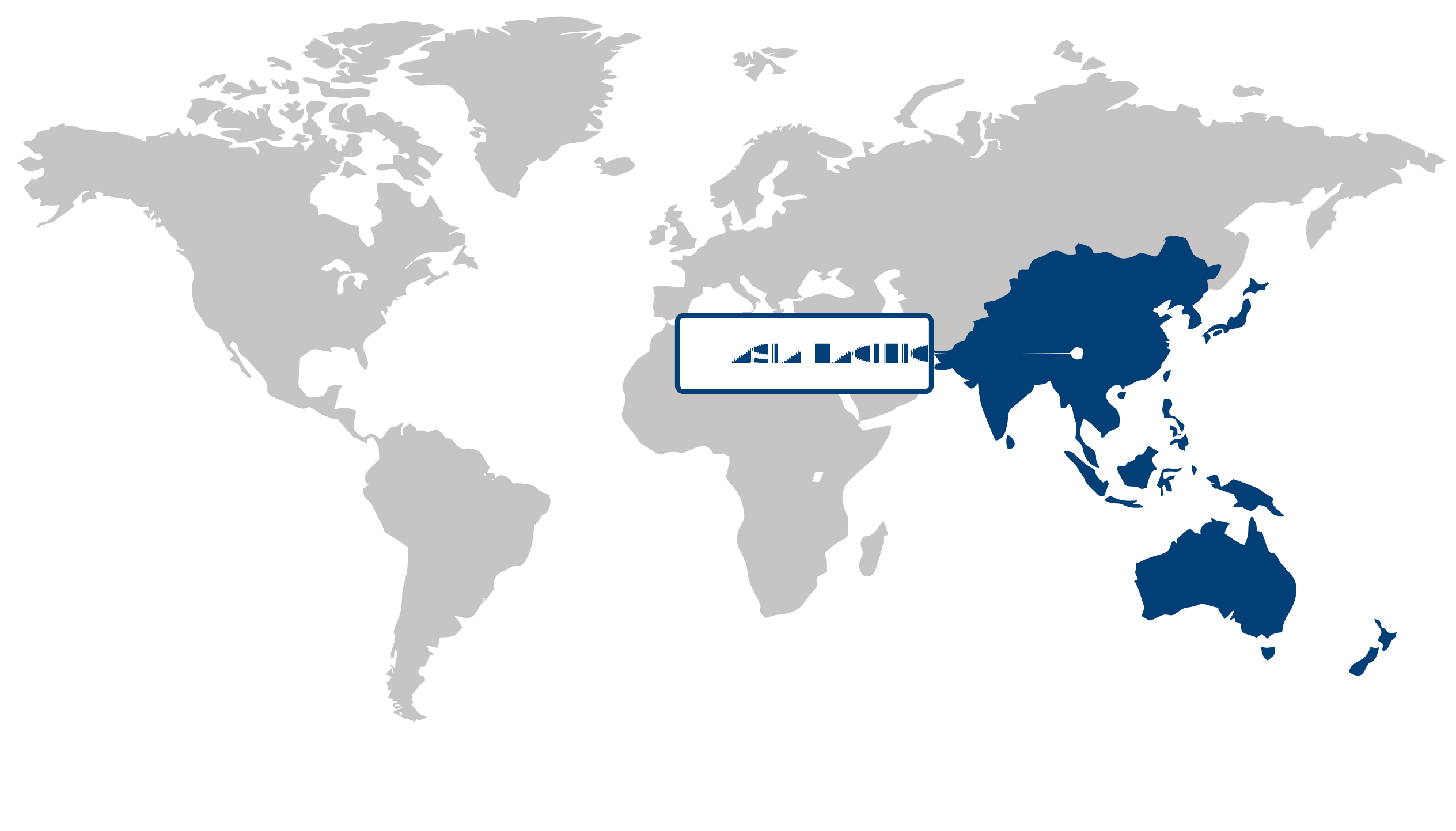
Largest Region
Asia Pacific
Largest Market Share in 2026
Asia Pacific (Largest Region) vs North America (Fastest-Growing Region)
In the DC switchgear market, Asia Pacific held the largest regional position in 2026, supported by rapid industrialization, expanding power infrastructure, and increasing investment in electricity transmission and distribution systems. The region's growing manufacturing base, expansion of renewable power generation, and development of data centers and other electricity-intensive facilities are creating greater requirements for reliable DC power management and protection equipment. Rising electrification across transportation, industrial facilities, and commercial infrastructure is further supporting demand for advanced switchgear solutions, while grid modernization initiatives are encouraging the deployment of more efficient and digitally enabled power distribution technologies.
North America is emerging as the fastest-growing regional market, driven by investments in grid modernization, renewable energy integration, and the expansion of data center and industrial infrastructure. Increasing electricity demand and the need to improve grid resilience are encouraging utilities and infrastructure operators to upgrade aging electrical systems and adopt advanced protection and switching technologies. The expansion of distributed energy resources and electrification across multiple applications is also creating new opportunities for DC switchgear, particularly where dependable power management and improved operational efficiency are priorities.
No card data available for this language/report.
Segment Leadership and Growth Trends
Voltage Segment Analysis: < 750 V (Largest Segment) vs ≥ 10,000 V (Fastest-Growing Segment)
Holding the largest share of the DC switchgear market, the below 750 V voltage segment accounted for 60% in 2026. Its dominance is driven by widespread deployment across low-voltage DC applications, including commercial buildings, industrial facilities, renewable energy systems, and data centers. The segment benefits from established infrastructure, cost-effective installation, and broad compatibility with distributed electrical systems, making it the preferred choice for a wide range of power management applications.
The 10,000 V and above voltage segment is projected to register the fastest growth as demand increases for high-capacity DC transmission and advanced utility-scale power infrastructure. Expanding renewable energy integration, large battery energy storage projects, and modernization of transmission networks are accelerating the adoption of high-voltage DC switchgear. Continuous advancements in insulation technologies and switching performance are further supporting the expansion of this segment.
Mounting Segment Analysis: Fixed Mounting (Largest Segment) vs Withdrawable Unit (Fastest-Growing Segment)
The fixed mounting segment led the market with the largest share in 2026. Its strong position is supported by its simple design, dependable performance, and lower installation and maintenance costs. Fixed-mounted switchgear is widely preferred in applications where operational requirements remain stable and long-term reliability is prioritized. Its broad use across industrial plants, commercial facilities, and utility installations continues to sustain demand.
The withdrawable unit segment is anticipated to witness the fastest growth due to rising demand for equipment that enables easier maintenance and minimizes operational downtime. The ability to replace or service switchgear components without shutting down the complete system makes withdrawable units particularly attractive for mission-critical power applications. Increasing emphasis on operational flexibility and workplace safety is further driving adoption.
Application Segment Analysis: Power Distribution (Largest Segment) vs Substation (Fastest-Growing Segment)
In the DC switchgear market, the power distribution segment held the largest share in 2026. The segment's leadership is attributed to the essential role of DC switchgear in ensuring reliable electricity distribution across industrial, commercial, and utility networks. Growing investments in renewable energy integration, data centers, and electrification projects continue to strengthen demand for efficient and dependable power distribution systems.
The substation segment is expected to expand at the fastest pace as utilities increasingly modernize electrical infrastructure to improve grid stability and accommodate renewable power sources. Rising investments in smart substations, high-voltage transmission projects, and advanced protection systems are supporting demand for specialized DC switchgear solutions capable of handling more complex operating environments.
| Report Segmentation | |||
| Segment | Sub-Segment | Largest Segment | Fastest Growing Segment |
|---|---|---|---|
| Voltage | < 750 V, ≥ 750 V to < 10,000 V, ≥ 10,000 V | < 750 V | ≥ 10,000 V |
| Mounting | Fixed Mounting, Plug-In, Withdrawable Unit | Fixed Mounting | Withdrawable Unit |
| Application | Power Generation, Substation, Power Distribution, Others | Power Distribution | Substation |
| Insulation | Air, Gas, Oil, Vacuum, Others | Air | Gas |
 Read our Research Approach
Competitive Landscape and Market Positioning
Prominent players in the DC switchgear market:
- ABB Ltd. (Switzerland)
- Siemens AG (Germany)
- Schneider Electric SE (France)
- Eaton Corporation plc (Ireland)
- General Electric Company (United States)
- Mitsubishi Electric Corporation (Japan)
- Hitachi Ltd. (Japan)
- Toshiba Corporation (Japan)
- Fuji Electric Co., Ltd. (Japan)
- Hyundai Electric & Energy Systems Co., Ltd. (South Korea)
Competitive priorities within the DC switchgear market are shifting toward solutions that can support increasingly diverse direct current applications while maintaining high operational reliability. Manufacturers are differentiating through advanced protection technologies, modular architectures, and designs that simplify integration into renewable energy systems, battery storage installations, and industrial power networks. The pace of electrification across multiple sectors is encouraging suppliers to broaden engineering capabilities and accelerate product development cycles, placing pressure on participants that rely on conventional product portfolios. At the same time, expertise in application-specific customization and compliance with demanding electrical safety requirements is becoming a meaningful source of competitive advantage.
Industry Development/News
| Company Name | Date | Key Development |
|---|---|---|
| Socomec | Oct-25 | Socomec announced a USD 10 million investment to establish a new manufacturing facility in India. This strategic expansion is designed to enhance the company's localized production capacity for electrical equipment and power management solutions, significantly strengthening its competitive positioning and operational footprint within the region's rapidly growing industrial infrastructure market. |
| Schneider Electric | Apr-24 | Schneider Electric partnered with Digital Realty to launch a dedicated circular economy initiative at the Paris 5 data center. The collaboration focuses on extending the operational lifespan of critical infrastructure components, including low-voltage and medium-voltage electrical switchgear and uninterruptible power supply units, supporting corporate environmental, social, and governance objectives. |
Why Choose Us
Specialized Expertise: Our team comprises industry experts with a deep understanding of your market segment. We bring specialized knowledge and experience that ensures our research and consulting services are tailored to your unique needs.
Customized Solutions: We understand that every client is different. That's why we offer customized research and consulting solutions designed specifically to address your challenges and capitalize on opportunities within your industry.
Proven Results: With a track record of successful projects and satisfied clients, we have demonstrated our ability to deliver tangible results. Our case studies and testimonials speak to our effectiveness in helping clients achieve their goals.
Cutting-Edge Methodologies: We leverage the latest methodologies and technologies to gather insights and drive informed decision-making. Our innovative approach ensures that you stay ahead of the curve and gain a competitive edge in your market.
Client-Centric Approach: Your satisfaction is our top priority. We prioritize open communication, responsiveness, and transparency to ensure that we not only meet but exceed your expectations at every stage of the engagement.
Continuous Innovation: We are committed to continuous improvement and staying at the forefront of our industry. Through ongoing learning, professional development, and investment in new technologies, we ensure that our services are always evolving to meet your evolving needs.
Value for Money: Our competitive pricing and flexible engagement models ensure that you get maximum value for your investment. We are committed to delivering high-quality results that help you achieve a strong return on your investment.
Select Licence Type

