Drip Coffee Maker Market Size & Growth Forecast 2027–2036, By Segments (Type, Application, Distribution Channel), Regional Demand Trends (North America, Asia Pacific, Europe), Key Country Insights (U.S., Japan, South Korea, Germany, France, Italy), and Competitive Landscape
Market Size and Growth Outlook
Drip Coffee Maker Market size was valued at USD 2.6 billion in 2026 and is projected to grow at a 3.33% CAGR from 2027 to 2036, exceeding USD 3.61 billion by 2036. The industry revenue for 2027 is estimated at USD 2.67 billion.
Get more details on this report
Request Free Sample ReportDrip Coffee Maker Market Intelligence Snapshot
Regional Market Dynamics
- Europe accounted for 34.41% of the market in 2026, supported by a strong household coffee culture, mature retail channels, and consistent replacement demand for brewing appliances.
- Asia Pacific is projected to grow at a 4.1% CAGR as home coffee consumption rises, retail access expands, and affordable drip coffee makers become more accessible through online and offline channels.
Segment Momentum
- Automatic drip coffee makers held a 58.55% share in 2026, driven by their ability to deliver consistent, convenient, and high-volume brewing with minimal user effort for everyday use.
- Residential is the fastest-growing application as more consumers prepare café-style coffee at home, increasing demand for convenient and personalized brewing solutions that fit evolving household routines.
Market Expansion Drivers
- Rising global coffee culture expansion driving household and commercial brewing equipment demand.
- Smart home appliance integration accelerating adoption of app-controlled coffee brewing systems.
- Premiumization of specialty coffee consumption increasing demand for precision brewing technologies.
Leading Market Participants
- Leading players in the drip coffee maker market include De'Longhi Appliances S.r.l. (Italy), Koninklijke Philips N.V. (Netherlands), Electrolux AB (Sweden), Spectrum Brands Holdings, Inc. (U.S.), illycaffè S.p.A. (Italy), Morphy Richards India Pvt. Ltd. (India), Breville Group Limited (Australia), Hamilton Beach Brands Holding Company (U.S.), SEB S.A. (France), Espresso Supply, Inc. (U.S.).
Global Market Forecast Snapshot
Market Outlook
- 2026 Market Size: USD 2.6 billion
- 2027 Estimated Market Size: USD 2.67 billion.
- Projected Market Size: USD 3.61 billion by 2036
- Growth Forecast: 3.33% CAGR (2027-2036)
Regional and Segment Outlook
- Leading Regional Market: Europe
- High-Growth Regional Hub: Asia Pacific
- Core Revenue Segment: Automatic (Type) | Commercial (Application) | Offline (Distribution Channel)
- Emerging Opportunity Segment: Manual (Type) | Residential (Application) | Online (Distribution Channel)
Market Growth Drivers and Industry Trends
Rising global coffee culture expansion driving household and commercial brewing equipment demand
The growing integration of coffee into everyday routines and social occasions is expanding demand for convenient brewing equipment, supporting the drip coffee maker market across both residential and commercial settings. Coffee consumption has become increasingly associated with lifestyle, hospitality, workplace routines, and at-home leisure, encouraging consumers to recreate café-style experiences using accessible brewing appliances. Drip systems remain attractive because they can prepare multiple servings with relatively straightforward operation, making them suitable for households, offices, hotels, restaurants, and other establishments where consistent coffee preparation is required. The spread of coffee culture across emerging consumer markets is also introducing more households to dedicated brewing equipment, while established coffee-consuming markets continue to support replacement and upgrade purchases.
Smart home appliance integration accelerating adoption of app-controlled coffee brewing systems
Connected appliance ecosystems are creating new opportunities for the drip coffee maker market as consumers become more comfortable managing household devices through smartphones and digital platforms. Integration with mobile applications, remote controls, programmable schedules, notifications, and connected home systems can make coffee preparation more convenient by allowing users to configure brewing routines around their daily schedules. Smart functionality also gives manufacturers opportunities to differentiate products through personalized settings, usage monitoring, and integration with broader connected-home experiences. As consumers increasingly expect kitchen appliances to offer intuitive digital controls and greater automation, connected brewing features can make advanced drip coffee makers more appealing to technology-oriented households.
Premiumization of specialty coffee consumption increasing demand for precision brewing technologies
The shift toward higher-quality and more personalized coffee experiences is encouraging consumers to invest in equipment capable of producing greater consistency and control, thereby supporting the drip coffee maker market. Specialty coffee consumers increasingly consider factors such as water temperature, brewing duration, extraction consistency, serving size, and programmable preparation when selecting brewing equipment. Manufacturers are responding with technologies designed to provide more precise control while preserving the convenience associated with automated drip brewing. This premiumization trend also extends beyond dedicated coffee enthusiasts, as consumers seeking café-inspired beverages at home become more willing to consider higher-specification appliances that complement their preferred beans, roast profiles, and brewing routines.
| Growth Driver | Impact on CAGR | Regulatory Influence | Geographic Relevance | Adoption Rate | Impact Timeline |
|---|---|---|---|---|---|
| Rising global coffee culture expansion driving household and commercial brewing equipment demand | 1.60% | Low | Europe, Asia Pacific | High | Near Term |
| Smart home appliance integration accelerating adoption of app-controlled coffee brewing systems | 1.40% | Low | North America, Europe | Medium | Mid Term |
| Premiumization of specialty coffee consumption increasing demand for precision brewing technologies | 1.50% | Low | North America, Europe | Medium | Mid Term |
Unlock insights tailored to your business with our bespoke market research solutions.
Click to get your customized report now.
Regional Demand Dynamics
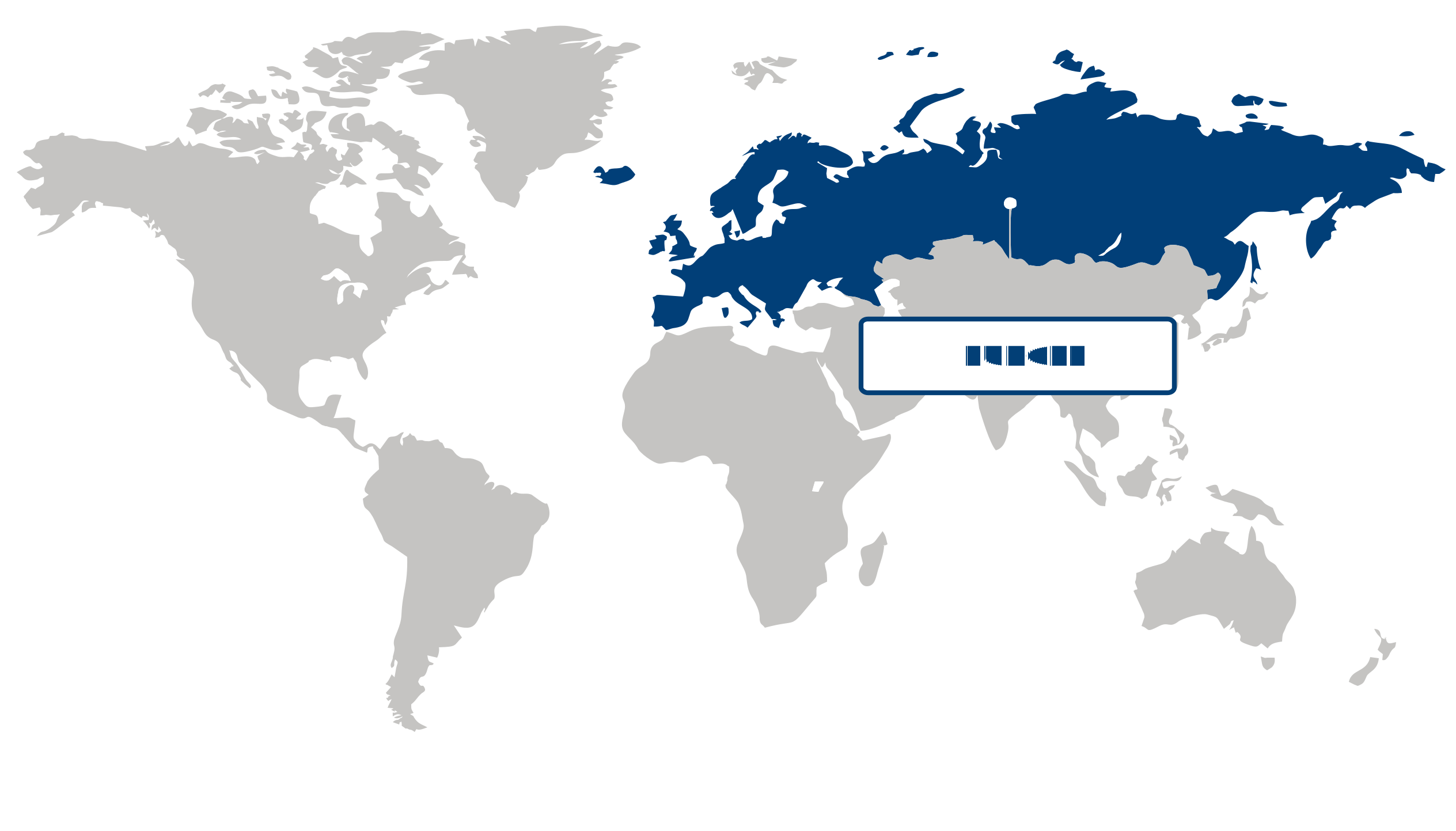
Europe (Largest Region)
Europe held the largest share of the drip coffee maker market at 34.41% in 2026, reflecting its strong coffee culture, established household appliance market, and consumer preference for convenient home-brewing solutions. Coffee consumption is deeply integrated into everyday lifestyles across the region, supporting sustained demand for appliances that provide consistent preparation with limited manual effort. Increasing interest in preparing café-style beverages at home is also encouraging consumers to invest in reliable brewing equipment, while appliance manufacturers are emphasizing ease of use, energy efficiency, programmable functions, and contemporary designs. The presence of mature retail networks and strong consumer awareness of kitchen appliances further supports product penetration, particularly as households seek convenient solutions that fit into increasingly fast-paced routines.
Asia Pacific (Fastest-Growing Region)
Asia Pacific is experiencing the fastest growth in the drip coffee maker market as coffee consumption expands beyond traditional tea-oriented markets and younger urban consumers increasingly adopt home-brewing habits. Rising disposable incomes, changing lifestyles, and the growing influence of café culture are encouraging consumers to experiment with different coffee preparation methods. E-commerce platforms are also making coffee makers more accessible by expanding product variety and enabling consumers to compare features and prices conveniently. In addition, the expansion of residential urban living and growing interest in convenient kitchen appliances are creating favorable conditions for compact and easy-to-operate brewing equipment. Manufacturers can further benefit from this trend by developing products tailored to regional preferences, including versatile brewing features and designs suited to modern households.
| Parameter | North America | Asia Pacific | Europe | Latin America | MEA |
|---|---|---|---|---|---|
| Innovation Hub i Scale Nascent Developing Advanced | |||||
| Cost-Sensitive Region i Scale Low Medium High | |||||
| Regulatory Environment i Scale Restrictive Neutral Supportive | |||||
| Demand Drivers i Scale Weak Moderate Strong | |||||
| Development Stage i Scale Emerging Developing Developed | |||||
| Adoption Rate i Scale Low Medium High | |||||
| New Entrants / Startups i Scale Sparse Moderate Dense | |||||
| Macro Indicators i Scale Weak Stable Strong |
Key Country Insights
Germany 🇩🇪
Energy Efficient DesignGermany places strong emphasis on durable and energy-efficient drip coffee makers, encouraging manufacturers to incorporate eco-friendly materials and precise temperature control. German consumers also favor compact appliances that fit modern kitchens while maintaining high brewing consistency.
France 🇫🇷
Café Culture AdaptationIn France, drip coffee makers are increasingly positioned as complementary appliances for consumers seeking café-style beverages at home. Product differentiation in France is centered on design appeal, ease of use, and brewing capabilities that accommodate evolving coffee consumption habits.
Italy 🇮🇹
Specialty Coffee ConvenienceItaly's drip coffee maker market is gradually expanding beyond traditional espresso preferences, supported by demand for convenient brewing solutions and specialty coffee preparation. Manufacturers in Italy are introducing premium designs and customizable settings to attract consumers experimenting with diverse coffee formats.
Japan 🇯🇵
Compact Precision BrewingJapan's drip coffee maker market prioritizes compact designs and precision brewing functions suited to smaller households and discerning coffee preferences. Manufacturers in Japan increasingly integrate advanced extraction settings and minimalist aesthetics to appeal to consumers seeking convenience without sacrificing quality.
South Korea 🇰🇷
Smart Kitchen IntegrationSouth Korea is seeing stronger demand for drip coffee makers that integrate with connected home ecosystems and multifunctional kitchen appliances. Consumers in South Korea show growing interest in stylish, feature-rich models that support personalized brewing and premium at-home coffee experiences.
United States 🇺🇸
Premium Home BrewingThe U.S. drip coffee maker market is increasingly centered on premium household appliances with programmable features, app connectivity, and specialty brewing modes. Consumers in the U.S. continue to replace basic machines with higher-value products that align with café-style coffee consumption at home.
Segment Leadership and Growth Trends
Drip Coffee Maker Market Share (%), by Type, 2026
Go beyond the chart, access full insights & data tables
Request Free Sample ReportType Segment Analysis: Automatic (Largest Segment) vs Manual (Fastest-Growing Segment)
The automatic segment dominated the drip coffee maker market with a 58.55% share in 2026, reflecting strong consumer preference for convenience, consistency, and simplified brewing. Automatic machines reduce the effort required to prepare coffee by managing key brewing steps with limited user intervention, making them suitable for households, workplaces, and other routine-use environments. Consistent preparation and ease of operation are particularly valuable for consumers seeking reliable coffee without extensive brewing expertise. Continued interest in convenient home appliances and time-efficient beverage preparation further supports the segment's leading position.
Manual drip coffee makers are gaining traction among consumers who place greater emphasis on brewing control, customization, and the overall coffee preparation experience. Manual preparation allows users to adjust aspects of the brewing process according to personal preferences, appealing to enthusiasts who are more engaged with coffee quality and technique. The growing interest in specialty coffee and hands-on brewing methods is creating greater demand for equipment that provides flexibility rather than full automation. This shift toward personalized beverage preparation is strengthening the appeal of manual drip coffee makers.
Application Segment Analysis: Commercial (Largest Segment) vs Residential (Fastest-Growing Segment)
Commercial applications represented the largest share of the drip coffee maker market at 56.65% in 2026, supported by demand from offices, hospitality establishments, foodservice venues, and other professional environments where coffee preparation is a regular operational requirement. Commercial users prioritize dependable equipment, consistent beverage quality, and efficient preparation to serve multiple consumers throughout the day. Drip brewing is particularly suitable for environments requiring convenient preparation and straightforward operation. Growing workplace and hospitality demand for readily available coffee further sustains the importance of commercial applications.
Residential use is expanding as consumers increasingly recreate café-style coffee experiences within their homes. Greater interest in specialty coffee, personalized brewing, and convenient home beverage preparation is encouraging households to invest in drip coffee equipment. Residential users also benefit from the flexibility to select preferred coffee varieties and control brewing according to individual tastes. As coffee culture becomes more integrated into everyday home routines, the residential segment is gaining momentum through greater emphasis on quality, convenience, and personalized preparation.
| Segment | Sub-Segment | Largest Segment | Fastest Growing |
|---|---|---|---|
| Type | Automatic, Manual | Automatic | Manual |
| Application | Residential, Commercial | Commercial | Residential |
| Distribution Channel | Offline, Online | Offline | Online |
Competitive Landscape and Market Positioning
Key companies in the drip coffee maker market:
1. De'Longhi Appliances S.r.l. (Italy)
2. Koninklijke Philips N.V. (Netherlands)
3. Electrolux AB (Sweden)
4. Spectrum Brands Holdings Inc. (U.S.)
5. illycaffè S.p.A. (Italy)
6. Morphy Richards India Pvt. Ltd. (India)
7. Breville Group Limited (Australia)
8. Hamilton Beach Brands Holding Company (U.S.)
9. SEB S.A. (France)
10. Espresso Supply Inc. (U.S.)
Brewing precision improvements are shaping the drip coffee maker market, where consistency and flavor extraction efficiency are key development priorities. Smart appliance integration is enhancing user control and convenience. In the drip coffee maker market, automation in brewing systems is improving home coffee experiences.
| Company | Market Share | Company Revenue | Revenue CAGR (%) | Product Portfolio | Geographic Presence | Innovation / R&D Focus | Strategic Developments |
|---|---|---|---|---|---|---|---|
| De'Longhi Appliances S.r.l. (Italy) | |||||||
| Koninklijke Philips N.V. (Netherlands) | |||||||
| Electrolux AB (Sweden) | |||||||
| Spectrum Brands Holdings Inc. (U.S.) | |||||||
| illycaffè S.p.A. (Italy) | |||||||
| Morphy Richards India Pvt. Ltd. (India) | |||||||
| Breville Group Limited (Australia) | |||||||
| Hamilton Beach Brands Holding Company (U.S.) | |||||||
| SEB S.A. (France) | |||||||
| Espresso Supply Inc. (U.S.). |
Industry Development/News
| Company Name | Date | Key Development |
|---|---|---|
| Hario | May-26 | Hario launched an updated V60 brewing system featuring proprietary technology designed to enhance pour-over extraction. This development reinforces the company’s focus on technical innovation within the premium specialty coffee segment, responding to rising consumer interest in advanced, barista-quality brewing methods that offer greater control over coffee preparation. |
| Aarke | Apr-26 | Aarke entered the premium drip coffee maker segment with the release of a new, design-oriented appliance. By combining aesthetic engineering with sophisticated brewing functions, the company is positioning itself to capture demand from high-end residential consumers seeking feature-rich, integrated coffee solutions as part of their home kitchen environments. |
| Fellow | Jun-25 | Fellow introduced the Aiden coffee maker, a premium system designed to advance home brewing capabilities through technology-focused design. The launch signifies a strategic push to differentiate its product portfolio within the competitive high-end drip coffee segment, leveraging precision features that cater to the evolving demands of specialty coffee enthusiasts. |
| Ninja | Jul-24 | Ninja launched the Luxe Café, a versatile three-in-one coffee system capable of brewing drip coffee, espresso, and cold brew. By integrating advanced features like 25 grind settings and automated dosing, the device addresses the consumer shift toward multi-functionality and convenience in home brewing, expanding the company's competitive footprint across multiple coffee segments. |
| De’Longhi America | May-23 | De’Longhi introduced the TrueBrew automatic drip machine, featuring patented Bean Extract Technology that enables fully automated grinding and brewing. The appliance includes an integrated Auto-Clean function and eliminates the need for disposable filters, representing a significant innovation in operational efficiency and sustainability within the residential drip coffee market. |
Customize Your Report
Explore examples of how this report can be tailored to different research needs, including custom segments, additional topics or chapters, and related reports. Click a section of the wheel or its numbered marker to explore the available options.
Drip Coffee Maker Market — Custom Segments
| Segment | Sub-Segment |
|---|---|
| Price Range | Economy, Mid-Range, Premium |
| Brewing Capacity | Single-Serve, Small-Batch, Full-Carafe |
| Consumer Usage Intensity | Occasional Users, Regular Users, Heavy Users |
Drip Coffee Maker Market — Custom TOC
| Custom Chapter | Custom Details |
|---|---|
| Home Coffee Consumption Trend Assessment |
|
| Smart Coffee Maker Adoption Strategy |
|
| Premium Coffee Equipment Opportunity Analysis |
|
Need a different cut of the data?
Request Custom ResearchHow big is the drip coffee maker market?
What is the expected industry size of drip coffee maker by 2036?
How is global coffee culture expansion influencing demand for drip coffee makers across household and commercial segments?
How are smart appliance features impacting purchase decisions in the drip coffee maker market?
Why are Automatic drip coffee makers the leading segment in the drip coffee maker market?
Why is Residential the fastest-growing application in the drip coffee maker market?
Why does Europe dominate the drip coffee maker market?
What factors are fueling drip coffee maker market growth in Asia Pacific?
Who are the major participants shaping the drip coffee maker landscape?
Our Clients
"The report provided us with a clear direction, and the level of detail was beyond what we expected. I would definitely recommend their services to others."
Haier Appliances
"The collaboration with Fundamental Business Insights has added significant value to our decision-making process, and we look forward to continuing this partnership for our future market research requirements."
Luxottica Group S.p.A.
"The team at FBI delivered an exceptional research report. The insights on industry innovations were particularly impressive and added a lot of value to the overall report."
Nike
Our Research Team & Methodology
Every Fundamental Business Insights report is built by a dedicated vertical research team, validated through a structured primary-and-secondary methodology, and reviewed for accuracy before it reaches you.
Research Team Overview
Prepared by the Consumer Goods & Services Research Team
Delivery
Published
Demand
Available
Support
Trust & Compliance
Research Domains
10 coverage areasResearch Intelligence
| Source | Reference |
|---|---|
| International Organization for Standardization (ISO) | www.iso.org |
| ASTM International | www.astm.org |
| U.S. Consumer Product Safety Commission (CPSC) | www.cpsc.gov |
| European Commission – Consumer Safety | ec.europa.eu/safety-gate |
| Consumer Technology Association (CTA) | www.cta.tech |
| National Retail Federation (NRF) | nrf.com |
| World Retail Congress | www.worldretailcongress.com |
| World Travel & Tourism Council (WTTC) | wttc.org |
| UN Tourism | www.unwto.org |
| Personal Care Products Council (PCPC) | www.personalcarecouncil.org |
| Cosmetics Europe | cosmeticseurope.eu |
| International Housewares Association (IHA) | www.housewares.org |
| American Apparel & Footwear Association (AAFA) | www.aafaglobal.org |
| World Federation of the Sporting Goods Industry (WFSGI) | wfsgi.org |
| Juvenile Products Manufacturers Association (JPMA) | www.jpma.org |
| Pet Industry Joint Advisory Council (PIJAC) | pijac.org |
| International Council of Toy Industries (ICTI) | www.toy-icti.org |
| International Association of Amusement Parks and Attractions (IAAPA) | iaapa.org |
| Organisation for Economic Co-operation and Development (OECD) | www.oecd.org |
| World Bank Data | data.worldbank.org |
Research Workflow & Quality Assurance
Data Collection
Verified information gathered through primary and secondary research.
Data Triangulation
Cross-validation using multiple independent data sources.
Forecast Modelling
Market estimates developed using historical trends and analytical models.
Analyst Validation
Findings reviewed by domain experts for accuracy and consistency.
Editorial & Quality Review
Final editorial, quality, and compliance checks before publication.
Final Publication
Released after successful completion of the internal review process.
Report Coverage
📊 Market Assessment
- Market Size & Forecast
- Market Segmentation
- Regional Analysis
- Growth Drivers & Challenges
- Market Dynamics
🏢 Competitive Intelligence
- Competitive Landscape
- Company Profiles
- Competitive Benchmarking
- Mergers & Acquisitions
- Market Share Analysis or Key Company Strategies
🔍 Strategic Analysis
- Value Chain Analysis
- Porter's Five Forces
- PESTLE Analysis
- Pricing Trends
- Supply-Demand Analysis
🚀 Future Outlook
- Technology Landscape
- Regulatory Landscape
- Investment & Funding Landscape
- Emerging Opportunities
- Future Market Outlook
Have a question about this report or need a custom scope?
Request Customization