



Electric Cargo Bikes Market Size & Growth Forecast 2027–2036, By Segments (Product, Application), Regional Demand Trends (North America, Asia Pacific, Europe), Key Country Insights (U.S., Japan, South Korea, Germany, France, Italy), and Competitive Landscape
Market Size and Growth Outlook
Electric Cargo Bikes Market size was valued at USD 2.1 billion in 2026 and is projected to grow at a 21.66% CAGR from 2027 to 2036, attaining USD 14.92 billion by 2036. The industry revenue for 2027 is estimated at USD 2.48 billion.
Base Year Value (2026)
USD 2.1 billion
CAGR (2027-2036)
21.66%
Forecast Year Value (2036)
USD 14.92 billion

Historical Data Period
2022-2026

Largest Region
Europe

Forecast Period
2027-2036
Electric Cargo Bikes Market Intelligence Snapshot:
-
Regional Market Dynamics:
- Europe leads with 42.93% share due to strong cycling infrastructure, dense urban delivery networks, and widespread adoption in last-mile logistics under congestion-driven mobility conditions.
- Asia Pacific is growing at 24.31% CAGR due to rapid urbanization, rising delivery density, and adoption of cost-efficient electric cargo bikes by small businesses and logistics operators.
-
Segment Momentum:
- Two-wheeled models held a 44.52% share in 2026 because they offer excellent maneuverability, easier parking, and compatibility with urban cycling infrastructure, making them ideal for routine city delivery operations.
- Personal use is expanding fastest as consumers increasingly replace short car trips with cargo e-bikes that can conveniently carry children, groceries, and household items in urban environments.
-
Market Expansion Drivers:
- Rapid growth of e-commerce and last-mile delivery driving commercial cargo bike adoption.
- Urban sustainability initiatives and emissions regulations accelerating green mobility transition.
- Rising fuel costs and urban congestion boosting shift toward electric micro-mobility solutions.
-
Leading Market Participants:
Major players in the electric cargo bikes market include Rad Power Bikes Inc. (United States), Riese & Müller GmbH (Germany), Tern Bicycles (Taiwan), Yuba Bicycles LLC (United States), Butchers & Bicycles ApS (Denmark), Douze Cycles (France), Carla Cargo Engineering GmbH (Germany), Cero Bikes Ltd. (United Kingdom).
Global Market Forecast Snapshot:
-
Market Outlook:
- 2026 Market Size: USD 2.1 billion
- 2027 Estimated Market Size: USD 2.48 billion.
- Projected Market Size: USD 14.92 billion by 2036
- Growth Forecasts: 21.66% CAGR (2027-2036)
-
Regional and Segment Outlook:
- Leading Regional Market: Europe
- High-Growth Regional Hub: Asia Pacific
- Core Revenue Segment: Two-Wheeled (Product) | Commercial (Application)
- Emerging Opportunity Segment: Four-Wheeled (Product) | Personal (Application)
Market Growth Drivers and Industry Trends
Rapid growth of e-commerce and last-mile delivery driving commercial cargo bike adoption
The continued expansion of online shopping is increasing the need for efficient delivery solutions capable of navigating dense urban areas and completing frequent short-distance trips. The electric cargo bikes market is gaining traction among delivery operators because these vehicles can transport goods while accessing streets and locations that may be difficult for larger commercial vehicles. Their compact dimensions and suitability for repeated urban routes support applications such as parcel delivery, grocery distribution, food delivery, and local retail fulfillment, where operational flexibility and access to congested neighborhoods are important.
Urban sustainability initiatives and emissions regulations accelerating green mobility transition
Municipal efforts to reduce transport-related emissions are encouraging businesses and urban fleets to consider cleaner alternatives for short-distance logistics. Within the electric cargo bikes market, sustainability programs and emissions regulations can improve the operating environment for electric-powered delivery vehicles by encouraging low-emission transportation and limiting the use of conventional vehicles in selected urban zones. Cargo bikes also support efforts to improve air quality and reduce road-space requirements, making them relevant to city logistics strategies focused on cleaner and more efficient movement of goods.
Rising fuel costs and urban congestion boosting shift toward electric micro-mobility solutions
Higher operating costs for conventional delivery vehicles are encouraging fleet operators and independent businesses to examine more efficient transportation options for urban trips. Rising fuel expenses will boost the electric cargo bikes market as electric drivetrains provide a practical alternative for frequent short-distance journeys, while the ability to maneuver through congested streets can reduce logistical difficulties associated with larger vehicles. Their suitability for narrow roads, dense commercial districts, and areas with limited parking further supports adoption among businesses seeking flexible urban delivery methods.
| Growth Driver Assessment Framework | |||||
| Growth Driver | Impact On CAGR | Regulatory Influence | Geographic Relevance | Adoption Rate | Impact Timeline |
|---|---|---|---|---|---|
| Rapid growth of e-commerce and last-mile delivery driving commercial cargo bike adoption | 2.20% | Moderate | Europe, Asia Pacific | High | Near Term |
| Urban sustainability initiatives and emissions regulations accelerating green mobility transition | 2.00% | High | Europe, North America | High | Near Term |
| Rising fuel costs and urban congestion boosting shift toward electric micro-mobility solutions | 1.60% | Moderate | Europe, Asia Pacific | High | Mid Term |
Unlock insights tailored to your business with our bespoke market research solutions - Click to get your customized report now!
Regional Demand Dynamics
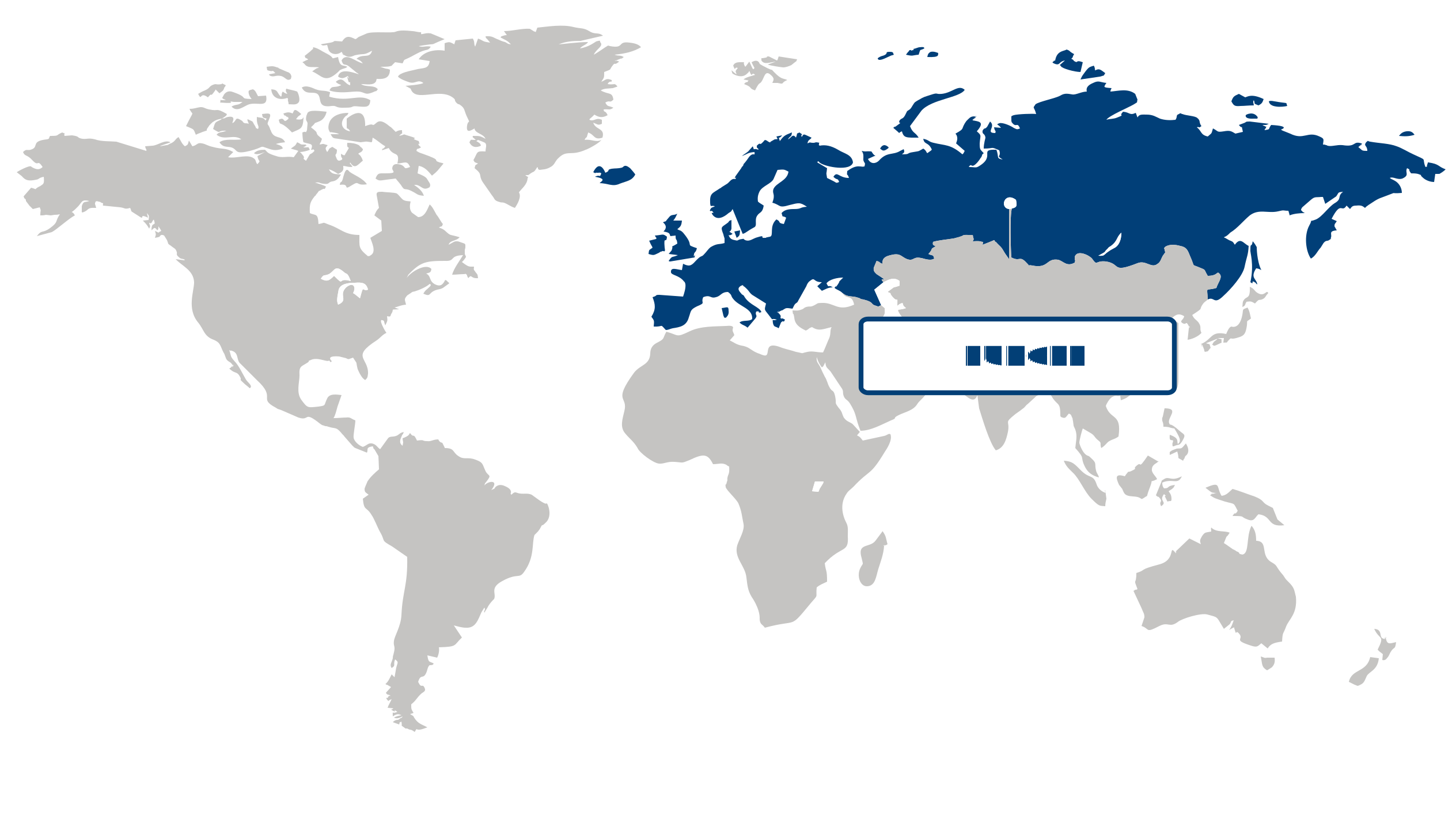
Largest Region
Europe
42.93% Market Share in 2026
Europe (Largest Region) vs Asia Pacific (Fastest-Growing Region)
Europe dominated the electric cargo bikes market in 2026, accounting for 42.93% in 2026, supported by established cycling infrastructure, strong environmental awareness, and growing demand for low-emission urban transportation. Electric cargo bikes are increasingly being used for last-mile deliveries, family transportation, local commerce, and urban logistics because they can provide flexible mobility while reducing reliance on conventional vehicles in congested areas. Municipal interest in sustainable mobility and continued development of cycling-friendly infrastructure are further supporting adoption. Asia Pacific is the fastest-growing region, driven by rapid urbanization, expanding e-commerce activity, and increasing demand for efficient last-mile transportation. The growth of delivery services and urban logistics is creating new applications for electric cargo bikes, particularly where congestion and operating efficiency are important considerations. Increasing interest in cleaner transportation, expanding cycling infrastructure, and improvements in electric mobility technologies are expected to encourage broader adoption across the region.
Key Country Insights
The U.S. market is increasingly adopting electric cargo bikes for last-mile logistics and neighborhood delivery services as retailers and courier companies seek alternatives to vans in dense cities. Municipal incentives and pilot programs are encouraging wider commercial fleet deployment.
In Japan, electric cargo bikes are gaining traction for local deliveries and family mobility where space constraints favor compact transportation solutions. Demand is shaped by dense urban environments and the need for practical alternatives to conventional delivery vehicles.
South Korea is exploring electric cargo bikes within smart city initiatives and sustainable urban logistics programs. The country is seeing growing interest from food delivery operators and local businesses seeking low-emission transport solutions for congested metropolitan areas.
Germany is integrating electric cargo bikes into urban freight strategies, supported by municipal subsidies and established cycling infrastructure. Businesses in Germany are using cargo bikes for parcel distribution and service operations to reduce congestion and improve delivery efficiency.
France is promoting electric cargo bikes through urban mobility policies that encourage low-emission transportation for commercial deliveries. Companies in France are increasingly adopting cargo bikes to comply with city restrictions on conventional vehicles and improve delivery flexibility.
Italy is witnessing rising use of electric cargo bikes among local retailers and food delivery providers serving historic city centers with limited vehicle access. Italian municipalities are supporting cleaner urban logistics, creating favorable conditions for cargo bike adoption.
Segment Leadership and Growth Trends
Product Segment Analysis: Two-Wheeled (Largest Segment) vs Four-Wheeled (Fastest-Growing Segment)
Two-wheeled electric cargo bikes held the largest share of the electric cargo bikes market in 2026 at 44.52%, supported by their maneuverability, compact footprint, and suitability for urban delivery and short-distance transportation. Their ability to navigate congested streets and access areas where larger vehicles may face restrictions makes them practical for many cargo applications. Growing interest in low-emission urban mobility and efficient last-mile transportation continues to support widespread adoption.
Four-wheeled electric cargo bikes are growing at the fastest pace as businesses and users seek greater carrying capacity, stability, and flexibility for cargo transportation. Their larger platform can accommodate more substantial loads while providing an alternative to conventional delivery vehicles for suitable routes. Increasing demand for sustainable last-mile logistics and the need for efficient urban delivery solutions are creating stronger opportunities for four-wheeled configurations.
Application Segment Analysis: Commercial (Largest Segment) vs Personal (Fastest-Growing Segment)
Commercial applications represented the largest share of the electric cargo bikes market in 2026, driven by demand from delivery services, retail businesses, logistics operators, and other organizations seeking efficient urban transportation. Electric cargo bikes can reduce reliance on conventional delivery vehicles while offering maneuverability in congested urban environments. The growth of last-mile delivery and increasing pressure to improve urban logistics efficiency are supporting strong commercial adoption.
Personal applications are growing at the fastest rate as consumers increasingly consider electric cargo bikes for household transportation, shopping, recreation, and family mobility. Their ability to combine passenger and cargo carrying functions provides a practical alternative to conventional personal transport for certain urban trips. Rising interest in sustainable mobility and growing awareness of versatile electric transportation options are encouraging greater household adoption.
| Report Segmentation | |||
| Segment | Sub-Segment | Largest Segment | Fastest Growing Segment |
|---|---|---|---|
| Product | Two-Wheeled, Three-Wheeled, Four-Wheeled | Two-Wheeled | Four-Wheeled |
| Application | Personal, Commercial | Commercial | Personal |
 Read our Research Approach
Competitive Landscape and Market Positioning
Prominent players in the electric cargo bikes market:
1. Rad Power Bikes Inc. (United States)
2. Riese & Müller GmbH (Germany)
3. Tern Bicycles (Taiwan)
4. Yuba Bicycles LLC (United States)
5. Butchers & Bicycles ApS (Denmark)
6. Douze Cycles (France)
7. Carla Cargo Engineering GmbH (Germany)
8. Cero Bikes Ltd. (United Kingdom)
The electric cargo bikes market is growing rapidly due to increasing demand for sustainable urban mobility solutions. In this market, innovation in battery efficiency and load capacity is improving performance. Expanding logistics applications are strengthening adoption trends.
Industry Development/News
| Company Name | Date | Key Development |
|---|---|---|
| Vok Bikes | May-25 | Vok Bikes formed a strategic partnership with Renault Group to utilize the Flins Refactory facility in France for manufacturing expansion. This collaboration aims to scale production capabilities for electric commercial cargo bikes, with significant manufacturing output and operational impact projected to commence from 2026, strengthening the company's industrial footprint in the European market. |
| Vok Bikes | May-25 | Vok Bikes successfully secured $6 million in Series A funding to accelerate the deployment of its electric cargo bike fleet across major European cities. The capital injection is strategically targeted at supporting the transition from conventional delivery vans to more efficient, low-emission cargo bike logistics, enhancing the company’s commercial scalability and market presence. |
| Evri | Apr-25 | Evri announced a £19 million capital investment to expand its electric cargo bike and electric vehicle delivery fleet. This strategic move aims to bolster the company's sustainable last-mile delivery operations across the UK, reflecting a broader organizational shift toward electrification and the integration of micro-mobility solutions within its established distribution network. |
| Sparqle | May-25 | Sustainable logistics platform Sparqle raised €1.2 million to facilitate the expansion of its low-emission delivery network across Europe. The investment underscores the increasing commercial viability of cargo-bike-based logistics services and provides the necessary capital to scale operations, supporting the broader market transition toward decarbonized urban delivery infrastructure. |
| Amazon | Jun-25 | Amazon expanded its sustainable last-mile delivery network by launching electric cargo bike operations in Washington, D.C. This deployment represents a strategic effort to optimize urban delivery logistics, mitigate the impacts of urban congestion, and align operations with corporate carbon reduction targets through the adoption of specialized micromobility hardware. |
| Lime / Cargo Cycling | May-25 | Lime integrated Cargo Cycling’s Chariot FS2 trikes into its battery-swapping infrastructure. This adoption signifies the growing utility of electric cargo bikes for specialized urban service logistics, demonstrating a shift toward utilizing high-capacity, purpose-built cycling solutions for operational fleet maintenance and efficiency in densely populated urban environments. |
Why Choose Us
Specialized Expertise: Our team comprises industry experts with a deep understanding of your market segment. We bring specialized knowledge and experience that ensures our research and consulting services are tailored to your unique needs.
Customized Solutions: We understand that every client is different. That's why we offer customized research and consulting solutions designed specifically to address your challenges and capitalize on opportunities within your industry.
Proven Results: With a track record of successful projects and satisfied clients, we have demonstrated our ability to deliver tangible results. Our case studies and testimonials speak to our effectiveness in helping clients achieve their goals.
Cutting-Edge Methodologies: We leverage the latest methodologies and technologies to gather insights and drive informed decision-making. Our innovative approach ensures that you stay ahead of the curve and gain a competitive edge in your market.
Client-Centric Approach: Your satisfaction is our top priority. We prioritize open communication, responsiveness, and transparency to ensure that we not only meet but exceed your expectations at every stage of the engagement.
Continuous Innovation: We are committed to continuous improvement and staying at the forefront of our industry. Through ongoing learning, professional development, and investment in new technologies, we ensure that our services are always evolving to meet your evolving needs.
Value for Money: Our competitive pricing and flexible engagement models ensure that you get maximum value for your investment. We are committed to delivering high-quality results that help you achieve a strong return on your investment.
Select Licence Type

