Electro-Mechanical Energy Storage Systems Market Size & Growth Forecast 2027–2036, By Segments (Technology, Application), Regional Demand Trends (North America, Asia Pacific, Europe), Key Country Insights (U.S., Japan, South Korea, Germany, France, Italy), and Competitive Landscape
Market Size and Growth Outlook
Electro-Mechanical Energy Storage Systems Market size was assessed at USD 2.92 Billion in 2026 and is poised to grow at 8.48% CAGR between 2027 and 2036, surpassing USD 6.59 Billion by 2036. The industry revenue for 2027 is calculated at USD 3.13 Billion.
Get more details on this report
Request Free Sample ReportElectro-Mechanical Energy Storage Systems Market Intelligence Snapshot
Regional Market Dynamics
- Europe led in 2026, supported by renewable energy integration, grid modernization, energy transition investments, and demand for flexible storage to improve grid stability.
- Accelerating renewable deployment, expanding electricity networks, industrialization, and investments in transmission, distribution, and decentralized power are increasing demand for grid-flexibility solutions.
Segment Momentum
- Flywheel technology leads the market because it delivers rapid response, high power density, reliable cycling performance, low maintenance, and efficient short-duration energy storage for utilities and industrial facilities.
- Renewable capacity firming is the fastest-growing application as expanding wind and solar generation increases demand for solutions that stabilize variable renewable power and improve grid reliability.
Market Expansion Drivers
- Renewable energy integration driving large-scale electro-mechanical storage deployment
- Grid stability concerns increasing demand for long-duration mechanical storage solutions
- Industrial backup power requirements accelerating adoption of hybrid storage systems
Leading Market Participants
- Prominent players in the electro-mechanical energy storage systems market include ABB Ltd. (Switzerland), Siemens AG (Germany), General Electric Company (United States), Hitachi Energy Ltd. (Switzerland), Toshiba Corporation (Japan), Panasonic Corporation (Japan), Samsung SDI Co., Ltd. (South Korea), LG Energy Solution Ltd. (South Korea), Fluence Energy, Inc. (United States), Johnson Controls International plc (Ireland)
Global Market Forecast Snapshot
Market Outlook
- 2026 Market Size: USD 2.92 Billion
- 2027 Estimated Market Size: USD 3.13 Billion
- Projected Market Size: USD 6.59 Billion by 2036
- Growth Forecast: 8.48% CAGR (2027-2036)
Regional and Segment Outlook
- Leading Regional Market: Europe
- High-Growth Regional Hub: Asia Pacific
- Core Revenue Segment: Flywheel (Technology) | Electric Energy Time Shift (Application)
- Emerging Opportunity Segment: CAES (Technology) | Renewable Capacity Firming (Application)
Market Growth Drivers and Industry Trends
Renewable energy integration driving large-scale electro-mechanical storage deployment
The rapid expansion of renewable electricity generation is creating greater demand for storage technologies capable of balancing intermittent power production and maintaining reliable grid operations. The electro-mechanical energy storage systems market growth is driven by utilities and energy developers integrating large-scale mechanical storage solutions to absorb excess renewable generation and supply electricity when production declines. These systems play an important role in improving grid flexibility while enabling higher penetration of renewable energy sources within modern power networks.
Grid stability concerns increasing demand for long-duration mechanical storage solutions
Power systems are increasingly challenged by fluctuating electricity demand, variable renewable generation, and evolving grid operating conditions that require dependable long-duration storage capabilities. Within the electro-mechanical energy storage systems market, these concerns are encouraging investment in storage technologies that provide sustained energy delivery, frequency regulation, and system balancing over extended operating periods. Grid operators are incorporating mechanical storage solutions into network planning to strengthen reliability while supporting efficient management of changing electricity supply patterns.
Industrial backup power requirements accelerating adoption of hybrid storage systems
Industrial facilities require resilient energy infrastructure capable of maintaining operational continuity during unexpected power disruptions and fluctuations in electricity supply. This requirement will boost the electro-mechanical energy storage systems market by increasing the adoption of hybrid storage systems that combine mechanical energy storage with complementary technologies to enhance backup power performance. Such integrated solutions improve operational reliability while providing industrial users with greater flexibility in managing critical processes that depend on uninterrupted electrical availability.
| Growth Driver | Impact on CAGR | Regulatory Influence | Geographic Relevance | Adoption Rate | Impact Timeline |
|---|---|---|---|---|---|
| Renewable energy integration driving large-scale electro-mechanical storage deployment | 2% | High | Europe, Asia Pacific | High | Near Term |
| Grid stability concerns increasing demand for long-duration mechanical storage solutions | 1.7% | High | North America, Europe | High | Mid Term |
| Industrial backup power requirements accelerating adoption of hybrid storage systems | 1.5% | Moderate | Asia Pacific | Medium | Mid Term |
Unlock insights tailored to your business with our bespoke market research solutions.
Click to get your customized report now.
Regional Demand Dynamics
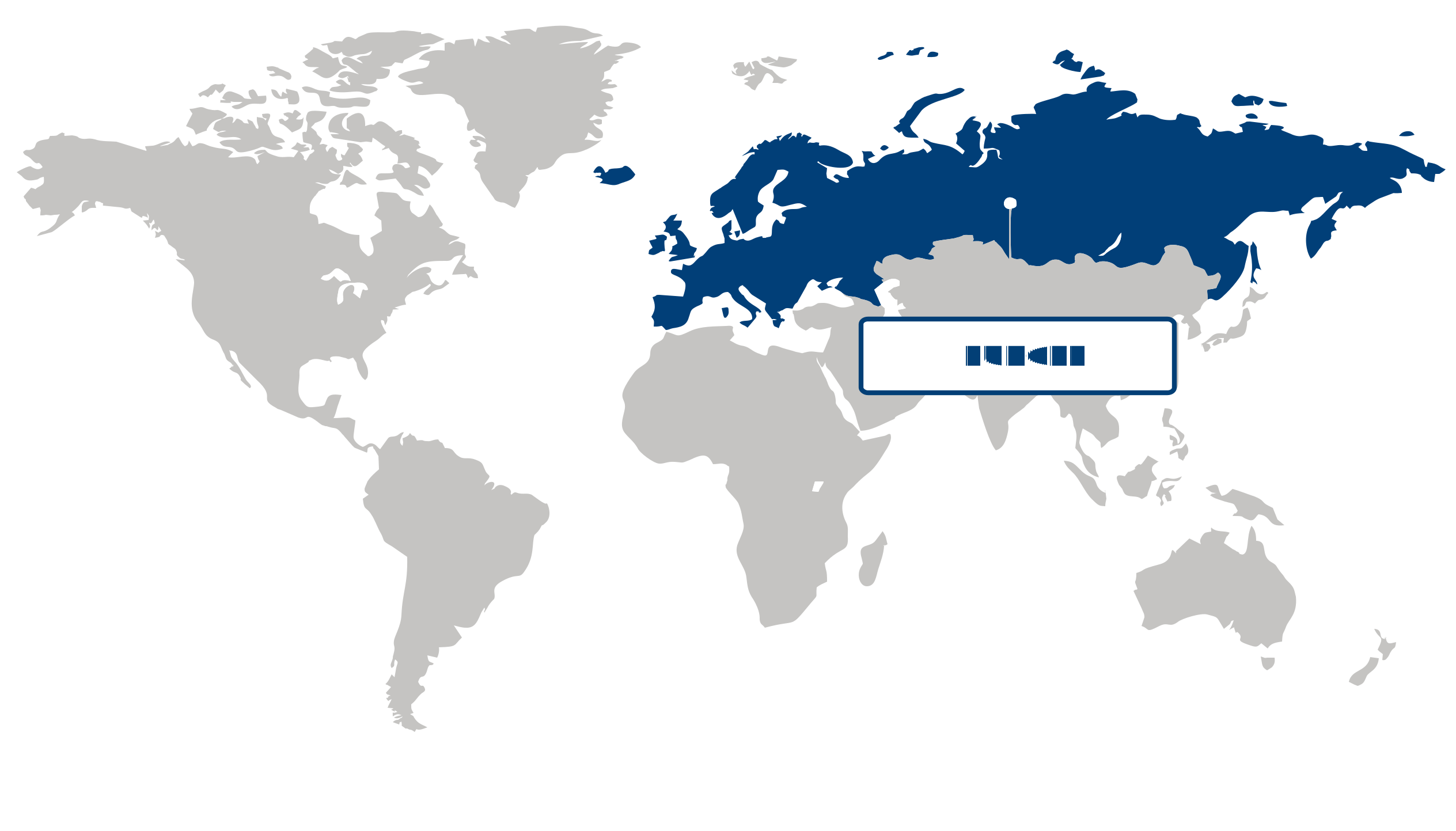
Europe (Largest Region)
Europe led the electro-mechanical energy storage systems market in 2026, supported by strong renewable energy integration, grid modernization initiatives, and growing requirements for flexible electricity storage. The increasing penetration of intermittent solar and wind generation is creating a greater need for technologies that can balance supply and demand while improving grid stability. Investments in energy transition infrastructure, coupled with efforts to strengthen energy security and reduce dependence on conventional fuels, are supporting deployment of mechanical and electro-mechanical storage technologies. The region's focus on resilient and flexible power systems is further encouraging adoption across utility and industrial applications.
Asia Pacific (Fastest-Growing Region)
Asia Pacific is expected to experience the fastest growth, driven by accelerating renewable energy deployment, expanding electricity networks, and rising industrial power requirements. Rapid industrialization and urban development are increasing the need for reliable energy infrastructure, while the integration of variable renewable generation is creating demand for storage solutions capable of supporting grid flexibility. Investments in modern transmission and distribution systems, energy transition projects, and decentralized power generation are also broadening opportunities for electro-mechanical storage, particularly in markets seeking greater grid reliability and improved utilization of renewable electricity.
| Parameter | North America | Asia Pacific | Europe | Latin America | MEA |
|---|---|---|---|---|---|
| Innovation Hub i Scale Nascent Developing Advanced | |||||
| Cost-Sensitive Region i Scale Low Medium High | |||||
| Regulatory Environment i Scale Restrictive Neutral Supportive | |||||
| Demand Drivers i Scale Weak Moderate Strong | |||||
| Development Stage i Scale Emerging Developing Developed | |||||
| Adoption Rate i Scale Low Medium High | |||||
| New Entrants / Startups i Scale Sparse Moderate Dense | |||||
| Macro Indicators i Scale Weak Stable Strong |
Key Country Insights
United States 🇺🇸
Grid Flexibility ApplicationsIn the U.S., electro-mechanical energy storage systems are being evaluated for grid balancing, renewable integration, and infrastructure resilience. Developers are prioritizing scalable technologies capable of delivering rapid response and long operating lifecycles across utility applications.
Germany 🇩🇪
Renewable Balancing SolutionsGermany is exploring electro-mechanical energy storage systems to strengthen renewable energy integration and improve grid stability. Investment is focused on technologies that provide efficient frequency regulation and complement the country's expanding clean energy infrastructure.
Japan 🇯🇵
Resilient Energy InfrastructureJapan is advancing electro-mechanical energy storage systems that enhance energy security and support resilient electricity networks. Market activity favors highly reliable storage technologies suitable for both grid stabilization and critical infrastructure applications.
South Korea 🇰🇷
Advanced Storage InnovationSouth Korea is supporting electro-mechanical energy storage systems through industrial innovation and modernization of power infrastructure. Companies are developing efficient storage platforms that integrate with digital grid management and renewable electricity resources.
France 🇫🇷
Low-Carbon Grid SupportFrance is assessing electro-mechanical energy storage systems as part of broader efforts to improve grid flexibility and accommodate variable renewable generation. Technology providers are emphasizing operational efficiency, durability, and compatibility with evolving transmission networks.
Italy 🇮🇹
Renewable Grid IntegrationItaly is expanding interest in electro-mechanical energy storage systems to strengthen renewable energy integration across regional electricity networks. Market priorities include dependable long-duration operation and flexible deployment that supports evolving grid management requirements.
Segment Leadership and Growth Trends
Electro-Mechanical Energy Storage Systems Market Share (%), by Technology, 2026
Go beyond the chart, access full insights & data tables
Request Free Sample ReportTechnology Segment Analysis: Flywheel (Largest Segment) vs CAES (Fastest-Growing Segment)
The flywheel technology segment held the largest share in 2026, driven by its ability to deliver rapid response times, high power density, and reliable cycling performance for grid support applications. Flywheel systems are widely deployed where frequent charge-discharge cycles, low maintenance requirements, and long operational lifespans are critical. Their capability to provide instantaneous power while maintaining high operational efficiency has made them a preferred technology for utilities and industrial facilities seeking dependable short-duration energy storage solutions.
In the electro-mechanical energy storage systems market, the compressed air energy storage (CAES) technology segment is expected to witness the fastest growth as energy providers increasingly invest in large-scale storage systems capable of supporting long-duration energy balancing. Rising integration of renewable power generation, growing demand for grid flexibility, and the need to improve energy reliability are encouraging greater adoption of CAES technology. Ongoing advancements in system design and expanding investments in utility-scale energy storage infrastructure are further supporting the segment's growth.
Application Segment Analysis: Electric Energy Time Shift (Largest Segment) vs Renewable Capacity Firming (Fastest-Growing Segment)
Holding the largest share in 2026, the electric energy time shift application segment remains the leading application because it enables electricity generated during periods of lower demand to be stored and dispatched when consumption rises. This capability improves grid utilization, reduces peak load pressures, and enhances overall power system efficiency. Increasing emphasis on optimizing electricity supply while improving grid stability continues to support widespread deployment of electro-mechanical energy storage systems for time-shifting applications.
The renewable capacity firming application segment is anticipated to experience the fastest growth as the expansion of wind and solar generation increases the need for technologies that compensate for variable power output. Electro-mechanical energy storage systems help smooth fluctuations in renewable generation, improve grid reliability, and support consistent electricity delivery. As utilities accelerate renewable energy integration and modernize transmission infrastructure, demand for renewable capacity firming solutions is expected to strengthen considerably.
| Segment | Sub-Segment | Largest Segment | Fastest Growing |
|---|---|---|---|
| Technology | Flywheel, CAES | Flywheel | CAES |
| Application | Electric Energy Time Shift, Electric Supply Capacity, Black Start, Renewable Capacity Firming, Frequency Regulation, Others | Electric Energy Time Shift | Renewable Capacity Firming |
Competitive Landscape and Market Positioning
Key companies in the electro-mechanical energy storage systems market:
- ABB Ltd. (Switzerland)
- Siemens AG (Germany)
- General Electric Company (United States)
- Hitachi Energy Ltd. (Switzerland)
- Toshiba Corporation (Japan)
- Panasonic Corporation (Japan)
- Samsung SDI Co., Ltd. (South Korea)
- LG Energy Solution Ltd. (South Korea)
- Fluence Energy, Inc. (United States)
- Johnson Controls International plc (Ireland)
The competitive environment is increasingly defined by engineering specialization as suppliers focus on addressing different grid stability, industrial, and infrastructure applications with technologies optimized for distinct operating profiles. Rather than competing exclusively on storage capacity, market participants are differentiating through system responsiveness, operational longevity, maintenance efficiency, and integration with advanced energy management platforms. Increasing demand for resilient power systems is also driving investment in digital control capabilities and project-specific customization, shifting competitive advantage toward providers capable of delivering reliable, application-oriented storage solutions for evolving electricity networks.
| Company | Market Share | Company Revenue | Revenue CAGR (%) | Product Portfolio | Geographic Presence | Innovation / R&D Focus | Strategic Developments |
|---|---|---|---|---|---|---|---|
| ABB Ltd. (Switzerland) | |||||||
| Siemens AG (Germany) | |||||||
| General Electric Company (United States) | |||||||
| Hitachi Energy Ltd. (Switzerland) | |||||||
| Toshiba Corporation (Japan) | |||||||
| Panasonic Corporation (Japan) | |||||||
| Samsung SDI Co. Ltd. (South Korea) | |||||||
| LG Energy Solution Ltd. (South Korea) | |||||||
| Fluence Energy Inc. (United States) | |||||||
| Johnson Controls International plc (Ireland) |
Industry Development/News
| Company Name | Date | Key Development |
|---|---|---|
| Toshiba Corporation | May-22 | Toshiba Corporation introduced the 125 VDC SCiB ESS, an energy storage solution integrating LTO battery chemistry with a modular and flexible cabinet design. This innovation is engineered for seamless integration into DC load applications and Uninterruptible Power Systems, offering enhanced operational versatility and expandability. |
| Voith GmbH & Co, KGaA | Jan-22 | Voith GmbH & Co, KGaA strategically acquired a majority stake in Green Highland Renewables to expand its role in the maintenance, operation, and advancement of hydropower facilities. This acquisition strengthens the company's industry position, increases engagement in the hydropower sector, and bolsters capabilities to innovate and enhance renewable energy infrastructure. |
Customize Your Report
Explore examples of how this report can be tailored to different research needs, including custom segments, additional topics or chapters, and related reports. Click a section of the wheel or its numbered marker to explore the available options.
Electro-Mechanical Energy Storage Systems Market — Custom Segments
| Segment | Sub-Segment |
|---|---|
| Energy Storage Duration | Short-Duration, Medium-Duration, Long-Duration |
| System Configuration | Standalone Storage Systems, Renewable-Integrated Systems, Hybrid Energy Storage Systems |
| Grid Integration Level | Behind-the-Meter, Distribution-Grid Connected, Transmission-Grid Connected |
Electro-Mechanical Energy Storage Systems Market — Custom TOC
| Custom Chapter | Custom Details |
|---|---|
| Grid Integration & Revenue Opportunities |
|
| Project Economics & Investment Attractiveness |
|
| Second-Life & Recycling Ecosystem |
|
Need a different cut of the data?
Request Custom ResearchHow large is the electro-mechanical energy storage systems market?
What is the expected industry size of electro-mechanical energy storage systems by 2036?
How is renewable energy integration shaping demand for electro-mechanical energy storage systems?
Why are grid stability requirements accelerating investment in electro-mechanical energy storage?
Why does the flywheel technology segment hold the largest share of the electro-mechanical energy storage systems market?
Which application segment is growing the fastest in the electro-mechanical energy storage systems market?
Why does Europe lead the electro-mechanical energy storage systems market?
What is driving the fastest growth of electro-mechanical energy storage systems in Asia Pacific?
Who holds a significant market share in the electro-mechanical energy storage systems landscape?
Our Clients
"The information presented in the report was genuinely insightful. The data was clear and easy to understand, which made it much easier to interpret the findings."
Amara Raja Group
"The responsiveness and professionalism exhibited by the team were exemplary. They were readily available to address queries, provide clarifications, and offer additional insights."
ONGC
"The reports offered a comprehensive analysis of various segments within the market. The detailed insights into market trends, and regulatory landscapes were excellent."
TotalEnergies
Our Research Team & Methodology
Every Fundamental Business Insights report is built by a dedicated vertical research team, validated through a structured primary-and-secondary methodology, and reviewed for accuracy before it reaches you.
Research Team Overview
Prepared by the Energy & Power Research Team
Delivery
Published
Demand
Available
Support
Trust & Compliance
Research Domains
10 coverage areasResearch Intelligence
| Source | Reference |
|---|---|
| International Energy Agency (IEA) | www.iea.org |
| U.S. Energy Information Administration (EIA) | www.eia.gov |
| International Renewable Energy Agency (IRENA) | www.irena.org |
| International Electrotechnical Commission (IEC) | www.iec.ch |
| International Organization for Standardization (ISO) | www.iso.org |
| IEEE | www.ieee.org |
| CIGRE (International Council on Large Electric Systems) | www.cigre.org |
| World Energy Council (WEC) | www.worldenergy.org |
| U.S. Department of Energy (DOE) | www.energy.gov |
| International Atomic Energy Agency (IAEA) | www.iaea.org |
| American Petroleum Institute (API) | www.api.org |
| Society of Petroleum Engineers (SPE) | www.spe.org |
| Hydrogen Council | hydrogencouncil.com |
| Battery Council International (BCI) | batterycouncil.org |
| Global Wind Energy Council (GWEC) | gwec.net |
| SolarPower Europe | www.solarpowereurope.org |
| World Bioenergy Association (WBA) | worldbioenergy.org |
| International Hydropower Association (IHA) | www.hydropower.org |
| Edison Electric Institute (EEI) | www.eei.org |
| National Renewable Energy Laboratory (NREL) | www.nrel.gov |
Research Workflow & Quality Assurance
Data Collection
Verified information gathered through primary and secondary research.
Data Triangulation
Cross-validation using multiple independent data sources.
Forecast Modelling
Market estimates developed using historical trends and analytical models.
Analyst Validation
Findings reviewed by domain experts for accuracy and consistency.
Editorial & Quality Review
Final editorial, quality, and compliance checks before publication.
Final Publication
Released after successful completion of the internal review process.
Report Coverage
📊 Market Assessment
- Market Size & Forecast
- Market Segmentation
- Regional Analysis
- Growth Drivers & Challenges
- Market Dynamics
🏢 Competitive Intelligence
- Competitive Landscape
- Company Profiles
- Competitive Benchmarking
- Mergers & Acquisitions
- Market Share Analysis or Key Company Strategies
🔍 Strategic Analysis
- Value Chain Analysis
- Porter's Five Forces
- PESTLE Analysis
- Pricing Trends
- Supply-Demand Analysis
🚀 Future Outlook
- Technology Landscape
- Regulatory Landscape
- Investment & Funding Landscape
- Emerging Opportunities
- Future Market Outlook
Have a question about this report or need a custom scope?
Request Customization