Excipients Market Size & Growth Forecast 2027–2036, By Segments (Formulation, Product, Function), Regional Demand Trends (North America, Asia Pacific, Europe), Key Country Insights (U.S., Japan, South Korea, Germany, France, Italy), and Competitive Landscape
Jump to content
Market Size and Growth Outlook
Excipients Market size was valued at USD 11.12 billion in 2026 and is anticipated to grow at a 3.9% CAGR from 2027 to 2036, surpassing USD 16.3 billion by 2036. The industry revenue for 2027 is assessed at USD 11.49 billion.
Get more details on this report
Request Free Sample ReportExcipients Market Intelligence Snapshot
Regional Market Dynamics
- Europe held a 39.54% share in 2026 due to its mature pharmaceutical manufacturing sector, strong formulation expertise, and stringent quality standards supporting consistent demand for high-performance excipients.
- Asia Pacific is projected to expand at a 4.67% CAGR as pharmaceutical manufacturing capacity increases, boosting demand for functional excipients that improve manufacturability, formulation stability, and drug delivery performance.
Segment Momentum
- Oral formulations held a 58.26% share in 2026 because they dominate pharmaceutical manufacturing, relying on excipients for tablet binding, coating, stability, taste masking, and efficient large-scale production.
- Alcohols are the fastest-growing product segment as their roles in improving solubility, preservation, and processing efficiency support increasing use in liquid and semi-solid pharmaceutical formulations.
Market Expansion Drivers
- Rising demand for advanced drug formulations enhancing stability and bioavailability of therapies.
- Growth in biologics and targeted drug delivery systems increasing demand for functional excipients.
- Expansion of nanoparticle-based and sustained-release formulations driving excipient innovation.
Leading Market Participants
- Top players in the excipients market include BASF SE (Germany), Ashland Inc. (United States), Roquette Frères S.A. (France), Colorcon Inc. (United States), Eastman Chemical Company (United States), The Lubrizol Corporation (United States), FMC Corporation (United States), Avantor, Inc. (United States), Evonik Industries AG (Germany), DuPont de Nemours, Inc. (United States).
Global Market Forecast Snapshot
Market Outlook
- 2026 Market Size: USD 11.12 billion
- 2027 Estimated Market Size: USD 11.49 billion.
- Projected Market Size: USD 16.3 billion by 2036
- Growth Forecast: 3.9% CAGR (2027-2036)
Regional and Segment Outlook
- Leading Regional Market: Europe
- High-Growth Regional Hub: Asia Pacific
- Core Revenue Segment: Oral (Formulation) | Polymers (Product) | Binders (Function)
- Emerging Opportunity Segment: Topical (Formulation) | Alcohols (Product) | Lubricants and Glidants (Function)
Market Growth Drivers and Industry Trends
Rising demand for advanced drug formulations enhancing stability and bioavailability of therapies
Increasing emphasis on the development of advanced pharmaceutical formulations is supporting the excipients market as drug manufacturers seek materials that can improve the stability, performance, and delivery characteristics of therapeutic products. Excipients play important roles in formulation processes by supporting properties such as solubility, dissolution, preservation, viscosity, and drug release, which can influence the usability and effectiveness of finished medicines. As formulation technologies become more sophisticated, manufacturers require excipients with functional characteristics suited to increasingly complex active pharmaceutical ingredients and dosage forms. The need to address formulation challenges associated with drug stability and bioavailability is therefore encouraging greater utilization of specialized excipient technologies across pharmaceutical development and manufacturing.
Growth in biologics and targeted drug delivery systems increasing demand for functional excipients
The growing development of biologics and targeted drug delivery systems is creating new requirements for the excipients market because these therapies can present formulation and stability challenges that differ from those of conventional small-molecule medicines. Biologic products may require carefully controlled formulation environments to maintain structural integrity and therapeutic performance during processing and storage. Functional excipients can contribute to stabilization, protection, solubility, and controlled delivery, making them important components in the development of complex pharmaceutical products. At the same time, targeted delivery approaches require formulation materials capable of supporting specific release or delivery characteristics, encouraging pharmaceutical manufacturers to evaluate excipients based on their functional performance and compatibility with advanced therapeutic platforms.
Expansion of nanoparticle-based and sustained-release formulations driving excipient innovation
The increasing development of nanoparticle-based and sustained-release formulations is encouraging innovation within the excipients market as pharmaceutical developers seek materials capable of supporting controlled and specialized drug delivery. Nanoparticle formulations can require excipients that assist with particle stabilization, dispersion, surface characteristics, and drug-loading performance, while sustained-release systems depend on materials that regulate the release of active ingredients over an intended period. These formulation approaches can help address challenges associated with drug solubility, dosing frequency, and controlled delivery, but they also require excipient properties that are precisely matched to formulation objectives. Consequently, research into functional materials and improved excipient performance is becoming increasingly important as pharmaceutical development moves toward more sophisticated delivery platforms.
| Growth Driver | Impact on CAGR | Regulatory Influence | Geographic Relevance | Adoption Rate | Impact Timeline |
|---|---|---|---|---|---|
| Rising demand for pharmaceutical and food excipients | 1.30% | Short term (≤ 2 yrs) | North America, Europe | Medium | Fast |
| Innovations in excipient formulations | 1.40% | Medium term (2–5 yrs) | North America, Asia Pacific | Low | Moderate |
| Expansion of production capacity in emerging markets | 1.40% | Long term (5+ yrs) | Asia Pacific, Latin America | Low | Slow |
| Rising demand for advanced drug formulations enhancing stability and bioavailability of therapies | 2.20% | High | North America, Europe | High | Near Term |
| Growth in biologics and targeted drug delivery systems increasing demand for functional excipients | 2.00% | High | North America, Asia Pacific | High | Mid Term |
| Expansion of nanoparticle-based and sustained-release formulations driving excipient innovation | 1.60% | Moderate | Europe, Asia Pacific | Emerging | Long Term |
Unlock insights tailored to your business with our bespoke market research solutions.
Click to get your customized report now.
Regional Demand Dynamics
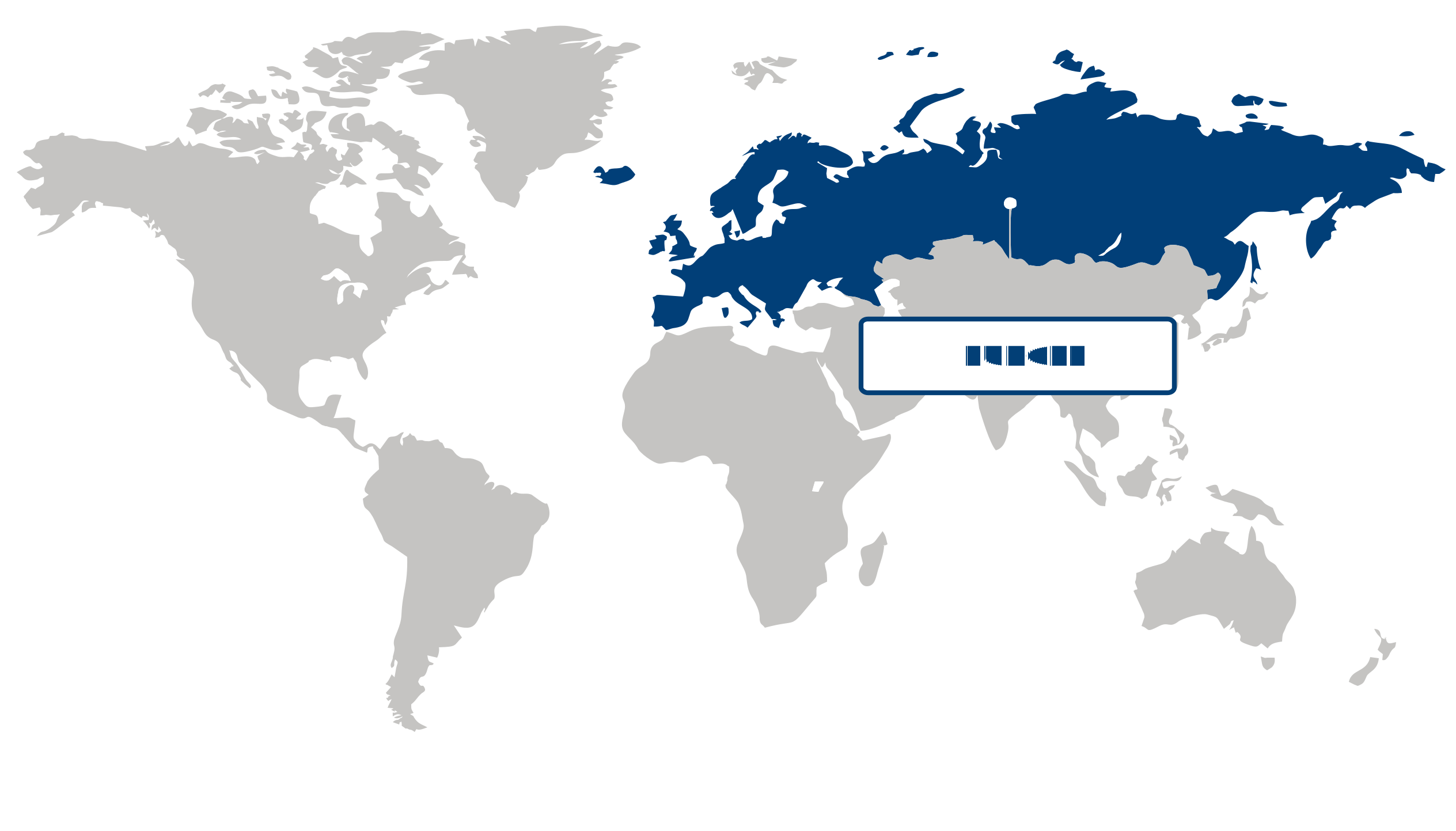
Europe (Largest Region)
Europe led the excipients market with a 39.54% share in 2026, reflecting its mature pharmaceutical manufacturing base, strong emphasis on medicine quality, and established regulatory environment. Excipients are essential for improving the stability, delivery, appearance, and manufacturability of pharmaceutical formulations, creating consistent demand across a broad range of drug products. The region's sophisticated pharmaceutical production capabilities and focus on stringent quality standards support the use of high-purity and specialized excipients. Growing development of advanced formulations, including modified-release and patient-friendly dosage forms, is also encouraging demand for functional excipients that can improve therapeutic performance and manufacturing efficiency.
Asia Pacific (Fastest-Growing Region)
Asia Pacific is the fastest-growing regional market as pharmaceutical production, healthcare access, and formulation capabilities continue to expand. Increasing investment in domestic drug manufacturing is creating greater demand for reliable pharmaceutical-grade excipients across both conventional and advanced formulations. The growing prevalence of chronic diseases is supporting pharmaceutical consumption, while expanding research and development capabilities are encouraging formulation innovation. Manufacturers are also seeking excipients that improve drug stability, bioavailability, and production efficiency as they develop more sophisticated dosage forms. Strengthening pharmaceutical infrastructure and rising demand for medicines across emerging markets are therefore creating substantial opportunities for excipient suppliers throughout Asia Pacific.
| Parameter | North America | Asia Pacific | Europe | Latin America | MEA |
|---|---|---|---|---|---|
| Innovation HubiScaleNascentDeveloping Advanced | |||||
| Cost-Sensitive RegioniScaleLowMedium High | |||||
| Regulatory EnvironmentiScaleRestrictiveNeutral Supportive | |||||
| Demand DriversiScaleWeakModerate Strong | |||||
| Development StageiScaleEmergingDeveloping Developed | |||||
| Adoption RateiScaleLowMedium High | |||||
| New Entrants / StartupsiScaleSparseModerate Dense | |||||
| Macro IndicatorsiScaleWeakStable Strong |
Key Country Insights
Germany 🇩🇪
Quality Manufacturing StandardsGermany prioritizes high-quality pharmaceutical excipients that support precision manufacturing and regulatory compliance. Suppliers focus on consistent material performance and robust quality systems to serve both innovative and established drug manufacturers.
France 🇫🇷
Specialized Pharmaceutical InputsFrance maintains steady demand for pharmaceutical excipients that enable sophisticated drug formulations and manufacturing reliability. Producers are prioritizing customized ingredient solutions that align with evolving pharmaceutical quality and regulatory requirements.
Italy 🇮🇹
Generic Medicine FormulationsItaly relies on high-quality excipients to support generic pharmaceuticals and contract manufacturing activities. Manufacturers are adopting versatile excipient portfolios that improve formulation efficiency while maintaining consistent product performance.
Japan 🇯🇵
High-Purity Ingredient FocusJapan emphasizes premium excipients designed for formulation consistency and pharmaceutical quality assurance. Companies continue investing in specialized materials that enhance dosage accuracy and support advanced drug development programs.
South Korea 🇰🇷
Biopharma Production SupportSouth Korea's excipients market is expanding alongside pharmaceutical manufacturing and biopharmaceutical development. Demand is increasing for functional excipients that improve production efficiency while supporting innovative dosage forms and therapeutic applications.
United States 🇺🇸
Advanced Formulation SupportThe U.S. excipients market is driven by pharmaceutical innovation and increasing demand for complex drug formulations. Manufacturers are developing multifunctional excipients that improve drug stability, manufacturability, and delivery performance while meeting stringent quality expectations.
Excipients Market Share (%), by Formulation, 2026
Go beyond the chart, access full insights & data tables
Request Free Sample ReportFormulation Segment Analysis: Oral (Largest Segment) vs Topical (Fastest-Growing Segment)
The oral segment dominated the excipients market, accounting for the largest share of 58.26% in 2026, supported by the extensive use of oral dosage forms across pharmaceutical therapies. Tablets and capsules require excipients to provide essential functions such as binding, flow enhancement, dissolution control, stability, and dose uniformity, creating consistent demand from formulation manufacturers. The established manufacturing infrastructure for oral medicines, combined with their convenience and broad therapeutic applicability, continues to reinforce the segment's strong position.
The topical segment is advancing rapidly as pharmaceutical development increasingly emphasizes localized delivery, ease of administration, and improved patient experience. Excipients play an important role in topical formulations by controlling viscosity, spreadability, texture, absorption, and stability. Growing development of creams, gels, ointments, and other externally administered therapies is encouraging demand for specialized excipient systems capable of supporting effective drug release and formulation performance.
Product Segment Analysis: Polymers (Largest Segment) vs Alcohols (Fastest-Growing Segment)
Polymers held the largest share of 48.43% in the excipients market in 2026, reflecting their broad functional versatility across pharmaceutical formulations. These materials can act as binders, coating agents, viscosity modifiers, stabilizers, and controlled-release components, allowing formulators to address diverse product requirements within a single excipient category. Their established role in conventional and modified-release dosage forms, together with increasing attention to formulation stability and performance, continues to support strong polymer utilization.
Alcohols represent the fastest-growing product segment as formulation developers increasingly require excipients that provide effective solubilization, processing flexibility, and stability support. Their functional properties make them valuable in formulations where active ingredients need to be incorporated efficiently while maintaining consistent product characteristics. The expanding complexity of pharmaceutical formulations and continued innovation in delivery approaches are creating additional opportunities for alcohol-based excipients.
| Segment | Sub-Segment | Largest Segment | Fastest Growing |
|---|---|---|---|
| Formulation | Oral, Topical, Parenteral, Others | Oral | Topical |
| Product | Polymers, Alcohols, Sugar, Minerals, Gelatin | Polymers | Alcohols |
| Function | Fillers and Diluents, Suspending & Viscosity Agents, Coating Agents, Binders, Flavoring Agents & Sweeteners, Disintegrants, Colorants, Lubricants and Glidants, Preservatives, Emulsifying Agents, Others | Binders | Lubricants and Glidants |
Competitive Landscape and Market Positioning
Major players in the excipients market:
1. BASF SE (Germany)
2. Ashland Inc. (United States)
3. Roquette Frères S.A. (France)
4. Colorcon Inc. (United States)
5. Eastman Chemical Company (United States)
6. The Lubrizol Corporation (United States)
7. FMC Corporation (United States)
8. Avantor Inc. (United States)
9. Evonik Industries AG (Germany)
10. DuPont de Nemours Inc. (United States)
The excipients market is advancing due to increasing demand for improved drug formulation efficiency and stability. Continuous innovation in formulation science is enhancing drug delivery performance. Collaborative research initiatives are supporting development of specialized excipient systems, while new product introductions are addressing complex pharmaceutical requirements. These developments are strengthening competitiveness in the excipients market.
| Company | Market Share | Company Revenue | Revenue CAGR (%) | Product Portfolio | Geographic Presence | Innovation / R&D Focus | Strategic Developments |
|---|---|---|---|---|---|---|---|
| BASF SE (Germany) | |||||||
| Ashland Inc. (United States) | |||||||
| Roquette Frères S.A. (France) | |||||||
| Colorcon Inc. (United States) | |||||||
| Eastman Chemical Company (United States) | |||||||
| The Lubrizol Corporation (United States) | |||||||
| FMC Corporation (United States) | |||||||
| Avantor Inc. (United States) | |||||||
| Evonik Industries AG (Germany) | |||||||
| DuPont de Nemours Inc. (United States). |
Industry Development / News
| Company Name | Date | Key Development |
|---|---|---|
| Ingredion | May-26 | Ingredion entered a strategic partnership with Sanstar Limited, involving a preferential equity investment and a joint venture agreement. The collaboration aims to scale production of specialty pharmaceutical excipients in India, combining local manufacturing expertise with global innovation resources to bolster supply chain capacity and market penetration in the region. |
| Safic-Alcan | May-26 | Safic-Alcan acquired a majority stake in S.A. Ingredients Private Limited to expand its specialty chemicals and excipients distribution footprint in India. This acquisition strengthens its regional supply chain and enhances service delivery for pharmaceutical customers, supporting growth across India’s rapidly expanding life sciences and formulation sectors. |
| Clariant | Mar-26 | Clariant opened a GMP-compliant polyethylene glycol (PEG) production facility at its Clear Lake, Texas site. As the company’s first US-based excipient manufacturing plant, this investment aims to enhance supply chain resilience and provide reliable access to high-quality, regulated excipients for pharmaceutical manufacturers across North and Latin America. |
| Univar Solutions | Mar-26 | Univar Solutions was appointed as a distributor for Ingredion Pharma Solutions across the United States and Canada. This partnership expands Univar’s pharmaceutical excipient portfolio, improving regional access to specialty ingredients and enhancing supply chain efficiency for pharmaceutical formulation customers throughout the North American market. |
| Daesang | Dec-25 | Daesang acquired German amino acid manufacturer Amino GmbH to facilitate entry into the pharmaceutical and biotechnology ingredients sector. The acquisition expands Daesang’s excipient-related portfolio and supports its corporate strategy to diversify into high-value life sciences markets through specialized amino acid-based formulation technologies. |
| Nitika Pharmaceutical Specialties | Jun-25 | The Technology Development Board granted financial support to Nitika Pharmaceutical Specialties under India’s PLI scheme. The funding is dedicated to scaling domestic manufacturing of 14 advanced excipients, a strategic effort to enhance local production capacity and reduce reliance on imported ingredients within the pharmaceutical supply chain. |
| BASF | Jun-25 | BASF inaugurated a GMP Solution Centre in Michigan to provide specialized support for pharmaceutical and biopharmaceutical formulation. By localizing advanced excipient technical support and bioprocessing services, the facility enhances BASF’s regional supply reliability and strengthens its competitive positioning within the North American pharmaceutical market. |
| Roquette | May-25 | Roquette completed the acquisition of IFF Pharma Solutions, significantly strengthening its global excipient portfolio and drug delivery capabilities. The integration consolidates advanced formulation expertise and broadens the company's product offerings, reinforcing its strategic position as a primary partner for pharmaceutical manufacturers seeking innovative drug delivery solutions. |
| JRS Pharma | Jul-24 | JRS Pharma and Gujarat Microwax established a new pharmaceutical excipient manufacturing facility in Mehsana, India. The project increases regional production capacity for specialty ingredients, addressing the growing demand for high-quality excipients and strengthening the regional supply chain for pharmaceutical manufacturing in the Indian market. |
| IMCD | Jan-24 | The Competition Commission of India approved IMCD India’s acquisition of an additional 30% stake in Signet Excipients. This transaction deepens IMCD’s control over its excipient distribution business, improving its capability to market and supply pharmaceutical ingredients throughout India’s formulation supply chain. |
Customize Your Report
Explore examples of how this report can be tailored to different research needs, including custom segments, additional topics or chapters, and related reports. Click a section of the wheel or its numbered marker to explore the available options.
Excipients Market — Custom Segments
| Segment | Sub-Segment |
|---|---|
| Source | Plant-Based, Animal-Based, Mineral-Based, Synthetic |
| Grade | Pharmaceutical Grade, Compendial Grade, Food Grade, Specialty Grade |
| End-User | Pharmaceutical Manufacturers, Biopharmaceutical Manufacturers, Nutraceutical Manufacturers, Contract Manufacturing Organizations |
Excipients Market — Custom TOC
| Custom Chapter | Chapter Details |
|---|---|
| Pharmaceutical Formulation Innovation Opportunities |
|
| Novel Excipient Adoption Landscape |
|
| Excipient Supply Chain Resilience Study |
|
Need a different cut of the data?
Request Custom ResearchFrequently Asked Questions
How large is the excipients market?
How will the excipients industry grow in terms of size and CAGR by 2036?
How are biologics and targeted therapies influencing formulation requirements in the excipients market?
What is driving innovation in excipients for advanced drug delivery systems in the excipients market?
Why is oral formulation the leading segment in the excipients market?
Which product segment is expanding the fastest in the excipients market?
Why does Europe dominate the excipients market?
What is supporting excipients market growth in Asia Pacific?
Who holds a significant market share in the excipients landscape?
Our Clients
"The report helped us understand emerging consumer trends in our product category. It clarified where to focus innovation for the next product launch."
LyondellBasell
"The regional forecast section was incredibly useful. We were able to identify two new potential partners in Europe thanks to the vendor mapping you included."
SABIC
"We appreciated how actionable the recommendations were. It guided us to improve supply chain resilience."
Olin Corporation
Our Research Team & Methodology
Every Fundamental Business Insights report is built by a dedicated vertical research team, validated through a structured primary-and-secondary methodology, and reviewed for accuracy before it reaches you.
Delivery
Published
Available
Support
- Market Size & Forecast
- Market Segmentation
- Regional Analysis
- Growth Drivers & Challenges
- Market Dynamics
- Competitive Landscape
- Company Profiles
- Competitive Benchmarking
- Mergers & Acquisitions
- Market Share Analysis or Key Company Strategies
- Value Chain Analysis
- Porter's Five Forces
- PESTLE Analysis
- Pricing Trends
- Supply-Demand Analysis
- Technology Landscape
- Regulatory Landscape
- Investment & Funding Landscape
- Emerging Opportunities
- Future Market Outlook