



Eyewear Frames Market Size & Growth Forecast 2026–2035, By Segments (Distribution Channel, Product, Type, Shape), Regional Demand Trends (North America, Asia Pacific, Europe), Key Country Insights (U.S., Japan, South Korea, Germany, France, Italy), and Competitive Landscape
Market Size and Growth Outlook
Base Year Value (2025)
USD 40.38 Billion
CAGR (2026-2035)
6.1%
Forecast Year Value (2035)
USD 73 Billion

Historical Data Period
2022-2025

Largest Region
Europe

Forecast Period
2026-2035
Eyewear Frames Market Intelligence Snapshot:
-
Regional Market Dynamics:
- Europe accounted for 36.51% of the market in 2025, supported by mature optical retail networks, strong branded product demand, and steady replacement purchases across corrective and fashion segments.
- Asia Pacific is projected to grow at a 6.89% CAGR as expanding optical retail, digital commerce, rising vision correction needs, and broader access to affordable stylish frames boost adoption.
-
Segment Momentum:
- The Offline channel held a 62.08% share in 2025 because consumers value in-person fitting, style comparison, and professional guidance, particularly when purchasing prescription-related eyewear frames.
- Metal frames are growing fastest as consumers increasingly prefer lighter designs, refined construction, and minimalist styling, making them an attractive alternative to traditional plastic-based frames.
-
Market Expansion Drivers:
- Rising vision impairment cases due to digital screen exposure increasing corrective eyewear demand globally.
- Growing fashion-driven eyewear adoption transforming frames into lifestyle and luxury accessories.
- Expanding adoption of sustainable bio-based frame materials supporting eco-friendly eyewear product innovation.
-
Leading Market Participants:
Key companies in the eyewear frames market include EssilorLuxottica SA (France), Safilo Group S.p.A. (Italy), Marchon Eyewear, Inc. (United States), Marcolin S.p.A. (Italy), De Rigo Vision S.p.A. (Italy), Fielmann AG (Germany), Silhouette International Schmied AG (Austria), Charmant Group (Japan), Warby Parker Inc. (United States), Kenmark Eyewear, Inc. (United States).
Global Market Forecast Snapshot:
-
Market Outlook:
- 2025 Market Size: USD 40.38 Billion
- Projected Market Size: USD 73 Billion by 2035
- Growth Forecasts: 6.1% CAGR (2026-2035)
-
Regional and Segment Outlook:
- Leading Regional Market: Europe
- High-Growth Regional Hub: Asia Pacific
- Core Revenue Segment: Offline (Distribution Channel) | Plastic/Acetate (Product) | Full-Rim Frames (Type) | Square/Rectangular Frames (Shape)
- Emerging Opportunity Segment: Online (Distribution Channel) | Metal (Product) | Rimless Frames (Type) | Cat-Eye Frames (Shape)
Market Growth Drivers and Industry Trends
Rising vision impairment cases due to digital screen exposure increasing corrective eyewear demand globallyLonger daily exposure to phones, laptops, and other digital devices is increasing eye strain, blurred vision, and the frequency of vision testing, which directly feeds replacement and first-time purchase activity in the eyewear frames market. As more consumers are prescribed corrective lenses earlier and use eyewear for both work and daily life, frame purchases shift from occasional medical necessity to a more regular buying cycle shaped by comfort, fit, durability, and compatibility with prescription lenses. This is increasing demand for the eyewear frames market through optical retailers, clinics, and online prescription channels that increasingly position frames as an essential part of vision management rather than a discretionary accessory.
Growing fashion-driven eyewear adoption transforming frames into lifestyle and luxury accessories
Consumer behavior in the eyewear frames market is being reshaped by the idea of frames as visible style markers, not just functional supports for lenses. That change encourages shoppers to own multiple pairs for different looks, trade up to premium materials and branded designs, and respond more quickly to seasonal trends, collaborations, and influencer-led styling cues. The result is stronger product segmentation spanning mass, premium, and luxury price points, with fashion orientation supporting market expansion by raising average selling values and widening the customer base beyond those purchasing frames solely for vision correction.
Expanding adoption of sustainable bio-based frame materials supporting eco-friendly eyewear product innovation
Material innovation is becoming a practical route to differentiation in the eyewear frames market as brands respond to consumer scrutiny around plastics, waste, and product sourcing. Bio-based acetates, recycled inputs, and other lower-impact materials give manufacturers a way to refresh collections without relying only on styling changes, while also helping retailers present sustainability as a tangible purchase criterion. This is influencing market adoption by aligning product development with evolving buyer preferences, especially in premium and design-led segments where material story, craftsmanship, and environmental positioning can shape brand selection and support higher-value frame purchases.
| Growth Driver Assessment Framework | |||||
| Growth Driver | Impact On CAGR | Regulatory Influence | Geographic Relevance | Adoption Rate | Impact Timeline |
|---|---|---|---|---|---|
| Rising vision impairment cases due to digital screen exposure increasing corrective eyewear demand globally | 2.00% | High | Europe, North America, Asia Pacific | High | Near Term |
| Growing fashion-driven eyewear adoption transforming frames into lifestyle and luxury accessories | 1.80% | Low | Europe, North America | High | Mid Term |
| Expanding adoption of sustainable bio-based frame materials supporting eco-friendly eyewear product innovation | 1.50% | Moderate | Europe, North America, Asia Pacific | Medium | Long Term |
Unlock insights tailored to your business with our bespoke market research solutions - Click to get your customized report now!
Regional Demand Dynamics
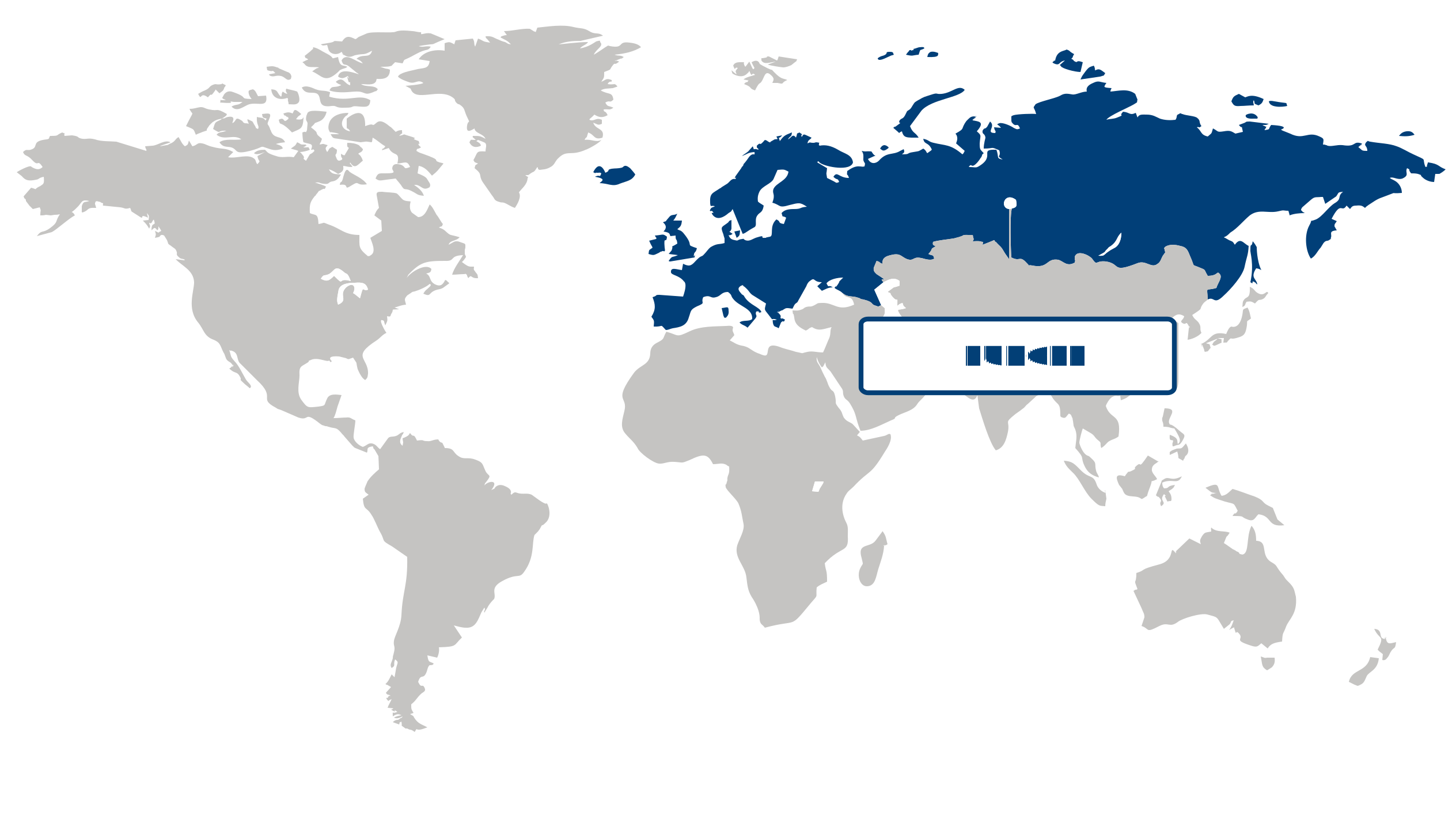
Largest Region
Europe
36.51% Market Share in 2025
Europe held a 36.51% share of the eyewear frames market in 2025, reflecting the region’s entrenched retail networks, strong brand presence, and steady replacement demand across prescription and fashion-oriented purchases. Market leadership is bolstered by a mature optical distribution structure that combines optician chains, independent stores, and premium fashion channels, allowing manufacturers to sustain volume across both corrective and style-led segments. The region’s established consumer preference for branded and design-focused products also helps maintain consistent product turnover, particularly where frame purchases are tied to eye care consultations and regular lens updates.
Asia Pacific is projected to expand at a 6.89% CAGR over the forecast period, with the eyewear frames market gaining momentum as consumer access broadens across both organized optical retail and digital commerce platforms. Growth is being impelled by rising eyewear adoption in densely populated urban markets, where increasing vision correction needs and stronger demand for affordable yet stylish frames are bringing new buyers into the category. The region’s acceleration is also tied to practical purchasing shifts, including wider product availability across price tiers and faster uptake of online-to-offline buying patterns that make frame selection more accessible.
Key Country Insights
The U.S. eyewear frames market is influenced by consumer interest in fashion-oriented designs, premium materials, and personalized eyewear options. Brands and retailers are expanding product variety while integrating comfort, durability, and style considerations to address changing consumer preferences.
Japan’s eyewear frames market is shaped by demand for refined designs, lightweight materials, and precision manufacturing. Companies emphasize craftsmanship, innovative frame structures, and premium styling to appeal to consumers seeking distinctive and comfortable eyewear products.
South Korea’s eyewear frames market reflects strong interest in contemporary designs, brand differentiation, and lifestyle-focused products. Manufacturers and retailers focus on fashionable collections, creative styling, and digital retail engagement to attract younger and style-conscious consumers.
Germany’s eyewear frames market emphasizes durable construction, ergonomic designs, and quality-focused products. Manufacturers are developing frames that combine aesthetics with performance, while optical retailers prioritize reliable materials and solutions suited to diverse consumer needs.
France’s eyewear frames market is influenced by demand for sophisticated designs, premium craftsmanship, and fashion-oriented collections. Brands focus on combining aesthetics, material innovation, and luxury appeal to serve consumers seeking distinctive eyewear experiences.
Italy’s eyewear frames market benefits from strong design capabilities and demand for premium frame collections. Manufacturers emphasize craftsmanship, innovative materials, and collaboration with fashion brands to develop differentiated eyewear products for global and domestic consumers.
Segment Leadership and Growth Trends
The offline channel held the strongest position in the eyewear frames market in 2025, accounting for a 62.08% share. Its leadership is underpinned by the highly tactile nature of frame selection, where customers often prefer in-person fitting, face-shape assessment, and immediate style comparison before purchase. Optical stores and specialty retail outlets also remain important because they combine product access with professional guidance, which supports purchase confidence for prescription-linked eyewear frames market demand.
Online is emerging as the fastest-growing channel in the eyewear frames market as consumers become more comfortable purchasing frames through digital platforms that simplify browsing, price comparison, and style discovery. Growth is being reinforced through the convenience of wider product visibility and easier access to design variety than many physical stores can stock. Relative to offline alternatives, online channels are gaining momentum because they better match evolving shopping habits centered on speed, digital engagement, and remote purchasing convenience.
Product Segment Analysis: Plastic/Acetate (Largest Segment) vs Metal (Fastest-Growing Segment)
In 2025, Plastic/Acetate represented the largest product segment in the eyewear frames market with a 51.11% share. This leadership reflects its broad consumer acceptance across fashion, daily wear, and price positioning, allowing manufacturers and retailers to serve a wide range of preferences at scale. The material’s design flexibility also helps sustain demand in the eyewear frames market, as it supports varied colors, shapes, and style updates that keep assortments commercially relevant across mass and premium offerings.
Metal is the fastest-growing product segment in the eyewear frames market, influenced by rising demand for cleaner aesthetics, lighter profiles, and more refined frame construction. Its momentum is increasing as buyers look for frames that align with modern styling preferences while also offering a distinct alternative to thicker plastic-based designs. Compared with Plastic/Acetate, metal frames are experiencing stronger uptake because they better fit the shift toward minimalist looks and versatile everyday wear.
| Report Segmentation | |||
| Segment | Sub-Segment | Largest Segment | Fastest Growing Segment |
|---|---|---|---|
| Distribution Channel | Offline, Online | Offline | Online |
| Product | Plastic/Acetate, Metal, Others | Plastic/Acetate | Metal |
| Type | Full-Rim Frames, Semi-Rimless Frames, Rimless Frames | Full-Rim Frames | Rimless Frames |
| Shape | Square/Rectangular Frames, Oval & Round Frames, Aviator Frames, Cat-Eye Frames, Others | Square/Rectangular Frames | Cat-Eye Frames |
 Read our Research Approach
Competitive Landscape and Market Positioning
Key companies in the eyewear frames market:1. EssilorLuxottica SA (France)
2. Safilo Group S.p.A. (Italy)
3. Marchon Eyewear Inc. (United States)
4. Marcolin S.p.A. (Italy)
5. De Rigo Vision S.p.A. (Italy)
6. Fielmann AG (Germany)
7. Silhouette International Schmied AG (Austria)
8. Charmant Group (Japan)
9. Warby Parker Inc. (United States)
10. Kenmark Eyewear Inc. (United States)
A strong design evolution is shaping the eyewear frames market, where aesthetic variation and material innovation are becoming key competitive levers. Consumer preference is shifting toward lightweight and customizable frame structures. In the eyewear frames market, style diversification is driving continuous reinvention of product lines.
Industry Development/News
| Company Name | Date | Key Development |
|---|---|---|
| Redington Limited & GENERA Mission Eyewear | Mar-26 | The companies established a strategic partnership to implement advanced 3D-printing manufacturing solutions within India. This initiative aims to enhance production capabilities, enabling greater design customization and technological innovation for eyewear frame manufacturers operating in the region. |
| Impact Coatings & LINDBERG | Mar-26 | The firms signed a letter of intent to deploy additional Physical Vapor Deposition (PVD) coating systems. This investment is designed to scale the manufacturing of premium eyewear frames, strengthening the production footprint and enabling the application of advanced surface treatments at higher volumes. |
| Breezm | Mar-26 | The company initiated its international expansion strategy by opening its first retail location in New York, with a stated objective of establishing 100 stores globally over the next five years. This scale-up aims to accelerate the adoption of customized, tech-enabled eyewear solutions in new markets. |
| Pair Eyewear & National Vision Holdings | Mar-26 | The companies formed an exclusive partnership to distribute Pair Eyewear’s customizable, swappable-frame products across more than 1,000 retail locations. This expansion significantly increases the physical distribution reach and market accessibility of the brand’s modular eyewear technology. |
| Mar-26 | The company announced the development of AI-powered intelligent eyewear integrated with Gemini AI. This move signals a significant strategic shift toward the integration of generative AI within eyewear frames, highlighting the industry's ongoing convergence with sophisticated wearable technology and smart capabilities. | |
| Alibaba | Mar-26 | The company launched the Qwen AI Glasses S1, a smart eyewear product incorporating real-time translation, voice-and-vision assistance, and multimedia functions. This development intensifies competition in the emerging smart eyewear segment and underscores the integration of advanced software interfaces into traditional frame form factors. |
| Evonik Industries | Mar-26 | The firm introduced a recycled, transparent TROGAMID R polyamide material tailored for the eyewear industry. This material innovation provides manufacturers with a sustainable raw material supply, supporting efforts to reduce environmental impact in frame production without compromising optical transparency or material performance. |
| De Rigo Group & Tous | Mar-26 | The companies finalized an early renewal of their long-term licensing agreement for Tous-branded eyewear. This strategic extension ensures the continuity of design, development, and distribution operations, maintaining stability in their premium eyewear portfolio and competitive market positioning. |
Why Choose Us
Specialized Expertise: Our team comprises industry experts with a deep understanding of your market segment. We bring specialized knowledge and experience that ensures our research and consulting services are tailored to your unique needs.
Customized Solutions: We understand that every client is different. That's why we offer customized research and consulting solutions designed specifically to address your challenges and capitalize on opportunities within your industry.
Proven Results: With a track record of successful projects and satisfied clients, we have demonstrated our ability to deliver tangible results. Our case studies and testimonials speak to our effectiveness in helping clients achieve their goals.
Cutting-Edge Methodologies: We leverage the latest methodologies and technologies to gather insights and drive informed decision-making. Our innovative approach ensures that you stay ahead of the curve and gain a competitive edge in your market.
Client-Centric Approach: Your satisfaction is our top priority. We prioritize open communication, responsiveness, and transparency to ensure that we not only meet but exceed your expectations at every stage of the engagement.
Continuous Innovation: We are committed to continuous improvement and staying at the forefront of our industry. Through ongoing learning, professional development, and investment in new technologies, we ensure that our services are always evolving to meet your evolving needs.
Value for Money: Our competitive pricing and flexible engagement models ensure that you get maximum value for your investment. We are committed to delivering high-quality results that help you achieve a strong return on your investment.
Select Licence Type

