



Filling Machines Market Size & Growth Forecast 2027–2036, By Segments (Application, Mode of Operation, Product), Regional Demand Trends (North America, Asia Pacific, Europe), Key Country Insights (U.S., Japan, South Korea, Germany, France, Italy), and Competitive Landscape
Market Size and Growth Outlook
Filling Machines Market size was over USD 10.47 billion in 2026 and is likely to grow at a 3.9% CAGR between 2027 and 2036, attaining USD 15.35 billion by 2036. The industry revenue for 2027 is calculated at USD 10.81 billion.
Base Year Value (2026)
USD 10.47 billion
CAGR (2027-2036)
3.90%
Forecast Year Value (2036)
USD 15.35 billion

Historical Data Period
2022-2026

Largest Region
Asia Pacific

Forecast Period
2027-2036
Filling Machines Market Intelligence Snapshot:
-
Regional Market Dynamics:
- Asia Pacific led the market in 2026 due to its extensive food, beverage, pharmaceutical, and personal care manufacturing base, driving sustained demand for high-speed, accurate filling equipment and capacity upgrades.
- Europe is projected to grow at a 4.79% CAGR as manufacturers modernize packaging lines and invest in advanced filling systems that improve precision, hygiene, automation, and operational efficiency.
-
Segment Momentum:
- Beverages dominate due to high-volume continuous production requirements, where manufacturers rely on efficient filling systems for bottled water, soft drinks, and juices with consistent speed and accuracy.
- Pharmaceuticals are growing fastest due to rising need for precision, contamination control, and compliance-driven filling systems used in sensitive and highly regulated drug manufacturing processes.
-
Market Expansion Drivers:
- Increasing demand for processed foods and beverages accelerating automated filling equipment deployment.
- Rising industrial automation adoption reducing labor dependency across packaging operations.
- Stricter hygiene and sanitation standards encouraging investment in advanced precision filling technologies.
-
Leading Market Participants:
Prominent companies in the filling machines market include Krones AG (Germany), GEA Group AG (Germany), KHS GmbH (Germany), Tetra Laval International S.A. (Switzerland), JBT Corporation (United States), Barry-Wehmiller Companies, Inc. (United States), Accutek Packaging Equipment Companies, Inc. (United States), Ronchi Mario S.p.A. (Italy), Syntegon Technology GmbH (Germany), I.M.A. Industria Macchine Automatiche S.p.A. (Italy).
Global Market Forecast Snapshot:
-
Market Outlook:
- 2026 Market Size: USD 10.47 billion
- 2027 Estimated Market Size: USD 10.81 billion.
- Projected Market Size: USD 15.35 billion by 2036
- Growth Forecasts: 3.9% CAGR (2027-2036)
-
Regional and Segment Outlook:
- Leading Regional Market: Asia Pacific
- High-Growth Regional Hub: Europe
- Core Revenue Segment: Beverages (Application) | Automatic (Mode of Operation) | Aseptic (Product)
- Emerging Opportunity Segment: Pharmaceuticals (Application) | Automatic (Mode of Operation) | Aseptic (Product)
Market Growth Drivers and Industry Trends
Increasing demand for processed foods and beverages accelerating automated filling equipment deployment
Growing consumption of processed foods and beverages is encouraging manufacturers to expand production capacity while maintaining consistent filling accuracy and product quality. The filling machines market will benefit as food and beverage processors increasingly adopt automated equipment capable of handling diverse product viscosities, container formats, and filling volumes at high production speeds. Automated filling systems also support streamlined packaging lines by reducing manual intervention and improving the consistency of portioning, which is particularly important for packaged liquids, sauces, dairy products, beverages, and other processed food categories. The need to accommodate changing consumer preferences and broader packaged product portfolios is encouraging manufacturers to integrate flexible filling equipment into their production facilities.
Rising industrial automation adoption reducing labor dependency across packaging operations
The growing shift toward automated manufacturing is prompting packaging operators to replace labor-intensive processes with integrated equipment that can deliver repeatable performance and continuous operation. For the filling machines market, broader industrial automation adoption is increasing demand for systems that can coordinate filling with other packaging stages, including container handling, capping, labeling, and inspection. Automated filling equipment can reduce dependence on manual handling while improving process consistency, minimizing operational interruptions, and supporting more efficient use of production-floor resources. Manufacturers are also seeking equipment with programmable controls and adaptable operating configurations to accommodate multiple product types and packaging formats within increasingly automated facilities.
Stricter hygiene and sanitation standards encouraging investment in advanced precision filling technologies
Heightened attention to hygiene, contamination prevention, and process control is driving food, beverage, pharmaceutical, and other sensitive-product manufacturers toward more sophisticated filling systems. Advanced filling technologies support the filling machines market growth by enabling controlled product handling, accurate dosing, and equipment designs that facilitate cleaning and sanitation procedures. Manufacturers increasingly require systems capable of maintaining product integrity while limiting opportunities for contamination during filling operations, particularly where products have stringent cleanliness requirements. Precision-oriented equipment also helps maintain consistent fill levels and reduce product handling variability, supporting quality control across high-throughput packaging environments.
| Growth Driver Assessment Framework | |||||
| Growth Driver | Impact On CAGR | Regulatory Influence | Geographic Relevance | Adoption Rate | Impact Timeline |
|---|---|---|---|---|---|
| Increasing demand for processed foods and beverages accelerating automated filling equipment deployment | 2.00% | Moderate | North America, Asia Pacific, Europe | High | Near Term |
| Rising industrial automation adoption reducing labor dependency across packaging operations | 1.80% | Moderate | North America, Europe | High | Mid Term |
| Stricter hygiene and sanitation standards encouraging investment in advanced precision filling technologies | 1.40% | High | North America, Europe, Asia Pacific | Medium | Mid Term |
Unlock insights tailored to your business with our bespoke market research solutions - Click to get your customized report now!
Regional Demand Dynamics
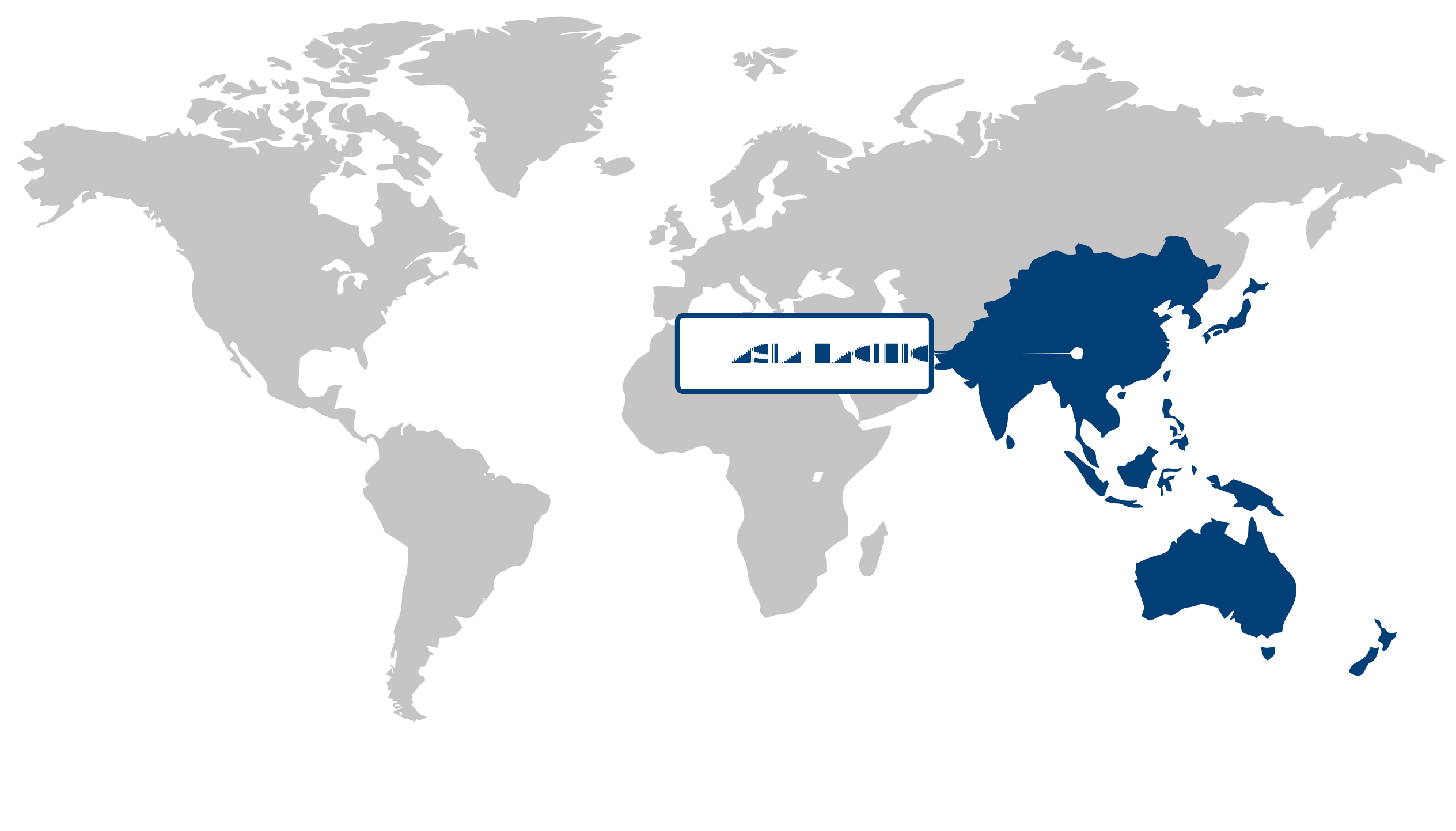
Largest Region
Asia Pacific
Largest Market Share in 2026
Asia Pacific (Largest Region) vs Europe (Fastest-Growing Region)
The filling machines market was led by Asia Pacific, supported by the region’s expanding food and beverage, pharmaceutical, cosmetics, chemical, and household product manufacturing industries. Rising production volumes and increasing adoption of packaged consumer goods are creating strong demand for automated equipment capable of delivering accurate, consistent, and hygienic filling operations. Manufacturers are also investing in flexible machinery that can handle diverse container formats and product viscosities while improving production efficiency. Rapid industrialization, expansion of modern manufacturing facilities, and growing demand for automation are further strengthening the regional market, particularly as producers seek to reduce manual intervention and improve process reliability.
Europe is the fastest-growing region, driven by increasing investments in advanced packaging automation, production efficiency, and sustainable manufacturing practices. Food, beverage, pharmaceutical, and personal care producers are adopting sophisticated filling equipment to improve accuracy, minimize product waste, and accommodate changing packaging formats. Strong emphasis on hygiene, product safety, and manufacturing quality is encouraging the replacement and upgrading of conventional machinery. In addition, the region’s focus on resource-efficient production and flexible automation is creating opportunities for filling systems equipped with improved controls, monitoring capabilities, and adaptable production configurations.
Key Country Insights
The U.S. filling machines market is benefiting from investments in automation and flexible packaging operations. Manufacturers are increasingly adopting advanced filling systems that improve production efficiency, reduce labor dependency, and support rapid product changeovers.
Japan's filling machines market prioritizes compact and high-speed equipment designed for efficient manufacturing environments. Producers are investing in systems that deliver precision filling and support increasingly automated packaging operations across consumer industries.
South Korea is accelerating the adoption of filling machines compatible with smart manufacturing initiatives and digitally connected production lines. Equipment suppliers are focusing on flexible systems that improve productivity and accommodate diverse packaging formats.
Germany places strong emphasis on highly accurate and technologically advanced filling machines for food, pharmaceutical, and industrial applications. Demand is centered on equipment capable of integrating digital controls and supporting stringent production quality requirements.
France is emphasizing filling machines that enhance operational efficiency and reduce material waste in food and beverage processing. Companies are increasingly seeking equipment capable of supporting sustainable packaging initiatives and shorter production cycles.
Italy's filling machines market is supported by strong demand from food, beverage, and personal care manufacturers requiring adaptable production systems. Investment priorities include equipment that enables rapid format changes and efficient handling of premium packaged products.
Segment Leadership and Growth Trends
Application Segment Analysis: Beverages (Largest Segment) vs Pharmaceuticals (Fastest-Growing Segment)
The beverages segment led the filling machines market with a 37.1% share in 2026. High-volume production of bottled and packaged beverages requires efficient, consistent, and hygienic filling operations, creating sustained demand for machinery capable of handling different liquid viscosities, container formats, and production requirements. Increasing consumption of packaged drinks and the need for reliable throughput, filling accuracy, and reduced product loss are encouraging beverage manufacturers to adopt increasingly sophisticated filling equipment.
Pharmaceutical applications are expected to experience the fastest growth as drug manufacturers place greater emphasis on precise, contamination-controlled, and highly repeatable filling processes. The increasing complexity of pharmaceutical formulations and the stringent requirements surrounding product quality and dosage consistency are strengthening demand for advanced filling systems. Greater automation and the need for efficient manufacturing workflows are also encouraging pharmaceutical producers to invest in equipment capable of meeting rigorous production and hygiene standards.
Mode of Operation Segment Analysis: Automatic (Largest & Fastest-Growing Segment)
Automatic filling machines represented the largest share of the filling machines market in 2026 and are also positioned as the fastest-growing segment. Their adoption is driven by the need for consistent filling accuracy, higher production efficiency, and reduced dependence on manual intervention across industries such as beverages, food, pharmaceuticals, and chemicals. Automated systems can support continuous production while improving process consistency and operational control, making them increasingly attractive as manufacturers pursue greater productivity, standardized output, and more efficient use of production resources.
| Report Segmentation | |||
| Segment | Sub-Segment | Largest Segment | Fastest Growing Segment |
|---|---|---|---|
| Application | Beverages, Food, Chemicals, Personal Care, Pharmaceuticals, Others | Beverages | Pharmaceuticals |
| Mode of Operation | Automatic, Semi-automatic | Automatic | Automatic |
| Product | Aseptic, Rotary, Net Weight, Volumetric, Others | Aseptic | Aseptic |
 Read our Research Approach
Competitive Landscape and Market Positioning
Prominent players in the filling machines market:
1. Krones AG (Germany)
2. GEA Group AG (Germany)
3. KHS GmbH (Germany)
4. Tetra Laval International S.A. (Switzerland)
5. JBT Corporation (United States)
6. Barry-Wehmiller Companies Inc. (United States)
7. Accutek Packaging Equipment Companies Inc. (United States)
8. Ronchi Mario S.p.A. (Italy)
9. Syntegon Technology GmbH (Germany)
10. I.M.A. Industria Macchine Automatiche S.p.A. (Italy)
Automation and precision engineering are becoming central to the evolution of the filling machines market. Manufacturers are increasingly prioritizing high-speed, low-waste systems that improve production throughput across industries. The filling machines market is also seeing a shift toward modular equipment designs that allow flexible configuration for varied packaging requirements.
Industry Development/News
| Company Name | Date | Key Development |
|---|---|---|
| 3WIN Corp. | Apr-26 | 3WIN Corp. acquired Alchemist Filling Machines to enhance its manufacturing capabilities, specifically within the cannabis production sector. This acquisition enables the integration of specialized filling equipment into the company's existing end-to-end processing solutions, broadening its technical portfolio and strengthening its competitive positioning for complex, highly regulated industrial filling and packaging applications. |
| Makro Labelling | May-26 | Makro Labelling expanded its operational scope beyond its traditional labelling business by launching a new range of filling equipment. This strategic entry into the filling machine segment allows the company to offer integrated packaging line solutions, leveraging a unified system architecture designed to improve line efficiency and streamline maintenance for liquid packaging manufacturers. |
| LUBBC | Apr-25 | LUBBC significantly increased its production capacity by integrating four additional aseptic filling machines from SIG into its operations. This capital investment enhances the company’s manufacturing output and operational flexibility, while strengthening its supply chain partnership with SIG to optimize efficiency across its liquid product filling and aseptic packaging workflows. |
| SIG | Feb-26 | SIG implemented its aluminum-free aseptic carton packaging technology, the Terra MidiBloc Alu-free + Full Barrier system, at Pomurske Mlekarne. By eliminating aluminum layers and increasing paper content to over 80%, this deployment demonstrates a significant shift toward sustainable material adoption in dairy filling applications while maintaining critical barrier protection standards. |
Why Choose Us
Specialized Expertise: Our team comprises industry experts with a deep understanding of your market segment. We bring specialized knowledge and experience that ensures our research and consulting services are tailored to your unique needs.
Customized Solutions: We understand that every client is different. That's why we offer customized research and consulting solutions designed specifically to address your challenges and capitalize on opportunities within your industry.
Proven Results: With a track record of successful projects and satisfied clients, we have demonstrated our ability to deliver tangible results. Our case studies and testimonials speak to our effectiveness in helping clients achieve their goals.
Cutting-Edge Methodologies: We leverage the latest methodologies and technologies to gather insights and drive informed decision-making. Our innovative approach ensures that you stay ahead of the curve and gain a competitive edge in your market.
Client-Centric Approach: Your satisfaction is our top priority. We prioritize open communication, responsiveness, and transparency to ensure that we not only meet but exceed your expectations at every stage of the engagement.
Continuous Innovation: We are committed to continuous improvement and staying at the forefront of our industry. Through ongoing learning, professional development, and investment in new technologies, we ensure that our services are always evolving to meet your evolving needs.
Value for Money: Our competitive pricing and flexible engagement models ensure that you get maximum value for your investment. We are committed to delivering high-quality results that help you achieve a strong return on your investment.
Select Licence Type

