Flame Retardants for Aerospace Plastics Market Size & Growth Forecast 2027–2036, By Segments (Product, Application), Regional Demand Trends (North America, Asia Pacific, Europe), Key Country Insights (U.S., Japan, South Korea, Germany, France, Italy), and Competitive Landscape
Market Size and Growth Outlook
Flame Retardants for Aerospace Plastics Market size was worth USD 37.02 million in 2026 and is poised to grow at a 6.65% CAGR between 2027 and 2036, exceeding USD 70.48 million by 2036. The industry revenue for 2027 is assessed at USD 39.09 million.
Get more details on this report
Request Free Sample ReportFlame Retardants for Aerospace Plastics Market Intelligence Snapshot
Regional Market Dynamics
- Europe leads the market through its established aerospace manufacturing base, strict safety standards, and mature supplier networks supporting certified flame-retardant materials for aircraft applications.
- Asia Pacific is expected to expand at an 8.02% CAGR as aerospace production, component manufacturing, and adoption of advanced lightweight polymer materials continue to increase across regional supply chains.
Segment Momentum
- Aluminum Trihydrate accounted for 44.52% of the market in 2026, supported by its proven flame-retardant performance, production consistency, and compatibility with established aerospace manufacturing and qualification processes.
- Epoxies are the fastest-growing application segment as their role in advanced composites and high-performance aerospace plastics increases, driving greater demand for compatible flame retardant incorporation.
Market Expansion Drivers
- Increasing aerospace composite usage driving flame retardant integration in lightweight aircraft structures.
- Strengthening aviation safety and material compliance regulations boosting certified flame retardant adoption.
- Rising shift toward non-halogenated flame retardant formulations enhancing aerospace material safety standards.
Leading Market Participants
- Key companies in the flame retardants for aerospace plastics market include Albemarle Corporation (United States), BASF SE (Germany), Clariant AG (Switzerland), Solvay SA (Belgium), LANXESS AG (Germany), DIC Corporation (Japan), Italmatch Chemicals S.p.A. (Italy), Huber Engineered Materials, Inc. (United States), RTP Company, Inc. (United States), ICL Group Ltd. (Israel).
Global Market Forecast Snapshot
Market Outlook
- 2026 Market Size: USD 37.02 million
- 2027 Estimated Market Size: USD 39.09 million.
- Projected Market Size: USD 70.48 million by 2036
- Growth Forecast: 6.65% CAGR (2027-2036)
Regional and Segment Outlook
- Leading Regional Market: Europe
- High-Growth Regional Hub: Asia Pacific
- Core Revenue Segment: Aluminum Trihydrate (Product) | Carbon Fiber Reinforced Plastic (CFRP) (Application)
- Emerging Opportunity Segment: Organophosphates/Phosphorous Compounds (Product) | Epoxies (Application)
Market Growth Drivers and Industry Trends
Increasing aerospace composite usage driving flame retardant integration in lightweight aircraft structures
The flame retardants for aerospace plastics market is being supported by the increasing use of composite materials in aircraft structures, where lightweight construction must be balanced with stringent fire safety requirements. As aerospace applications incorporate more plastic and composite components to support weight reduction and functional performance, flame retardant technologies become important for improving the fire resistance of these materials. Their integration into lightweight structural and interior applications helps manufacturers address safety requirements while maintaining the material advantages associated with advanced aerospace composites.
Strengthening aviation safety and material compliance regulations boosting certified flame retardant adoption
Stricter aviation safety and material compliance requirements are encouraging greater adoption within the flame retardants for aerospace plastics market, as aerospace plastics must meet demanding fire performance criteria before being incorporated into aircraft applications. Certification requirements increase the importance of flame retardant formulations that can consistently support required material performance under aviation operating conditions. This regulatory focus encourages manufacturers and material suppliers to prioritize compliant solutions for plastic and composite applications where fire resistance is a critical consideration.
Rising shift toward non-halogenated flame retardant formulations enhancing aerospace material safety standards
A growing preference for non-halogenated flame retardant formulations is influencing the flame retardants for aerospace plastics market as aerospace material development increasingly emphasizes improved safety characteristics and formulation suitability. Non-halogenated technologies provide alternatives for manufacturers seeking flame retardant performance without relying on halogen-based chemistries, supporting the development of material systems aligned with evolving safety and material requirements. Their use can also facilitate the incorporation of flame protection into advanced aerospace plastics and composite components while maintaining attention to overall material performance.
| Growth Driver | Impact on CAGR | Regulatory Influence | Geographic Relevance | Adoption Rate | Impact Timeline |
|---|---|---|---|---|---|
| Increasing aerospace composite usage driving flame retardant integration in lightweight aircraft structures | 2.10% | High | Europe, North America | High | Near Term |
| Strengthening aviation safety and material compliance regulations boosting certified flame retardant adoption | 1.90% | High | North America, Europe | High | Near Term |
| Rising shift toward non-halogenated flame retardant formulations enhancing aerospace material safety standards | 1.60% | High | Asia Pacific, Europe | Medium | Mid Term |
Unlock insights tailored to your business with our bespoke market research solutions.
Click to get your customized report now.
Regional Demand Dynamics
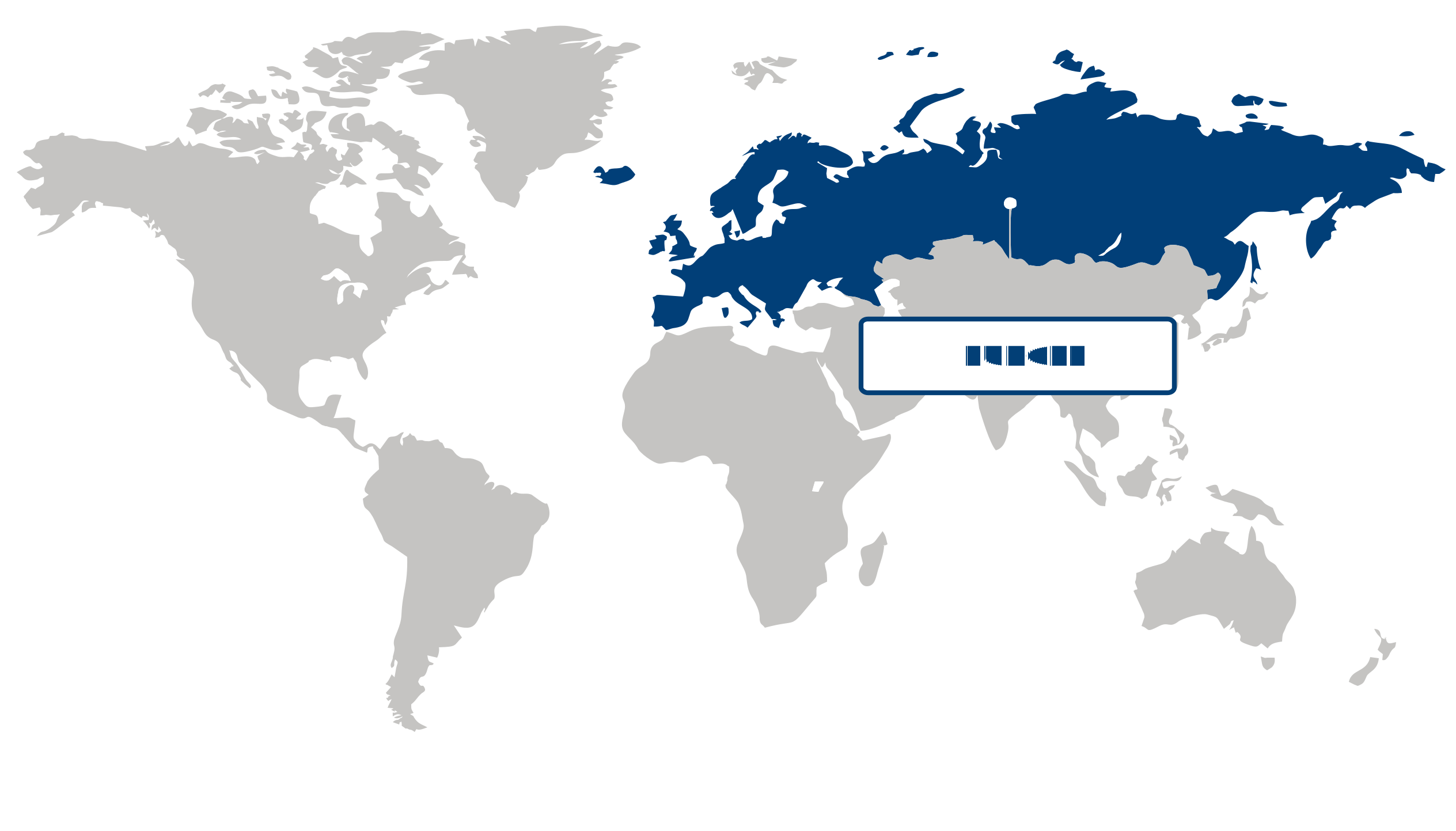
Europe (Largest Region)
Europe accounted for the largest share of the flame retardants for aerospace plastics market in 2026, underpinned by its established aerospace manufacturing base, stringent safety requirements, and strong emphasis on lightweight and high-performance materials. The region's aerospace industry increasingly relies on engineering plastics to reduce component weight while maintaining thermal and mechanical performance, creating sustained demand for effective flame-retardant solutions. Regulatory attention toward fire safety, material performance, and environmental considerations also encourages manufacturers to adopt advanced formulations that meet demanding aerospace applications without compromising material functionality.
Asia Pacific (Fastest-Growing Region)
Asia Pacific is anticipated to register the fastest growth in the flame retardants for aerospace plastics market as aerospace manufacturing, aircraft component production, and aviation infrastructure continue to expand across the region. Increasing investments in domestic aerospace capabilities and the development of new aircraft production and maintenance ecosystems are supporting greater use of lightweight polymer-based components. At the same time, growing attention to aircraft safety, fire resistance, and material efficiency is encouraging manufacturers to incorporate specialized flame-retardant technologies into aerospace plastics, strengthening regional demand.
| Parameter | North America | Asia Pacific | Europe | Latin America | MEA |
|---|---|---|---|---|---|
| Innovation Hub i Scale Nascent Developing Advanced | |||||
| Cost-Sensitive Region i Scale Low Medium High | |||||
| Regulatory Environment i Scale Restrictive Neutral Supportive | |||||
| Demand Drivers i Scale Weak Moderate Strong | |||||
| Development Stage i Scale Emerging Developing Developed | |||||
| Adoption Rate i Scale Low Medium High | |||||
| New Entrants / Startups i Scale Sparse Moderate Dense | |||||
| Macro Indicators i Scale Weak Stable Strong |
Key Country Insights
Germany 🇩🇪
Engineering-Grade ComplianceGermany emphasizes flame retardant aerospace plastics that balance mechanical performance with demanding aviation safety standards. Aerospace manufacturers in Germany work closely with specialty material suppliers to qualify advanced polymer formulations for structural and interior applications.
France 🇫🇷
Aircraft Interior MaterialsFrance prioritizes flame retardant plastics for aircraft interior systems requiring strict fire safety compliance and weight optimization. Aerospace suppliers in France continue refining specialty compounds that support efficient production while maintaining demanding regulatory requirements.
Italy 🇮🇹
Specialty Composite IntegrationItaly incorporates flame retardant plastics into aerospace components through expertise in composite manufacturing and precision engineering. Material developers in Italy increasingly focus on formulations that complement lightweight aircraft structures and reliable processing performance.
Japan 🇯🇵
High-Reliability Polymer SystemsJapan focuses on flame retardant materials offering long-term durability, thermal stability, and manufacturing consistency for aerospace plastics. Collaboration between Japanese material developers and aircraft component manufacturers supports qualification of specialized engineering polymers.
South Korea 🇰🇷
Aerospace Manufacturing SupportSouth Korea expands the use of flame retardant aerospace plastics by strengthening domestic aircraft manufacturing capabilities and advanced materials development. Suppliers in South Korea emphasize lightweight polymer solutions that satisfy evolving aviation performance and safety expectations.
United States 🇺🇸
Advanced Material QualificationThe U.S. aerospace sector prioritizes flame retardant formulations that satisfy stringent certification requirements while supporting lightweight aircraft components. Material suppliers in the U.S. focus on developing high-performance plastic compounds compatible with next-generation aerospace manufacturing processes.
Segment Leadership and Growth Trends
Flame Retardants for Aerospace Plastics Market Share (%), by Product, 2026
Go beyond the chart, access full insights & data tables
Request Free Sample ReportProduct Segment Analysis: Aluminum Trihydrate (Largest Segment) vs Organophosphates/Phosphorous Compounds (Fastest-Growing Segment)
The aluminum trihydrate segment accounted for the largest share of 44.52% in the flame retardants for aerospace plastics market in 2026, supported by its established use in polymer systems requiring improved fire resistance and smoke suppression. Its thermal decomposition characteristics and ability to release water during heating make it suitable for formulations where flame control and material stability are important. Demand is further reinforced by the aerospace industry's emphasis on lightweight materials that must meet stringent fire-safety requirements. Compatibility with various plastic systems and established processing practices also supports continued adoption of aluminum trihydrate in aerospace applications.
Organophosphates and phosphorous compounds are gaining momentum as aerospace manufacturers seek flame-retardant technologies that can deliver effective fire protection while maintaining the performance characteristics of advanced plastics. These compounds can provide efficient flame inhibition at relatively low loading levels and can be incorporated into specialized polymer formulations. Their growing relevance is also linked to the increasing use of lightweight, high-performance materials in aircraft interiors and structural components. Continued development of formulations that balance flame resistance, mechanical properties, and material weight is supporting broader interest in phosphorous-based solutions.
Application Segment Analysis: Carbon Fiber Reinforced Plastic (CFRP) (Largest Segment) vs Epoxies (Fastest-Growing Segment)
Carbon fiber reinforced plastic (CFRP) held the largest share of 35.87% in the flame retardants for aerospace plastics market in 2026, reflecting the extensive use of lightweight composite materials in aerospace applications. CFRP combines high strength and stiffness with weight advantages, making effective fire protection particularly important where composite materials are deployed in aircraft structures and components. The need to meet stringent safety requirements while preserving mechanical performance encourages the incorporation of specialized flame-retardant systems. Increasing emphasis on lightweight aircraft design and material efficiency continues to reinforce demand for flame-retardant solutions compatible with CFRP formulations.
The epoxies application segment is expanding more rapidly as epoxy-based systems remain important matrices for aerospace composites, adhesives, coatings, and other high-performance applications. Their strong bonding characteristics, durability, and processing flexibility make them suitable for demanding aerospace environments, while flame-retardant modification helps address stringent safety requirements. Ongoing development of epoxy formulations that preserve mechanical strength, thermal stability, and lightweight characteristics is supporting increased adoption. As advanced composite structures become more important to aerospace manufacturing, demand for compatible flame-retardant technologies in epoxy systems is strengthening.
| Segment | Sub-Segment | Largest Segment | Fastest Growing |
|---|---|---|---|
| Product | Antimony Oxide, Aluminum Trihydrate, Organophosphates/Phosphorous Compounds, Boron Compounds, Others | Aluminum Trihydrate | Organophosphates/Phosphorous Compounds |
| Application | Carbon Fiber Reinforced Plastic (CFRP), Glass Reinforced Plastic (GRP), Polycarbonate, Thermoset Polyimide, Acrylonitrile Butadiene Styrene (ABS), Acetal/Polyoxymethylene (POM), Epoxies, Others | Carbon Fiber Reinforced Plastic (CFRP) | Epoxies |
Competitive Landscape and Market Positioning
Key companies in the flame retardants for aerospace plastics market:
1. Albemarle Corporation (United States)
2. BASF SE (Germany)
3. Clariant AG (Switzerland)
4. Solvay SA (Belgium)
5. LANXESS AG (Germany)
6. DIC Corporation (Japan)
7. Italmatch Chemicals S.p.A. (Italy)
8. Huber Engineered Materials Inc. (United States)
9. RTP Company Inc. (United States)
10. ICL Group Ltd. (Israel)
The flame retardants for aerospace plastics market is advancing through the development of lightweight and environmentally compliant formulations that meet stringent aerospace safety standards. Ongoing research efforts aimed at improving thermal resistance and reducing toxic emissions are supporting innovation while aligning with the industry's broader sustainability and performance objectives.
| Company | Market Share | Company Revenue | Revenue CAGR (%) | Product Portfolio | Geographic Presence | Innovation / R&D Focus | Strategic Developments |
|---|---|---|---|---|---|---|---|
| Albemarle Corporation (United States) | |||||||
| BASF SE (Germany) | |||||||
| Clariant AG (Switzerland) | |||||||
| Solvay SA (Belgium) | |||||||
| LANXESS AG (Germany) | |||||||
| DIC Corporation (Japan) | |||||||
| Italmatch Chemicals S.p.A. (Italy) | |||||||
| Huber Engineered Materials Inc. (United States) | |||||||
| RTP Company Inc. (United States) | |||||||
| ICL Group Ltd. (Israel). |
Industry Development/News
| Company Name | Date | Key Development |
|---|---|---|
| Evonik | Nov-24 | Evonik introduced flame-retardant PA12 and carbon black-infused powders specifically for 3D printing applications. The materials offer high resistance to heat and light exposure, making them particularly suitable for aerospace components where durability and stringent fire-safety standards in extreme operating environments are required. |
| Clariant | Oct-23 | Clariant inaugurated a new production facility for its Exolit OP flame retardant range in Daya Bay, China. This expansion increases local capacity to meet the growing demand for flame-retardant engineering plastics, supporting rapid development in the electrical and transportation segments where specialized flame-retardant performance is a critical safety and regulatory requirement. |
Customize Your Report
Explore examples of how this report can be tailored to different research needs, including custom segments, additional topics or chapters, and related reports. Click a section of the wheel or its numbered marker to explore the available options.
Flame Retardants for Aerospace Plastics Market — Custom Segments
| Segment | Sub-Segment |
|---|---|
| Aircraft Type | Commercial Aircraft, Business & General Aviation Aircraft, Military Aircraft, Helicopters, Unmanned Aerial Vehicles |
| Aerospace Component | Interior Components, Electrical & Electronic Components, Structural Components, Engine & Propulsion Components |
| OEM vs. Aftermarket | OEM Supply, Maintenance Repair & Overhaul (MRO), Replacement & Retrofit |
Flame Retardants for Aerospace Plastics Market — Custom TOC
| Custom Chapter | Custom Details |
|---|---|
| Aerospace Materials Qualification and Approval Landscape |
|
| Sustainable and Halogen-Free Transition Readiness |
|
| Aerospace Tier Supplier Sourcing and Procurement Analysis |
|
Need a different cut of the data?
Request Custom ResearchHow big is the flame retardants for aerospace plastics market?
How will the flame retardants for aerospace plastics industry grow in terms of size and CAGR by 2036?
Why are composite aircraft structures increasing demand for advanced flame retardant solutions?
How are certification requirements influencing sourcing strategies in the flame retardants for aerospace plastics market?
Why is Aluminum Trihydrate the leading product segment in the flame retardants for aerospace plastics market?
Which application segment is expanding fastest in the flame retardants for aerospace plastics market?
What factors make Europe the largest market for flame retardants for aerospace plastics?
What is driving growth in the flame retardants for aerospace plastics market across Asia Pacific?
Who are the major participants shaping the flame retardants for aerospace plastics landscape?
Our Clients
"The report helped us understand emerging consumer trends in our product category. It clarified where to focus innovation for the next product launch."
LyondellBasell
"The regional forecast section was incredibly useful. We were able to identify two new potential partners in Europe thanks to the vendor mapping you included."
SABIC
"We appreciated how actionable the recommendations were. It guided us to improve supply chain resilience."
Olin Corporation
Our Research Team & Methodology
Every Fundamental Business Insights report is built by a dedicated vertical research team, validated through a structured primary-and-secondary methodology, and reviewed for accuracy before it reaches you.
Research Team Overview
Prepared by the Chemicals & Materials Research Team
Delivery
Published
Demand
Available
Support
Trust & Compliance
Research Domains
10 coverage areasResearch Intelligence
| Source | Reference |
|---|---|
| American Chemistry Council (ACC) | www.americanchemistry.com |
| European Chemical Industry Council (Cefic) | cefic.org |
| International Council of Chemical Associations (ICCA) | icca-chem.org |
| European Chemicals Agency (ECHA) | echa.europa.eu |
| U.S. Environmental Protection Agency (EPA) | www.epa.gov |
| ASTM International | www.astm.org |
| International Organization for Standardization (ISO) | www.iso.org |
| National Institute of Standards and Technology (NIST) | www.nist.gov |
| Plastics Industry Association (PLASTICS) | www.plasticsindustry.org |
| European Biplastics | www.european-bioplastics.org |
| The Adhesive and Sealant Council (ASC) | www.ascouncil.org |
| National Association of Corrosion Engineers (AMPP) | www.ampp.org |
| Society of Plastics Engineers (SPE) | www.4spe.org |
| International Fertilizer Association (IFA) | www.fertilizer.org |
| CropLife International | croplife.org |
| Packaging Europe | packagingeurope.com |
| Flexible Packaging Association (FPA) | www.flexpack.org |
| Battery Council International (BCI) | batterycouncil.org |
| International Copper Association (ICA) | internationalcopper.org |
| World Steel Association | worldsteel.org |
Research Workflow & Quality Assurance
Data Collection
Verified information gathered through primary and secondary research.
Data Triangulation
Cross-validation using multiple independent data sources.
Forecast Modelling
Market estimates developed using historical trends and analytical models.
Analyst Validation
Findings reviewed by domain experts for accuracy and consistency.
Editorial & Quality Review
Final editorial, quality, and compliance checks before publication.
Final Publication
Released after successful completion of the internal review process.
Report Coverage
📊 Market Assessment
- Market Size & Forecast
- Market Segmentation
- Regional Analysis
- Growth Drivers & Challenges
- Market Dynamics
🏢 Competitive Intelligence
- Competitive Landscape
- Company Profiles
- Competitive Benchmarking
- Mergers & Acquisitions
- Market Share Analysis or Key Company Strategies
🔍 Strategic Analysis
- Value Chain Analysis
- Porter's Five Forces
- PESTLE Analysis
- Pricing Trends
- Supply-Demand Analysis
🚀 Future Outlook
- Technology Landscape
- Regulatory Landscape
- Investment & Funding Landscape
- Emerging Opportunities
- Future Market Outlook
Have a question about this report or need a custom scope?
Request Customization