Flight Simulator Market Size & Growth Forecast 2027–2036, By Segments (Product, Application), Regional Demand Trends (North America, Asia Pacific, Europe), Key Country Insights (U.S., Japan, South Korea, Germany, France, Italy), and Competitive Landscape
Jump to content
Market Size and Growth Outlook
Flight Simulator Market size was worth USD 6.11 billion in 2026 and is poised to grow at a 4.85% CAGR between 2027 and 2036, exceeding USD 9.81 billion by 2036. The industry revenue for 2027 is assessed at USD 6.36 billion.
Get more details on this report
Request Free Sample ReportFlight Simulator Market Intelligence Snapshot
Regional Market Dynamics
- Europe held a 33.50% share in 2026, supported by established aerospace ecosystems, advanced training infrastructure, and steady civil and defense demand.
- Asia Pacific is growing at a 5.02% CAGR as airlines, flight schools, and defense organizations expand simulator adoption and training capacity.
Segment Momentum
- Full Flight Simulator (FFS) held an 87.69% share in 2026 due to its central role in advanced pilot training, certification programs, and high-fidelity simulation that closely replicates real aircraft operations.
- Military and defense users are increasingly adopting simulation for mission rehearsal, tactical training, and platform-specific preparation while reducing dependence on costly live-platform training exercises.
Market Expansion Drivers
- Increasing global pilot training requirements driving demand for advanced full flight simulators.
- Advancements in visual and motion simulation technologies enhancing near real-world training experiences.
- Rising UAV and defense aviation training investments expanding simulator deployment opportunities.
Leading Market Participants
- Key companies in the flight simulator market include CAE Inc. (Canada), The Boeing Company (United States), Airbus SE (France), Lockheed Martin Corporation (United States), L3Harris Technologies, Inc. (United States), Thales Group (France), Collins Aerospace (United States), Leonardo S.p.A. (Italy), Saab AB (Sweden), Kratos Defense & Security Solutions, Inc. (United States).
Global Market Forecast Snapshot
Market Outlook
- 2026 Market Size: USD 6.11 billion
- 2027 Estimated Market Size: USD 6.36 billion.
- Projected Market Size: USD 9.81 billion by 2036
- Growth Forecast: 4.85% CAGR (2027-2036)
Regional and Segment Outlook
- Leading Regional Market: Europe
- High-Growth Regional Hub: Asia Pacific
- Core Revenue Segment: Full Flight Simulator (FFS) (Product) | Civil (Application)
- Emerging Opportunity Segment: Fixed Flight Training Devices (FTD) (Product) | Military & Defense (Application)
Market Growth Drivers and Industry Trends
Increasing global pilot training requirements driving demand for advanced full flight simulators
The need to train pilots for increasingly sophisticated aircraft and maintain high standards of operational proficiency is increasing demand for advanced simulation-based training environments. Growing pilot training requirements will support flight simulator market growth as aviation operators and training organizations use full flight simulators to replicate aircraft systems, procedures, and operational scenarios without exposing trainees to the risks and costs associated with equivalent live-flight exercises. Simulation also enables repeated practice of normal and emergency procedures, allowing pilots to build proficiency in a controlled environment while reducing dependence on aircraft availability for certain training activities.
Advancements in visual and motion simulation technologies enhancing near real-world training experiences
Improvements in visual systems, motion platforms, cockpit interfaces, and simulation software are making training environments increasingly representative of actual flight conditions. These technological advances will strengthen the flight simulator market by enabling pilots to practice complex maneuvers, environmental conditions, navigation situations, and emergency responses with greater realism. High-fidelity visual environments and responsive motion systems can improve trainee immersion and allow instructors to reproduce a broader range of operational scenarios, supporting more comprehensive skill development across different aircraft and training requirements.
Rising UAV and defense aviation training investments expanding simulator deployment opportunities
Increasing use of unmanned aerial vehicles and continued investment in defense aviation are broadening the application base for simulation-based training. The flight simulator market will gain from demand for specialized systems that allow military personnel and UAV operators to develop operational skills, practice mission scenarios, and rehearse complex procedures without relying exclusively on live platforms. Simulation-based environments can also support repeated training for high-risk missions and geographically dispersed personnel, while configurable software and hardware enable training systems to accommodate different aircraft configurations and mission requirements.
| Growth Driver | Impact on CAGR | Regulatory Influence | Geographic Relevance | Adoption Rate | Impact Timeline |
|---|---|---|---|---|---|
| Increasing global pilot training requirements driving demand for advanced full flight simulators | 1.90% | High | Europe, Asia Pacific | High | Near Term |
| Advancements in visual and motion simulation technologies enhancing near real-world training experiences | 1.60% | Moderate | North America, Europe | High | Mid Term |
| Rising UAV and defense aviation training investments expanding simulator deployment opportunities | 1.30% | High | North America, Middle East | Emerging | Long Term |
Unlock insights tailored to your business with our bespoke market research solutions.
Click to get your customized report now.
Regional Demand Dynamics
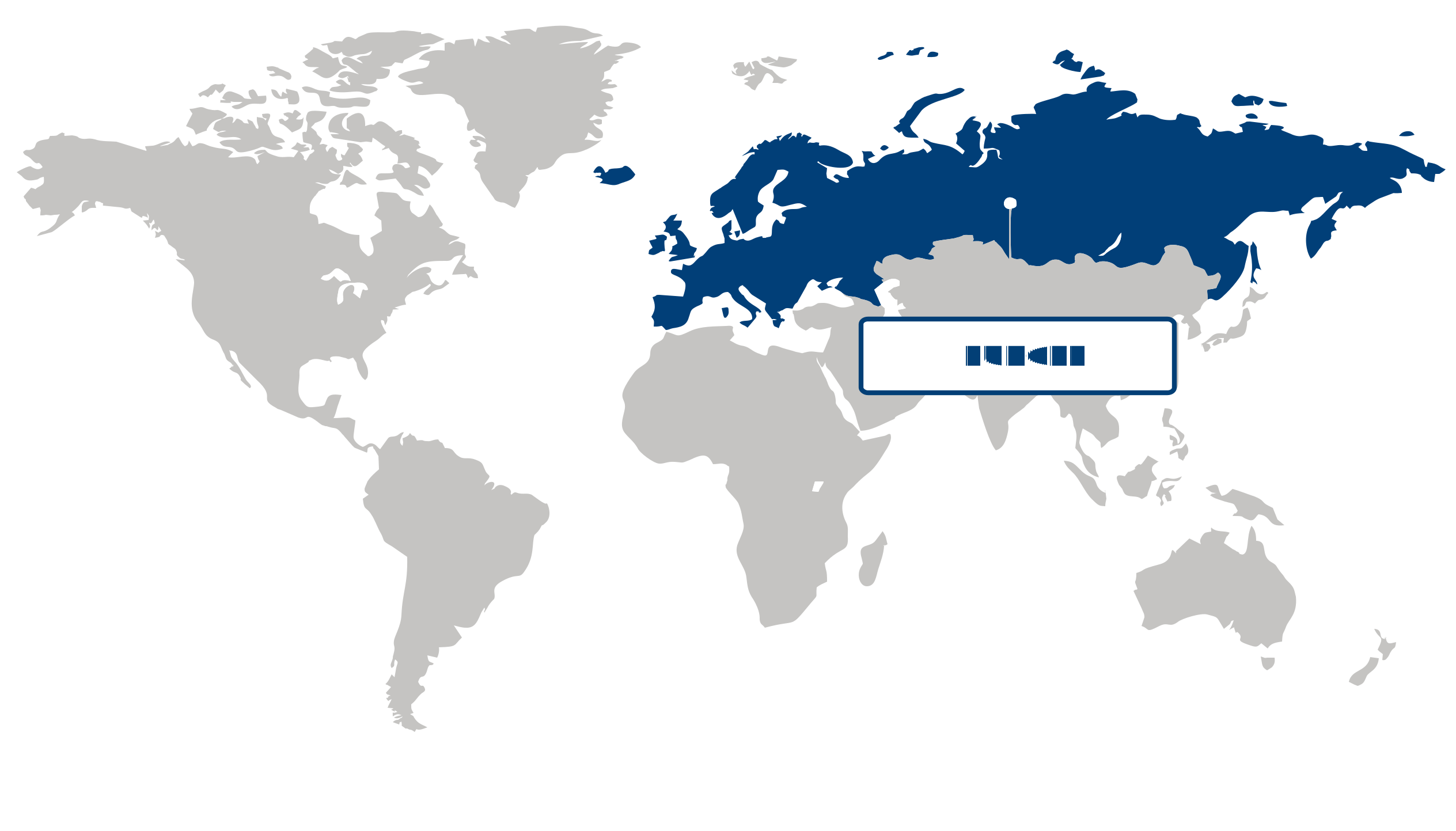
Europe (Largest Region)
Europe led the flight simulator market with a 33.50% share in 2026, supported by its established aerospace ecosystem, extensive aviation infrastructure, and strong emphasis on pilot training and flight safety. The region benefits from a mature commercial aviation sector alongside significant military and defense aviation activity, creating sustained requirements for advanced simulation technologies. Flight simulators provide airlines, training organizations, and defense operators with a controlled environment for developing pilot proficiency, practicing complex procedures, and preparing for emergency situations while reducing reliance on actual aircraft for training activities. Europe's stringent aviation safety standards and structured training frameworks further reinforce the importance of high-fidelity simulation throughout pilot development and recurrent training. Technological capabilities in visual systems, motion platforms, avionics replication, and scenario-based training are also supporting continued modernization of simulator fleets. The combination of established training institutions, aerospace expertise, and regulatory focus on competency and safety enables Europe to maintain a strong position in the global market.
Asia Pacific (Fastest-Growing Region)
Asia Pacific is the fastest-growing region in the flight simulator market, reflecting the expansion of commercial aviation, rising demand for trained pilots, and continued development of aviation infrastructure across the region. Growing air travel activity is encouraging airlines and training organizations to expand and modernize their pilot-training capabilities, increasing the importance of simulator-based instruction. New and expanding airports, airline fleets, and aviation academies are creating additional demand for training systems that can provide realistic flight experience while improving training efficiency and safety. The region is also strengthening domestic aviation ecosystems, with greater attention to developing skilled aviation professionals and reducing dependence on external training capacity. Advances in simulation technology are making sophisticated training environments increasingly suitable for a wider range of operators, from commercial airlines to specialized aviation institutions and defense organizations. As aviation markets mature and operators place greater emphasis on standardized training, operational readiness, and cost-efficient pilot development, Asia Pacific is positioned to experience strong expansion in simulator adoption.
| Parameter | North America | Asia Pacific | Europe | Latin America | MEA |
|---|---|---|---|---|---|
| Innovation HubiScaleNascentDeveloping Advanced | |||||
| Cost-Sensitive RegioniScaleLowMedium High | |||||
| Regulatory EnvironmentiScaleRestrictiveNeutral Supportive | |||||
| Demand DriversiScaleWeakModerate Strong | |||||
| Development StageiScaleEmergingDeveloping Developed | |||||
| Adoption RateiScaleLowMedium High | |||||
| New Entrants / StartupsiScaleSparseModerate Dense | |||||
| Macro IndicatorsiScaleWeakStable Strong |
Key Country Insights
Germany 🇩🇪
Engineering Simulation ExcellenceGermany emphasizes flight simulators that deliver precise aircraft modeling and advanced pilot instruction. Aviation organizations in Germany continue integrating sophisticated simulation technologies into professional training programs to improve operational efficiency and safety outcomes.
France 🇫🇷
Aerospace Training SupportFrance leverages its aerospace ecosystem to expand demand for sophisticated flight simulation technologies. Aviation institutions in France focus on simulation systems that enhance pilot proficiency, mission preparation, and efficient certification across civil and defense applications.
Italy 🇮🇹
Aviation Skills DevelopmentItaly continues strengthening pilot competency through expanded use of flight simulators across commercial and defense aviation. Training providers in Italy increasingly adopt modern simulation systems that improve instructional flexibility and support cost-effective operational training.
Japan 🇯🇵
Technology-Driven InstructionJapan prioritizes flight simulators that support highly structured pilot education and recurrent training requirements. Aviation operators in Japan increasingly invest in simulation platforms with realistic environments that strengthen training consistency and operational preparedness.
South Korea 🇰🇷
Defense Training IntegrationSouth Korea utilizes flight simulators extensively to strengthen military aviation readiness alongside commercial pilot development. Training centers in South Korea continue expanding advanced simulation capabilities that support diverse aircraft platforms and evolving operational requirements.
United States 🇺🇸
Advanced Pilot TrainingThe U.S. flight simulator market is driven by continuous investment in commercial, military, and aviation training capabilities. Training organizations in the U.S. increasingly adopt high-fidelity simulation technologies that improve operational readiness while reducing dependence on live flight hours.
Flight Simulator Market Share (%), by Product, 2026
Go beyond the chart, access full insights & data tables
Request Free Sample ReportProduct Segment Analysis: Full Flight Simulator (FFS) (Largest Segment) vs Fixed Flight Training Devices (FTD) (Fastest-Growing Segment)
Holding the largest share of 87.69% in 2026, the full flight simulator (FFS) segment maintained a dominant position in the flight simulator market because of its ability to replicate aircraft operations and flight conditions with a high degree of realism. Full flight simulators provide comprehensive training environments that support pilot preparation across routine operations, abnormal situations, and emergency procedures without exposing trainees to the risks and costs associated with actual aircraft operation. Their extensive use for professional pilot training is reinforced by the need for highly realistic simulation environments and consistent training standards. The increasing focus on pilot proficiency and safety further supports continued demand for advanced full flight simulation systems.
Fixed flight training devices (FTD) represent the fastest-growing product segment as training organizations increasingly seek flexible and cost-effective simulation solutions for targeted instruction. These systems can support specific aircraft procedures, cockpit familiarization, and skills development without requiring the full motion capabilities associated with higher-level simulation platforms. Their suitability for focused training applications can help organizations expand training capacity while addressing specific instructional requirements. Growing demand for accessible simulation-based learning and the broader adoption of technology-assisted pilot training are contributing to increased interest in fixed flight training devices.
Application Segment Analysis: Civil (Largest Segment) vs Military & Defense (Fastest-Growing Segment)
The civil segment accounted for the largest share in 2026, supported by the extensive requirement for simulation-based training across commercial aviation and other civilian flight operations. Flight simulators allow civil aviation organizations to train pilots in realistic operating environments while reducing reliance on actual aircraft for routine instruction and emergency preparedness. They also support standardized training and recurrent skill development, which are important for maintaining operational readiness and safety. Continued activity within civilian aviation and the need for structured pilot training are therefore sustaining the segment's leading position in the flight simulator market.
Military & defense is expected to be the fastest-growing application segment, driven by increasing emphasis on advanced training environments that can replicate complex and demanding operational conditions. Simulation enables military personnel to practice mission scenarios, aircraft handling, emergency responses, and tactical procedures in controlled environments while limiting the operational risks associated with live training. The growing importance of readiness, mission-specific preparation, and technologically advanced training systems is encouraging greater investment in simulation capabilities. As defense organizations increasingly integrate sophisticated training technologies into preparedness programs, demand for flight simulators across military applications is gaining momentum.
| Segment | Sub-Segment | Largest Segment | Fastest Growing |
|---|---|---|---|
| Product | Full Flight Simulator (FFS), Fixed Flight Training Devices (FTD) | Full Flight Simulator (FFS) | Fixed Flight Training Devices (FTD) |
| Application | Military & Defense, Civil | Civil | Military & Defense |
Competitive Landscape and Market Positioning
Key companies in the flight simulator market:
1. CAE Inc. (Canada)
2. The Boeing Company (United States)
3. Airbus SE (France)
4. Lockheed Martin Corporation (United States)
5. L3Harris Technologies Inc. (United States)
6. Thales Group (France)
7. Collins Aerospace (United States)
8. Leonardo S.p.A. (Italy)
9. Saab AB (Sweden)
10. Kratos Defense & Security Solutions Inc. (United States)
The flight simulation industry is advancing rapidly with immersive technologies and enhanced training environments. In the flight simulator market, innovation is focused on realism and scenario-based training improvements. New simulation system introductions are expanding training capabilities, while continuous research in virtual environments is strengthening simulation accuracy and adaptability.
| Company | Market Share | Company Revenue | Revenue CAGR (%) | Product Portfolio | Geographic Presence | Innovation / R&D Focus | Strategic Developments |
|---|---|---|---|---|---|---|---|
| CAE Inc. (Canada) | |||||||
| The Boeing Company (United States) | |||||||
| Airbus SE (France) | |||||||
| Lockheed Martin Corporation (United States) | |||||||
| L3Harris Technologies Inc. (United States) | |||||||
| Thales Group (France) | |||||||
| Collins Aerospace (United States) | |||||||
| Leonardo S.p.A. (Italy) | |||||||
| Saab AB (Sweden) | |||||||
| Kratos Defense & Security Solutions Inc. (United States). |
Industry Development / News
| Company Name | Date | Key Development |
|---|---|---|
| Microsoft | May-26 | Microsoft Flight Simulator 2024 expanded its platform utility through PS VR2 support and a comprehensive update featuring localized world content and new mission types. By continuously enhancing gameplay mechanics and broadening cross-platform hardware compatibility, Microsoft reinforces its position in the consumer aviation simulation segment through a scalable, content-driven digital ecosystem. |
| HAVELSAN | Mar-26 | HAVELSAN is expanding its simulator production capacity by commissioning a new manufacturing facility. This infrastructure investment is designed to meet the rising demand from both civil and military aviation sectors. The expansion increases the company's production throughput, enabling it to deliver advanced flight simulation systems at a greater scale to global defense and aviation training markets. |
| Exail Technologies | May-25 | Exail Technologies partnered with Babcock France for the Mentor 2 program to deliver a comprehensive suite of simulation devices for the Pilatus PC-7 MKX aircraft. The contract includes the development of mixed-reality training devices, high-fidelity software, and specialized ejection training simulators, significantly enhancing the capability for realistic, immersive emergency and mission-critical flight procedure drills. |
| Leonardo S.p.A. | Apr-24 | Leonardo S.p.A. contracted with ST Engineering Antycip to develop a custom Image Generator utilizing Epic Games’ Unreal Engine. This integration enables highly realistic, real-time virtual environments across Leonardo’s training portfolio, including full-flight and procedural simulators. The technology significantly increases the complexity and density of simulated entities, enhancing the fidelity of mission-oriented training scenarios. |
| Thales | Feb-24 | Thales entered an agreement with Airbus Helicopters to supply eight Reality H Full Flight Simulators for the German Armed Forces' H145M program. The contract includes a three-year on-site support commitment at the Bückeburg International Helicopter Training Center. This delivery strengthens Thales' position in defense aviation training by providing mission-critical infrastructure to Europe’s largest helicopter training facility. |
Customize Your Report
Explore examples of how this report can be tailored to different research needs, including custom segments, additional topics or chapters, and related reports. Click a section of the wheel or its numbered marker to explore the available options.
Flight Simulator Market — Custom Segments
| Segment | Sub-Segment |
|---|---|
| Aircraft Type | Fixed-Wing Aircraft Simulators, Rotary-Wing Aircraft Simulators, Unmanned Aircraft Simulators |
| Procurement Model | Direct Purchase, Leasing, Simulator-as-a-Service |
| Training Purpose | Ab-Initio Training, Type Rating Training, Recurrent Training, Mission-Specific Training |
Flight Simulator Market — Custom TOC
| Custom Chapter | Chapter Details |
|---|---|
| Defense Procurement Pipeline and Budget Opportunity Assessment |
|
| Commercial Aviation Training Demand Outlook |
|
| Simulator Certification and Compliance Landscape |
|
Need a different cut of the data?
Request Custom ResearchFrequently Asked Questions
What is the market valuation of flight simulator?
How much is the flight simulator industry expected to grow by 2036?
Why are advanced full flight simulators becoming a strategic investment for training organizations?
How are evolving defense and UAV training requirements expanding opportunities in the flight simulator market?
Which product segment dominates the flight simulator market?
Why is Military & Defense the fastest-growing application in the flight simulator market?
How does Europe maintain leadership in the flight simulator market?
What is driving Asia Pacific growth in the flight simulator market?
Which companies dominate the flight simulator landscape?
Our Clients
"The reports offered a comprehensive view of the Food and Beverage landscape, covering market trends, consumer behavior, and competitive dynamics."
Terma A/S
"Our experience in acquiring market research reports has been outstanding — the depth of analysis and actionable insights have proven invaluable."
The Aerospace Corporation
"Fundamental Business Insights demonstrated a keen understanding of our business needs, delivering reports tailored to our specific objectives."
Kongsberg Gruppen
Our Research Team & Methodology
Every Fundamental Business Insights report is built by a dedicated vertical research team, validated through a structured primary-and-secondary methodology, and reviewed for accuracy before it reaches you.
Delivery
Published
Available
Support
- Market Size & Forecast
- Market Segmentation
- Regional Analysis
- Growth Drivers & Challenges
- Market Dynamics
- Competitive Landscape
- Company Profiles
- Competitive Benchmarking
- Mergers & Acquisitions
- Market Share Analysis or Key Company Strategies
- Value Chain Analysis
- Porter's Five Forces
- PESTLE Analysis
- Pricing Trends
- Supply-Demand Analysis
- Technology Landscape
- Regulatory Landscape
- Investment & Funding Landscape
- Emerging Opportunities
- Future Market Outlook