



Food Colors Market Size & Growth Forecast 2027–2036, By Segments (Type, Form, Source, Application), Regional Demand Trends (North America, Asia Pacific, Europe), Key Country Insights (U.S., Japan, South Korea, Germany, France, Italy), and Competitive Landscape
Market Size and Growth Outlook
Food Colors Market size was around USD 3.7 billion in 2026 and is slated to grow at a 5.61% CAGR from 2027 to 2036, crossing USD 6.39 billion by 2036. The industry revenue for 2027 is assessed at USD 3.87 billion.
Base Year Value (2026)
USD 3.7 billion
CAGR (2027-2036)
5.61%
Forecast Year Value (2036)
USD 6.39 billion

Historical Data Period
2022-2026

Largest Region
Europe

Forecast Period
2027-2036
Food Colors Market Intelligence Snapshot:
-
Regional Market Dynamics:
- Europe accounted for 33.92% of the market in 2026, supported by a mature food processing industry, strong clean-label reformulation demand, and widespread use across packaged food and beverage applications.
- Asia Pacific is projected to expand at a 7.46% CAGR as processed food production, urban consumption, and product launches increase demand for color solutions across commercial food manufacturing.
-
Segment Momentum:
- Natural leads with 45.58% share as manufacturers shift toward clean-label, transparent ingredients, with strong adoption in reformulated food and beverage products prioritizing consumer-friendly positioning.
- Liquid is fastest-growing due to easier blending and rapid dispersion in production lines, improving process efficiency and supporting flexible formulation needs in modern food manufacturing environments.
-
Market Expansion Drivers:
- Rising demand for visually differentiated packaged foods across bakery, beverage, and dairy segments.
- Shift toward clean-label natural pigments driving adoption of plant-based color solutions.
- Expansion of processed food industry and convenience consumption boosting colorant formulation use.
-
Leading Market Participants:
Prominent players in the food colors market include Cargill, Incorporated (United States), BASF SE (Germany), DSM-Firmenich AG (Netherlands), Kerry Group plc (Ireland), Oterra A/S (Denmark), Sensient Technologies Corporation (United States), GNT Group B.V. (Netherlands), Roha Dyechem Pvt. Ltd. (India), Lycored Ltd. (Israel), Archer Daniels Midland Company (United States).
Global Market Forecast Snapshot:
-
Market Outlook:
- 2026 Market Size: USD 3.7 billion
- 2027 Estimated Market Size: USD 3.87 billion.
- Projected Market Size: USD 6.39 billion by 2036
- Growth Forecasts: 5.61% CAGR (2027-2036)
-
Regional and Segment Outlook:
- Leading Regional Market: Europe
- High-Growth Regional Hub: Asia Pacific
- Core Revenue Segment: Natural (Type) | Powder (Form) | Plants, Animals, & Insects (Source) | Food (Application)
- Emerging Opportunity Segment: Natural (Type) | Liquid (Form) | Plants, Animals, & Insects (Source) | Beverages (Application)
Market Growth Drivers and Industry Trends
Rising demand for visually differentiated packaged foods across bakery, beverage, and dairy segments
The growing emphasis on product appearance will drive the food colors market growth as manufacturers use color to strengthen visual appeal, distinguish product varieties, and influence consumer perceptions of freshness and flavor. Bakery products, beverages, dairy items, and other packaged foods frequently rely on consistent coloration to support brand identity and maintain uniform product presentation. Increasing product variety and competition within packaged foods are also encouraging manufacturers to develop visually distinctive formulations that attract consumers at the point of purchase.
Shift toward clean-label natural pigments driving adoption of plant-based color solutions
Consumer preference for recognizable and naturally derived ingredients will propel the food colors market as food manufacturers increasingly replace or reduce reliance on synthetic colorants where suitable alternatives are available. Plant-derived pigments from sources such as fruits, vegetables, spices, and other botanical materials can support clean-label positioning while providing color functionality across different food applications. Improvements in extraction, stabilization, and formulation technologies are helping manufacturers address challenges related to color consistency and performance under varying processing conditions.
Expansion of processed food industry and convenience consumption boosting colorant formulation use
Expansion of processed and convenience food consumption will boost food colors market demand as manufacturers increasingly require colorants to maintain consistent appearance across large-scale production. Ready-to-eat meals, snacks, sauces, beverages, desserts, and other processed products often undergo processing and storage conditions that can affect natural product coloration, creating a need for suitable color formulations. Colorants also support product differentiation and help manufacturers maintain standardized visual characteristics across batches and distribution channels.
| Growth Driver Assessment Framework | |||||
| Growth Driver | Impact On CAGR | Regulatory Influence | Geographic Relevance | Adoption Rate | Impact Timeline |
|---|---|---|---|---|---|
| Rising demand for visually differentiated packaged foods across bakery, beverage, and dairy segments | 2.00% | Low | Europe, Asia Pacific | High | Near Term |
| Shift toward clean-label natural pigments driving adoption of plant-based color solutions | 1.80% | Moderate | North America, Europe | High | Mid Term |
| Expansion of processed food industry and convenience consumption boosting colorant formulation use | 1.50% | Low | Asia Pacific, Latin America | High | Mid Term |
Unlock insights tailored to your business with our bespoke market research solutions - Click to get your customized report now!
Regional Demand Dynamics
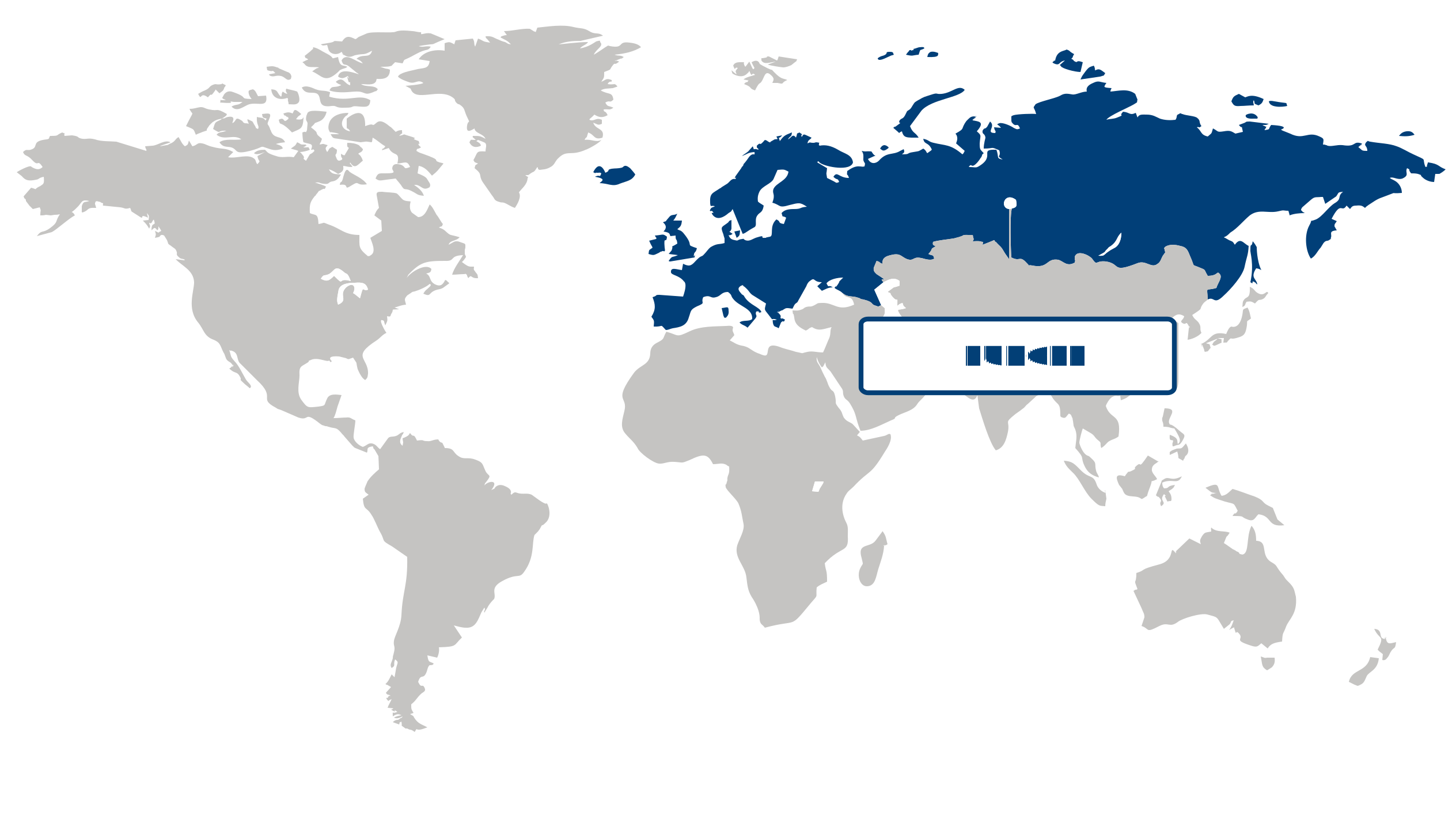
Largest Region
Europe
33.92% Market Share in 2026
Europe (Largest Region) vs Asia Pacific (Fastest-Growing Region)
Europe dominated the food colors market with a 33.92% share in 2026, supported by a highly developed food and beverage industry and strong demand for products with appealing visual characteristics. The region's regulatory environment and increasing consumer preference for clean-label and naturally derived ingredients are encouraging manufacturers to focus on color solutions that align with evolving transparency and ingredient-quality expectations. Continued innovation across processed foods, beverages, bakery products, confectionery, and other applications, together with growing interest in premium and differentiated food offerings, further supports Europe's leading position.
Asia Pacific is expected to emerge as the fastest-growing region in the food colors market, driven by the expanding processed food and beverage sector, rapid urbanization, and changing consumer preferences. Rising disposable incomes and increasing demand for packaged, convenience, and visually distinctive food products are broadening the need for food coloring solutions across multiple applications. The growth of modern retail networks, foodservice channels, and product innovation is also increasing demand, while greater consumer interest in natural and recognizable ingredients is supporting the adoption of newer food color formulations.
Key Country Insights
The U.S. food colors market increasingly favors natural color solutions across beverages, confectionery, dairy, and processed foods. Manufacturers in the U.S. reformulate products to satisfy clean-label expectations while maintaining visual appeal and processing stability.
Japan emphasizes food colors that enhance premium product presentation while preserving flavor integrity and product quality. Japanese manufacturers increasingly adopt naturally derived coloring ingredients for confectionery, beverages, and specialty food applications.
South Korea applies food colors to support premium packaged foods, beverages, and confectionery with distinctive visual appeal. Manufacturers in South Korea continue expanding naturally sourced color ingredients that align with evolving consumer purchasing preferences.
Germany focuses on food color innovation that combines regulatory compliance with reliable processing performance. German ingredient suppliers continue developing stable natural color formulations suitable for diverse food and beverage manufacturing applications.
France prioritizes naturally derived food colors that complement premium food production and evolving ingredient standards. French manufacturers focus on clean-label formulations, botanical color sources, and product authenticity across multiple processed food categories.
Italy integrates food colors into confectionery, bakery, dairy, and specialty food products while preserving traditional product character. Italian manufacturers increasingly select naturally sourced coloring solutions that support premium quality and ingredient transparency.
Segment Leadership and Growth Trends
Type Segment Analysis: Natural (Largest & Fastest-Growing Segment)
The natural food colors segment dominated the food colors market, holding a 45.58% share in 2026, and is also expected to be the fastest-growing segment. Its strong position reflects the accelerating shift toward clean-label food and beverage products, as consumers increasingly scrutinize ingredient lists and favor colors derived from natural sources. Food manufacturers are responding by replacing or reducing the use of synthetic additives while developing products that maintain visual appeal and meet evolving preferences for recognizable ingredients. Advances in extraction, stabilization, and formulation technologies are improving the performance of natural colors across a wider range of applications, while growing demand for minimally processed and health-conscious products continues to strengthen the segment's growth prospects.
Form Segment Analysis: Powder (Largest Segment) vs Liquid (Fastest-Growing Segment)
The powder form segment led the market with a 54.29% share in 2026, supported by its advantages in storage stability, handling, transportation, and ease of incorporation into dry formulations. Powder food colors are widely used across bakery, confectionery, beverage premixes, and other processed food applications where consistent dispersion and longer product stability are important. Their concentrated nature also supports efficient formulation and inventory management for manufacturers, contributing to broad adoption across industrial food production.
In the food colors market, the liquid form segment is expected to be the fastest-growing, driven by its convenience and suitability for applications requiring rapid mixing and uniform color distribution. Liquid colors are particularly beneficial in beverages, sauces, dairy products, and other formulations where direct incorporation can simplify processing. The increasing development of customized food and beverage products, along with demand for visually distinctive formulations, is encouraging wider use of liquid color solutions. Ongoing improvements in stability and compatibility with different product matrices are further supporting the segment's expansion.
| Report Segmentation | |||
| Segment | Sub-Segment | Largest Segment | Fastest Growing Segment |
|---|---|---|---|
| Type | Natural, Synthetic, Nature-identical | Natural | Natural |
| Form | Powder, Liquid, Gel & Paste | Powder | Liquid |
| Source | Plants, Animals, & Insects, Microorganisms, Petroleum, Others | Plants, Animals, & Insects | Plants, Animals, & Insects |
| Application | Food, Beverages | Food | Beverages |
 Read our Research Approach
Competitive Landscape and Market Positioning
Leading companies in the food colors market:
1. Cargill Incorporated (United States)
2. BASF SE (Germany)
3. DSM-Firmenich AG (Netherlands)
4. Kerry Group plc (Ireland)
5. Oterra A/S (Denmark)
6. Sensient Technologies Corporation (United States)
7. GNT Group B.V. (Netherlands)
8. Roha Dyechem Pvt. Ltd. (India)
9. Lycored Ltd. (Israel)
10. Archer Daniels Midland Company (United States)
The food colors market is evolving as manufacturers focus on natural and clean-label coloring solutions that align with changing consumer preferences. Advancements in formulation technology are enabling improved stability and broader application across food categories. The food colors market is increasingly shaped by health-conscious and regulation-driven innovation trends.
Industry Development/News
| Company Name | Date | Key Development |
|---|---|---|
| Phytolon | May-26 | Phytolon closed a $23.6 million Series B funding round to accelerate the commercialization of its fermentation-based natural food colors in the United States. This investment enables the company to scale production and strengthen its market presence, providing food manufacturers with sustainable alternatives to synthetic dyes in response to the growing consumer and regulatory demand for clean-label ingredients. |
| Sensient Food Colors | Apr-26 | Sensient Food Colors initiated a major capacity expansion at its flagship natural color production facility in St. Louis as part of a $250 million investment program. This strategic move aims to significantly increase production volume to support the broad industry transition from synthetic to natural food colorants across diverse food and beverage applications. |
| Debut | May-26 | Debut entered a strategic partnership with Oterra to develop and commercialize alternatives to Red Dye 40. This collaboration addresses escalating regulatory pressure on synthetic additives in the U.S. market, offering food manufacturers a viable pathway for product reformulation using advanced natural color solutions. |
| Oterra | Jun-25 | Oterra announced the acquisition of Diana Food’s natural food coloring division from Symrise AG. This strategic transaction underscores Oterra's aggressive expansion strategy in the global food colorant market, consolidating its product portfolio and strengthening its supply chain capabilities to better serve manufacturers transitioning to natural ingredients. |
| Earthrise Nutritionals | Apr-25 | Earthrise Nutritionals, a subsidiary of DIC Corporation, inaugurated a state-of-the-art edible algae cultivation facility in California. The plant utilizes advanced, renewable energy-powered "smart farming" technologies to produce Spirulina-derived LINABLUE, significantly boosting regional production capacity for sustainable, natural blue colorants and enhancing the company's footprint in eco-friendly ingredient supply. |
| Oterra | Feb-25 | Oterra inaugurated a dedicated color blending and application center in Kochi, Kerala, India. This facility is designed to enhance customer support, product development, and supply chain responsiveness, strategically positioning the company to capture the rising demand for natural color solutions across the Asia-Pacific and Middle Eastern food and beverage markets. |
| Michroma | Oct-25 | Michroma partnered with CJ CheilJedang to scale the manufacturing and commercial production of its fermentation-derived natural food colors. This alliance provides Michroma with the industrial infrastructure necessary to provide high-performance, cost-effective natural alternatives to synthetic dyes, strengthening its ability to serve large-scale global food manufacturing clients. |
| Givaudan Sense Colour | Jul-24 | Givaudan Sense Colour expanded its Amaize portfolio with the launch of a corn-based orange-red colorant designed as a natural alternative to synthetic Red 40. The product features enhanced heat and light stability, targeting acidic food and beverage applications where maintaining color integrity during processing and shelf life is technically challenging. |
| ROHA | Jan-25 | ROHA launched its next-generation NATRACOL natural food color range, specifically engineered for confectionery applications such as cream fillings and compound coatings. Derived from various plant-based sources, this portfolio offers the high vibrancy and technical stability required for clean-label product development, addressing the surging demand for plant-based, transparent ingredient sourcing in the sweets sector. |
| Oterra | Dec-24 | Oterra opened a new innovation, collaboration, and production hub in Wisconsin. This expansion of its U.S. operations strengthens the company’s manufacturing capacity, product development capabilities, and customer engagement infrastructure, reinforcing its leadership position in the North American market for natural food colors. |
Why Choose Us
Specialized Expertise: Our team comprises industry experts with a deep understanding of your market segment. We bring specialized knowledge and experience that ensures our research and consulting services are tailored to your unique needs.
Customized Solutions: We understand that every client is different. That's why we offer customized research and consulting solutions designed specifically to address your challenges and capitalize on opportunities within your industry.
Proven Results: With a track record of successful projects and satisfied clients, we have demonstrated our ability to deliver tangible results. Our case studies and testimonials speak to our effectiveness in helping clients achieve their goals.
Cutting-Edge Methodologies: We leverage the latest methodologies and technologies to gather insights and drive informed decision-making. Our innovative approach ensures that you stay ahead of the curve and gain a competitive edge in your market.
Client-Centric Approach: Your satisfaction is our top priority. We prioritize open communication, responsiveness, and transparency to ensure that we not only meet but exceed your expectations at every stage of the engagement.
Continuous Innovation: We are committed to continuous improvement and staying at the forefront of our industry. Through ongoing learning, professional development, and investment in new technologies, we ensure that our services are always evolving to meet your evolving needs.
Value for Money: Our competitive pricing and flexible engagement models ensure that you get maximum value for your investment. We are committed to delivering high-quality results that help you achieve a strong return on your investment.
Select Licence Type

