Food Safety Testing Market Size & Growth Forecast 2027–2036, By Segments (Technology, Test, Application), Regional Demand Trends (North America, Asia Pacific, Europe), Key Country Insights (U.S., Japan, South Korea, Germany, France, Italy), and Competitive Landscape
Market Size and Growth Outlook
Food Safety Testing Market size stood at USD 28.29 billion in 2026 and is predicted to grow at a 7.41% CAGR from 2027 to 2036, reaching USD 57.82 billion by 2036. The industry revenue for 2027 is calculated at USD 30.06 billion.
Get more details on this report
Request Free Sample ReportFood Safety Testing Market Intelligence Snapshot
Regional Market Dynamics
- Europe held a 36.15% market share in 2026, supported by mature regulations, established laboratory infrastructure, standardized testing protocols, and strong compliance requirements across the food supply chain.
- Asia Pacific is forecast to expand at an 8.81% CAGR as food manufacturing, cross-border trade, and stricter quality oversight increase demand for routine testing across domestic and export markets.
Segment Momentum
- Traditional technology accounted for 58.07% of the market in 2026, supported by widespread laboratory adoption, regulatory familiarity, validated methods, and dependable compliance workflows for routine food safety testing.
- Residues & Contamination Testing is the fastest-growing segment as food producers increasingly screen for broader chemical and contamination risks to satisfy expanding safety expectations and compliance requirements.
Market Expansion Drivers
- Rising global foodborne illness outbreaks driving stricter food safety compliance requirements.
- Expansion of global food supply chains increasing need for standardized contamination testing.
- Adoption of rapid automated testing technologies improving efficiency and regulatory compliance.
Leading Market Participants
- Key players in the food safety testing market include Eurofins Scientific SE (Luxembourg), SGS S.A. (Switzerland), Bureau Veritas S.A. (France), Intertek Group plc (United Kingdom), Thermo Fisher Scientific Inc. (United States), Mérieux NutriSciences Corporation (United States), TÜV SÜD AG (Germany), NSF International (United States), Agilent Technologies, Inc. (United States), ALS Limited (Australia).
Global Market Forecast Snapshot
Market Outlook
- 2026 Market Size: USD 28.29 billion
- 2027 Estimated Market Size: USD 30.06 billion.
- Projected Market Size: USD 57.82 billion by 2036
- Growth Forecast: 7.41% CAGR (2027-2036)
Regional and Segment Outlook
- Leading Regional Market: Europe
- High-Growth Regional Hub: Asia Pacific
- Core Revenue Segment: Traditional (Technology) | Microbiological Testing (Test) | Meat, Poultry, & Seafood Products (Application)
- Emerging Opportunity Segment: Rapid (Technology) | Residues & Contamination Testing (Test) | Processed Food (Application)
Market Growth Drivers and Industry Trends
Rising global foodborne illness outbreaks driving stricter food safety compliance requirements
The food safety testing market is gaining momentum as the increasing occurrence of foodborne illness outbreaks places greater pressure on food producers, processors, distributors, and retailers to strengthen safety controls. More frequent contamination concerns involving pathogens, allergens, chemical residues, and other hazards are encouraging organizations to implement systematic testing across production and distribution processes. Stricter compliance expectations also require reliable verification of raw materials, processing environments, and finished products, increasing the need for laboratory-based and on-site testing solutions that can support traceability, quality assurance, and adherence to established food safety requirements.
Expansion of global food supply chains increasing need for standardized contamination testing
As food products move through increasingly interconnected international sourcing, processing, storage, and distribution networks, standardized contamination testing is becoming more important, supporting food safety testing market growth. Raw materials and finished products may pass through multiple jurisdictions and handling stages, creating greater requirements for consistent testing procedures and quality controls. Food manufacturers and supply-chain operators therefore require dependable analytical methods to identify microbial, chemical, and physical contaminants at different points in the value chain, while standardized testing practices help maintain product integrity and facilitate compliance across diverse regulatory environments.
Adoption of rapid automated testing technologies improving efficiency and regulatory compliance
Rapid analytical platforms and automated testing workflows are transforming how food safety checks are conducted, creating favorable conditions for the food safety testing market. Automated systems can streamline sample preparation, detection, data processing, and reporting, reducing manual intervention and supporting more consistent testing procedures. Faster detection also enables food manufacturers to identify potential contamination earlier and make timely decisions regarding production batches, thereby limiting operational disruptions. Integration of automation with digital data management further supports documentation, traceability, and regulatory recordkeeping requirements.
| Growth Driver | Impact on CAGR | Regulatory Influence | Geographic Relevance | Adoption Rate | Impact Timeline |
|---|---|---|---|---|---|
| Rising global foodborne illness outbreaks driving stricter food safety compliance requirements | 2.30% | High | North America, Europe | High | Near Term |
| Expansion of global food supply chains increasing need for standardized contamination testing | 2.00% | High | Asia Pacific, Latin America | High | Mid Term |
| Adoption of rapid automated testing technologies improving efficiency and regulatory compliance | 1.70% | Moderate | Europe, North America | Medium | Mid Term |
Unlock insights tailored to your business with our bespoke market research solutions.
Click to get your customized report now.
Regional Demand Dynamics
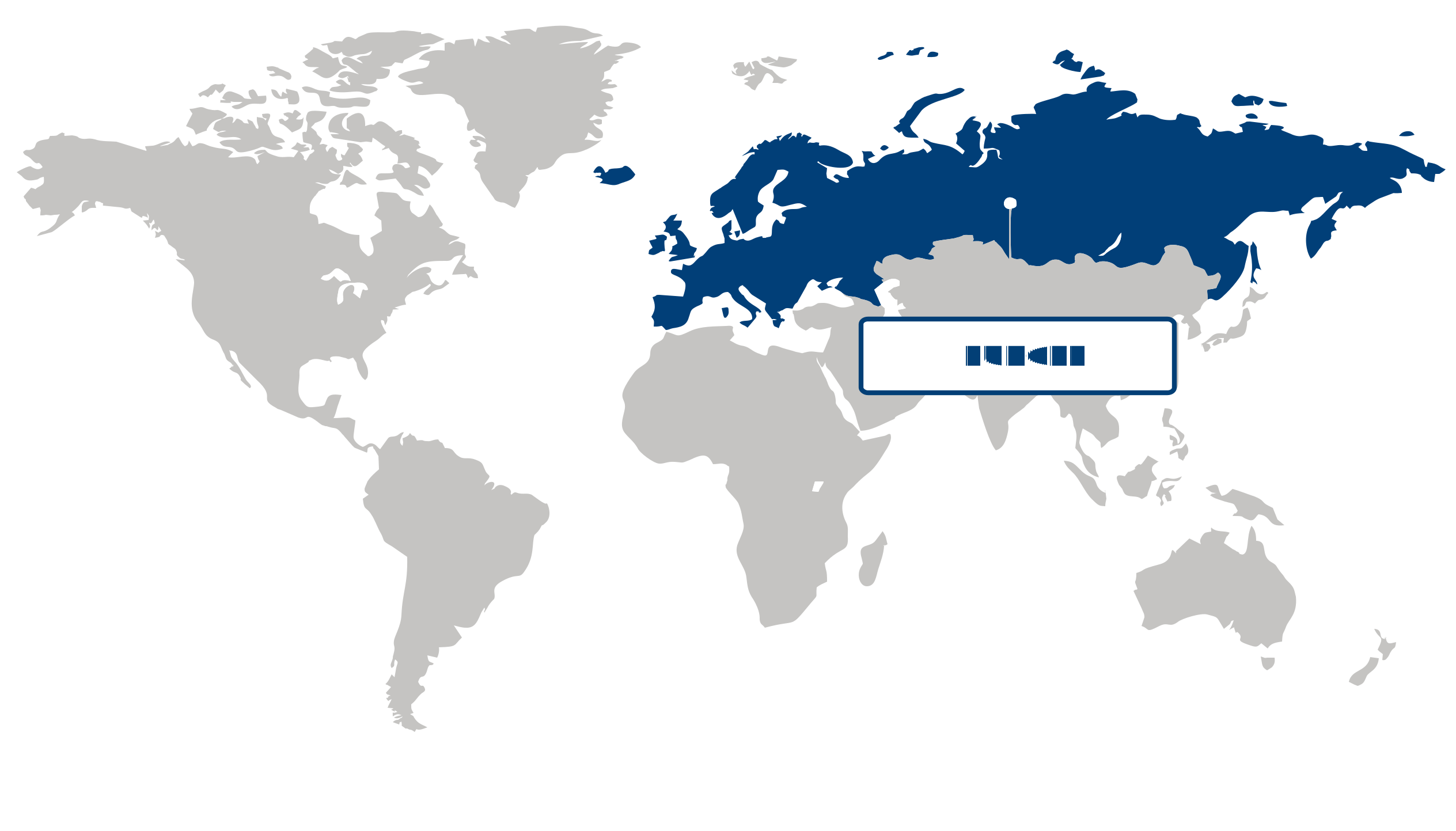
Europe (Largest Region)
Europe held the largest share of the food safety testing market, accounting for 36.15% in 2026, supported by stringent food safety requirements, established laboratory infrastructure, and strong emphasis on traceability across the food supply chain. Food producers and processors increasingly rely on microbiological, chemical, and contaminant testing to maintain product quality and meet demanding safety standards. Consumer awareness of foodborne risks and growing preference for transparent food production practices are also encouraging broader testing adoption, while advances in rapid and automated analytical methods are improving testing efficiency.
Asia Pacific (Fastest-Growing Region)
Asia Pacific is expected to be the fastest-growing region as expanding food processing industries, urbanization, and changing consumption patterns increase the need for reliable food safety controls. The development of modern retail and organized food distribution is placing greater emphasis on consistent quality and traceability, encouraging producers to strengthen testing procedures. Rising regulatory attention to food contamination, improvements in laboratory capabilities, and growing consumer awareness are further supporting adoption of advanced food safety testing solutions across the region.
| Parameter | North America | Asia Pacific | Europe | Latin America | MEA |
|---|---|---|---|---|---|
| Innovation Hub i Scale Nascent Developing Advanced | |||||
| Cost-Sensitive Region i Scale Low Medium High | |||||
| Regulatory Environment i Scale Restrictive Neutral Supportive | |||||
| Demand Drivers i Scale Weak Moderate Strong | |||||
| Development Stage i Scale Emerging Developing Developed | |||||
| Adoption Rate i Scale Low Medium High | |||||
| New Entrants / Startups i Scale Sparse Moderate Dense | |||||
| Macro Indicators i Scale Weak Stable Strong |
Key Country Insights
Germany 🇩🇪
Precision Laboratory NetworksGermany relies on highly standardized laboratory processes to support food manufacturers and exporters with stringent safety requirements. German testing providers are adopting automation and advanced analytical methods to improve efficiency and regulatory compliance.
France 🇫🇷
Traceability-Centered TestingFrance prioritizes food safety testing solutions that reinforce product traceability and protect high-value agricultural and processed food sectors. French laboratories are expanding multi-residue and authenticity testing services to address increasingly complex supply chains.
Italy 🇮🇹
Export Quality VerificationItaly's food safety testing market is closely tied to maintaining the quality reputation of packaged foods, dairy products, and specialty exports. Testing providers in Italy are enhancing contaminant screening and certification services to support international trade requirements.
Japan 🇯🇵
Quality Assurance EmphasisJapan places strong emphasis on food quality and contamination prevention across domestic production and imported food products. The Japanese market is increasingly adopting rapid microbiological testing and enhanced verification procedures to strengthen consumer confidence.
South Korea 🇰🇷
Technology-Led MonitoringSouth Korea is integrating digital technologies and advanced analytical equipment into food safety testing operations. Food producers in South Korea are strengthening routine testing capabilities to support export requirements and respond quickly to evolving safety standards.
United States 🇺🇸
Regulatory Compliance ExpansionThe U.S. food safety testing market is driven by rigorous oversight of pathogens, allergens, and contaminants across complex food supply chains. Laboratories in the U.S. are increasing investments in rapid testing technologies and data-driven traceability solutions to improve response times.
Segment Leadership and Growth Trends
Food Safety Testing Market Share (%), by Technology, 2026
Go beyond the chart, access full insights & data tables
Request Free Sample ReportTechnology Segment Analysis: Traditional (Largest Segment) vs Rapid (Fastest-Growing Segment)
Traditional food safety testing accounted for the largest share of the food safety testing market in 2026 at 58.07%, reflecting the established use of laboratory-based methods for detecting pathogens, contaminants, and other food safety risks. These methods remain widely utilized because they provide structured testing procedures and are supported by established laboratory practices and regulatory requirements. Food producers and testing facilities continue to depend on traditional approaches for routine quality assurance, verification, and compliance across diverse food products.
Rapid testing is gaining momentum as food manufacturers and testing laboratories increasingly prioritize faster identification of safety risks. Rapid methods can support quicker decision-making by reducing the time required to obtain actionable testing results, which is particularly valuable for high-throughput food production and time-sensitive quality control. Growing emphasis on supply chain responsiveness, preventive food safety, and efficient release of products is supporting greater adoption of rapid testing technologies.
Test Segment Analysis: Microbiological Testing (Largest Segment) vs Residues & Contamination Testing (Fastest-Growing Segment)
Microbiological testing represented the largest share of the food safety testing market in 2026 at 31.21%, driven by the need to identify harmful microorganisms that can compromise food quality and consumer safety. Testing for bacteria and other microbial hazards remains fundamental to food safety programs because contamination can occur across production, processing, storage, and distribution stages. Strong regulatory attention to pathogen control and the continued need for routine quality verification sustain demand for microbiological testing services and technologies.
Residues & contamination testing is expanding rapidly as food supply chains face growing scrutiny over chemical residues, environmental contaminants, and other unwanted substances. Producers and regulators increasingly require testing approaches capable of identifying contaminants that may enter food through agricultural inputs, processing activities, or environmental exposure. Greater emphasis on traceability, product quality, and consumer protection is strengthening the adoption of specialized residue and contamination testing.
| Segment | Sub-Segment | Largest Segment | Fastest Growing |
|---|---|---|---|
| Technology | Traditional, Rapid | Traditional | Rapid |
| Test | Allergen Testing, Chemical & Nutritional Testing, Genetically Modified Organism (GMO)Testing, Microbiological Testing, Residues & Contamination Testing, Others | Microbiological Testing | Residues & Contamination Testing |
| Application | Meat, Poultry, & Seafood Products, Dairy & Dairy Products, Processed Food, Beverages, Cereals & Grains, Others | Meat, Poultry, & Seafood Products | Processed Food |
Competitive Landscape and Market Positioning
Top players in the food safety testing market:
1. Eurofins Scientific SE (Luxembourg)
2. SGS S.A. (Switzerland)
3. Bureau Veritas S.A. (France)
4. Intertek Group plc (United Kingdom)
5. Thermo Fisher Scientific Inc. (United States)
6. Mérieux NutriSciences Corporation (United States)
7. TÃœV SÃœD AG (Germany)
8. NSF International (United States)
9. Agilent Technologies Inc. (United States)
10. ALS Limited (Australia)
Increasing regulatory scrutiny and safety awareness are driving growth in the food safety testing market, with stronger emphasis on rapid and accurate detection methods. Advanced analytical technologies are improving contamination identification and compliance assurance. Continuous innovation is reinforcing reliability within the food safety testing market.
| Company | Market Share | Company Revenue | Revenue CAGR (%) | Product Portfolio | Geographic Presence | Innovation / R&D Focus | Strategic Developments |
|---|---|---|---|---|---|---|---|
| Eurofins Scientific SE (Luxembourg) | |||||||
| SGS S.A. (Switzerland) | |||||||
| Bureau Veritas S.A. (France) | |||||||
| Intertek Group plc (United Kingdom) | |||||||
| Thermo Fisher Scientific Inc. (United States) | |||||||
| Mérieux NutriSciences Corporation (United States) | |||||||
| TÜV SÜD AG (Germany) | |||||||
| NSF International (United States) | |||||||
| Agilent Technologies Inc. (United States) | |||||||
| ALS Limited (Australia). |
Industry Development/News
| Company Name | Date | Key Development |
|---|---|---|
| Randox Laboratories | Apr-24 | Randox Laboratories announced plans to expand its Jefferson County, West Virginia site into a full-scale production laboratory. This investment is intended to bolster the company’s manufacturing capacity for diagnostic and food safety testing reagents, supporting broader growth in its commercial testing operations. |
| Thermo Fisher Scientific | Apr-24 | Thermo Fisher Scientific launched the Orbitrap Exploris EFOX Mass Detector, a high-resolution mass spectrometry system engineered for food safety and environmental testing. The system enhances analytical capabilities for complex contaminant detection, offering laboratories improved throughput and precision for routine testing workflows. |
| Bio-Rad Laboratories | Apr-24 | Bio-Rad Laboratories introduced the XP-Design Assay Salmonella Serotyping Solution. Utilizing real-time PCR technology, the platform facilitates rapid and specific identification of Salmonella serotypes. This innovation streamlines laboratory workflows by providing a ready-to-use solution for high-accuracy pathogen detection in food and environmental samples. |
| Mérieux NutriSciences | Mar-24 | Mérieux NutriSciences acquired the worldwide food testing business of Bureau Veritas for USD 389.6 million. This strategic consolidation adds 34 laboratories and approximately 1,900 technical staff across 15 countries to its operations, significantly expanding the company’s global food testing footprint and service capacity. |
| bioMérieux | Mar-24 | bioMérieux inaugurated a 32,000-square-foot Molecular and Genomic Innovation Center in Philadelphia. This dedicated facility establishes a new global site for food safety and quality, specifically designed to accelerate the development and commercialization of advanced molecular testing technologies and innovation programs. |
| SGS North America | Mar-24 | SGS expanded its North American food safety and quality assurance operations by opening an upgraded, larger testing facility in Fairfield, New Jersey. This expansion increases the company's laboratory throughput capacity and enhances its technical service capabilities to meet growing industry demand for robust quality testing. |
| Carso Group | Mar-24 | Backed by investment firm Archimed, Carso Group completed three add-on acquisitions including specialized food safety testing operations. These acquisitions strengthen the company's laboratory services portfolio and extend its analytical testing capabilities within the broader environmental and food safety market sectors. |
| Atiko Labs | Mar-24 | Atiko Labs secured USD 2 million in funding to advance its contamination control technologies. This capital injection is targeted at accelerating the development of specialized safety and quality assurance solutions, aiming to improve testing sensitivity and operational reliability within the food and beverage industry. |
| Neogen Corporation | Mar-24 | Neogen launched the Petrifilm Automated Feeder to integrate with its existing Petrifilm Plate Reader Advanced systems. The automation solution is designed to optimize high-volume microbial testing workflows, reducing manual handling and increasing throughput efficiency for food safety testing laboratories. |
| QIAGEN | Nov-23 | QIAGEN launched new QIAcuity digital PCR kits and updated software to enhance applications in food safety and biopharma. The solution improves detection sensitivity for food testing and streamlines laboratory workflows through features such as automated data documentation and temperature gradient optimization, supporting compliance with rigorous industry standards. |
Customize Your Report
Explore examples of how this report can be tailored to different research needs, including custom segments, additional topics or chapters, and related reports. Click a section of the wheel or its numbered marker to explore the available options.
Food Safety Testing Market — Custom Segments
| Segment | Sub-Segment |
|---|---|
| End User | Food Manufacturers & Processors, Food Retailers & Distributors, Foodservice Providers, Government & Regulatory Agencies |
| Sample Type | Food Samples, Beverage Samples, Environmental Samples, Packaging & Contact Materials |
| Testing Location | In-House Testing Facilities, Third-Party Laboratories, On-Site & Field Testing |
Food Safety Testing Market — Custom TOC
| Custom Chapter | Custom Details |
|---|---|
| Foodborne Risk Intelligence Assessment |
|
| Testing Outsourcing Opportunity Analysis |
|
| Emerging Contaminant Surveillance |
|
Need a different cut of the data?
Request Custom ResearchWhat is the market valuation of food safety testing?
How is the food safety testing industry size expected to evolve during the forecast period?
How are stricter food safety compliance requirements shaping demand for food safety testing?
Why are rapid automated testing technologies gaining strategic importance in the food safety testing market?
Why does Traditional technology lead the food safety testing market?
Which test segment is expanding fastest in the food safety testing market?
What makes Europe the leading region in the food safety testing market?
Why is Asia Pacific experiencing the fastest growth in the food safety testing market?
Which companies dominate the food safety testing landscape?
Our Clients
"The report provided a thorough look at market trends, technological advancements, and the competitive landscape. The depth of insights was really valuable."
ITC Limited
"We would highly recommend Fundamental Business Insights & Consulting to anyone looking for reliable, detailed, and comprehensive market research in the Food industry."
Tyson Foods
"The clarity and presentation of the information were commendable. The report was delivered timely, which made the overall experience smooth and convenient."
Mondelēz International
Our Research Team & Methodology
Every Fundamental Business Insights report is built by a dedicated vertical research team, validated through a structured primary-and-secondary methodology, and reviewed for accuracy before it reaches you.
Research Team Overview
Prepared by the Food & Beverage Research Team
Delivery
Published
Demand
Available
Support
Trust & Compliance
Research Domains
10 coverage areasResearch Intelligence
| Source | Reference |
|---|---|
| Food and Agriculture Organization (FAO) | www.fao.org |
| World Health Organization (WHO) | www.who.int |
| U.S. Food & Drug Administration (FDA) | www.fda.gov |
| European Food Safety Authority (EFSA) | www.efsa.europa.eu |
| U.S. Department of Agriculture (USDA) | www.usda.gov |
| Codex Alimentarius Commission | www.fao.org/fao-who-codexalimentarius |
| International Organization for Standardization (ISO) | www.iso.org |
| AOAC INTERNATIONAL | www.aoac.org |
| Institute of Food Technologists (IFT) | www.ift.org |
| International Dairy Foods Association (IDFA) | www.idfa.org |
| International Sweeteners Association (ISA) | www.sweeteners.org |
| International Probiotics Association (IPA) | internationalprobiotics.org |
| Good Food Institute (GFI) | gfi.org |
| American Feed Industry Association (AFIA) | www.afia.org |
| International Feed Industry Federation (IFIF) | ifif.org |
| Specialty Food Association (SFA) | www.specialtyfood.com |
| Brewers Association | www.brewersassociation.org |
| International Bottled Water Association (IBWA) | bottledwater.org |
| International Alliance for Dietary/Food Supplement Associations (IADSA) | www.iadsa.org |
| OECD Agriculture & Food | www.oecd.org/agriculture |
Research Workflow & Quality Assurance
Data Collection
Verified information gathered through primary and secondary research.
Data Triangulation
Cross-validation using multiple independent data sources.
Forecast Modelling
Market estimates developed using historical trends and analytical models.
Analyst Validation
Findings reviewed by domain experts for accuracy and consistency.
Editorial & Quality Review
Final editorial, quality, and compliance checks before publication.
Final Publication
Released after successful completion of the internal review process.
Report Coverage
📊 Market Assessment
- Market Size & Forecast
- Market Segmentation
- Regional Analysis
- Growth Drivers & Challenges
- Market Dynamics
🏢 Competitive Intelligence
- Competitive Landscape
- Company Profiles
- Competitive Benchmarking
- Mergers & Acquisitions
- Market Share Analysis or Key Company Strategies
🔍 Strategic Analysis
- Value Chain Analysis
- Porter's Five Forces
- PESTLE Analysis
- Pricing Trends
- Supply-Demand Analysis
🚀 Future Outlook
- Technology Landscape
- Regulatory Landscape
- Investment & Funding Landscape
- Emerging Opportunities
- Future Market Outlook
Have a question about this report or need a custom scope?
Request Customization