Fragrance Fixatives Market Size & Growth Forecast 2027–2036, By Segments (Type, Application, Product), Regional Demand Trends (North America, Asia Pacific, Europe), Key Country Insights (U.S., Japan, South Korea, Germany, France, Italy), and Competitive Landscape
Jump to content
Market Size and Growth Outlook
Fragrance Fixatives Market size was assessed at USD 2.37 Billion in 2026 and is poised to grow at 5.18% CAGR between 2027 and 2036, surpassing USD 3.93 Billion by 2036. The industry revenue for 2027 is estimated at USD 2.47 Billion.
Get more details on this report
Request Free Sample ReportFragrance Fixatives Market Intelligence Snapshot
Regional Market Dynamics
- Europe held 32.94% in 2026, supported by its established fragrance and cosmetics industry, mature personal care sector, premium fragrance demand, and emphasis on product quality.
- Asia Pacific is expanding rapidly as rising incomes, urbanization, middle-class growth, and increasing spending on premium personal care and sophisticated fragrance products strengthen demand.
Segment Momentum
- Fine fragrances accounted for 36.72% of the market in 2026, supported by demand for premium perfumes, long-lasting scent performance, and differentiated fragrance formulations.
- Skincare products are the fastest-growing application as manufacturers increasingly use fixatives in creams, lotions, and serums to enhance fragrance appeal and formulation stability.
Market Expansion Drivers
- Rising demand for long-lasting fragrances driving cosmetic formulation innovation
- Increasing disposable income boosting premium personal care and fragrance consumption
- Advancements in aroma stabilization technologies improving fragrance retention performance
Leading Market Participants
- Key players in the fragrance fixatives market include Givaudan SA (Switzerland), International Flavors & Fragrances Inc. (United States), Symrise AG (Germany), Eastman Chemical Company (United States), Takasago International Corporation (Japan), Alpha Aromatics, Inc. (United States), BASF SE (Germany), Sensient Technologies Corporation (United States), Mane SA (France)
Global Market Forecast Snapshot
Market Outlook
- 2026 Market Size: USD 2.37 Billion
- 2027 Estimated Market Size: USD 2.47 Billion
- Projected Market Size: USD 3.93 Billion by 2036
- Growth Forecast: 5.18% CAGR (2027-2036)
Regional and Segment Outlook
- Leading Regional Market: Europe
- High-Growth Regional Hub: Asia Pacific
- Core Revenue Segment: Synthetic (Type) | Fine Fragrances (Application) | Sclareolide (Product)
- Emerging Opportunity Segment: Natural (Type) | Skincare Products (Application) | Ambergris (Product)
Market Growth Drivers and Industry Trends
Rising demand for long-lasting fragrances driving cosmetic formulation innovation
Consumer preference for fragrances that maintain their scent profile throughout the day is driving innovation across formulations, and this trend will propel the fragrance fixatives market growth by increasing the need for ingredients that slow the evaporation of volatile aroma compounds. Fixatives help preserve fragrance intensity and improve the stability of scent compositions across perfumes, cosmetics, personal care products, and household applications, allowing formulators to maintain desired sensory characteristics for longer periods. The shift toward sophisticated fragrance experiences is also encouraging formulators to balance longevity with characteristics such as skin feel, scent diffusion, and compatibility with other formulation ingredients, increasing the importance of effective fixative systems in product development.
Increasing disposable income boosting premium personal care and fragrance consumption
Rising disposable income is encouraging consumers to allocate more spending toward premium perfumes, skincare, haircare, and other fragranced personal care products, thereby supporting expansion of the fragrance fixatives market. Premium formulations typically place greater emphasis on distinctive scent profiles, lasting performance, and refined sensory experiences, creating stronger requirements for ingredients that can stabilize aromatic compositions without compromising fragrance quality. In emerging consumer markets, improving purchasing power and greater exposure to international beauty and lifestyle trends are also broadening demand for higher-value fragrance products, while established markets continue to see premiumization through niche scents, luxury formulations, and personalized fragrance offerings.
Advancements in aroma stabilization technologies improving fragrance retention performance
Technological progress in aroma stabilization is improving the ability of formulators to control fragrance release, preserve volatile compounds, and maintain consistent scent performance across different product formats. These developments will support fragrance fixatives market expansion as manufacturers adopt more sophisticated approaches to managing interactions between aroma molecules, solvents, oils, polymers, and other formulation components. Encapsulation systems, controlled-release technologies, and improved compatibility between fixatives and fragrance ingredients can help reduce premature evaporation while maintaining the intended sensory profile during storage and use. Such innovations are particularly valuable for formulations exposed to heat, air, moisture, or repeated handling, where fragrance stability can otherwise deteriorate.
| Growth Driver | Impact on CAGR | Regulatory Influence | Geographic Relevance | Adoption Rate | Impact Timeline |
|---|---|---|---|---|---|
| Rising demand for long-lasting fragrances driving cosmetic formulation innovation | 2% | Low | North America, Europe | High | Near Term |
| Increasing disposable income boosting premium personal care and fragrance consumption | 1.6% | Low | Asia Pacific, North America | High | Near Term |
| Advancements in aroma stabilization technologies improving fragrance retention performance | 1.2% | Low | Europe, Asia Pacific | Medium | Mid Term |
Unlock insights tailored to your business with our bespoke market research solutions.
Click to get your customized report now.
Regional Demand Dynamics
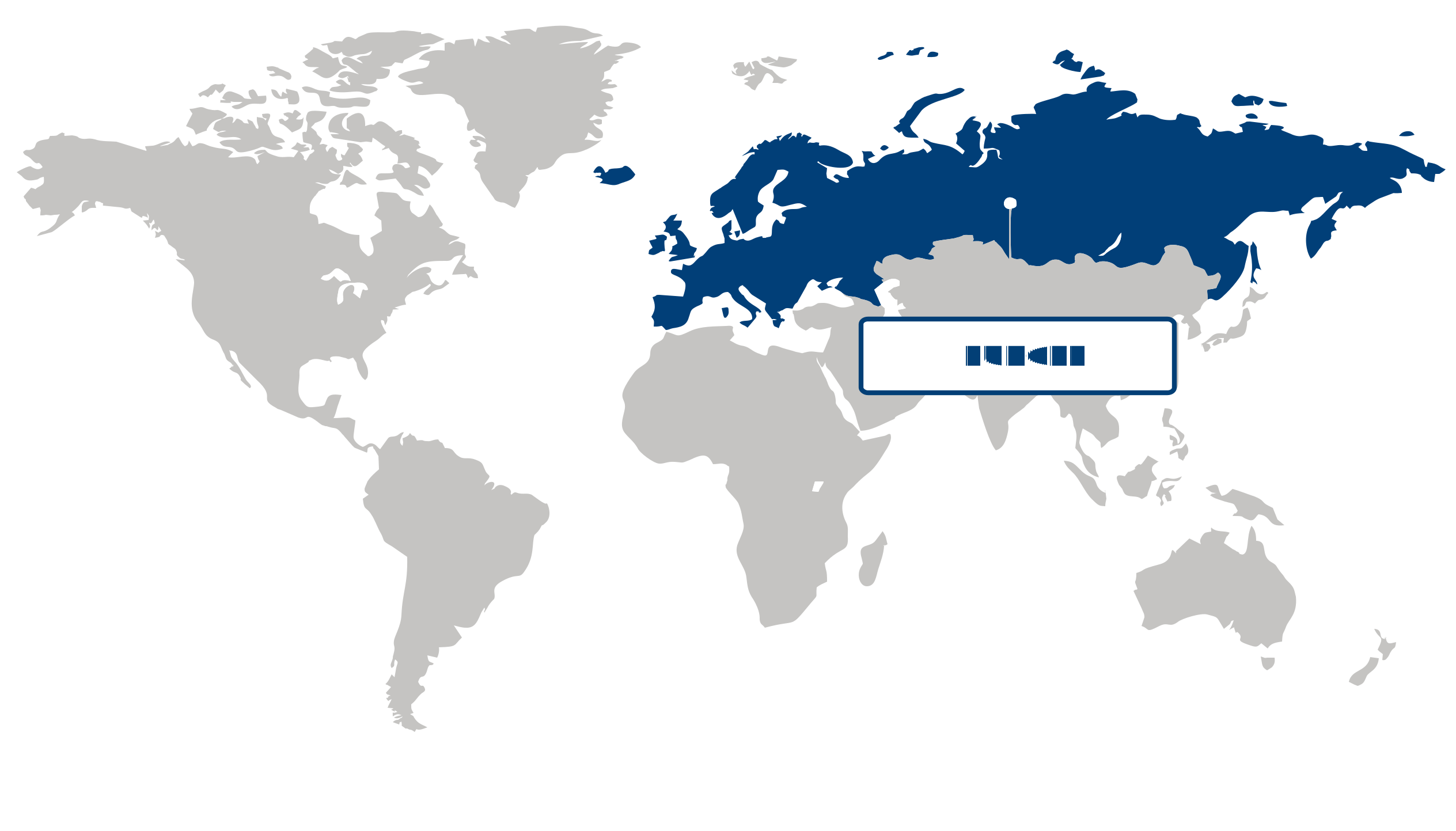
Europe (Largest Region)
Holding the largest share of the fragrance fixatives market, Europe accounted for 32.94% in 2026. The region's established fragrance and cosmetics industry provides a strong demand base for ingredients used to improve fragrance stability and longevity. Europe's mature personal care sector, sophisticated consumer preferences, and emphasis on product quality support the use of effective fixative ingredients across perfumes and other scented formulations. In addition, continued interest in premium fragrances and evolving formulation requirements encourage manufacturers to develop products that provide longer-lasting scent profiles while meeting changing regulatory and consumer expectations.
Asia Pacific (Fastest-Growing Region)
Asia Pacific is expected to witness the fastest growth over the forecast period as rising disposable incomes, urbanization, and expanding consumer spending on personal care products strengthen demand for fragrances. The region's growing middle-class population is increasing interest in premium and personal grooming products, creating greater opportunities for fragrance formulators and related ingredient suppliers. Expanding beauty and cosmetics markets, together with changing consumer preferences toward sophisticated fragrance products, are likely to support increasing utilization of fragrance fixatives across the region.
| Parameter | North America | Asia Pacific | Europe | Latin America | MEA |
|---|---|---|---|---|---|
| Innovation HubiScaleNascentDeveloping Advanced | |||||
| Cost-Sensitive RegioniScaleLowMedium High | |||||
| Regulatory EnvironmentiScaleRestrictiveNeutral Supportive | |||||
| Demand DriversiScaleWeakModerate Strong | |||||
| Development StageiScaleEmergingDeveloping Developed | |||||
| Adoption RateiScaleLowMedium High | |||||
| New Entrants / StartupsiScaleSparseModerate Dense | |||||
| Macro IndicatorsiScaleWeakStable Strong |
Key Country Insights
United States 🇺🇸
Premium Fragrance FormulationThe U.S. fragrance fixatives market is shaped by demand for long-lasting personal care and fine fragrance products. Manufacturers in the U.S. increasingly evaluate sustainable and high-performance fixatives that improve scent retention while meeting evolving formulation preferences.
Germany 🇩🇪
Performance Ingredient DevelopmentGermany focuses on fragrance fixatives that deliver formulation stability and consistent sensory performance. Producers in Germany emphasize innovative aroma ingredients that satisfy regulatory expectations while supporting premium fragrance and cosmetic applications.
Japan 🇯🇵
Refined Scent EnhancementJapan values fragrance fixatives that enhance subtle, balanced scent profiles across cosmetics and personal care products. Manufacturers in Japan prioritize high-purity ingredients that maintain fragrance longevity without compromising product quality or consumer experience.
South Korea 🇰🇷
Beauty Formulation InnovationSouth Korea integrates advanced fragrance fixatives into cosmetic and skincare product development. Brands in South Korea focus on ingredient compatibility and long-lasting sensory appeal to support differentiated beauty formulations and evolving consumer preferences.
France 🇫🇷
Luxury Perfumery ExpertiseFrance continues advancing fragrance fixatives through its established perfume industry and ingredient innovation. Fragrance houses in France seek sophisticated fixative technologies that preserve fragrance character while improving product longevity across premium applications.
Italy 🇮🇹
Artisan Fragrance ApplicationsItaly applies fragrance fixatives across luxury fragrances and premium personal care formulations. Ingredient developers in Italy emphasize balanced performance, formulation flexibility, and refined scent preservation to support distinctive fragrance creation.
Fragrance Fixatives Market Share (%), by Type, 2026
Go beyond the chart, access full insights & data tables
Request Free Sample ReportType Segment Analysis: Synthetic (Largest Segment) vs Natural (Fastest-Growing Segment)
The synthetic segment held the largest share of the market at 71.33% in 2026. Synthetic fragrance fixatives are widely preferred because they provide consistent quality, superior formulation stability, and reliable fragrance longevity across a broad range of perfume and personal care products. Their scalable production, predictable performance, and compatibility with diverse fragrance compositions make them the preferred choice for manufacturers seeking cost-efficient and standardized ingredient solutions. Continuous innovation in aroma chemical development has further reinforced the segment's leading position.
The natural segment is emerging as the fastest-growing category in the fragrance fixatives market. Increasing consumer demand for naturally derived ingredients, clean-label formulations, and environmentally responsible products is encouraging fragrance manufacturers to expand the use of botanical and bio-based fixatives. Growing interest in premium and sustainable fragrances, together with advancements in natural extraction technologies, continues to accelerate the adoption of natural fragrance fixatives.
Application Segment Analysis: Fine Fragrances (Largest Segment) vs Skincare Products (Fastest-Growing Segment)
The fine fragrances application accounted for 36.72% of the market in 2026, making it the largest application segment. Fragrance fixatives play a vital role in premium perfumes by slowing the evaporation of volatile aroma compounds and extending scent longevity on the skin. The continued demand for luxury fragrances, differentiated scent profiles, and high-performance formulations has sustained the widespread use of fixatives within this application.
Within the fragrance fixatives market, skincare products represent the fastest-growing application. The incorporation of fragrances into creams, lotions, serums, and other skincare formulations has increased as manufacturers focus on enhancing product appeal and consumer experience. Rising demand for multifunctional personal care products and premium skincare offerings is encouraging greater utilization of advanced fixatives that preserve fragrance performance while maintaining formulation stability.
Product Segment Analysis: Sclareolide (Largest Segment) vs Ambergris (Fastest-Growing Segment)
The sclareolide segment secured the largest market share of 26.14% in 2026. Sclareolide is extensively utilized as a fragrance fixative because of its excellent ability to improve scent persistence while complementing a broad spectrum of fragrance compositions. Its stability, compatibility with modern formulations, and suitability for fine fragrances and personal care products have contributed to its broad commercial acceptance across the fragrance industry.
The ambergris segment is expected to witness the fastest growth in the fragrance fixatives market. Rising interest in premium fragrance profiles and sophisticated scent formulations has encouraged manufacturers to explore ingredients capable of delivering exceptional depth and longevity. The increasing availability of ethical and innovative ambergris-inspired alternatives has further expanded opportunities for this segment across luxury fragrance applications.
| Segment | Sub-Segment | Largest Segment | Fastest Growing |
|---|---|---|---|
| Type | Natural, Synthetic | Synthetic | Natural |
| Application | Fine Fragrances, Homecare Fragrance, Color Cosmetics, Skincare Products, Haircare Products | Fine Fragrances | Skincare Products |
| Product | Sclareolide, Galaxolide, ISO E Super, Sucrose Acetate Isobutyrate, Ambergris, Civet | Sclareolide | Ambergris |
Competitive Landscape and Market Positioning
Major players in the fragrance fixatives market:
- Givaudan SA (Switzerland)
- International Flavors & Fragrances, Inc. (United States)
- Symrise AG (Germany)
- Eastman Chemical Company (United States)
- Takasago International Corporation (Japan)
- Alpha Aromatics, Inc. (United States)
- BASF SE (Germany)
- Sensient Technologies Corporation (United States)
- Mane SA (France)
The fragrance fixatives market is evolving as suppliers compete to improve scent longevity, formulation compatibility, and performance across increasingly diverse fragrance applications. Traditional ingredient providers are strengthening their positions through broad formulation expertise, while specialized manufacturers are differentiating through innovative molecules and naturally derived alternatives that align with changing consumer preferences. Competitive pressure is increasing around the ability to balance lasting fragrance performance with regulatory requirements and sustainability expectations. Companies with stronger research capabilities and flexible development processes are gaining an advantage as fragrance creators seek more distinctive and reliable solutions.
| Company | Market Share | Company Revenue | Revenue CAGR (%) | Product Portfolio | Geographic Presence | Innovation / R&D Focus | Strategic Developments |
|---|---|---|---|---|---|---|---|
| Givaudan SA (Switzerland) | |||||||
| International Flavors & Fragrances Inc. (United States) | |||||||
| Symrise AG (Germany) | |||||||
| Eastman Chemical Company (United States) | |||||||
| Takasago International Corporation (Japan) | |||||||
| Alpha Aromatics Inc. (United States) | |||||||
| BASF SE (Germany) | |||||||
| Sensient Technologies Corporation (United States) | |||||||
| Mane SA (France) |
Industry Development / News
| Company Name | Date | Key Development |
|---|---|---|
| Mane | Mar-25 | Mane completed the acquisition of Avoca from Ashland Inc., strengthening its operational capabilities in fragrance fixatives through the integration of specialized production facilities and technical expertise in the United States. |
| LANXESS | Jan-25 | LANXESS launched new high-purity benzyl benzoate fixative grades, including Ultrapure Scopeblue variants, designed to deliver long-lasting fragrance performance and reduce environmental impact across fine fragrance, personal care, and home scent applications. |
Customize Your Report
Explore examples of how this report can be tailored to different research needs, including custom segments, additional topics or chapters, and related reports. Click a section of the wheel or its numbered marker to explore the available options.
Fragrance Fixatives Market — Custom Segments
| Segment | Sub-Segment |
|---|---|
| Customer Type | Fragrance Houses, Cosmetics Manufacturers, Household & Homecare Manufacturers, Personal Care Manufacturers |
| Procurement Model | Direct Procurement, Distributor-Based Procurement, Contract/Custom Supply |
| Performance Requirement | Standard Fixation, Long-Lasting Fixation, Enhanced Stability & Heat Resistance |
Fragrance Fixatives Market — Custom TOC
| Custom Chapter | Chapter Details |
|---|---|
| Natural-to-Synthetic Fixative Transition |
|
| Sustainable Fixative Commercialization |
|
| Customer Switching and Sourcing Dynamics |
|
Need a different cut of the data?
Request Custom ResearchFrequently Asked Questions
What is the current revenue of the fragrance fixatives market?
What is the forecasted size of the fragrance fixatives industry?
How is premium fragrance demand influencing formulation strategies?
How are stabilization technologies improving fragrance product performance?
Why do fine fragrances represent the largest application segment in the fragrance fixatives market?
How is the skincare products segment creating growth opportunities for fragrance fixatives?
What makes Europe the leading market for fragrance fixatives?
Why is Asia Pacific expected to see the fastest growth in fragrance fixatives?
Which companies are driving growth in the fragrance fixatives landscape?
Our Clients
"The report helped us understand emerging consumer trends in our product category. It clarified where to focus innovation for the next product launch."
LyondellBasell
"The regional forecast section was incredibly useful. We were able to identify two new potential partners in Europe thanks to the vendor mapping you included."
SABIC
"We appreciated how actionable the recommendations were. It guided us to improve supply chain resilience."
Olin Corporation
Our Research Team & Methodology
Every Fundamental Business Insights report is built by a dedicated vertical research team, validated through a structured primary-and-secondary methodology, and reviewed for accuracy before it reaches you.
Delivery
Published
Available
Support
- Market Size & Forecast
- Market Segmentation
- Regional Analysis
- Growth Drivers & Challenges
- Market Dynamics
- Competitive Landscape
- Company Profiles
- Competitive Benchmarking
- Mergers & Acquisitions
- Market Share Analysis or Key Company Strategies
- Value Chain Analysis
- Porter's Five Forces
- PESTLE Analysis
- Pricing Trends
- Supply-Demand Analysis
- Technology Landscape
- Regulatory Landscape
- Investment & Funding Landscape
- Emerging Opportunities
- Future Market Outlook