



Green Steel Market Size & Growth Forecast 2027–2036, By Segments (Production Technology, End-use), Regional Demand Trends (North America, Asia Pacific, Europe), Key Country Insights (U.S., Japan, South Korea, Germany, France, Italy), and Competitive Landscape
Market Size and Growth Outlook
Green Steel Market size was worth USD 604.3 billion in 2026 and is expected to grow at a 11.12% CAGR between 2027 and 2036, crossing USD 1.73 trillion by 2036. The industry revenue for 2027 is calculated at USD 660.86 billion.
Base Year Value (2026)
USD 604.3 billion
CAGR (2027-2036)
11.12%
Forecast Year Value (2036)
USD 1.73 trillion

Historical Data Period
2022-2026

Largest Region
Europe

Forecast Period
2027-2036
Green Steel Market Intelligence Snapshot:
-
Regional Market Dynamics:
- Europe led the market in 2026 through supportive decarbonization policies, established steelmaking capacity, investment in lower-emission production, and regulatory pressure encouraging cleaner steel commercialization.
- Asia Pacific is projected to expand at a 6.89% CAGR, supported by industrial modernization, cleaner energy integration, capacity upgrades, and growing investment in lower-emission steel production technologies.
-
Segment Momentum:
- Electric Arc Furnace leads due to its commercial readiness, compatibility with steel recycling, and ability to produce lower-emission steel using established infrastructure and scrap-based production.
- Building & Construction is expanding fastest as demand for low-emission materials increases in structural and infrastructure projects, supporting wider adoption of green steel to reduce embodied carbon.
-
Market Expansion Drivers:
- Increasing industrial decarbonization initiatives driving adoption of low-emission steel production technologies.
- Growing construction sector preference for sustainable building materials supporting green steel consumption.
- Expanding renewable energy infrastructure investments increasing demand for environmentally compliant steel supply.
-
Leading Market Participants:
Top companies in the green steel market include SSAB AB (Sweden), ArcelorMittal S.A. (Luxembourg), ThyssenKrupp AG (Germany), Nucor Corporation (United States), voestalpine AG (Austria), Emirates Steel Arkan (United Arab Emirates), Nippon Steel Corporation (Japan), China Baowu Steel Group Corporation Limited (China), Salzgitter AG (Germany), Tata Steel Limited (India).
Global Market Forecast Snapshot:
-
Market Outlook:
- 2026 Market Size: USD 604.3 billion
- 2027 Estimated Market Size: USD 660.86 billion.
- Projected Market Size: USD 1.73 trillion by 2036
- Growth Forecasts: 11.12% CAGR (2027-2036)
-
Regional and Segment Outlook:
- Leading Regional Market: Europe
- High-Growth Regional Hub: Asia Pacific
- Core Revenue Segment: Electric Arc Furnace (Production Technology) | Building & Construction (End-use)
- Emerging Opportunity Segment: Hydrogen-Based DR (Production Technology) | Building & Construction (End-use)
Market Growth Drivers and Industry Trends
Increasing industrial decarbonization initiatives driving adoption of low-emission steel production technologies
Stronger efforts by industries to reduce carbon emissions are accelerating the transition toward cleaner manufacturing processes, and the green steel market is gaining momentum as steel producers seek lower-emission alternatives to conventional production routes. Decarbonization strategies are encouraging investment in technologies that reduce dependence on carbon-intensive processes, including production pathways that integrate renewable electricity, hydrogen, and other lower-carbon inputs. As manufacturers across steel-consuming industries face increasing pressure to reduce the environmental footprint of their supply chains, demand for steel produced through more sustainable processes is becoming increasingly relevant to procurement and production decisions.
Growing construction sector preference for sustainable building materials supporting green steel consumption
Sustainability considerations are becoming more prominent in construction projects as developers, contractors, and building owners seek materials that can contribute to lower environmental impacts throughout the project lifecycle. The green steel market will benefit from this shift because steel is extensively used in structural frameworks, reinforcement systems, infrastructure components, and commercial buildings, creating opportunities for lower-emission alternatives within material procurement. Green building practices and environmentally focused project specifications are also encouraging construction stakeholders to consider the emissions associated with material production, increasing interest in steel products that can support sustainability objectives without changing the structural role of steel in construction.
Expanding renewable energy infrastructure investments increasing demand for environmentally compliant steel supply
The expansion of renewable power infrastructure is creating substantial requirements for steel across equipment, support structures, transmission systems, and related infrastructure, while project developers are placing greater emphasis on the environmental characteristics of their supply chains. This trend will propel the green steel market as renewable energy projects increasingly align their material sourcing with broader decarbonization objectives. Wind installations, solar infrastructure, energy storage facilities, and grid modernization projects require durable steel components, and the use of lower-emission steel can help project stakeholders address embodied emissions alongside the clean-energy benefits associated with the infrastructure itself.
| Growth Driver Assessment Framework | |||||
| Growth Driver | Impact On CAGR | Regulatory Influence | Geographic Relevance | Adoption Rate | Impact Timeline |
|---|---|---|---|---|---|
| Increasing industrial decarbonization initiatives driving adoption of low-emission steel production technologies | 1.90% | High | Europe, Asia Pacific, North America | High | Mid Term |
| Growing construction sector preference for sustainable building materials supporting green steel consumption | 1.60% | Moderate | Asia Pacific, Europe | High | Near Term |
| Expanding renewable energy infrastructure investments increasing demand for environmentally compliant steel supply | 1.40% | Moderate | North America, Europe, Asia Pacific | Emerging | Long Term |
Unlock insights tailored to your business with our bespoke market research solutions - Click to get your customized report now!
Regional Demand Dynamics
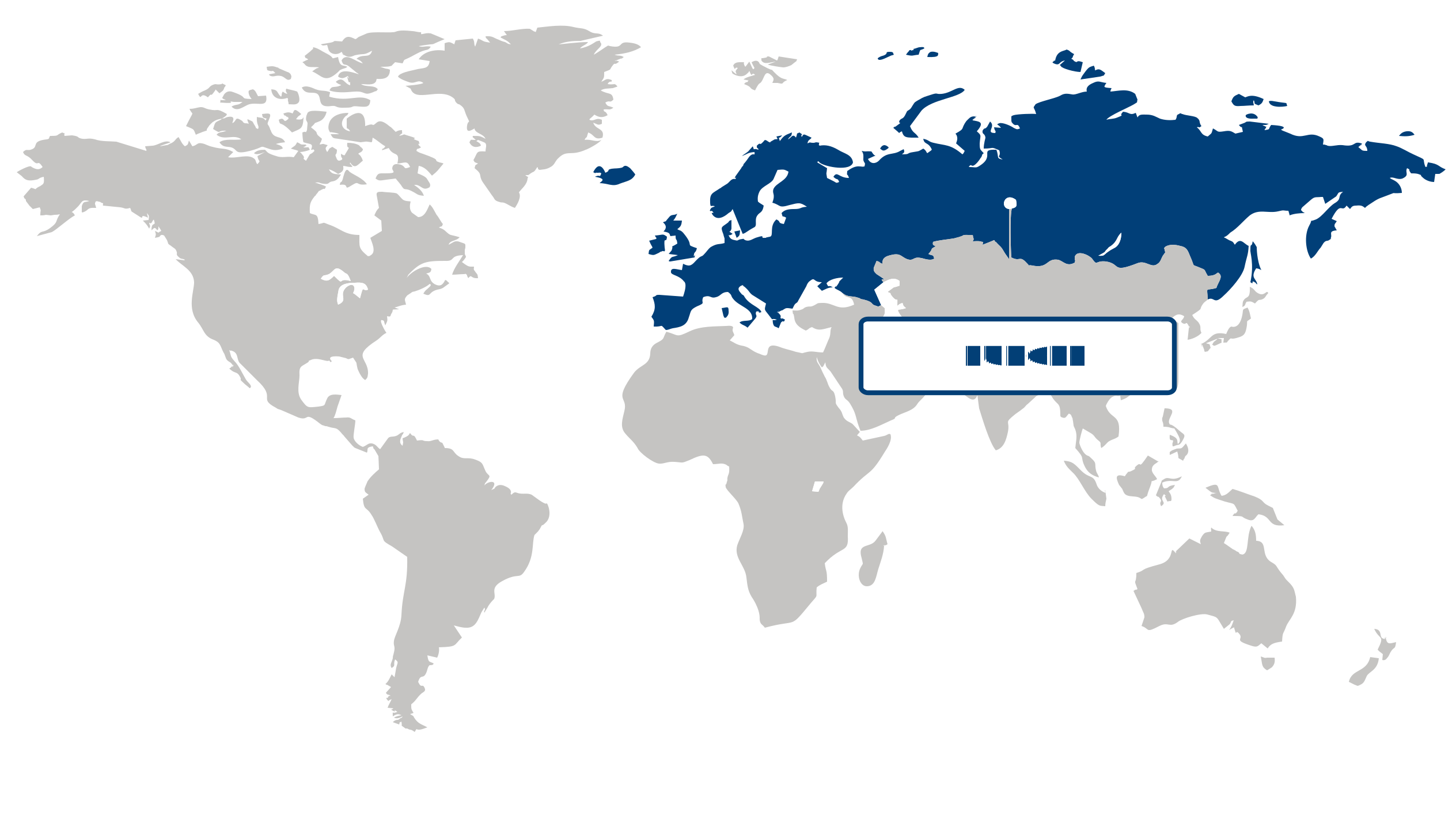
Largest Region
Europe
Largest Market Share in 2026
Europe (Largest Region) vs Asia Pacific (Fastest-Growing Region)
Europe held the largest share in 2026 in the green steel market, supported by strong decarbonization policies, established environmental standards, and sustained investment in cleaner industrial production. The region's steel industry is under increasing pressure to reduce carbon emissions, encouraging producers to adopt hydrogen-based reduction, renewable energy integration, electric arc furnace technologies, and other lower-emission production pathways. Growing demand for low-carbon materials from automotive, construction, and engineering industries is further strengthening the commercial case for green steel. Public and private investment in industrial transformation, alongside Europe's broader emphasis on circularity and sustainable manufacturing, continues to reinforce its leadership in the transition toward cleaner steel production.
Asia Pacific is the fastest-growing region, driven by its extensive steel manufacturing base, rapid industrial development, and increasing pressure to improve the environmental performance of heavy industry. Expanding renewable energy capacity and growing investment in hydrogen, electrification, and low-emission production technologies are creating opportunities to scale green steel manufacturing. Demand from construction, automotive, infrastructure, and other steel-intensive industries is also encouraging producers to explore lower-carbon materials. As governments and industrial stakeholders strengthen decarbonization initiatives, the region's large manufacturing ecosystem provides significant potential for accelerating the adoption and production of green steel.
Key Country Insights
The U.S. green steel market is advancing through investments in lower-emission production technologies and cleaner manufacturing processes. Steel producers in the U.S. increasingly collaborate with downstream industries seeking materials that align with corporate sustainability and procurement objectives.
Japan is strengthening green steel development through process innovation, energy efficiency, and collaboration across industrial value chains. Steel producers in Japan focus on integrating lower-carbon production methods while meeting demanding quality standards for advanced manufacturing sectors.
South Korea is expanding green steel capabilities to support export-oriented manufacturing industries facing stricter sustainability requirements. Steel producers in South Korea continue investing in cleaner production technologies and partnerships that improve competitiveness across international supply chains.
Germany continues investing in green steel production supported by industrial modernization and decarbonization initiatives. Manufacturers in Germany prioritize technologies that reduce production emissions while maintaining material quality for automotive, engineering, and construction applications.
France promotes green steel adoption across infrastructure, construction, and industrial manufacturing projects that emphasize lower-carbon materials. Producers in France increasingly align production investments with customer demand for verified environmental performance and responsible sourcing practices.
Italy is encouraging green steel adoption through modernization of steelmaking facilities and stronger collaboration with downstream manufacturing sectors. Steel producers in Italy prioritize practical decarbonization measures that support long-term supply relationships in automotive, machinery, and construction markets.
Segment Leadership and Growth Trends
Production Technology Segment Analysis: Electric Arc Furnace (Largest Segment) vs Hydrogen-Based DR (Fastest-Growing Segment)
Electric arc furnace represented the largest production technology segment in the green steel market in 2026, supported by its ability to produce steel using electric power and recycled metallic feedstock while offering a pathway toward lower-emission production. The technology provides flexibility in steelmaking operations and can benefit from increasing availability of renewable electricity and scrap-based inputs. Growing efforts among steel producers to reduce the environmental intensity of manufacturing are encouraging greater interest in electric-based production routes. Its established industrial application and compatibility with decarbonization strategies reinforce the strong position of electric arc furnace technology.
Hydrogen-Based direct reduction is advancing rapidly as the steel industry explores production pathways capable of substantially reducing reliance on carbon-intensive reduction processes. Hydrogen can serve as a reducing agent in direct reduction, creating opportunities to lower emissions when produced using low-carbon energy sources. Increasing investment in industrial decarbonization and clean hydrogen infrastructure is strengthening interest in this technology. As steelmakers and policymakers pursue deeper emissions reductions, hydrogen-based reduction is becoming an increasingly important pathway for developing lower-carbon primary steel production.
End-use Segment Analysis: Building & Construction (Largest & Fastest-Growing Segment)
Building & construction held the largest share of the green steel market in 2026 and is also the fastest-growing end-use segment, reflecting the construction sector’s substantial need for steel in structural frameworks, reinforcement, infrastructure, and commercial and residential development. Green steel enables construction stakeholders to address embodied carbon considerations while retaining the strength and durability required for structural applications. Increasing emphasis on sustainable buildings, environmentally responsible procurement, and lower-carbon construction practices is strengthening demand for materials with reduced environmental impact. As sustainability becomes increasingly integrated into building design and project development, the building & construction segment is positioned as a major source of both current demand and future market expansion.
| Report Segmentation | |||
| Segment | Sub-Segment | Largest Segment | Fastest Growing Segment |
|---|---|---|---|
| Production Technology | Natural Gas DR, Electric Arc Furnace, Hydrogen-Based DR | Electric Arc Furnace | Hydrogen-Based DR |
| End-use | Building & Construction, Automotive & Transportation, Electronics, Others | Building & Construction | Building & Construction |
 Read our Research Approach
Competitive Landscape and Market Positioning
Leading companies in the green steel market:
1. SSAB AB (Sweden)
2. ArcelorMittal S.A. (Luxembourg)
3. ThyssenKrupp AG (Germany)
4. Nucor Corporation (United States)
5. voestalpine AG (Austria)
6. Emirates Steel Arkan (United Arab Emirates)
7. Nippon Steel Corporation (Japan)
8. China Baowu Steel Group Corporation Limited (China)
9. Salzgitter AG (Germany)
10. Tata Steel Limited (India)
The green steel market is gaining momentum as manufacturers invest in low-carbon production methods, hydrogen-based steelmaking technologies, and renewable energy integration. Companies are prioritizing emission reduction strategies and resource-efficient manufacturing processes to align with global sustainability targets. Growing demand for environmentally responsible construction and industrial materials is further accelerating innovation in the market.
Industry Development/News
| Company Name | Date | Key Development |
|---|---|---|
| Stegra | Apr-26 | Stegra secured €1.4 billion in financing from a consortium including Wallenberg and Temasek. This capital infusion is earmarked for the development of large-scale, low-emission steel production capacity, marking a critical advancement in the company's efforts to industrialize green steel manufacturing processes at its Boden facility. |
| Jindal Steel | May-26 | Jindal Steel committed US$390 million toward a new steelmaking project in Oman following its acquisition of MISCO. This investment is strategically designed to expand the company’s overall steel production capacity while simultaneously advancing regional capabilities and ambitions regarding green steel development and low-carbon manufacturing. |
| Boston Metal | May-26 | Boston Metal finalized US$75 million in financing, supported by investors including Tata Steel. These funds are intended to accelerate the commercial deployment of the company's proprietary molten oxide electrolysis technology, a key innovation aimed at enabling more efficient green steel production and the recovery of critical metals. |
| Metinvest | Feb-25 | Metinvest and Danieli established a formal shareholder agreement to co-develop a green steel production plant in Piombino, Italy. This partnership defines the structural and operational framework for the project's construction, representing a significant collaborative effort to establish new low-carbon steelmaking capacity within the European market. |
| Midrex Technologies | Mar-23 | Midrex Technologies, a Kobe Steel subsidiary, was contracted to provide and install a MIDREX Flex reduction facility for ThyssenKrupp Steel Europe AG in Duisburg, Germany. Designed for an annual capacity of 2.5 million tons, this infrastructure project is central to transitioning large-scale steel operations toward hydrogen-based reduction processes. |
| ArcelorMittal Sestao | Sep-25 | ArcelorMittal Sestao selected Danieli to supply advanced fume-treatment and vacuum degassing systems for its Spanish facility. This equipment integration is part of a broader decarbonization and capacity expansion program, specifically aimed at modernizing production infrastructure to meet increasingly stringent corporate and regulatory zero-carbon steel manufacturing benchmarks. |
| HD Renewable Energy | May-26 | HD Renewable Energy entered a long-term power purchase agreement with Greensteel Australia. This partnership ensures a dedicated supply of renewable energy required to power green steel manufacturing, serving as a critical infrastructure enabler for the decarbonization of energy-intensive steel production operations through clean power integration. |
Why Choose Us
Specialized Expertise: Our team comprises industry experts with a deep understanding of your market segment. We bring specialized knowledge and experience that ensures our research and consulting services are tailored to your unique needs.
Customized Solutions: We understand that every client is different. That's why we offer customized research and consulting solutions designed specifically to address your challenges and capitalize on opportunities within your industry.
Proven Results: With a track record of successful projects and satisfied clients, we have demonstrated our ability to deliver tangible results. Our case studies and testimonials speak to our effectiveness in helping clients achieve their goals.
Cutting-Edge Methodologies: We leverage the latest methodologies and technologies to gather insights and drive informed decision-making. Our innovative approach ensures that you stay ahead of the curve and gain a competitive edge in your market.
Client-Centric Approach: Your satisfaction is our top priority. We prioritize open communication, responsiveness, and transparency to ensure that we not only meet but exceed your expectations at every stage of the engagement.
Continuous Innovation: We are committed to continuous improvement and staying at the forefront of our industry. Through ongoing learning, professional development, and investment in new technologies, we ensure that our services are always evolving to meet your evolving needs.
Value for Money: Our competitive pricing and flexible engagement models ensure that you get maximum value for your investment. We are committed to delivering high-quality results that help you achieve a strong return on your investment.
Select Licence Type

